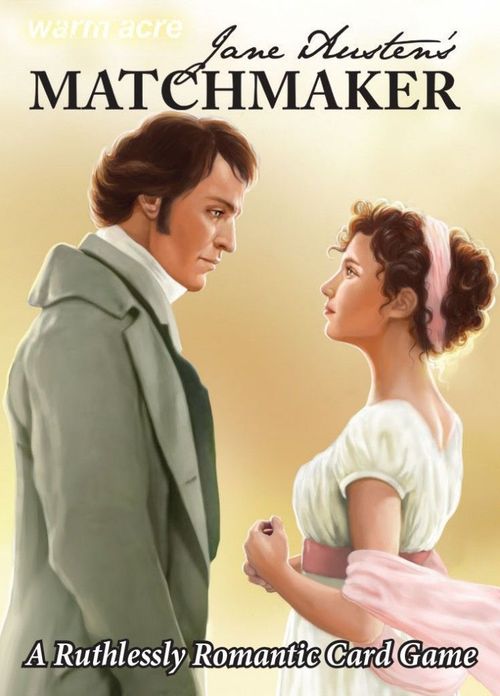
Jane Austen's Matchmaker
Jane Austen's Matchmaker Rulebook
Table of Contents
Table of Contents
Aim of the Game
Collect cards (Ladies and Gentlemen) by making and accepting marriage proposals. The player who has collected cards with the most Virtue at the end of the game wins.
Beware – any unmarried Ladies left in your Society have their Virtue deducted from your final score.
The game ends immediately when someone needs to draw a card and the Draw pile is empty.
The Cards
There are 3 types of card:
- Ladies
- Gentlemen
- Have a Ball
Note: the 6 'heroines' have purple frames, the other Ladies have pink frames.
Scores
Virtue – A Gentlemen's Virtue ranges from 0 to 3, a Ladies' Virtue from 1 to 5.
The combined Virtue of all cards in your Marriage pile is your final score. Any unmarried Ladies left in your Society ('old maids') have their Virtue deducted from your final score.
Charm – Ranges from 1 to 5.
A Gentleman with a high Charm is hard to resist, a Lady with a high Charm is hard to impress.
Rank – Ranges from 1 to 5.
A Lady who refuses a Gentleman with a higher Rank draws cards equal to the difference.
Wealth – Ranges from 1 to 5.
If you marry someone with a higher Wealth, you draw cards equal to the difference.
Set up
-
Separate the 6 heroines (purple framed cards) from the deck and deal one randomly to each player. Place your heroine face up and facing away from you so other players can see her.
This is the start of your Society. Any Ladies you bring into Society during the game will be placed like this. Each player has their own separate Society.
-
Put any unused heroines back into the deck. Shuffle it and deal 3 cards face down to each player.
These 3 cards are your Hand. Look at them, but keep them hidden from other players until you are ready to play them. Whenever you draw a card, it is taken into your Hand.
-
Put the deck in the centre of the table face down. This is now the Draw pile.
During play whenever you are told to discard a card, place it face up on a separate pile beside the Draw pile.
-
The player who has most recently read a Jane Austen novel goes first. Play proceeds clockwise.
-
Turn over this sheet and start matchmaking!
Play
On your turn you must choose one option from the list below.
Exception: if you have more Ladies in Society than anyone else when your turn comes round, you take two turns! You can choose two different options or take the same option twice.
Choose an Option
-
Bring a Lady into Society. If you have a Lady in your Hand, place her card in front of you, face up and facing outwards so other players can see it.
Only Ladies in Society can be proposed to.
-
Propose to another player's Lady with a Gentleman from your Hand; see 'Making a Proposal' below.
-
Push a Lady from your Society into another player's Society. You can only do this if the other if that player currently has less Ladies in Society than you.
Tip: this is a cunning way to get rid of an 'old maid' – by making her someone else's problem!
-
Have a Ball. You must play (discard) a 'Have a Ball' card from your Hand to do this.
-
Draw a card. Take a card from the Draw pile into your Hand.
Making a Proposal
Choose a Lady in another player's Society and play a Gentleman from your Hand to make the proposal. Pay attention to the rules…
- The Gentleman may not propose to his own sister! Siblings are listed at the bottom of the Gentleman's card.
- You cannot propose if the Lady's Charm is higher than the Gentleman's Charm. However you can discard cards to make up the difference; see below.
- You can enhance your Gentleman's Charm by discarding cards. Each card discarded from your Hand increases his Charm by +1 for this proposal only. If his Charm is higher than the Lady's, his proposal will be harder to decline, see 'Declining'. Any cards spent in this manner are lost, whatever the outcome of the proposal.
- If your proposal is accepted, you swap cards with the other player (they take the Gentleman and you take the Lady); see 'Accepting'. If you are declined, take the Gentleman back into your Hand.
Receiving a Proposal
When a Gentleman proposes to one of your Ladies, you may either accept or decline. You should consider the Gentleman's Virtue and/or Wealth. Towards the end of the game, you cannot always afford to be fussy – remember that any of your Ladies left in Society will have their Virtue subtracted from your final score.
Accepting
- Swap your card with the other player; you take the Gentleman and they take the Lady. Keep both cards on the table for now.
- Compare the Wealth scores of the Lady and Gentleman. The player holding the card with the higher Wealth draws cards equal to the difference between the two scores. If the scores are the same, no cards are drawn.
- Finally, both players put their newly-wed card (face down) onto their 'Marriage piles'. Be sure to keep your Marriage pile separate from your Hand and Society cards.
Declining
- If the Gentleman's Charm is higher than your Lady's Charm, you must discard cards equal to the difference between the two scores. If you can't afford this, you must accept the proposal!
- If the Gentleman's Rank is higher than your Lady's Rank, draw cards equal to the difference after your decline. The attention of superior Gentleman is good for your social standing even if you spurn him!
Have a Ball!
If you play this card, you are the host and the other players are invited to attend.
- Each player (including you) can attend the ball by immediately putting a Lady into Society from their Hand.
- For each player who attends (including you), draw a card. You do not have to attend your own ball.
- Discard the 'Have a Ball' card at the end of your turn after playing it.
The End
If the Draw pile is empty and a player needs to draw a card, the game ends immediately.
- Everyone puts their Hand into the Discard pile but keeps their Society and Marriage piles in play.
- Add up the Virtue of all the cards in your Marriage pile and subtract the Virtue of all the Ladies left in your Society (if any).
- The player with the highest score wins. If there is a tie, you can always have a rematch.