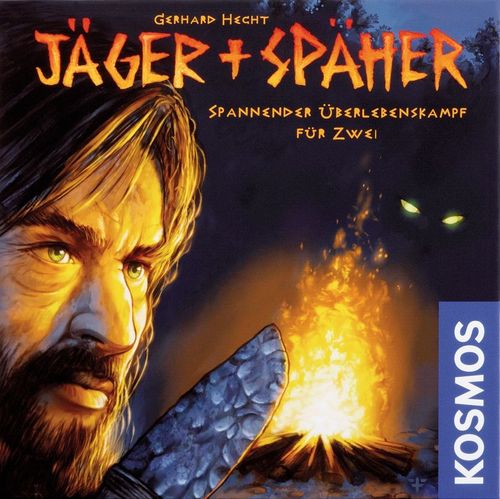
Jäger und Späher
Jäger und Späher Rulebook
Table of Contents
Table of Contents
Game Material
- 1 game board
- 99 game cards:
- 24 x characters (of which 12 are "special characters")
- 31 x objects
- 18 x wilderness
- 18 x hunting grounds
- 2 x tribe cards
- 6 x holy places
- 10 tribe members (black and white wooden pieces)
- 30 consumption stones
- 16 hunger tiles
- 2 victory point markers
For 2 players, ages 12 and up.
First the rules for the simpler introductory game are explained. The additional rules for the normal game are on page 5. And whoever wants to face the challenge will find the survival-struggle variant on page 6.
Introductory Game
Game Setup
- Before the first game, carefully release the game board and the hunger tiles from the frame.
- The 6 "Holy Places" cards are not needed in the introductory game and go back in the box.
- Of the 12 "Special Characters" cards (orange bar on the left), only the 3 trackers and the 1 shaman are needed in the introductory game. The remaining 8 "Special Characters" go back in the box.
- The 3 trackers are laid out in 3 rows, one below the other. On top of each tracker, offset slightly to the side, comes 1 shaman. For this, the shaman is taken from the "Special Characters," and the 2 shamans that are in the deck of "normal" characters (light bar on the left) are used. These 6 cards form the display (see figure on page 2).
- Each player receives 5 tribe members and 1 tribe card. Each player lays their tribe card in front of themselves with the "Sunset — Introductory Game" side face up. On it, they place 2 of their tribe members. 1 further tribe member they place on the game board. And their 2 remaining tribe members they set aside next to the game board as a reserve.
- Of the "normal" character cards, each player receives these 5 cards: 1 hunter, 1 scout, 1 chief, 1 gatherer, 1 offspring.
- The two victory point markers start on the victory point track of the game board on the space "10".
- Each player receives 2 "object" cards, which they look at and place face down in front of themselves. These they may create in the course of the game. The remaining objects are shuffled and placed as a face-down draw pile next to the game board.
- Furthermore, each player receives 2 hunger tiles, which they place next to their tribe card. The remaining hunger tiles and the consumption stones are set aside within reach.
- The location cards (wilderness and hunting grounds) are each shuffled and set out as face-down draw piles. 2 "wilderness" cards are drawn and laid face up below the game board.
- The player with the most hair becomes the starting player. After that, the players alternate taking turns.
Introductory Game Setup (diagram note)
The setup diagram on page 2 shows: the tribe card with tribe members and hunger tiles, the game board with its victory point track and cave-camp illustration, the 5 starting character cards and 3 object cards fanned in each player's hand, the wilderness and hunting-ground draw piles with their face-down backs shown, and the 3 tracker cards with a shaman card layered on each, arranged in 3 rows to form the display.
Turn Sequence
Whoever is on turn has 3 options, of which they must decide on one:
1 Play a character: follow the instructions
OR
Take back any number of tribe members from location cards: gather raw materials, discard hunger tiles, create objects
OR
Perform sunset: interim scoring
a) Play 1 Character
- At the start, each player received 5 character cards. When the player plays a character, they carry out all the instructions on the card from top to bottom. Afterward, they place the card in the display, in the row with the fewest character cards. If there are two or all three rows with an equal number of cards, they may choose which row to place it in.
- Most characters allow the player to place their own tribe members on location cards in order to later retrieve them along with raw materials. Important: each location card may hold at most 3 tribe members. These may come from one player or from both.
b) Take Back Any Number of Tribe Members from Location Cards
- At the start, each player has 2 tribe members available, which they place on the location cards "wilderness" or "hunting grounds" by playing their character cards.
- By taking back their tribe members onto their tribe card, the player collects 1 raw material for each tribe member. They cover the depicted raw material on the location card with a consumption stone.
- Raw materials are meat, hide, stone, wood, clay, and fruit.
- The player does not receive the raw materials as physical items, but instead uses them immediately:
- If the player collects meat, for each meat they have uncovered, they may discard 1 hunger tile.
- If the player collects 2 hides (each tribe member brings 1 with it), they may put 1 new tribe member from the reserve onto the cave camp (the game board). Later, by playing their character card "Offspring," they can put their new tribe member from the camp onto their tribe card and thereby have 1 more tribe member available. At the start, 1 new tribe member already stands "ready to collect" on the camp.
- If the player collects other raw materials, they may create objects by playing their face-down "object" cards. At the start, each player already has 2 objects. To create an object, the player must, in their turn, gather all at once all the raw materials depicted on the card. The raw materials may come from one or from several location cards. Most objects bring victory points.
c) Perform Sunset
If the player has no character card left in hand and does not want to take back any tribe members, sunset scoring occurs for their tribe:
-
The player receives 1 victory point for each of their tribe members located on their tribe card or on location cards. Important: tribe members on the camp or in the reserve bring no victory points.
From these victory points, the player must subtract 1 point for each hunger tile they possess.
The player then advances their victory point marker on the victory point track of the camp by the victory points thus determined.
Hint: If a player has too many hunger tiles, it can happen that a player receives no victory points, or even loses some. Then they must move their victory point marker back accordingly. If the player reaches 0 victory points, they must take their victory point marker off the board. You cannot have fewer than 0 points.
Early scoring: normally a player performs sunset only once they have no character card left in hand. However, it can be quite sensible to decide on this action earlier. Then they must subtract 1 victory point for each character card they still hold in hand.
-
For each of their tribe members on their tribe card and on location cards, the player must take 1 hunger tile. Important: the hunger tiles the player already has are kept; the new ones are simply added.
-
To conclude the sunset, the player takes 6 character cards into their hand from the display. The player may choose the cards from one row or from several rows. However, they may only take cards that are free. That is, they take a card that lies at the far right end of any row. After that, they may take the next, now free, character card from the same row, or a free card from another row. The player may also take "Special Characters" if they are free. In this way, the player assembles their hand of cards for their next day.
The Objects
The object card diagram shows: bottom left, the raw-material costs; bottom center, the victory points; bottom right, the effect.
- By taking back their tribe members, a player can create one or more objects. To do so, they turn over one of their "object" cards and lay it face up in front of themselves. Bottom left on the card are the raw-material costs. For each depicted raw material, they must take back one of their tribe members from a location card and cover this raw material with a consumption stone. Important: it is not possible to "pay a deposit" on an object and "pay the remainder" of the missing raw materials later. If a player does not have the raw materials required, they cannot play the object.
- For most objects the player receives 1, 2, or 3 victory points, which they immediately advance on the victory point track with their victory point marker. Hint: "Hand axe" and "vegetable bed" bring no victory points.
- Many objects have one or two additional effects, which are shown as symbols on the card, bottom right:
- Set 1 of your tribe members on any location card.
- Draw 1 object from the face-down pile.
- Take 1 hunger tile.
- Put 1 hunger tile back into the reserve.
The Victory Point Track
On the game board, the developmental progress of the two tribes is recorded. For this, the victory points that a player receives at their sunset, and those they get from creating objects, are tallied on the surrounding track.
- In the introductory game, each player starts with 10 victory points.
- The spaces 9, 14, and 18, which are marked with cave paintings, are bonus spaces. When a player's victory point marker arrives at one of these spaces for the first time, or moves beyond it, they may receive 1 additional victory point and advance further. To do this, they must place 2 of their created objects lying in front of them onto a discard pile. If the player cannot do this, they do not get the bonus point.
- In order to advance onto the target space or beyond, the player must have at most 3 hunger tiles. If they have more hunger tiles, they may advance at most to space 23. Remaining points are forfeited.
Game End
- As soon as a player's victory point marker reaches the target space (the hand), the game ends. If they have more than 24 victory points, they still advance by 1 more.
- If this is the player who started the game, the other player still has one complete turn, so that both players have had an equal number of turns. If the following player does not reach the target space, the first player has won. If the following player also reaches the target space, whoever has advanced further on the scoring track wins. In case of a tie, the following player wins.
- Should the player end the game who did not start it, it ends immediately. This player has won.
Further Notes
- Each player moves only their own tribe members, never the other player's tribe members.
- When a player draws a wilderness or a hunting-ground card because of a character card, this means they take the card from the face-down draw pile and lay it face up alongside the other location cards.
- Should no "wilderness" cards remain face up at the end of a turn, a wilderness card is revealed from the draw pile and laid out. Should a draw pile be used up, the discard pile is shuffled and becomes the new draw pile.
- Whenever a player discards an object, a wilderness, or a hunting-ground card, they place the card on a corresponding discard pile, one of which is formed for each of these card types. Should a draw pile be used up, the discard pile is shuffled and becomes the new draw pile.
- When a player must cover fields on location cards with consumption stones because of a character card, they may choose the fields freely.
- Each player may hoard any number of objects face down in front of themselves. There is no obligation to create objects.
- When a player takes back tribe members, they decide for themselves in which order this happens.
- Before a player can create their next object in the same turn, all effects of the object just created must first be carried out.
- If a player, by creating an object, puts a tribe member on a location card, they cannot take it back onto their tribe card in the same turn.
- A player may add further tribe members to a location card on which tribe members already stand (regardless of which player they belong to), so long as afterward there are at most 3 tribe members on that location card.
- When the last space of a location card is covered, the card is placed on its corresponding discard pile. The consumption stones return to the reserve. Should any tribe members still be on this location card, they are returned to their respective tribe cards.
Normal Game
Whoever has already played the introductory game once should switch to the "normal" game from now on. All the rules of the introductory game apply, with the following changes and additions:
Setup
- Each player lays their tribe card in front of themselves with the "Sunset — Normal Game" side face up.
- Each player receives, in addition to the 5 character cards, 1 shaman (also with a light bar on the left).
- All 12 "Special Characters" (orange bar) are shuffled. 6 cards are drawn at random and, as described, laid out in 3 rows of 2 cards each. The remaining 6 "Special Characters" are not needed in this game and go back in the box.
- Of the 6 "Holy Places" cards, 3 cards are laid out face up next to the game board. Each card shows, on both sides, two different "Holy Places" with different functions. In your first game, the cards "Ice Cavern," "Mud Springs," and "Mammoth Graveyard" should be in play. The remaining 3 cards are not needed in this game and go back in the box. In later games, the players may choose the Holy Places at random or agree on them together.
- The victory point markers start on space "3".
- The oldest player becomes the starting player. They receive only 1 object. Their opponent receives 2 objects.
Performing Sunset
- After the player has received their victory points, they must discard all but 1 of the face-down objects lying in front of them. Already-created objects do not count toward this.
- At the end of their sunset, the player may, of their choice, take 5, 6, or 7 free characters.
Hint: these additional rules are also listed on the tribe card "Normal Game."
The Holy Places
-
The Holy Places count, just like wilderness or hunting grounds, as "locations" onto which tribe members may be set.
-
On a Holy Place, any number of tribe members may stand — however, all the tribe members there must belong to one player.
-
If a player sets more tribe members on a Holy Place than the other player has standing there, the other player's tribe member, or tribe members, is/are driven off. They are placed back on that player's tribe card.
Example: Player Black has 1 tribe member standing on the "Mammoth Graveyard." Player White plays a Gatherer and may place up to 4 tribe members on any locations. Among others, they place 2 tribe members on the Mammoth Graveyard and thereby drive off Player Black's tribe member. They could also have placed 3 tribe members there, to make it harder for Player Black to drive them off there again later.
-
Each Holy Place has a somewhat different function. On the card, under "Trigger," it states the condition for when the card applies.
-
For a player to be able to use a Holy Place, they must leave at least 1 tribe member standing there on their turn.
The Survival-Struggle Variant
Whoever has played the normal game several times can try their hand at this variant, in which the players experience the true harshness of Stone Age (sur)vival. All the rules of the normal game apply, with the following additions:
- On most hunting grounds (except the saber-toothed tiger), some spaces are marked with a small symbol. When such a card is revealed, these marked spaces are immediately covered with consumption stones. This means that less meat and hide come into play.
- If a player's victory point marker arrives at a bonus space on the victory point track, or moves beyond it, and has no 2 objects that they can give up, then, as usual, they do not receive the bonus victory point. In addition, they must now take 1 hunger tile.