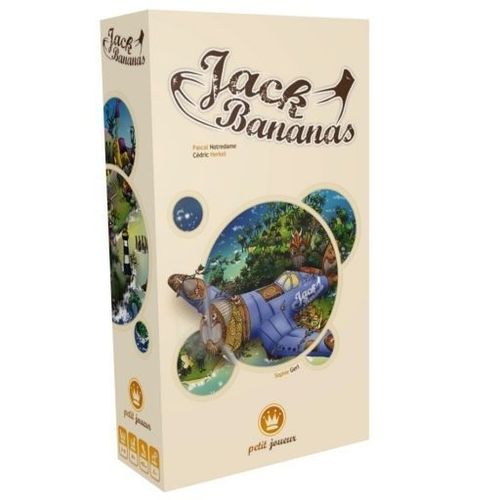
Jack Bananas
Jack Bananas Rulebook
Table of Contents
Table of Contents
Components
- 24 wooden dice *
- 6 Island boards
- 6 Arbitration tokens *
- 1 Resupply token
- 1 Banana Cup token
- 1 rulebook
- 6 play aids *
- 6 wooden Plane discs *
- 6 Pilot stickers *
* In 6 different colours: Pink, Green, Orange, Yellow, Red and Blue. Put the stickers on the wooden discs of the same colour.
Note: This version of the rules is slightly different from the text on the back of the play aids, although those are still useful!
Object of the Game
Write your name into legend by winning the prestigious Banana Cup. There are 2 variants of this famous race, of differing difficulty:
- The Banana Cup, ideal for discovering the game (page 2).
- The Super Banana Cup, honest people abstain (page 10).
Setup (Banana Cup)
The following illustrates an example of setup for a 6-player game. The diagram's labels mark the Start, the Resupply and the Banana Cup.
Jack's Tips: "When there are many planes at the start, it can be useful to show the 3-plane face for the first island (1). Also, the more islands with the 2-plane face showing, the harder the race will be, with many overtakes. Finally, feel free to create the course of your choice, the game is entirely open. So why not play across the room with the islands scattered around?" — Jack
- Create the race course by arranging the 6 islands in the order of your choice. For each one, choose whether the 2-plane or 3-plane face is showing (1). Raise some of them using one or more objects; here the 1st, 2nd, 4th and 6th islands are raised (2). In this example, the 2nd is higher than the 1st.
- Place the planes at the start in front of the first island, Pilot faces showing (3), and place the Arbitration tokens in the centre of the table, colours showing (4). Place the Banana Cup token on the last island (5), and place the Resupply token on the island of your choice, except the first and last islands (6).
- Each player draws a colour at random and takes all the material of that colour: 4 dice, 1 play aid, plus one cup (7). The setup varies depending on the number of players:
Number of players
- 5 players: Same as the 6-player setup, with 1 colour fewer.
- 4 players: 2 colours fewer. Put all islands with the 2-plane face showing.
- 3 players: Each player draws 2 colours at random and plays with a team of 2 completely independent planes.
- 2 players: Each player plays with a team of 2 or 3 planes, of their choice. If 2 planes, put all islands with the 2-plane face showing.
Unused material is returned to the box. It will not be used again during the game.
Start of the Race
The first turn of the game is divided into 2 phases, always in the same order:
- Pilots
- Arbitrations
1. Pilots
This is the main phase of the game, the one that gives it all its spice: bluffing.
A. Calculate Your Speed
All Pilots calculate their speeds at the same time. There are 2 types of trial. Each depends on the position of the island they are about to reach.
- Altitude: If this island is higher than the Pilot.
- Low-flying (Rase-motte): If this island is lower than the Pilot.
The player shakes all their dice in their cup, then turns the cup over in front of them, out of sight. They discreetly look at the result and calculate their speed:
- Add up all the dice showing a number.
- Add the result of each banana. This varies depending on the type of trial:
- Altitude: Each banana is worth the value of its highest die.
- Low-flying: Each banana is worth the value of its lowest die.
Example 1: Calculating speed. Blue takes part in an Altitude trial and Red in a Low-flying trial:
- Blue speed: 2 + (banana) 4 + 4 + 3 = 13
- Red speed: 6 + 6 + (banana) 3 + 3 = 18
B. Announcing Speed
Pilots play in colour order (from Pink to Blue, or from 1 to 6).
One after the other, each player announces a speed or passes their turn. They are not obliged to outbid the other speeds, and bluffing is always allowed. The announced speed must be:
- Greater than or equal to the minimum speed of the next island.
- Different from all the speeds already announced on this same island.
Minimum speed: the number printed on the island's card (for example, 12).
Colour order: 1 Pink, 2 Green, 3 Orange, 4 Yellow, 5 Red, 6 Blue.
C. Making an Accusation
At any time during the speed announcements, a plane suspecting another of cheating can make an accusation against them. The accused's real speed is then checked immediately:
- The accusation succeeds if the real speed is lower than the announced speed.
- The accusation fails if the real speed is greater than or equal to the announced speed.
The accusing plane places in front of it the Arbitration token of the colour of the player it accuses (example 2). The visible side depends on whether the accusation succeeded:
- If the accusation succeeds: the token shows the "+" side.
- If the accusation fails: the token shows the "−" side.
Each plane may make only one accusation per turn. It can be made at any time as long as the movement toward the island has not yet begun. If several players accuse at the same time, they agree on the order. If they cannot agree, the accused chooses one of them.
With 2 or 3 players, planes of the same team cannot accuse each other.
Example 2: Making an accusation. Pink, Green and Orange take part in an Altitude trial:
- Pink: speed 18, announced 18.
- Green: speed 18, announced 17.
- Orange: speed 10, announced 14.
Orange cheats. Red accuses Green in error. Red takes the Green Arbitration token on the lost side. Then Yellow accuses Orange and wins. Yellow takes the Orange Arbitration token on the successful side.
D. Plane Movement
Any Pilot that has passed its turn, or has been caught cheating following a successful accusation, stays in place. All other Pilots advance towards the next island, in ascending order of their announced speeds and respecting overtaking.
Overtaking (Dépassement): Each island accepts a maximum of 2 or 3 planes, except the last island, which always accepts only one plane. If this limit is already reached, any new plane pushes back one plane of its choice, taking its place. Only one plane is pushed back following an overtaking, and that plane no longer plays during the current phase.
Maximum number of planes is shown on the island card (for example, 2).
Example 3: Pilot phase and overtaking. In order, Pink announces 18, Green 17, Orange 14, Yellow passes its turn, Red 16, Blue 21. Red accuses Green in error. It takes the Green Arbitration token and places it in front of it on the lost side. Yellow accuses Orange and wins. It takes the Orange Arbitration token and places it in front of it on the successful side. Orange and Yellow do not advance. Red then advances with 16, followed by Green 17, Pink 18, then Blue 21. The island only accepts 3 planes, so Blue chooses to push back Green.
2. Arbitrations
Any plane that took an Arbitration token during the turn now applies the result. If there is nothing to do during this phase, the turn ends and the game moves to the next turn: Course Progress.
Pilot:
- Accusation succeeds: It advances one island, respecting overtaking, then gains 1 die from the player it accused. The loser chooses the colour.
- Accusation fails: It loses 1 die of the colour of its choice, which it gives to the opponent of its choice.
If there are several tokens in play, they are applied in the colour order of the planes playing them. The colour of each token recalls which plane was accused, and its drawing specifies the result. All Arbitration tokens are returned to play at the end of the phase, and then a new turn begins: Course Progress.
With 2 or 3 players, a die exchange always takes place in favour of an opponent, never within the same team.
Course Progress
From now on, a turn is divided into 4 phases, until the end of the game. If there is nothing to do during a phase, move to the next. If the Banana Cup is still in play at the end of the turn, a new turn begins:
- Reckless Flyers (Fous volants)
- Pilots
- Resupply
- Arbitrations
1. Reckless Flyers
A Reckless Flyer is a plane in difficulty that goes all out. It is useful to become one when your plane is short of dice. This phase has 2 parts:
A. Becoming a Reckless Flyer. "Who wants to become a Reckless Flyer?" Any plane missing at least 1 die of its colour may now become a Reckless Flyer. This is not compulsory, as it carries some risks. It is turned face down and from then on plays with only 1 die of its colour. All its other dice are put in its cup. It must think carefully before becoming one, as it can only become a Pilot again in 3 ways: following an accident, at a resupply, or following a lost accusation.
B. Playing the Reckless Flyers. All Reckless Flyers roll their remaining die, face up, then apply the results in the order of islands and colours:
- Order of islands and colours: All Reckless Flyers play in island order: those at the head of the race first, then the following ones, and so on to the stragglers. If several are on the same island, they play in colour order. So the order of players often changes during the game (example 4, phase 1).
Example 4: Order of islands and colours.
- Phase 1, Reckless Flyers: Yellow plays first, then Pink, and Green afterwards.
- Phase 2, Pilots: Red plays first, then Blue, and Orange last.
Result (the rulebook shows each result as an icon):
- Icon of two dice: the Reckless Flyer stays in place.
- Icon of three dice: it advances one island, respecting overtaking.
- Icon of a banana: it is the victim of an accident.
Accident: If the accident happens before the Resupply island, the Reckless Flyer returns to the start. If it happens on or after the Resupply, it stays on the Resupply, whatever the number of planes there. The Reckless Flyer then becomes a Pilot again. It turns its plane face up and recovers all the lost dice of its colour, as well as all those in its cup. It will play normally in the next phase: Pilots.
Example 5: Accident. Green, Red, then Orange each have an accident:
- Green returns to the Resupply, even though this exceeds the maximum limit of 2 planes.
- Red stays on the Resupply.
- Orange returns to the start.
They all become Pilots again and recover all their dice.
2. Pilots
Played like the Pilot phase of the first turn (page 3), with a few details changed:
A. Calculate Your Speed. Pilots calculate their speeds this time by counting the dice they have gained during the game:
- Add up all the dice of its own colour showing a number.
- Add the result of each banana, whatever its colour. This varies depending on the type of trial:
- Altitude: Each banana is worth the value of the highest die of its own colour.
- Low-flying: Each banana is worth the value of the lowest die of its own colour.
Example 6: Calculating speed. Blue takes part in an Altitude trial and Red in a Low-flying trial:
- Blue speed: 2 + (banana) 4 + 4 + (banana) 4 = 14
- Red speed: 6 + 6 + (banana) 3 + 3 = 18
B., C., D. Speeds, accusations, movement. Pilots now play in island and colour order (example 4, phase 2). So speed announcements on an island begin only once movement on the previous one is finished. When all Pilots have played, move on to the next phase.
3. Resupply
A Pilot on the Resupply island recovers from the other players all the lost dice of its colour. A Reckless Flyer there must become a Pilot again. It turns its plane face up, then recovers all the lost dice of its colour, as well as all those in its cup.
4. Arbitrations
Played like the Arbitrations phase of the first turn (page 6), with a few details changed: a plane cannot lose the last die of its colour. In that case it keeps it, as an exception. Also, the result of the Arbitration token is different if the plane that took it is a Reckless Flyer:
Reckless Flyer:
- Accusation succeeds: It advances one island, respecting overtaking, then gains 1 die from the player it accused and puts it in its cup. The loser chooses the colour.
- Accusation fails: It is the victim of an accident (page 8).
Last island: The last island is the one at the end of the course, with the Banana Cup. Be careful, a plane can never go further than the last island, even if it gains an island following an arbitration. If the Banana Cup is still in play at the end of the turn, a new turn begins.
End of the Game
Any plane, whether Pilot or Reckless Flyer, present on the last island at the end of a turn wins the game. It takes the Banana Cup and writes its name into legend. The last island only ever accepts one plane.
With 2 or 3 players, it is enough for one plane of a team to win the race for the game to end.
Super Banana Cup
The Super Banana Cup is almost identical to the Banana Cup, so it is preferable to know that one well before continuing. The Super Banana Cup does, however, include some new features, for a race even richer in twists and turns.
Acrobatics
A new trial appears, allowing more choice in the setup.
Acrobatics: If the next island is at the same level as the Pilot.
- Each banana is worth the value of the highest die of its own colour.
- Have at least 1 banana among all its dice, whatever their colour.
This banana being essential, the player announces their speed while stating "With banana" ("Avec banane"). Bluffing is always allowed.
Example 7: Acrobatics. Blue takes part in an Acrobatics trial:
- Blue speed: 6 + 3 + 4 + (banana) 6 = 19, "With banana"
Super Accident
The accident rules apply normally (page 8). In addition, the Reckless Flyer that is the victim of it must choose 1 Pilot present on the island where the accident took place, if there is one. That plane is also unlucky and is also the victim of the accident. It loses 1 die of the colour of its choice, which it gives to an opponent of its choice. A Reckless Flyer that gains a die this way puts it in its cup. A plane cannot lose the last die of its colour.
Example 8: Super accident. In example 5 (page 8), after Green has become a Pilot again on the Resupply island, Red must choose whether Pink or Green is the victim of its accident. That plane is unlucky and loses 1 die of the colour of its choice, which it gives to another plane of its choice.
Bananas!
If, when calculating its speed, a Pilot obtains 3 bananas or more, whatever the colour of the dice or the type of trial, it is "BANANAS!":
- It says "BANANAS!" when its turn comes to announce a speed.
- It is the maximum speed and plays last on its island.
- It advances 2 islands, respecting overtaking for each one.
If several Pilots on the same island announce "BANANAS!", they play in colour order. Bluffing is always allowed, especially when it comes to a "BANANAS!".
Example 9: Bananas! Green takes part in an Altitude trial. Green advances one first island and chooses to push back Orange, then advances a second island and pushes back Blue.