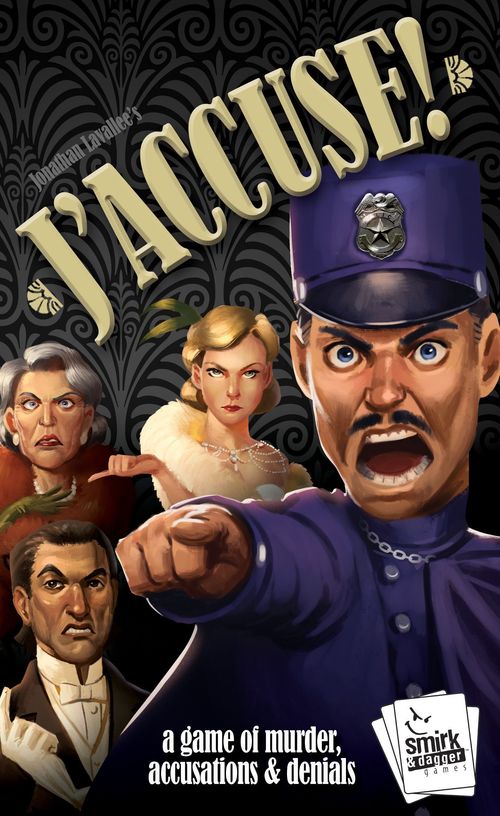
J'Accuse!
J'Accuse! Rulebook
Table of Contents
Table of Contents
Contents
- 6 Suspect Character Sheets
- 25 Evidence cards (8 Motive, 8 Opportunity, 9 Murder Weapon)
- 24 Suspicion cards (6 sets: Left, Right, Across, J'ACCUSE!)
- 18 Investigation cards (9 single, 6 double, 3 triple)
- 1 Chief Inspector card and stand
Object
J'ACCUSE is a game for 3-6 devious players bent on implicating and accusing their friends and family of MURDER! So no one 'wins' the game, so much as, one of you will LOSE. The object is to avoid suspicion for as long as you can, while assuring that someone else ends up accused for the crime. The game ends, and the loser is 'Arrested,' when one player gets stuck with at least one of each type of Evidence (a Motive, Opportunity & Weapon, which solves the case) OR by having ANY 5 pieces of Hard Evidence against them (a Preponderance of Evidence).
Set Up
Create three separate piles of Evidence, one each for Motive, Opportunity and Weapon cards. Shuffle each pile and place them face down at the center of the playing area.
Any time a new piece of Evidence is put into play, it will be drawn from the top of these piles.
Have players choose their favorite Suspect and place the Character Sheet in front of them on the table.
Give each player a set of 4 Suspicion cards: Implicate Left, Implicate Right, Implicate Across and J'ACCUSE!
Shuffle the Investigation Cards & deal 3 face down to each player. These cards will ONLY be used when you become the Inspector for the Round. Place any remaining Investigation cards face down to the side of the table. A discard pile will form beside it.
The Chief Inspector token begins the game in front of the player who first crosses their arms in an accusing manner. Starting with the player on the Inspector's left, place one Motive card, face up, in front of that player's character sheet. Proceed clockwise around the table, placing an Opportunity card and then a Weapon Card in front of the next two players. There will only ever be one of each Evidence type actively in play at any given time.
Note: Evidence cards in front of a player's character sheet are said to be 'Suspected Evidence.' Suspected Evidence can be easily moved from player to player, but is also at risk of becoming 'Hard Evidence' against the player, should they be so accused. It is best not to have any in front of you.
The page 5 set-up diagram shows the table layout (Investigation draw and discard piles, Chief Inspector token, Evidence draw piles, each player's Character Sheet and Suspicion cards). Its captions state the following:
- There will always be exactly one Motive, one Opportunity and one Weapon 'in play' as Suspected Evidence at any given time.
- Your Investigation cards can be tucked here, until you are ready for them.
- Hard Evidence will get placed here during play.
Playing the Game
Overview
Each Round, players will attempt to avoid pieces of Evidence by trying to pass them away from themselves or lock down pieces of Evidence on others by accusing them of guilt. This is done as a group by 'Casting Suspicion' upon others, voting in secret with your Suspicion cards.
A Round of Play
-
The current Inspector will choose one of her three Investigation cards and place it secretly, face down, under the Inspector card stand. The Investigation card will show one, two or three Evidence icons. Only the Evidence type(s) shown on the card will be affected (either passed around the table or turned to Hard Evidence) this Round.
-
All players, including the current Inspector, then vote by choosing a Suspicion card from their hand and holding it face down in front of them. A player will vote to pass Evidence to the Left, the Right or Across the Table or will try to force an accusation, by playing their 'J'ACCUSE!' card.
Strategy Tip: Choosing a Suspicion card may sometimes seem like a random act. But the adage, "don't play the cards, play the people" is fully in force here. There are usually one or two people at the table that you can make an educated guess as to their likely choice. For example: If all the Evidence is currently to the LEFT of one player, they will likely not be playing 'RIGHT.' You may also recall how many of a certain card has been played before. Use all the information you have and you may be able to swing the voting. Table talk is encouraged, just don't specifically mention the Suspicion cards by name.
-
All Suspicion cards are revealed at the same time and examined to see where Suspicion has been cast.
-
If one type of Suspicion card has more votes than any other, the Evidence will be resolved accordingly:
- a. If Left prevails, Evidence will be passed to the left.
- b. If Right prevails, Evidence will be passed to the right.
- c. If Across prevails, Evidence will be passed to a player across from you. Note: If playing with 4 or more players, "Across" is defined as any player not to your immediate Left or Right. In a 3-player game, choose any other player.
- d. If J'ACCUSE prevails, Evidence will become Hard Evidence against a player.
- e. If no single type has more votes than any other, treat it as though J'ACCUSE prevailed.
-
The Inspector now reveals the Investigation card. It is only at this time that we know which Evidence card(s) will be passed or become Hard Evidence. Remember, only the Evidence type shown on the Investigation card will be affected.
In the example pictured on page 7, the Investigation card shows a Motive and an Opportunity; only the MOTIVE and OPPORTUNITY will move in the prevailing direction or become Hard Evidence.
Resolve the Round
6A. If Passing Evidence Left, Right or Across
The Inspector dramatizes the shifting suspicions (have fun with it!) by announcing aloud each piece of Evidence that is being affected. For example, as he moves each of the Evidence cards to the LEFT, the Inspector says, "You, Madame, have SECRETS. And you Sir, were seen IN THE STABLES." The last Evidence icon on the card has a dialogue bubble to read as an accusation. For example, an Investigation card showing Motive, Opportunity and Weapon icons, with the text "Then, explain your finger prints on THIS...", leads to: "And you, Butler... Explain your fingerprints on THIS... THE PISTOL."
The player in question should do their best to explain away the Evidence. (While their answer has no bearing on the outcome of play, it does add to the fun.)
Players then flip over their used Suspicion card on their character sheets in the area provided.
Note: Players MUST use three of their Suspicion cards before they may be picked up for use again.
The Inspector advances clockwise to the next player on the left and play proceeds, returning to Step 1.
6B. If J'ACCUSE!
If J'ACCUSE! prevailed, the Evidence types listed on the Investigation card become Hard Evidence against the player(s) who currently have those Evidence cards in front of them. The Inspector acts out his discovery. "So it WAS you in the Wine Cellar. And you DID have the Rope!"
Players may continue to deny it, for fun, but this Evidence now counts against them. Place these cards along the bottom edge of the accused player's character sheet. These cards are locked and may not be removed or passed by any means. Exception: see Exonerated Evidence below.
For any Evidence that has become Hard Evidence, replacements must now be drawn from their respective Evidence piles. As during set up, start with the player to the Left of the current Inspector and place the first Evidence type listed on the Investigation, as Suspected Evidence, in front of the player's character sheet, and proceed clockwise with any additional Evidence types. The current Inspector announces newly introduced Evidence by name as they are doled out. "The Iron." And you, "Infidelity."
Players then flip over their used Suspicion card on their character sheets in the area provided.
Note: Players MUST use three of their Suspicion cards before they may be picked up for use again.
The Inspector advances clockwise to the next player on the left and play proceeds, returning to Step 1.
Exonerated Evidence
If your character is 'J'ACCUSED' of a specific piece of Evidence that appears on your character sheet as Exonerated, it does not become Hard Evidence against you!
Each character sheet lists Exonerated Evidence under the heading "Exonerated against:": one of each type of Evidence listed for that character. (Example: The Affair's sheet is exonerated against Money, In the Woods and Knife.)
Instead, the Evidence card is placed on the bottom of the matching Evidence pile. A new piece of Evidence of that same type is put into play normally at the end of the turn (as detailed in 6B).
Running Out of Investigation Cards
Players must play all three of their Investigation Cards before they may draw a new set of three, so plan accordingly. You may find yourself in a situation where you have no choice but to set an investigation that puts you at significant risk. Only after all players have run out of Investigation cards is the deck shuffled and a new set of three dealt to each player.
Running Out of Evidence Cards
If the draw piles for certain types of Evidence (Motive, Opportunity, Weapon) run out, no further Evidence of that type will enter play. Continue play with the remaining Evidence types.
Ending the Game
When one player has at least one of each of the 3 Evidence types as Hard Evidence against them (Motive, Opportunity & Weapon, which solves the case), or has ANY 5 pieces of Hard Evidence against them (a Preponderance of Evidence) they immediately LOSE – and everyone else WINS, getting away with MURDER.
Quick Reference: A Round of Play
- Inspector chooses an Investigation card
- All Players choose a Suspicion card
- Reveal all Suspicion cards simultaneously
- Determine the direction Evidence will move OR if Hard Evidence will be assigned this Round
- Reveal Investigation card 6A. Move Evidence, Advance Inspector token and return to Step 1 – OR – 6B. Assign Hard Evidence, Redraw and place new Evidence, Advance Inspector token and return to Step 1
- After every three Rounds, regain all Suspicion cards
- After all players run out of Investigation cards, shuffle and redeal three to each player.