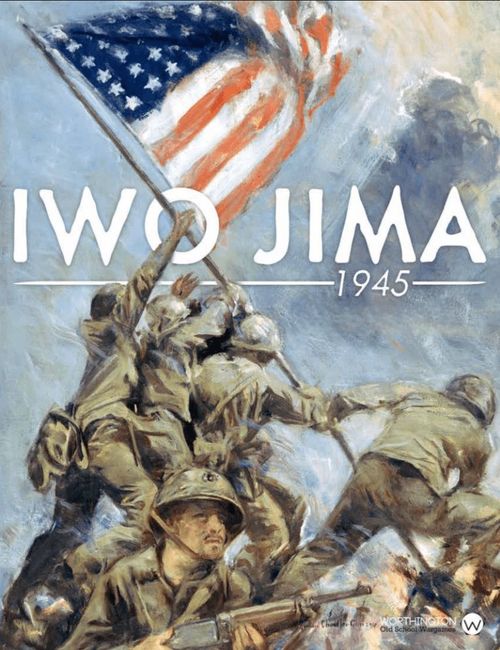
Iwo Jima 1945
Iwo Jima 1945 Rulebook
Table of Contents
Table of Contents
1.0 Introduction
It was decided that an invasion and capture of the island of Iwo Jima would serve several purposes:
- A landing base for damaged bombers returning from drops on the Japanese home island.
- It would prevent additional air losses by preventing the alert of the home island on incoming raids.
The USMC had 2 years of experience now with island fighting going from Guadalcanal, Tarawa, Saipan, Tinian and more. Based on previous experiences, US intelligence estimated that Iwo Jima would fall in 1 week.
On February 19, 1945 the USMC would land 30,000 Marines on the island against a Japanese defensive force that numbered roughly 21,000 Japanese soldiers. Facing a Japanese commander who had learned valuable lessons from the losses on other Japanese islands, the USMC would eventually land over 70,000 Marines and suffer over 25,000 casualties during the 36 day campaign. Iwo Jima was the only island assault during the Pacific war that the attacking US forces would suffer worse casualties than the Japanese defenders.
You, as the player will command the USMC invasion of Iwo Jima, while the game system, driven by cards, will control the Japanese defenders. The Japanese defenders may be hereafter referred to as Japanese AI.
The cards may read the same on some of the cards, however, there are differences as to some of the cards as well as the balance.
While Iwo Jima 1945 will play like Tarawa 1943, the decisions you make will need to be somewhat different due to the tunnel movement by the Japanese forces, and the more mountainous defensive terrain.
Game Differences from Tarawa 1943
If you have played Tarawa 1943 you will be familiar with the system and play. Key changes are as follows:
- During the set up the number of cards dealt out of each of the Japanese and USMC card decks.
- The number of dice rolled during the Special Landing Phase.
- There are mountain positions on the island where the attacking USMC will roll 1 less attack dice.
- The USMC player will now be allowed to play any number of their cards in their hand during their turn, and the Japanese turn.
Almost all other rules are the same and you can begin play with just a brief reading of the rules.
2.0 Game Board
The game board represents the island of Iwo Jima and the water around the island. On the island are 4 beach positions: Green, Yellow, Red, and Blue; each of which has 3 rectangular slots for the wooden troop markers. Only USMC regiments may occupy beach positions.
There are ten island positions, and each is labeled with a circle around a number, with the position's name.
Four of the island positions have mountain icons which affect how many dice the Marines roll when attacking that position if Japanese occupied.
Only 3 markers may ever occupy an island or beach position. A bunker cube may be placed in a position with 3 markers. Bunker cubes do not count as markers.
Positions are considered adjacent when they have arrows connecting them. Movement and attack actions are allowed when positions are adjacent.
Control of positions: Positions are controlled by either the Japanese or USMC. All positions are considered controlled by the Japanese AI unless the last marker(s) to solely occupy the position were USMC markers. An infiltrating Japanese cube gains control of a previously controlled USMC position, even if USMC markers are present. This is important for victory, movement, combat, and card play.
Regiment Cohesion Tracks: Located in the bottom left of the game board. The cohesion tracks list the 3 USMC divisions, and their regiments. For each division there are 3 regiments with a track from 12 to 1.
Mt. Suribachi: Above the Cohesion tracks is a USMC emblem. When a Marine regiment occupies Mt. Suribachi the first time place a cube on the emblem and raise all ON BOARD USMC cohesion tracks by 2 (maximum of 12). This is a one time event.
Japanese Rising Sun squares: On the right side of the board are 3 Japanese Rising Sun squares. During setup place a gold cube on each square. These represent Japanese infiltrators and are placed by card play.
3.0 Game Components
USMC Tactic Cards: The USMC player has a deck of 36 Tactic Cards. The cards give various bonuses to USMC during play. The card instructions tell the player how to use the card. Card instructions may counter rules within the game, in this case, the card instructions take precedence.
At the top of each USMC Tactic card is a picture. A title bar name of the card is at the bottom of the picture. The center section gives the card instructions on how the card is played and what to do when played. The section below that is some history related to the card. At the card bottom tells when to play the card. The play of an USMC tactic card does not count as an action.
Japanese AI Activation Cards: The Japanese AI has a deck of 36 AI Activation Cards. The cards tell the player which Japanese units to activate and how to use the card. Card instructions may counter rules within the game, in this case, the card instructions take precedence. Only 1 Japanese AI activation card is played during the Japanese turn.
At the top of each Japanese AI card is a picture. A title bar name of the card is at the bottom of the picture. The center section gives the card instructions on how the card is played and what to do when played. The section below that is some history related to the card.
Bunker Cubes: Brown wooden cubes are used to represent bunkers. These are placed by play of Japanese AI Activation cards and USMC Tactics cards into occupied island positions. No more than one bunker cube may be in a position. A USMC or Japanese occupied position that has a bunker that must lose a marker due to defending a position removes the bunker as the first loss. Any excess hits are applied to USMC or Japanese markers occupying the position.
*If all the USMC or Japanese markers leave a position with a bunker for any reason, the bunker is removed from the position, unless a USMC regiment is swapping positions.
Key Rule: A bunker does not occupy a position, it adds to the defense of it.
For example: The 3/9 occupies #3 Field 1 with all three of its markers and a bunker. A Japanese fire attack causes a marker loss at that location. The bunker would absorb the first hit and be removed from the position.
Important: Attacking formations cannot use bunkers in their position to absorb losses. If the USMC regiment in the example above were the attacker and had rolled double 1's and not rerolled the result, they could not have taken the bunker as the loss as they were attacking, not being attacked. The same is true for the Japanese AI.
Exhaustion Cubes: These cubes show regiments that have failed an exhaustion check and are represented by a red cube. Place a red cube in a position with a USMC regiment that fails an exhaustion check. They do not occupy slots or positions and are to show status.
Formation Markers: Units (USMC regiments, or Japanese units) within positions are represented by the colored rectangular wooden markers.
Japanese Markers: The Japanese formation wooden markers are golden. Place ONE Japanese label showing a picture of a Japanese soldier with the label of IJA per marker. Because of the way the Japanese were defending on the island their movement, attack and defense are handled differently and you will be moving markers singly, doubly, or all from a position.
USMC Markers: The USMC regiment wooden markers are green with a USMC label applied to one of its long sides. Place ONE label with a picture of a Marine on one side of the wooden marker. Only one label per marker should be applied.
For each of the regiments there is a set of 3 labels on green wooden markers which represent a regiment (each label shows the division and the regiment, e.g. 4/23).
USMC regiments are organized with the three markers sharing the same regiment designation considered as one unit. The markers should be placed so the player may see the regiment designation. There are nine USMC regiments, three each in the 3rd, 4th and 5th USMC divisions, in the game.
During game play all USMC markers of a regiment are moved as one complete unit and attack and defend as one complete unit within a position. When all markers of a regiment have been removed due to marker losses by combat, that regiment is out of the game.
*An alternate set of labels with the USMC emblem is included for players who would rather use that label.
*Spares have been provided if there are any problems.
4.0 USMC Regiment Cohesion & Exhaustion
Unique to the USMC formations are regiment cohesion and exhaustion. Each regiment tracks its cohesion, and at certain states may reach a level of exhaustion.
Cohesion
Cohesion represents a USMC regiment's morale, fatigue, combat effectiveness, etc. The USMC Regiment Cohesion Track, on the game board, is from 12 to 1. It is used to track each USMC regiment's cohesion by using red cubes. Cohesion may never go lower than 1 or higher than 12.
When USMC regiments' actions are rotation (one of the two regiments), move or attack, they reduce their cohesion by 1, moving the red cube down 1 space on the cohesion track. It may be reduced further due to combat or card actions by the Japanese AI. Cohesion may be increased or added to by the play of cards or a regiment regroup action. Once a regiment's cohesion reaches 5 or less it must conduct an Exhaustion Check to see if it is exhausted.
Note: Regiments at 6 cohesion or higher are never exhausted and never do an exhaustion check.
Key Rule: An exhausted regiment may only rotate positions as the result of a different regiment's rotate action.
Cohesion reductions, when a regiment is at 5 cohesion or less, triggers exhaustion checks after its actions are completed. Regiments at 1 cohesion can not go any lower and ignore further reductions (unlike Tarawa these do not convert to marker losses).
Note: Regiments at 1 cohesion cannot move or attack.
Exhaustion Check
An exhaustion check must be conducted when a non-exhausted regiment performing an action has its cohesion at 5 or less on its regiment cohesion track AND has completed its action (rotation, moving, and attack) or an exhausted regiment regroups or by card play.
Any Japanese attack causing a cohesion reduction against a USMC regiment at 5 or less also causes an immediate exhaustion check.
An exhaustion check is not conducted if the regiment is not exhausted and the cohesion has been moved up the track due to a regroup action.
For example: A non-exhausted regiment at 3 cohesion that regroups and raises its cohesion to 5 would not make an exhaustion check. However, if the regiment was exhausted and regrouped, it would make a exhaustion check to see if it became non-exhausted.
To make an exhaustion check, roll one die and compare the result to the regiment's current cohesion level on its regiment cohesion track. If the result is equal to or less than the current cohesion, the regiment is not exhausted. The exhaustion marker is removed from a previously exhausted regiment.
If the result is higher than the regiment's current cohesion, then the regiment is exhausted. Place an exhaustion marker on the regiment (or leave in place).
A regiment that fails its exhaustion check is not removed from the board. Once the USMC regiment reaches 1 on its cohesion track any additional cohesion reduction are ignored.
An exhausted regiment that takes additional cohesion losses does not make an exhaustion check for the additional losses.
Key Rule: An exhausted regiment may only be part of regroup or rotation actions. An exhausted regiment may not conduct an advance after another regiments attack action.
5.0 Game Set Up
Place 3 Japanese markers in each numbered island position.
Separate the USMC markers by their regiments, each regiment having 3 markers sharing the same unit designation. Place 1 regiment in each beach position with the label facing the player. These are Green, Red, Yellow, and Blue beaches. The other 5 regiments are kept off board as reserves until the player brings them onto a beach position later in the game.
Take a cube and place it in the #12 space of each USMC Regiment Cohesion Track.
Place the three gold cubes in the three Japanese Infiltration squares at the right of the board.
Place the brown bunker cubes near the game board. Place any remaining cubes there too. These cubes will be used to mark on the game board when Mt. Suribachi is taken, and exhausted USMC regiments.
Shuffle the Japanese AI activation deck and deal 30 cards face down without looking at them. Place them in the Japanese Draw space on the game board. This is the Japanese AI activation deck. Place undealt cards aside face up in the Japanese discard pile space on the game board without looking at them. They will not be used in this game.
Shuffle the USMC tactic cards and deal 30 cards face down without looking at them. Place them in the Marine Draw space on the game board. This is the USMC tactics deck. Place undealt cards aside face down in the Marine Discard pile on the game board without looking at them. They will not be used in this game.
Draw the top 3 cards of the USMC tactics deck and place face up near you. This is the USMC starting hand of tactic cards. Discard any Bad Weather cards drawn at this time. Do not draw a replacement card if Bad Weather is discarded.
Regiments and Japanese formation markers are placed in the numbered positions, or for the USMC player the beach positions. Not all USMC formations will start on the board. 5 regiments start off board to start the game.
6.0 Sequence of Play
Before the first round of the game is played, the Special Landing Phase is conducted.
Special Landing Phase: This only occurs once during the game. Make an initial Japanese fire attack roll of 3 dice against each of the USMC occupied Beach positions adjacent to an occupied Japanese position. Any die roll of 1 are treated as no result during this phase. This phase is only conducted before the first turn of the game. No cards are played for either side during this phase.
After the Special Landing phase at the beginning of a game, a series of rounds is played in the sequence below. Each round consists of one turn for the USMC player followed by a turn with the play of the Japanese AI.
USMC Turn
Draw up to 3 new cards from the tactics draw deck and place it face up into the USMC hand of tactic cards. Maximum of 3 cards allowed in the USMC tactics hand.
The USMC player at the start of their turn draws cards up to their maximum hand size of 3 cards. The USMC player may play or discard any number of cards from their hand during their turn, and play (not discard) any number of cards from their hand during the Japanese turn.
Perform ONE of the actions below:
- Place a new wave
- Regroup
- Rotate Regiments
- Move
- Attack
Note: A USMC tactics card may be played before, during, or immediately after this activation.
Check for exhaustion for any USMC regiment that reduces below 6 cohesion this USMC turn.
If no tactics card was played, the USMC player may discard 1 tactics card from their hand.
Japanese AI Turn
Draw the top card from the Japanese activation draw deck and place face up in the discard pile. Follow all instructions from the face up Japanese AI activation card.
Note: A USMC tactics card may or may not be played before, during, or immediately after this activation.
Check for exhaustion for any USMC regiment that reduces below 6 cohesion this Japanese turn.
Play continues in the above sequence until the following occurs
-
Once the last Japanese card is played, the game ends after the next USMC player turn.
Note: The USMC player gets one last turn after the last card is played from the Japanese AI deck.
-
The game immediately ends when the USMC player controls all island positions at the end of the USMC turn.
Tactic Cards
At the start of the USMC player turn, draw up to 3 tactics cards from the Marine Draw deck if there are less than 3 cards in the USMC player hand.
The USMC player may play any tactic card(s) that is in their hand of 3 tactic cards. The USMC player may play any number of cards from their hand during their turn and any number of cards during the Japanese AI turn. The bottom of the card states during which turn it may be played. If a card's effect cannot be played, then the card may not be played. The tactics card will explain how it is to be played and what bonuses or possible penalties it gives the USMC player. Once played the card is placed in the discard pile.
The USMC player may discard 1 card from their hand to the discard pile IF a card was not played in the USMC turn.
The play of tactic cards does not count as an action for the USMC player turn and thus does not reduce cohesion.
Once all cards have been played, or discarded, and are in the discard pile the discard pile is NOT reshuffled as in other games. Once you are out of cards, that is it, you are out.
Performing Actions
The USMC player during their turn may perform one action. Depending on the action, the cohesion for the activated regiment(s) will be moved up, down, or not at all on the USMC Regiment Cohesion Track.
When performing actions, it allows one of the following five actions:
Place a new wave: The USMC player may place up to 2 regiments that are off board into any vacant beach positions. It does not reduce cohesion for the regiment's being placed in the beach positions, but it is the USMC action for the turn.
Regroup: One regiment adds 3 to its current cohesion, move the marker up 3 spaces on its regiment cohesion track. If the regiment is currently exhausted and the marker is in the 4 or 5 space on its regiment cohesion track, make an immediate exhaustion check. If after the Regroup action the exhausted regiment is 6 or higher on its regiment cohesion track, the regiment is immediately rallied back to not exhausted. Remove the Exhaustion cube from the regiment position. Regroups on non-exhausted regiments do not require an exhaustion check.
Rotate Regiments: One regiment may swap positions with another regiment in an adjacent position. One of the two regiments must reduce its cohesion by 1 and perform any necessary exhaustion checks. Players choice of which regiment to reduce cohesion but it may not be an exhausted regiment. However, exhausted regiments may rotate during a Rotate Regiments action.
Move: One regiment moves its markers from its currently occupied position to any unoccupied position which may be friendly controlled or enemy controlled but not enemy occupied. Reduce the regiment's cohesion by 1. Further, one daisy chain effect is allowed; if there is an adjacent non-exhausted regiment to the moving regiment, it may reduce 1 cohesion and enter the position previously occupied by the moving regiment. A regiment may not move through an enemy occupied position.
Attack: One regiment attacks an adjacent Japanese occupied position from its currently occupied position. To attack, move the cohesion for the attacking regiment down 1 on its cohesion track. The attacking regiment must be adjacent to the Japanese occupied position being attacked. To attack, roll 5 dice, plus any for tactics cards played. Results are only applied to the regiment attacking and the Japanese markers in the position being attacked.
On USMC attacks against Mountain Positions, reduce the number of dice rolled from 5 to 4. This does not apply to attacks against infiltrating Japanese cubes in these positions.
USMC Dice Results for Attacks
- DOUBLE 6's = Remove 1 Japanese marker
- DOUBLE 5's = Remove 1 Japanese marker
- EACH 4 = Immediately remove all 4's, they may not be rerolled
- EACH 3 = Reroll all 3's immediately (do not reduce cohesion)
- DOUBLE 2's = Reduce the regiment's cohesion by 1
- DOUBLE 1's = Remove 1 marker from the regiment
After the dice have been rolled and any dice immediately removed (4's) or automatically rerolled (3's), the USMC player decides which of the rolled dice to keep at this point in the attack; including single 1, 2, 5, and 6's. Set those keeper dice aside. The USMC attacking regiment may now choose to reroll any 1, 2, 5, and 6's from the previous roll that was not set aside as a keeper. If the USMC player chooses to reroll any dice the attacking regiment's cohesion is reduced by 1. On any reroll a player may choose to reroll a previous keeper die. Rerolls may be repeated until the USMC player decides they are done attacking, or the regiment cohesion reaches 1 on the Regiment Cohesion Track. Each reroll of the dice immediately reduces the attacking regiment cohesion by 1.
Key Concept: Rerolls of 1, 2, 5, and 6's are the only dice that reduce attacking USMC regiment cohesion for a reroll. Rerolls of 3's are automatic and do not reduce cohesion. 4's are never rerolled and are removed before any rerolls of the other attacking dice.
Applying the Result of USMC Attacks
When a USMC attack ends, results are applied, for any keeper dice that are DOUBLE 1, 2, 5, and 6's. Each set of double 1's eliminates a USMC marker. Each set of double 2's reduces the attacking regiment's cohesion by 1. Each set of double 5's or 6's eliminates a Japanese marker.
Remaining single dice have no effect on the USMC attack results.
Key Concept on Attack Dice: Only final USMC keeper dice affect regiment cohesion and marker elimination when the USMC attack ends.
After results are applied, if all Japanese markers in the position are removed, the attacking USMC regiment may advance into the attacked vacant Japanese position. (See Advance below). After all rerolls, results applied, and advances, if any exhaustion checks are necessary they are done at this time. Note that advances are conducted before cohesion checks.
For example: The USMC player attacks with a regiment at a cohesion of 6. The player would reduce the cohesion to 5 for the attack. The player rolls the dice and gets a result of 6, 5, 4, 3, and 1. The 4 is removed as it may not be rerolled. The 3 is immediately rerolled (causing no reduction in cohesion), resulting in a 1. The dice are now 6, 5, 1, and 1. The two 1's cause a USMC marker loss, so the player decides to reroll the two 1's. The USMC player reduces the regiment cohesion from 5 to 4, and rerolls the 1's, getting a 3 and 1. The 3 is rerolled resulting in a 5. The dice are now 6, 5, 5, and 1. This would result in the removal of 1 Japanese marker. The USMC player is satisfied and stops rolling. Results are applied and an exhaustion check is made since the regiment cohesion is now 4.
Advance After USMC Attacks
The regiment that has just attacked a Japanese position and eliminated the last Japanese marker may move its regiment markers into the now unoccupied position. Advance does not cost the USMC regiment a cohesion reduction, the advance is considered part of the attack. Further, any one non-exhausted USMC regiment that is adjacent to the now vacant position that the USMC regiment advanced from, may move into the now vacant former USMC position. Unlike moves, this does not reduce the cohesion of the advancing regiment. Only one regiment such advance is allowed per attack (you may not daisy chain more than 1 regiment to the initial advancing regiment).
For example: A USMC regiment in #5 Turkey Knob attacks Japanese occupied #6 Airfield 3. There is a non-exhausted USMC regiment in Blue beach position adjacent to #5 Turkey Knob. The attack eliminates all Japanese markers in #6 Airfield 3. The attacking USMC regiment advances from #5 Turkey Knob into #6 Airfield 3. As part of the advance, the USMC non-exhausted regiment in Blue beach position adjacent to #6 Turkey Knob then advances into #6 Turkey Knob but does not reduce its cohesion for the advance. If there had been a USMC regiment adjacent to Blue beach, it could not have advanced as you may only advance one extra regiment.
Japanese Turn
The Japanese AI turn is different from the USMC player turn as it is dependent on the artificial intelligence (AI) generated from the cards. Therefore, Japanese units do not track cohesion, may have multiple actions in a turn in attacks generally cause effects with single die results and do not reroll any dice other than 3's.
Other Japanese functions are different in some cards, in that adjacency is not required for Japanese attack or movement.
The Japanese card deck provides the instructions for the Japanese AI play each turn. At the start of the Japanese turn, the player will draw and turn face up one card from the Japanese AI activation draw deck. Follow all instructions on the card. If any effects on the card are not possible to be played, then they are ignored. After all instructions have been followed the card is placed in the Japanese discard pile.
Most of the Japanese cards are for Japanese occupied positions attacking USMC occupied positions.
Key Rule: Unique to Japanese attacks are the concept of Attack Priority. Attack priority is the highest priority USMC island occupied or controlled position being attacked from the lowest priority adjacent Japanese occupied position.
1 is the highest priority island position. 10 is the lowest priority island position.
The Marine beaches are prioritized from left to right - Green, Red, Yellow, Blue.
The exception to this rule is when a USMC regiment does not occupy an island position and is in a beach position. In that case, the Japanese attack the beach USMC occupied position adjacent to the highest priority Japanese occupied island position. All Japanese fire attacks against beach positions roll 1 additional die (except during the landing phase, as it has already been factored in).
Until a USMC regiment occupies a numbered island position, beach positions are prioritized based on the priority of the adjacent island position to the beach.
For example: A USMC regiment in Green beach would take Japanese attack priority over a USMC regiment Yellow beach, etc.
In the event of multiple fire attacks by a Japanese card, island occupied positions always take attack priority over beach adjacent positions.
Japanese Attacks
Japanese attacks are different than USMC attacks in that the Japanese roll attack dice one time, all results are keepers except for automatic reroll dice.
Fire Attack and Fields of Fire: Using attack priority, are attacks from positions occupied by Japanese unit markers to adjacent USMC occupied positions. Fire attacks and Fields of Fire attacks roll 3 dice. Fire attacks against USMC beach positions, add one die. Results are only applied to the regiment(s) being attacked and the Japanese markers attacking. Japanese fire attack dice combinations are as follows:
Japanese Fire Attack (3 dice)
- EACH 6 = Remove 1 marker from the USMC regiment being attacked
- EACH 5 = Reduce the cohesion by 1 of the USMC regiment being attacked
- EACH 4 = Reduce the cohesion by 1 of the USMC regiment being attacked
- EACH 3 = Reroll the die immediately
- EACH 2 = Cancels a 6 rolled (ex. two 2's cancels two 6's)
- DOUBLE 1's = Remove 1 Japanese marker from the position attacking (ignore when attacking beach positions)
- SINGLE 1 = No Effect
Banzai: These attacks only occur against USMC occupied island positions. Banzai attacks are not allowed against USMC beach positions. Using attack priority, are attacks from positions occupied by Japanese unit markers to adjacent USMC occupied positions. Banzai attacks roll 5 dice. Results are only applied to the regiment(s) being attacked and the Japanese markers attacking. Japanese Banzai attack dice combinations are as follows:
Japanese Banzai Attacks (5 dice)
- SINGLE 6 = Remove 1 marker from the USMC regiment being attacked
- SINGLE 5 = Reduce the cohesion by 1 of the USMC regiment being attacked
- SINGLE 4 = Reduce the cohesion by 1 of the USMC regiment being attacked
- SINGLE 3 = Remove all 3's, they may not be rerolled
- SINGLE 2 = Remove 1 Japanese marker from the position attacking
- SINGLE 1 = Remove 1 Japanese marker from the position attacking
Japanese Markers and Cubes
Marker Movement: Move the number of Japanese markers given on the card from the Japanese occupied position to the position indicated, normally by lowest to highest priority. The positions do not have to be adjacent unless specified by the card.
Infiltration Cubes: This is the only time cubes of the Japanese and USMC regiments markers may occupy the same position. Move one Japanese gold infiltration cube from an infiltration box to the USMC occupied position IF there is an empty marker slot in the occupied position (note bunkers do not occupy slots in a position). Japanese cubes infiltrating may also move into controlled USMC positions that are unoccupied by Marine markers. The USMC regiment in that infiltrated position must only attack that cube in its position until it is removed. An adjacent USMC regiment may attack the cube without affecting any of the USMC markers in the infiltrated position. The USMC regiment that has been infiltrated may regroup but may not move or rotate regiments.
Key Rule: Japanese infiltration cubes gain control of the position they occupy until they are removed, may not attack any USMC position, and may not move.
Japanese infiltration cubes can only be removed by a successful USMC attack action directly against it with a roll of double 5's or double 6's.
7.0 Victory
Victory is determined at the end of the game which occurs one of two ways given below:
- Once the last Japanese card is played, the game ends after the next USMC player turn.
- The game immediately ends when the USMC player controls all island positions.
Victory Points
Victory points are totaled to determine the victor and level of victory.
USMC:
- Marines receive 2 VP per USMC controlled island position.
- Marines receive 1 VP per Japanese card remaining after USMC control all island positions.
Japanese:
- Japanese receive 2 VP per USMC marker eliminated.
- Japanese receive 1 VP per USMC regiment exhausted.
- Japanese receive 3 VP for each Japanese controlled island position.
Victory Results
- If the Japanese tie or exceed the USMC VP total it is a Japanese win.
- If the Marines have more VP than the Japanese it is a USMC victory determined as follows:
- 1 - 5 VP = Marginal (Historical Victory)
- 6 - 9 VP = Moderate Victory
- 10 VP+ = Smashing USMC Victory
8.0 Optional Rules
Adjusting Difficulty
To make the game more difficult for the USMC player, reduce the number of Japanese cards used during setup to 27.
To make the game easier for the USMC player, increase the number of Japanese cards used during setup to 33.
9.0 Key Things to Remember When Playing
- The card instructions take precedence over the rules.
- Certain Japanese card actions may have markers "moving" through USMC occupied positions to higher priority USMC occupied positions. This is allowed. The battle was not a solid line of Marines across the island and the Japanese infiltrated through USMC lines repeatedly, as well as snipers popping out of previously bypassed Japanese positions.
- What increases USMC regiment cohesion:
- Regroup action
- USMC cards
- The first USMC occupation of Mt. Suribachi (+2)
- When cohesion is reduced for a USMC regiment:
- Before a USMC regiment move is executed
- Before a USMC regiment attack is executed
- Before re-rolling USMC regiment attack dice
- After USMC regiment attacks with final keeper dice double 2's
- After Japanese attacks for each single 4 or 5 die rolled against a USMC regiment.
- Exhaustion Checks are made for non-exhausted regiments with cohesion under 6. The exhaustion check is made after actions are completed.
- USMC attack die rolls end when the USMC player decides they are done with rerolls OR their regiment cohesion is at 1.
- Only keeper dice affect cohesion and marker elimination.
- On any reroll a USMC player may choose to reroll their previous keeper die.
- Infiltration cubes gain control of positions they occupy and may not move or attack.
10.0 Game Setup and Turn Example
The USMC player sets up three markers of the same unit designation for each regiment in the following locations, the 3/3 USMC regiment in Green beach, the 3/9 USMC regiment in Red beach, the 3/21 USMC regiment Yellow beach, and the 4/23 on Blue beach. A cube is placed on the 12 space for all four regiments. All ten island positions on the island are occupied by three Japanese markers.
The USMC draws their three tactics card to begin play. He draws a Fighting Seabee's card, a Command Coordination card (allowing actions by 3 regiments in a turn), and a Bad Weather card. The Bad Weather card is discarded immediately, and no replacement is drawn. This leaves the USMC player with only 2 cards to start the game.
During the Landing Phase the Japanese player rolls 4 dice using the Japanese Fire Attack chart against each of the regiments in Green, Red, Yellow and Blue beach positions. Against the 3/3 USMC regiment the attack removes 1 marker and reduces the regiment's cohesion from 12 to 11. Against the 3/9 USMC regiment the attack reduces the regiment's cohesion from 12 to 9. Against the 3/21 USMC regiment the attack removes 2 markers. The 4/23 has no negative results as the Japanese player rolled two 2's and two 1's for no result. The USMC player is not allowed to play any cards during the Special Landing Phase.
It is now the USMC turn.
The USMC player decides to play the Command Coordination card which allows actions by 3 regiments this turn (normally you can only use one action for one regiment per turn). The USMC player activates the 3/3 regiment in Green beach to Attack island position #2, The Neck. It reduces its cohesion by 1 rolls two 6's, a 5, and a 1, eliminating a Japanese marker. The 3/9 regiment also Attacks island position #2, The Neck. It reduces its cohesion by 1 to 8, and rolls one 6, a 5, a 4, and two 1's. The 4 is removed. The player elects to reroll and reduces the 3/9 cohesion to 7 for the reroll of the two 1's and rolls another 6 and 5! This gives them two 6's and two 5's eliminating two more Japanese markers clearing the position. The 3/9 advances into the position.
For it's last of the three actions the USMC places a new wave and places the three markers of the 4/24 into the now vacant Red beach position that the 3/9 advanced out of. The player places a cube in the 12 location on the 4/24 cohesion track. It does not reduce cohesion for placement as a new wave.
The USMC player plays the Fighting Seabee's card to raise the cohesion of the 3/9 by 3 from 7 to 10. The USMC is out of cards in their player hand.
This ends the USMC player turn.
For USMC attacks against Japanese occupied mountain positions only roll 4 dice (does not apply to infiltration cubes).
Rule questions: frame the question in a "Yes" or "No" style and email it to the publisher at [email protected]. Visit worthingtonpublishing.com for any future rule updates.