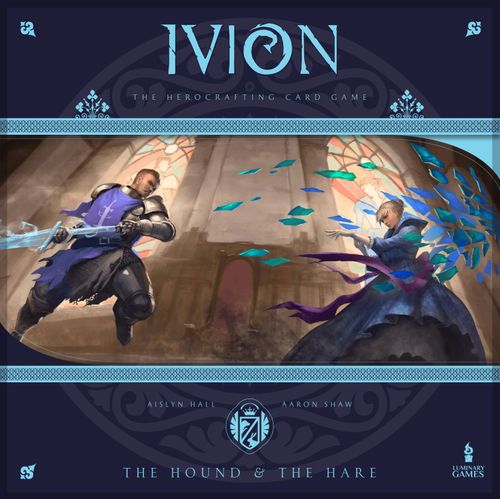
Ivion: The Hound & The Hare
Ivion: The Hound & The Hare Rulebook
Table of Contents
Table of Contents
Learn to Play
Overview
Reduce your opponent's hit points to zero to win the game!
In between each game, players may customize their hero's deck with the simple Herocrafting System, or reimagine their own custom character from scratch. A hero is composed of three archetypes, such as Knight, Wizard, and Sorcerer. With each new Ivion archetype added to your collection, new options become available to further hone your character into the ultimate hero!
Setup
a. Place the board in between you and your opponent. Each empty card slot on these boards represents one tile, making up the 4 x 4 tile battlefield the game is played within. Each board also contains areas on either side for you to track your resources and other information.
b. Gather tokens. Punch out the tokens and create a communal pool for them within easy reach of both players.
Each player follows the remaining steps.
c. Choose your hero. There are two shrink-wrapped heroes included: The Saint and the Illusionist. Choose who you will play, set aside their 3 "Feat" cards (found at the bottom of their decklist), then shuffle the remaining 40 cards together.
d. Connect your HP tracker to the board. Place your hero's HP (hit point) tracker in one of the two shaped slots on the board, facing you. Then place a heart token on the highest-value spot. This is your hero's current health.
e. Enter the battlefield. Place your hero's miniature in the bottom right tile of the board.
f. Create your "feat zone". Place your hero's "feats" in front of you.
g. Draw the top five cards of your deck. There are no mulligans!
Immediate bonus. The Saint player should perform the first line of rules text on the 'Destiny' card. (Check out the relics card for more information.)
Begin! The player who comes up with the best name for their hero goes first.
How to Play
Players alternate taking turns as the active player until a player is reduced to 0 on their HP tracker from damage. Each turn is split into three parts: Start, Main, and End.
Start
Draw a card, gain 3 action tokens and gain 1 initiative token. Then, any effects that trigger at the start of your turn happen.
Exception: The player who goes first does not draw a card on their very first turn.
Main
While it is the main part of your turn, you can perform each of the following as many times as you wish in any order:
-
Play a card from your hand, or one of your Feats. (Check out the Rules Reference for more information).
-
Move one tile (no diagonals!) away from your hero's current position by spending one action. You can't move if you're slowed, and you can't move into the same tile as your opponent.
-
Spend your Initiative token to...
- ...move without spending an action, or
- ...draw a card
Initiative tokens aren't permanent, but you'll gain another at the start of your next turn.
-
Remove Control from yourself by spending actions and / or power tokens equal to the total amount of Control you wish to remove.
End
When you no longer wish to take actions, your turn ends. Effects that occur at the end of your turn happen. Then, if you have more than 7 cards in your hand, choose cards to discard down to 7.
Any unspent initiative tokens are lost, but unspent action and power tokens are kept. Now, it's your opponent's turn.
Important: Because unspent initiatives are lost at the end of your turn, you always want to spend your Initiative token each turn.
Rule of Five. Any one hero may never have more than five action, power, or initiative tokens, nor more than five of each of the slow, silence, and disarm tokens affecting them at any given time.
The Golden Rule. If the rules text of a card directly conflicts with the rules in this guide, the card takes precedence.
The Board & Cards
Card Anatomy
- Resources: Actions. How many Action tokens does this card cost to play?
- Card name
- Resources: Power. How many Power tokens does this card grant or cost?
- Range. How far away can this card's target be from your character?
- Card type
- Rules Text
- Control Banner. What kinds of Control (Slow, Silence, or Disarm) can stop this card?
- Instant Indicator. Can you play this to interrupt your foe's turn?
- Archetype Name. What Class or Specialization is this card from?
Rules Reference
Introduction
This Rules Reference expands upon the Learn to Play. It contains detailed rules for more advanced concepts, and basic strategy tips to get you started. Reading through this document will help you tackle advanced situations during gameplay. Each starter deck additionally comes with a reference card to review basic game concepts, a mechanics card that explains key features of your character, and a decklist card in case you'd like to recreate the starter decks at any point.
After you've played a game or two with the starter decks, we recommend opening the extra shrink-wrapped deck in your box. At this point, you'll have some options on how to approach the game. Check out the Herocrafting and Make Your Own Hero sections for more information.
We recommend first reading through the Learn to Play before diving into this Rules Reference. Once you've read through the Learn to Play and setup your first game, review these rules if you have any questions or need to clarify something. Before starting your second game we recommend reading from Core Concepts up to just before Additional Rules in this Rules Reference, as many of the concepts will become more clear after having experienced the game firsthand.
Core Concepts
Playing Cards
You may play cards from your hand, and you may play feats that have resource costs.
To play a card, go through these steps:
- Choose your card. Select a card to play and place it face up in front of you. a. If the card requires you to "choose", decide now. b. If the card requires one or more targets, select them now. c. If the card has a range, the selected targets must fall within it.
- Pay its cost. Spend resources equal to the card's cost by removing the appropriate amounts of actions and / or power from your resource pools. Control is removed accordingly.
Your card has now been played. But watch out! Before your card "resolves" and its effects occur, your opponent can respond by playing an instant card. If they do, you can respond to their instant by playing an instant of your own!
When a player chooses not to respond, all played cards attempt to resolve in the reverse order of which they were played.
To resolve a card, go through these steps:
- Was it countered? If the card has been countered or meta-countered, it has no further effect and is placed in its owner's discard. a. If the card was meta-countered, the resources spent to play it are refunded.
- Gain resources. If the card generates resources, those resources are gained now.
- Resolve its effect. The effects listed in the rules text of the card occur, from top to bottom. a. If the card is not attached, it is then placed in its owner's discard.
Important: Players cannot take other game actions such as moving, spending resources to remove control, or expending initiatives while one or more cards are unresolved.
Example: Daring Strike costs one action and generates one power.
Resources
Actions and power are collectively referred to as resources. You can use resources to move, play cards, remove control, and pay for effects. Unspent resources are saved in your resource pools between turns, but a player can never have more than five of each resource.
ACTIONS. You gain three actions at the start of each of your turns. There are very few other ways to generate actions, so spend them wisely!
POWER. You don't gain power at the start of your turn. Instead, some cards give you power, and others cost power to play. The only way to gain power is through card effects.
DAMAGE. The most common effect a card will have is damage. In Ivion, a player is defeated when their HP is reduced to zero. When a card "deals damage" to a player, that player's HP is reduced by that amount.
RANGE. A card's range is the maximum number of tiles away you can be from the card's target; if a card's range is not listed, there is no maximum.
MOVEMENT. On your turn, you may move your miniature to an adjacent tile. This costs one action each time. Tiles that are diagonal to one another are not considered adjacent.
INITIATIVE. You gain an initiative token at the start of each of your turns. You can expend an initiative token to either draw a card or move one tile.
SAVING RESOURCES. You'll need to save actions and power between turns to play your most powerful cards. Remember that the maximum of each is five, but that you gain three actions each turn – try to spend your actions each turn down to two so you don't waste any. With five actions, five power, and a fistful of cards at the start of your turn, no evil can stand against you!
Control
Some cards can apply "control" to your hero. The three kinds of control are slow, silence, and disarm. Control does not deal damage but does prevent your hero from doing certain things. When you receive control, place the appropriate number and kind of tokens in front of you.
Control will prevent you from playing some of your cards. Each card has a banner to the left of its rules text which indicates what kinds of control prevent it from being played. If you have any control of those kinds applied to you, you cannot play that card. Additionally, while slowed, you can't move nor spend an initiative token to move.
Control is counted in increments, up to a maximum of five for each type. A hero may never be affected by more than five tokens of a single type of control at any given time.
Example banner: "This card is unaffected by slow, and affected by silence and disarm."
REMOVING CONTROL. After you spend resources in any way, you remove that many control tokens in any combination from your hero. Some game effects such as stun can cause you to lose resources. Lost resources do not remove control. A player may also spend resources during their turn for the sole purpose of removing control.
HEROIC CARDS. Some cards have the heroic icon instead of the control banner, denoting that they are heroic. They are unaffected by control. Try using them while you're controlled to escape it quickly!
ESCAPING CONTROL. Your foes will try to keep you constrained by applying control to you, but there are ways to manage this. It's almost always better to spend resources by playing cards or moving to remove control rather than paying resources explicitly for that purpose. Save heroic cards to fight through heavy control, and opt to spend resources that would otherwise be wasted to remove control. Sometimes it's difficult to break free, but properly manage your resources to avoid control and you will stand tall against these fiends!
Instants
Instant cards can be played in response to your opponent playing a card, and will take effect before your opponent's card resolves. Instant cards have the instant icon in the top right of their rules text. These cards can also be played normally during your turn.
Some cards will have a major impact on the battle, turning the tide to one side's favor. Save powerful instant cards for a pivotal moment to ensure that your important cards resolve – and that theirs do not. Try to anticipate when your foe is planning to strike a decisive blow, then prevent them from resolving their important cards. If you have multiple instant cards, aggressively use them, and if they attempt to stop you with their own, engage in a "counter-war" to strain their resources. Remain unpredictable and victory will become a mere illusion for them!
Additional Rules
Attached Cards
Some cards will attach to your hero, an opponent, a tile, or something else when they resolve. Only empty tiles can have cards attached to them.
DESTROY. Some cards destroy attached cards. An attached card must have resolved before it can be destroyed. Destroying cards uses the normal targeting rules; attached cards are in either the tile they are attached to, the tile of the player/card they are attached to, or else in the tile of their controller.
COUNTERS. Some effects can counter cards, which is a way of preventing a card from resolving. A countered card does not resolve and goes to its owner's discard.
META-COUNTERS. Sometimes, when a card you have played attempts to resolve, the conditions which allowed you to play that card are no longer met. If this is the case, your card is meta-countered. A meta-countered card does not resolve, but any resources you spent to play it are refunded. Generally, cards are meta-countered in one of two ways:
- You have received control which would prevent your card from being played.
- None of your card's targets are valid, usually because they are out of range.
Feats
Each hero has three special cards that are kept separate from their 45-card deck: one ultimate and two traits. Ultimates and traits are collectively referred to as feats. Instead of being shuffled into your deck, feats reside in the feat zone. Some feats have resource costs and can be played like cards in your hand, others have effect as long as they are in the feat zone. Once a feat is played, regardless of whether it successfully resolves, it cannot be played again until the start of its controller's next turn. If a feat would be sent to the discard, hand, or deck, it is instead returned to the feat zone.
ULTIMATES. Each hero has an ultimate card which comes from their specialization. An ultimate functions the same as all feats but also determines the starting and maximum HP of the hero.
TRAITS. In addition to their ultimate, each hero has two "traits". Traits have a bar at the bottom of the card indicating what kinds of heroes can use them. Trait eligibility during deck construction is explained further in the Make Your Own Hero section.
Second Wind
When you flip your hero's HP tracker to the wounded side for the first time during the game, interrupt the current player's turn and immediately use your second wind. Look at the top five cards of your deck and pick two from among them to put into your hand, then put the other three on the bottom of your deck in any order.
Exhaustion
A player is exhausted while they have no cards in their deck. When you are exhausted, damage you take can't be reduced, you can't gain HP, and if you would draw a card, instead take 5 damage.
You haven't lost the game yet while exhausted, but you're close. Try to finish off your opponent with the cards still at your disposal, or suffer defeat!
Terrain
When terrain is created in a tile, place the appropriate terrain token onto that tile. If terrain is made on a tile that already has terrain on it, the previous terrain is replaced.
Traveling
Traveling is a term for when a card effect causes a player to change tiles. Traveling causes players to enter and leave tiles, but does not count as moving. Players do not travel along "paths"; players simply leave one tile and enter the other.
Occupied Tiles
A player can't enter a tile that has an opponent in it. A card that would cause a player to travel to a tile with an opponent cannot resolve and will be meta-countered. If a card allows you to choose between multiple tiles to travel a player to, you cannot choose a tile with their opponent in it.
Simultaneous Effects
If multiple effects trigger at the same time, each player in turn order resolves their effects in whichever order they wish, starting with the player whose turn it is.
Zones
Cards exist in zones. Zones are either public or private. Cards in public zones are available for any player to look through at any time, while cards in private zones cannot be viewed by some or all players. Each player has their own deck and hand (private), and their own discard and feat zones (public), and they share the field (public).
Revealing Cards
When a card in a private zone is placed in a public zone, it becomes revealed. When a card is revealed it is shown to all players. The card then remains face up for the rest of the game, even if in a private zone. When a player's deck is shuffled, any revealed cards in that deck are no longer revealed.
Glossary
CANTRIP. A card with cantrip can be played for free by expending an initiative token. Because initiative tokens are not resources, if a card played this way is meta-countered, the initiative token is not refunded.
CHIVALRY. While you are chivalrous, at the start of your turn, you heal 2 HP. Once you become chivalrous, you will remain so until you dishonor the code of chivalry. You dishonor the code of chivalry when:
- You play a card targeting an enemy affected by control.
- You play a card during an enemy's turn
- A game action or effect you control causes you to leave a tile near an enemy and enter a tile that is not near an enemy.
COPY. When you copy a card, you play an identical version of it. If it would normally attach, it instead does not. Additionally, copied cards don't go to the discard. In all other ways, treat it like playing a normal card.
EMPTY TILE. A tile is empty if it has no cards attached to it and no heroes in it. An empty tile may have a terrain token on it.
ENCHANTED TERRAIN. After a player enters a tile with enchanted terrain, they gain 1 power, and the enchanted terrain is removed.
FREE. When a card is played "for free", its controller plays it as if its cost were 0 actions and 0 power. For example, a -1/+1 card played for free will not generate power.
NEAR. Something is near when it is in the same tile as or adjacent to the referenced object. Tiles that are diagonal to one another are not considered adjacent.
RELICS. Before a game begins, if your deck can gain relics, you'll shuffle them together into their own, separate pile. When you gain a random relic, draw the top card of this deck and immediately activate its effects. If a relic would enter the discard, instead remove it from the game. It cannot be gained again in this game.
STUN. When a hero is stunned, they lose a resource of their choice. This resource is lost, not spent, and thus does not contribute towards removing control tokens.
UNLEASH. When you play a card with unleash, you choose whether or not to unleash it. If you choose to unleash it, you spend the rest of your remaining power to gain the secondary effect. If a card that is unleashed is meta-countered, the additional unleashed power is also returned to the controller. A card can only be unleashed if one or more extra power is available to be spent.
Moving Methodically
Maneuvering across the board with purpose is critical to gaining and maintaining the advantage. While you're ahead, aggressively keep your foe within distance so they can't escape your onslaught. While you're on the backfoot, disrupt their assault by slowing them and moving away. Beyond this, attach cards to central tiles, forcing your opponent towards the outer edge to reduce their avenues of escape or assault. Move methodically and illusory chains will figuratively bind them!
Herocrafting
This box alone is a complete, replayable game experience. However, the Herocrafting System empowers you to quickly try new characters without the usual hassle of constructing your own deck. To get started using the Herocrafting System, you will need each of the three content boxes: The Hound and the Hare, The Knight and the Lady, and The Sun and the Stars.
Beyond the Herocrafting System is a fully customizable card game to explore – the options to create your perfect fantasy hero are vast and expand with each new release. While one content box alone is sufficient to craft a hero from scratch, we recommend two or more content boxes to unlock the true potential of choices available in Ivion.
Using This Box
Each starter deck in this product also has an extra package of cards for your hero that are not used in the starter deck. Simply try swapping out a few cards that you didn't find useful with a few cards that look fun!
How It Works
Each hero is a combination of three fantasy archetypes. Two of these archetypes are classes, and one is a specialization.
- Choose your two classes. Firstly, pick two different classes in your collection that sound fun, cool, or otherwise interesting—what kind of hero you want to craft is ultimately up to you! Note the color of the classes you choose. You may pick the same class twice. If you do, simply take two copies of each of the cards marked for Herocrafting instead of one. Class cards can be identified by the gold bar above the name of the class.
- Choose your specialization. Pick a specialization in your collection. It must share a color with at least one of your chosen classes. Furthermore, each specialization has an associated card that has a unique back compared to its other cards. For now, set this card aside. Specialization cards can be identified by the platinum bar above the name of the Specialization.
- Craft your hero! In each of your three chosen archetypes, 15 cards will bear the Herocrafting System icon. Find each of these 45 cards and combine them into a deck! Additionally, there are two trait cards that aren't associated with any archetype you'll need to add to your new character. Based on the color of your two class choices, you'll find Herocrafting-marked trait cards for each. Take whichever two you'd prefer and set them aside.
- Shuffle & play! Shuffle your new, 45 card deck. The three extra cards from the archetypes you chose initially will be your hero's feats. Once you've found your associated specialization's miniature, you and your new hero are ready to play!
Example. In this example, we'll take a look at a Herocrafted Illusionist. Gianna knows she wants to be an Illusionist, so picks Wizard as her first class and sets those cards aside. Wizard is blue, and thus satisfies the color requirement of Illusionist, a blue and green specialization. She additionally picks Sorcerer as her second class and sets those cards aside. Second, she picks Illusionist as her specialization and sets those cards aside. She finds that the Herocrafted traits associated with Wizard (blue) are Timerunner and Ponder, and the Herocrafted traits associated with Sorcerer (red) are Spellwake and Enchant. She can pick any combination of these two, and opts for Timerunner and Spellwake, then sets those cards aside. Finally, Gianna takes the set aside cards she's gathered. She sifts through to find each card with the Herocrafting icon and creates her deck with those cards. She takes the Illusionist miniature and the Illusionist ultimate, Confuse. Along with her two chosen traits, she's ready to shuffle and play!
Additionally, there are extra decklist cards that contain interesting characters for you to try. Please note that to construct these decks, you will need one or more additional content boxes of Ivion.
Make Your Own Hero
An Ivion deck is comprised of the following elements exactly:
- One or two classes (30 class cards total)
- One specialization (15 specialization cards)
- One ultimate (from your specialization)
- Two traits (for which you qualify)
How It Works
- Choose your classes. Your hero's classes define the core of your hero. Take each card from up to two classes and set them aside in separate piles. You'll pick cards from them soon!
- Choose your specialization. Pick a specialization in your collection. It must share a color with at least one of your chosen classes. Your hero's specialization will define the unique strengths of your hero. Take each card in that specialization and the corresponding ultimate card and set them aside. You'll pick cards from it later.
- Choose your traits. Trait cards can be anything from a bonus attack to a subtle passive. Try to find two that seem fun or useful to you. Traits are feats that have colored pips at the bottom middle instead of an associated class or specialization. For each required color, one of your archetypes must also be that color (an archetype's color is indicated at the bottom of the card). If a trait requires two pips of the same color, then two of your archetypes must be that color.
- Make your hero! Pick 30 class cards from among your hero's two classes and 15 cards from your hero's specialization. Those 45 cards comprise your new hero's deck! Your ultimate and two traits comprise your new hero's feats.
Which Cards Should You Choose?
A hero isn't simply born—they grow over time. Keep these tips in mind to get started.
- Add many cards that generate power.
- Add many attack cards to deal damage.
- Add some cards that cost power for big plays.
- Add a few cards with the destroy effect.
- Add a few instant cards that surprise your opponents.
Making custom decks is rewarding, but can be difficult and competitive. For strategy advice and examples of other player's decks, visit playivion.com and join the Ivion HCG Discord server!
Initiative Strategy
How to spend your initiative each turn may seem like a simple choice, but understanding when to move, when to draw, and when to use special choices is key to gaining the advantage. If you need more cards to fill your hand, and you often will, consider using your initiative to draw a card. If you find that you have more cards than resources to play them, it may be more useful to put your character in an advantageous position on the board by spending an initiative to move. While each turn this choice may seem minimal, it adds up! Expertly spend your initiative and you will become a phantom of the battlefield!
Evaluating Momentum
As you play games with your character, you'll find they align better with an attacking playstyle, a defensive playstyle, or somewhere in between. While battling your foes, it's important to consider which deck will be playing more aggressively, which will be playing more defensively, and which style you should adopt in the match. A deck more suited to defense will not succeed in playing aggressively against a deck with far more explosive damage potential, and an offensive deck can't easily outlast a deck with numerous defensive options. Understand this theory and you will honor the king and the Lady!