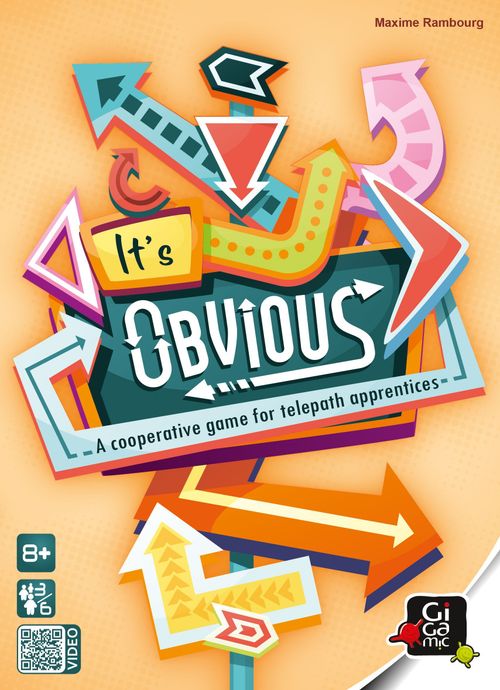
It's Obvious
It's Obvious Rulebook
Table of Contents
Table of Contents
Components
- 300 Image cards (double-sided)
- 10 Round tokens (double-sided: Victory side and Defeat side)
- 8 Number tokens
- 6 Vote dials
Setup
- Make a stack of Round tokens, depending on the number of players (see the table below).
| Number of players | 3 | 4 | 5 | 6 |
|---|---|---|---|---|
| Number of rounds | 10 | 9 | 8 | 7 |
- Arrange in a circle, in the centre of the table, as many Number tokens as there are players, plus one, in numerical order (1, 2, 3, etc.).
- Shuffle the Image cards, then place two of them, face up, in front of each player, along with one vote dial. Place the remaining Image cards nearby, face down.
- When all players have looked at their images, place one Image card face up in front of each Number token. The game begins.
Example: for a 4-player game, the players make a stack of 9 Round tokens and place 5 Number tokens in the centre of the table. Note: different variants allow you to increase or decrease the difficulty (see Variants and Difficulty, p. 6).
Course of the Game
The game is played over several rounds. Each round is divided into two phases:
- The vote
- The resolution
Vote Phase
All together, the players look at the cards in the centre of the table. Each player must choose one of them, which seems linked to one and/or the other of the two cards in front of them.
However, during this phase, players are forbidden from speaking directly about the card they wish to take, about one of the cards in front of them, or from explaining the logical link that guides their choice. They must remain evasive. Everything they may say is limited to assessing how certain their choice is, for example: "My choice is obvious", "My choice is a bit far-fetched", "Nothing fits, I'll try to take a card nobody else will take", "I think we'll take the same card, I'll leave it to you", etc.
All of the following forms of communication are therefore forbidden:
- Mentioning or pointing to one of your two cards specifically. "It's obvious for my card on the right." / "I have the teddy bear, so it's obvious!"
- Mentioning or pointing to the card of your choice.
- Making your train of thought understood, or referring to a previous association. "I'm continuing with the same logic!" / "I'm taking the darkest one."
- Referring to elements outside the game (TV series, songs, etc.). "It's obvious, based on a recent series..."
Once their choice is made, players secretly indicate on their vote dial the number corresponding to the card they wish to take.
Example: Joseph has the Fries and Salt/Pepper cards in front of him. He looks at the cards and exclaims, "It's obvious!" He sets his desired number on his dial. Benoît assumes that Joseph will take the Burger, so he decides not to choose that card. He chooses the Water, sets it on his dial and exclaims, "In that case, my choice is obvious!" Mathilde hesitates between the Water, to go with her Submarine sandwich, and the Truck, to go with her Cardboard box. After looking at her neighbours' cards, she finally decides to take the Truck, considering it less likely that the other players will have selected this card.
When all players have chosen a number on their dial, they move on to the resolution phase.
Resolution Phase
In the order of their choice, players reveal the result of their vote one by one.
If nobody else has chosen the same Image card as a player, that player takes this Image card and places it immediately in front of them, replacing one of their previous images of their choice.
If one or more players have chosen the same Image card, they reveal it immediately. The card in question stays in the centre of the table and the round is counted as a defeat.
Example: Joseph turns his dial. He has chosen card no. 1, the Monkey. As he is the only one, he takes the image and replaces his Snake card. Mathilde, for her part, voted for no. 3. She takes it and replaces her Guitar with the Radio. Benoît announces that he chose no. 4, the Sports Jersey. Unfortunately, it was also Delphine's choice. They therefore do not take the card, which stays in place.
End of Round
When the resolution phase is over, if all players chose a different card, the players place the first Round token on the table, Victory side up. Otherwise, the token is placed on its Defeat side. If this is the third Defeat token, the game is immediately lost (see End of Game, p. 6).
All players who failed draw a new Image card from the stack and replace one of their two cards of their choice.
Then, all cards that remained in the centre of the table are discarded.
New Image cards are drawn and placed in front of each Number token. A new round begins.
End of Game
The game ends when:
- all Round tokens have been placed on the table without reaching three defeats: the game is won!
or
- the players obtain a third Defeat token: the game is lost.
Variants and Difficulty
To vary the difficulty, it is possible to add or remove Image cards from the centre of the table.
- For an easier game, place 2 more Number tokens than the number of players in the centre of the table.
- Want more difficulty? Place as many Number tokens as there are players in the centre of the table.
Note: the base game is more difficult with 5 and 6 players.
For Beginners
During your first game, we recommend playing with this variant. The setup does not change. Place your Number tokens so as to play in Normal mode (the base rules) or Easy mode (see above).
To win the game, the players must obtain 3 Round tokens on the Victory side (regardless of how many defeats they have) before all the rounds have been completed.
Once this first challenge is successful, you are ready for a normal game!
Passport Challenge
Want to go further? Here is a list of challenges to make the game a little more demanding. The setup does not change, unless otherwise indicated. Be warned, some of these game modes will drive you crazy!
Don't forget to write down the date and the name of your dream team for each feat!
- Off to infinity and beyond: succeed in several rounds in a row without any Defeat tokens. Succeed in 5 rounds / 10 rounds / 15 rounds / 20 rounds.
- Perfect!: win a 3-player game without any Defeat tokens.
- Close call: win a 5-player game despite 2 Defeat tokens.
- Hardcore group: win a 6-player game with only 6 Number tokens.
- The one ring: win a 5-player game with each player having only 1 card in front of them. During setup, only 1 card is dealt to each player.
- Even more: win a 4-player game with each player having 3 cards in front of them. During setup, 3 cards are dealt to each player.
- Always more!: win a game without replacing the cards in front of you. The Image cards won are added to the previous ones to have 3, then 4 cards in front of you, until each player has 6.
- Stubborn, "it's my card and I'm keeping it": win a game while always keeping visible one of your 2 starting cards.
- Very stubborn: win a game while always keeping visible both of your starting cards.
- Quiet, action!: win a game without any communication.
- Moody: win a game by dealing new cards to each player at each round. At the end of each round, all Image cards are discarded and replaced with new ones, including those in front of the players.