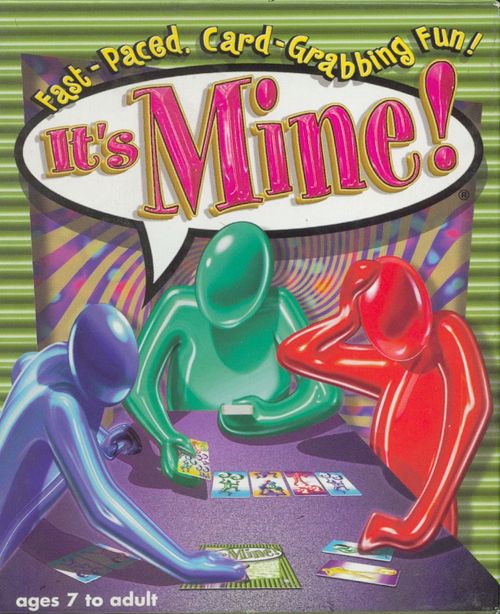
It's Mine! (Knizia)
It's Mine! (Knizia) Rulebook
Table of Contents
Table of Contents
How to Play
The dealer deals cards, one by one, face up onto the playing surface until another player slaps the "Slam Dunk" board and claims all of the cards dealt. This player collects all the cards dealt, keeps them in a separate face down stack and becomes the next dealer. When the deck is exhausted, each player counts up the combined value of all cards he/she claimed during the deal. The player with the most points wins the hand. NOTE: Rules for 2 player Slam Dunk on Page 3.
Object
To be the first player to win two hands of play.
Equipment
A "Slam Dunk" board and a special deck of 78 cards.
Set-up for 3 or More Players
Place the "Slam Dunk" board in the centre of the table so that each player can reach it easily. The oldest player becomes the first dealer. The dealer shuffles the entire deck and offers a cut to the player on the right.
Dealing the First Offer
The dealer holds the deck in his/her hand and turns over one card after another from the top of the deck, placing them in an ever-growing row on the table. These cards are the first "offer."
- The dealer may talk up the offer as it unfolds or remain silent. It's up to the dealer. When the dealer flips over each card, it should be flipped over fast so that everyone sees the card at the same time.
- All cards flipped over should be clearly visible on the table. If space runs out, the dealer starts another row.
Claiming the Offer
Any player, except the dealer, may claim the offer. The first player to slap the board and say "Slam Dunk" claims all the face up cards, including the card the dealer may be in the process of dealing - as long as the dealer has at least started to turn the card over. The claiming player now owns all of these cards. The cards claimed are called a "stack."
- Sometimes an offer is claimed after only 2 or 3 cards. Sometimes an offer may go unclaimed for many cards. It all depends on their value and the mood of the players!
- The claiming player takes all of the cards and places them face down in a stack in front of him/herself. The faces of these cards may not be looked at again until the end of the hand when they are totalled.
The Next Offer
The player who slapped the board becomes the new dealer. He/she picks up what's left of the deck and deals the next offer.
Stacks
Each offer claimed must be kept in a separate stack by its owner. After a player has claimed the maximum number of stacks (see below), that player cannot claim any more cards.
- When three people are playing, 4 stacks is the limit.
- When four or five people are playing, 3 stacks is the limit.
The first player to reach his/her limit becomes the dealer for the remainder of the hand.
The End of the Hand
- The hand ends when all but one player have reached their limit. This player takes all of the cards remaining in the deck (if any).
- Should the deck run out beforehand, the hand ends immediately.
- If two or more players remain when the deck expires and no one claims the last offer on the table, the offer is discarded and the hand ends.
2 Player Slam Dunk
To play "Slam Dunk" with 2 players you should sit opposite each other with the "Slam Dunk" card in between you. Deal out all the cards and then decide who will call. Upon the call each player draws a card from their own pile and lays it in front of his/herself. Play continues in this manner until one of the players decides that ALL of the cards that are face up are worth claiming. NOTE: When claiming an offer you pick up the cards you have laid as well as those your opponent has. Continue until all cards are claimed and score, as explained below.
Scoring
When the hand ends, each player combines all of his/her stacks and counts up the combined value of all his/her cards. Points with a minus sign in front of them are SUBTRACTED from the total.
- "Sure Thing" cards always score their face value. Each Sure Thing card pictures a character and a donut.
- "Double or Nothing" cards score only if a player has two of them. Each Double or Nothing card pictures a character and two donuts. For example, each pair of Double or Nothing "3" cards score 3 points. If a player has only one of them, it's worthless.
- "Toast or Most" cards are worth 10 points to the player who has more than any other player. For example, Player A has 5 Toast or Most cards, Player B has 4 Toast or Most cards and Player C has 2 Toast or Most cards. Player A scores 10 points. Players B and C score nothing for their Toast or Most cards. If there is a tie for the most Toast or Most cards, no player scores for Toast or Most cards. Note: it's 10 points for having the most Toast or Most cards, not 10 points for each Toast or Most card.
- "Jackpot" cards score depending on how many a player claims. Players can figure out how many points their Jackpot cards are worth by looking at them. Match the number of Jackpot cards claimed (the number on the blue square) with the points next to it (on the donut). The number on the scoring ball is the amount of points scored. Jackpot cards score from 0 to 40 points. For example, a player with four Jackpot cards scores 5 points.
- "Wild" cards are used to complete a Double or Nothing scoring combination where a player is short of a card. If a player can't complete a positive Double or Nothing he/she must use a Wild card to complete a minus Double or Nothing. A Wild card can not be used as a Sure Thing, Toast or Most, or Jackpot card.
Winning the Hand
The player who scores the most points wins the hand. In the event of a tie, each player involved scores a "win" for the hand.
The Next Hand
The player to the left of the last dealer becomes the new dealer, collects all the cards, shuffles them thoroughly, offers a cut and then deals the first offer of the next hand.
Winning the Game
The first player to win two hands wins the game! For a longer game, try playing until someone wins three (or more) hands.