It's a Pharaohs Life
It's a Pharaohs Life Rulebook
Table of Contents
Table of Contents
Time Period
The game begins around the Second Dynasty of the Archaic Period (2686 BC). You can use that date to start counting your pharaoh's years of reign, and record every event that takes place.
Components Needed
To play you will need:
- A couple of sheets of paper (or a word processor)
- A pencil or pen
- A six-sided die (d6)
- These instructions
Common Rules
It's a Pharaohs Life! uses two simple rules that let you determine the result of any action in the game.
-
Rule 1 (Against): Roll 1d6 and compare the result with the value the pharaoh has in the attribute you must test. If the die result is less than or equal to the attribute, the pharaoh succeeds in the attempt. If the die result is greater than the attribute, the pharaoh fails and must face the consequences.
Example: The pharaoh makes a "Dynasty" roll and has 4 points in Dynasty. He rolls 1d6 and gets 3. The die result is less than his attribute, so he succeeds in his "Dynasty" test.
-
Rule 2 (Double Against): This rule works like the previous one, except that you must test and succeed in 2 attributes instead of 1 to pass the test.
Example: The pharaoh must make a "Dynasty" roll and a "Holiness" roll. He has 4 points in both attributes. He rolls 1d6 for Dynasty and gets 3. The die result is less than his attribute, so he succeeds. Next he rolls 1d6 for Holiness and gets 4. The die result is equal to his attribute, so he succeeds. Since the pharaoh succeeded in both rolls, he passes the test.
Creating Your Pharaoh
Name: How can your pharaoh go down in history without a name? Your first step is to give a name to your king or queen. If you cannot think of one, you may look on the internet or in a history book.
Attributes: Your pharaoh has 4 attributes that determine his or her performance in certain situations. To determine each value, roll 1d6 and write down the results:
- Intelligence: Determines how brilliant your pharaoh is and how efficient he or she is at solving the kingdom's problems.
- Leadership: Determines how your pharaoh handles military problems, or how well he or she leads armies in combat.
- Holiness: Determines how close your pharaoh's relationship is with the gods.
- Dynasty: Determines how memorable your pharaoh's name will be in the future, and how strong and lasting the pharaoh's lineage will be.
Tomb: Death is an inevitable step in your pharaoh's life, so from the very beginning you need to plan his or her final resting place. Use the Location Table to find a site on which to build the tomb, and the Dimensions Table to find out how large it will be.
Playing a Game
A game of It's a Pharaohs Life! ends as soon as your pharaoh dies. But before reaching that tragic end, you must play through the years of his or her reign one by one. Each year lasts 1 turn. Throughout each year (or game turn), your pharaoh's actions influence Egypt and the territories around it. For how many years will your pharaoh remain in power? Start playing and find out!
Order of a Game Turn
- Roll 1d6 and find the result on the Event Table.
- Roll 1d6 and find the result on the Location Table.
- Roll 1d6 and find the result on the Decision Table.
- Resolve the event according to the common rule the decision asks for.
- Write the results on a sheet of paper (or in a word processor). If your pharaoh is still alive, begin a new turn (which represents one more year of his or her rule).
End of the Game
As soon as your pharaoh dies, roll 1d6 and find the number rolled on the Mummification Table. This tells what happened to your ruler's remains in modern times. Your game then ends. If you wish to start a new game, create a new pharaoh and go!
Tables I
Event Table
| Roll | Event |
|---|---|
| 1 | Nothing happens |
| 2 | Diplomacy |
| 3 | Dynasty |
| 4 | Population |
| 5 | Military |
| 6 | Economy |
Dimensions Table
| Roll | Dimensions |
|---|---|
| 1 | Tiny |
| 2 | Small |
| 3 | Average |
| 4 | Medium |
| 5 | Large |
| 6 | Gigantic |
Location Table
| Roll | Location |
|---|---|
| 1 | Abydos |
| 2 | Giza |
| 3 | Memphis |
| 4 | Thebes |
| 5 | Luxor |
| 6 | Karnak |
Mummification Table
| Roll | Result |
|---|---|
| 1 | The remains are never found, and are lost forever amid the desert sands. |
| 2 | Found between 1901 and 1950 and sent to a small museum of little importance, which closes a few years later for lack of funding. |
| 3 | Tomb robbers desecrate the tomb, steal its contents, and sell them to a private collector on the black market. |
| 4 | Found between 1920 and 1940 by a renowned Egyptologist and sent to the Cairo Museum, where it becomes part of the collection of Kings of the Old Kingdom. |
| 5 | Found thanks to costly advanced technology. Egypt's minister of culture declares the discovery national heritage, and in a solemn ceremony the remains are buried again. |
| 6 | The remains are moved from their place by vandals and then destroyed in the middle of a political or religious conflict. A group of archaeologists tries to save the surviving fragments, and from them a history is built that does not correspond to what actually happened. |
Tables II
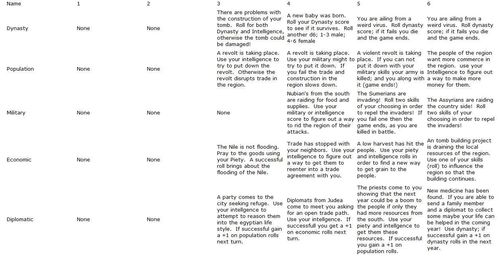
Decision Table
The table is read by Type (the event rolled on the Event Table) and by the die result of step 3 of the turn order (columns 1 to 6). Columns 1 and 2 read "Nothing happens" for every type.
Dynasty
- 1: Nothing happens.
- 2: Nothing happens.
- 3: There are problems with the construction of your tomb. Rule 2: Dynasty / Intelligence. Failure: Subtract 1 from the size of your tomb.
- 4: A baby is born! Rule 1: Dynasty. Failure: The baby dies. Everyone mourns. Success: The baby lives. Roll 1d6: 1 to 3 is a boy, 4 to 6 is a girl.
- 5: You fall ill from an infection of unknown origin. Rule 1: Dynasty. Failure: You suffer a slow and painful death because of your ailment.
- 6: Due to the high temperatures, an old wound you had becomes infected. Rule 1: Dynasty. Failure: The doctors cannot cure you. You die.
Population
- 1: Nothing happens.
- 2: Nothing happens.
- 3: A revolt takes place. Rule 1: Intelligence. Success: You calm the leaders and gain popularity among the citizens. Failure: A decrease in trade in the city.
- 4: A revolt takes place. Use your soldiers to pacify it. Rule 1: Leadership. Failure: A decrease in trade in the city. The works are suspended for a time.
- 5: A violent revolt takes place. Rule 1: Leadership. Success: You manage to pacify the population and send its leaders into exile. Failure: You die at the hands of a rebel group.
- 6: The people of the region ask you for more trade routes. Rule 1: Intelligence. Success: You manage to open new routes, increasing trade.
Military
- 1: Nothing happens.
- 2: Nothing happens.
- 3: Nothing happens.
- 4: A Nubian vanguard attacks the southern border settlements and steals food reserves. Rule 1: Intelligence or Leadership. Success: You stop the vanguard. Failure: Subtract 1 from the size of your tomb due to your low popularity.
- 5: The Sumerians invade your kingdom! Rule 2: You choose the two attributes to test. Success: You lead your army to victory. Failure: You die in the middle of a bloody battle.
- 6: A group within your army plans to betray you with the help of the high priest. Rule 2: You choose the two attributes to test. Success: You discover the traitors and execute them. Failure: You are murdered inside your palace.
Economy
- 1: Nothing happens.
- 2: Nothing happens.
- 3: The Nile does not rise this year. Rule 1: Holiness. Success: The gods bring rain. Failure: A great drought wipes out half the city's population.
- 4: Trade with your allies is suspended. Rule 1: Intelligence. Success: You restore trade relations. Failure: Your kingdom loses income, which prevents the construction of monuments for a time.
- 5: A plague of locusts destroys all of that year's crops. Rule 2: Holiness / Intelligence. Success: The gods destroy the plague. Failure: A third of your population dies from famine.
- 6: The construction project for the royal tomb demands higher taxes. Rule 1: Choose the attribute to test. Failure: The citizens vandalize the tomb entrance.
Diplomacy
- 1: Nothing happens.
- 2: Nothing happens.
- 3: A group of distant lands asks for asylum in your territory. Rule 1: Intelligence. Success: You receive new labour. Add +1 to the advantage of your next Population roll.
- 4: A diplomatic group from Judea comes to meet you to ask you for freedom of trade. Rule 1: Intelligence. Success: You obtain new income. Add +1 to the advantage of your next Economy roll.
- 5: The priests announce prosperity if you manage to expand your borders. Rule 2: Leadership / Dynasty. Success: You conquer new territories south of the Nile. Failure: Subtract 1 from the size of your tomb.
- 6: A new medicinal herb has been discovered in an allied kingdom. Rule 1: Dynasty. Success: Your chief physician manages to bring a sample to the kingdom.