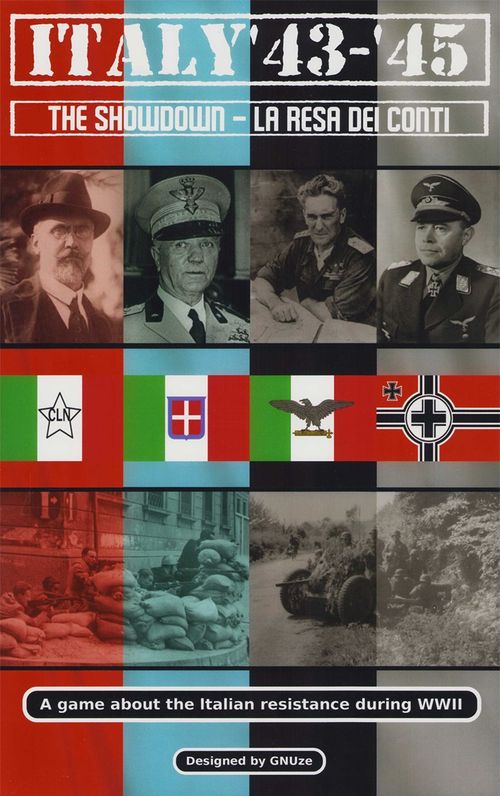
ITALY '43-'45: La Resa Dei Conti
ITALY '43-'45: La Resa Dei Conti Rulebook
Table of Contents
Table of Contents
2. Materials
The game includes:
- a map, representing the Italian peninsula, divided into areas
- cardboard disks to overlay the cities represented on the map
- tokens to indicate areas subject to sabotage
- tokens to indicate the loyalty of the population
- many wood pieces, representing the forces involved
- a deck of event cards, consisting of 96 event cards and 9 offensive cards
- four aid-sheets for the player bearing operations, special activities, the conditions of victory and the incomes of the four factions.
- a 6 faces die
2.1 Map
The map is divided into areas.
- City areas: are circles depicting the main urban and industrial areas of the Kingdom of Italy. They are overlapped by cardboard discs that indicate the population values (black background) and production (gray background), useful for the calculation of incomes and scores. The side of the city disks edged in red indicates values as a result of a bombing. In a corner of the population value is also indicated, in a red circle, the point value for the CLN faction. from south to north: Napoli (NA), Roma, Ancona (AN), Firenze (FI), Genova (GE), Torino (TO), Milano (MI), Venezia (VE), Trieste (TS).
- Countryside areas: regions with average production capacity and a small population. They are green coloured.
- Mountain areas: regions with no substantial production capacity, not particularly important from a strategic point of view, but characterized by a particularly difficult terrain. Used by brigades to hide. They are brown coloured.
- Logistic lines: Dotted lines connecting some areas of the map. The logistic lines are used by Germany to quickly move their pieces. In each area crossed by logistic lines it appears a circle useful to accommodate a possible marker sabotage. Logistic lines are considered interrupted also by a city controlled by the Autonomous faction.
- Special areas: these are areas not directly usable by players, which represent important regions for some game mechanics and the resolution of some event cards. They are:
- Regno del Sud (RdS) - the southern Italian area that was historically controlled indirectly by the king of Italy.
- Etat Française - also called Regime de Vichy, a satellite state occupied by the Third Reich troops.
- Switzerland - neutral, independent.
- Nezavisna Država Hrvatska (NDH) - independent state of Croatia, a satellite state occupied by the Third Reich troops.
- Großdeutsches Reich - directly controlled by German forces, considered German national territory.
- Bozen - city controlled directly by the Third Reich, in the game is the seat of recruitment for the player who controls the German forces.
- five boxes called reserves in which to place the pieces not in play: one for each game faction, plus one for the Anglo-American troops.
2.2 City Disks
Eight disks to overlay the cities on map used to take track of the population (black square), production values (grey square) and points for CLN faction (the small red circle with stars). The discs are double-sided: one side for the city intact (black border), the other for the damaged city (red border).
2.3 Sabotage Tokens
These are used to indicate the places where the logistical lines are interrupted as a result of sabotage. They can be removed by German troops through the German special activity Repairs or through civic action for both the Axis factions. During the score calculation, the CLN faction gets a point for each sabotage token in play.
2.4 Loyalty Tokens (Collaborationism / Resistance)
These are double-sided tokens, one side shows the RSI fasces, the other the CLN star. During the game, the areas (countryside, mountains, cities) are marked with these tokens to indicate the loyalty of the population against the forces in the field:
- Collaborationism: the population supports the RSI troops, black side
- Neutral: no token
- Resistance: the population supports the brigades of the CLN, red side
The Collaborationist areas force the brigades that enter in them to make themselves visible, exposing to possible attacks.
The Resistance areas favor the CLN player in numerous ways: they allow to hide the brigades that enter, act as recruiting centers, modify the score and the income: during the Offensive phase some of these tiles will be placed in the reserve of the CLN player and will represent additional points.
2.5 Wooden pieces
The box contains:
- 25 green cubes, for the Anglo-American troops
- 20 gray cubes, for the German troops
- 15 black cubes, for RSI troops
- 10 blue cubes, representing the Autonomous Troops who met with the Anglo-American troops beyond the front line, identified historically as a co-belligerent forces.
- 10 blue octagons, representing partisan Brigades of the Autonomous faction.
- 4 blue discs, representing the Bases of the Autonomous faction. The bases favor the Autonomous player: they guarantee an income, are recruiting centers, modify the score and can be used to hide the brigades and obtain resources.
- 15 red octagons, representing partisan Brigades of the CLN faction. Octagons have one side engraved with a symbol: when they are on the map with the symbol on the top, they must be considered visible, then they could be attacked by the Axis factions, vice versa, as long as the symbol is not visible, the brigades are considered hidden and therefore unassailable. If an event indicates to place a brigade in an area, place it hidden, unless the area is at Collaborationism.
- 8 cylinders, two for each faction, used to indicate eligibility and available resources. Two green cylinders: one to determine the priority of the reinforcements along the front line, called reinforcements pawn, one to follow the steps of the Offensive phase (offensive pawn).
2.6 Cards
There are 9 Offensive cards and 96 cards Event.
Event cards are used to identify reinforcements and bombings, determine the order of play of the factions and allow players any action Event. (6.1 Event card) Every game uses only a portion, about half of those available.
The Offensive cards are placed within the playing deck and interrupt the regular flow to activate the offensive phase during which the Anglo-American troops will attempt to overcome the defending axis pieces (6.2 Offensive card).
3. Set-up
- Overlay the nine cities with their corresponding disks
- Place the initial forces and loyalty tokens as indicated on the game map.
- Place the excess loyalty tokens on the side of the board, together with sabotage tokens.
- Place the reinforcements pawn in the Regno del Sud area, place the offensive pawn on top place on his track. -
- Place a cylinder for each faction in the Eligible space.
- Place the four remaining cylinders on the resource track, in the indicated spaces
- Select randomly 40 Event cards, shuffle them and break them down into five covered piles of eight cards. At the end of each pile put an Offensive card randomly choosen. Take one of these pile and mix it, so that it is not determinable when the Offensive card contained in it will appear. Build a single deck by placing the shuffled pile below the other four, obtaining a single deck of 45 cards. Place the entire deck on the side of the playing area and show the top card (current event).
4. Glossary
Liberated areas: all areas located south of the Anglo-American troops or with Anglo-American troops in it. They can no longer be the object of special operations or activities (exception: counteroffensive).
Front: all areas immediately adjacent to the liberated areas but still available to players.
Control of an area: a faction controls an area when it have the absolute majority of pieces in it. For the purposes of the game, an area can still be controlled by the joint factions of axis (Germany and RSI) or rebels (CLN and Autonomous). A city controlled by the Autonomous faction interrupt logistic lines.
Moving the loyalty: remove a Collaborationism/Resistance marker or add it in the affected area to indicate the new value. The values are considered in the sequence:
Resistance <-> Neutral <-> Collaborationism
es: an area at Collaborationism, when shifted towards Resistance, will become Neutral (remove the loyalty token), while a Neutral area, if shifted towards Resistance, move to Resistance. and needs a Resistance token
Coll. / Res.: abbreviations used in the event cards to indicate, respectively, Collaborationism and Resistance values.
Mountain Areas: brown areas on the map.
Countryside Areas: green areas on the map.
5. Objective of the game
From the second Offensive card, during the score step (6.2 Offensive) if any faction has reached at least 15 points, the game ends. In the case where more factions simultaneously reach the 15 points, the tie is resolved according to this order: CLN, Autonomous, RSI, Germany.
6. Game Flow
A game turn starts when the top card is turned visible from the top of the draw pile.
6.1 Event card
If the card is a Event card:
6.1.1 - Look at the upper left area of the card; there could be different symbols:
- One or more green infantry icons (marine): add, taking them from the reserve, a number of Anglo-American troops in the area indicated by the reinforcements pawn. If there are not enough Anglo-American troops available in the reserve, add all available ones. The Autonomous player must then move the pawn in an adjacent liberated area.
- One blue infantry blue (Royal Army): add, taking from the reserve, a troop of the Autonomous faction in the area indicated by the reinforcements pawn. If there is no Autonomous troops available in the reserve, the icon has no effect. The Autonomous player must then move the pawn in an adjacent liberated area.
- Air bombing (Stukas): the player who controls the German faction removes an Anglo-American troops at his choice, placing it in its reserve. If there are no more Anglo-American troops in the game he can remove an Autonomous troop, placing it in the relative reserve.
- Bomb (indicates the cities involved): place the city-disk indicated in its city, facing the bombarded side (red border). Fix the city loyalty to neutral.
6.1.2 - Using the icon sequence shown at the top of the card determine the active player. Starting from the left, the first faction whose cylinder is located in the eligible position has the right to play or pass. If the player chooses to pass, he will remain eligible for the next card and he receive a number of resource points according to the table below:
| Faction | Resource Points Obtained through the turn |
|---|---|
| RSI | 2 |
| CLN | 1 |
| Autonomous | 1 |
| Germany | 3 |
6.1.3 - If the player chooses to play the current round he will select one of the following options:
- Play one of the events listed on the card.
- Perform an operation in one or more areas, without combine it with a special activity. The sequence of operation must be carried out entirely before proceeding to the next area.
- Perform an operation in one or more areas, combining it with a special activity. The special activity may be carried out before, after or during the operations: it is therefore possible to end an operation, perform the special activity and resume following the operation. The sequence of operation must be carried out entirely before proceeding to the next area. The special activity should be carried out entirely before proceeding with any further operations.
6.1.4 - When the turn is over, the player indicates his choice by placing the cylinder of his faction in the space within the eligibility area corresponding to the choice he had made.
6.1.5 - If, once the player's turn is over, there are still Eligible factions, the turn passes to the next faction indicated on the card. Again, the new player can choose to pass obtaining the resources indicated in the table above, or to play the round, in which case its options depend on the choice made by the previous player:
| Action performed by the first player | Possible actions for the second player |
|---|---|
| Event | Operation + special activity |
| Operation in one or more areas | Operation limited to one area (Limited Operation) |
| Operation + special activity | Event or Operation limited to only one area (Limited Operation) |
After her turn, the player indicates her choice by placing the cylinder of her faction in the corresponding space inside the eligibility area.
6.1.6 - In the event that two players have performed their turn without passing, or there are no more eligible factions in the sequence on the card, the turn is over - take the cylinders placed in the area marked NOT eligible and put them in the Eligible area. Now put the cylinders used in this turn in the NOT eligible area.
Turn the next card.
6.2 Offensive Card
If the card is an Offensive Card:
It shows some arrows indicating the Offensive power (one, two or three arrows).
6.2.1 Offensive
Proceed with the following sequence:
- A. Assault: For each area containing Anglo-American units, starting from the south-west, the Anglo-American units are distributed in the adjacent non-liberated-areas in clockwise order. Independent units are distributed at will by the Autonomous player, but she could not leave the cities placed south of the front undefended as long as there are Aut. troops to garrison.
- B. Battles: For each area on the front, starting from the north-east where there are Anglo-American pieces and / Autonomous troops (and any brigades) and Axis pieces the battle procedure is activated:
- Anglo-Americans attack value = number of Anglo-Americans cubes and Autonomous cubes + number of brigades
- Axis attack value = number of axis cubes + 2 if in a city area + 1 if in a mountain area
- C. Losses: the difference of the two attack values corresponds to the number of units that the loser will have to remove. Half of this value (rounded up) corresponds to the number of losses incurred by the winner. In case of a tie both sides lose one unit and the Anglo-American faction is considered the loser.
- Losses priority: To inflict losses to the Anglo-American faction follow the sequence: CLN brigade, Anglo-American troop, Autonomous piece (troop or brigade). If necessary, repeat the sequence until inflict expected losses.
- To inflict losses to the axis faction following the sequence: RSI troop, German troop. If necessary, repeat the sequence until inflict expected losses.
- D. Withdrawn: The loser (in case of a draw the Anglo-American) must also withdraw his pieces in an adjacent area not controlled by enemy troops. The repositioning of the Axis troops is set by the German player, the Autonomous player retire the Anglo-American units. An area controlled by brigades does not prevent the retreat of the Axis troops. The Anglo-American troops and Autonomous must always withdraw to an adjacent liberated area.
- E. Pockets: if, as a result of retreat, there is an area occupied by the axis troops surrounded only by liberated areas, the axis units contained therein are placed in the reserve and the area is considered liberated.
- F. Repeat the sequence from point A a number of times equal to the Offensive power (the number of arrows on the card).
All the resistance tokens that are now in liberated areas are awarded to the CLN player, which places them in his reserve.
All CLN brigades that are now in a liberated areas are eliminated and the CLN faction receive 1 resource for every brigade so eliminated.
All autonomous brigades, that are now in a liberated area are replaced with Autonomous troops (cubes).
All Autonomous bases that are now in a liberated area are eliminated and worth two resources to the Aut. player.
The Autonomous player then redistributes evenly the Anglo-American troops along the front line, placing at least an autonomous troop in cities south of the front, then he places the reinforcements pawn in a liberated area of his choice.
6.2.2 Victory Control
Each faction calculates his/her points based on the following table:
| Faction | Score |
|---|---|
| Germany | Production of the cities controlled by the axis excluding the cities at collaborationism without German presence + Offensive number of cards in the discard pile (0-4) |
| RSI | Population of collaborationist cities + Offensive number of cards in the discard pile (0-4) |
| Autonomous | Number of cubes of the Autonomous faction in play + production of the city controlled by the Autonomous faction + number of bases in non-mountain areas + Offensive number of cards yet to be revealed (4-0) |
| CLN | Number of areas at resistance (1 point for each non-city area, 2/3 points for each city) + loyalty tokens in reserve + number of active sabotage + Offensive number of cards yet to be revealed (4-0) |
If, after the second offensive card, any faction reached 15 points, the game ends immediately. In the case when more factions simultaneously reach the 15 points, the possible tie is resolved according to this order: CLN, Autonomous, RSI, Germany.
If, at the end of the fifth offensive, no faction had won, the game still end and the faction with the most points will be the winner (fix any draws as above).
6.2.3 Incomes
Each faction adds an amount of resources based on the following table:
| Faction | Income |
|---|---|
| Germany | Productions of the cities controlled by axis |
| RSI | Sum of Productions in collaborationist cities divided by two (round up). Subtract the resources from Germany faction. |
| Autonomous | Number of bases in play + number of cities controlled by the Autonomous faction (including the liberated ones with an Autonomous cube in it) |
| CLN | Number of areas with a resistance token and a CLN brigade |
6.2.4 Civic Actions
In order of the table below, each faction can spend resources to perform one or more civic actions:
| Faction | Civic Action |
|---|---|
| Germany | Repair: In one or more axis controlled areas with German troops, remove a sabotage token or turn the city disk to the black bordered side. Pay two resources for area. |
| RSI | Repairs: In one or more axis controlled areas with RSI presence, remove a sabotage token or turn the citydisk to the black bordered side. Pay two resources for area. Move loyalty towards Collaborationism. Propaganda: In one or more non-city areas with RSI presence, at the cost of a resource per area, move loyalty towards collaborationism. In one or more city areas controlled by axis with RSI PRESENCE, at a cost of two resources per city, move loyalty toward collaborationism. |
| CLN | Revolt: In one or more areas with at least a hidden CLN brigade, move loyalty toward resistance at the cost of one resource per area. Do NOT flip any Brigade. |
| Autonomous | Liberation: In one or more areas with Autonomous control, fix loyalty to neutral and, optionally, at the cost of a resource, replace an Autonomous Brigade with a base. It is never possible to put a second base in the same area. Do NOT flip any brigade. |
Turn the next card.
7. Operations
7.1 RSI
- Conscription (Related activity: Police): In one or more cities controlled by the axis, for each resource spent, put a RSI troop. If the city is collaborationist, you can recruit more troops, spending a resource per troop but you can never recruit more troops than the city's production.
- Propaganda (Related activity: Seizure, Police): In one or more non-city areas with RSI presence, at the cost of a resource per area, move loyalty toward collaborationism. In one or more city areas with RSI CONTROL, at a cost of two resources per city, move loyalty toward collaborationism.
- Mobilize (related activity: Seizure): In one or more areas with RSI troops move troops to an adjacent area. At the end of the movement, if there are Brigades in the arrival areas, make visible a number of hidden brigades equal to the number of Axis troops in the area (including German troops). It is possible to move troops in place in order to reveal the Brigades in the area. This operation costs a resource for each destination area, no matter how many source areas are chosen.
- Assault (Related activity: Punitive Expedition): In one or more areas with RSI presence, for each resource spent, eliminate a number of pieces (visible brigades, resistance token, autonomous base) equal to the number of Axis troops (including German troops) in the area. A base can be eliminated only if it is the last piece of Autonomous faction. The resistance token can be removed only if there are no more CLN brigades in the area. Gain one resource for every Resistance token so eliminated.
7.2 Germany
- Reinforce (Related activity: Convoys, Repairs): Place a number of troops from the reserve in Bozen equal to the number of resources spent. Then, in a city with German control and seamlessly connected to Bozen through the logistics lines, move the loyalty toward Resistance and receive a number of resources equal to the city production.
- Retaliate (related activity: Repairs, Counteroffensive): In one or more areas with German presence, at the cost of a resource for area, make visible and move in an adjacent area a number of brigades equal to the cubes present, then fix loyalty to neutral. Brigades are moved by the german player, remaining visible.
- Deploy (related activity: Convoys): Move all or part of the pieces present in an area in one or more adjacent areas.
7.2.1 Mobility of German troops
If you move into a city area, or in a countryside area (not mountain), you can move the same troops in an additional adjacent area. In this way the German troops may move up to two areas away.
At the end of the movement, if there are Brigades in the arrival area, making visible a number of hidden brigades equal to the number of axis cubes (including RSI) present in the area. It is possible to move troops in place, in order to reveal the Brigades. This operation costs a resource for each destination area, no matter how many source areas.
- Attack (Related activities: Counteroffensive): In one or more areas with German presence, pay a resource and reveal one brigade, then eliminate a number of Visible brigades and bases equal to the number of Axis troops present (including RSI). A base can be eliminated only if it is the last piece of the Autonomous faction in the area.
7.3 CLN
- Enlist (Related activity: Clandestinity): In one or more areas at Resistance and not controlled by axis forces, put a CLN Brigade hidden. You can not make more than one Enlist in every area. It costs one resource per brigade.
- Revolt (related activity: Clandestinity): In one or more areas with at least a hidden CLN brigade, MAKE VISIBLE one CLN brigade and move loyalty toward resistance at the cost of one resource per area.
- Move (related activity: Expropriation, Clandestinity): Move a brigade to an adjacent area. The action does not cost. If the movement ends in an area at resistance or in a mountain area, hide the brigade. If the movement ends in an area at collaborationism, make the brigade visible. A brigade can not move more than once per turn.
- Shooting (related activity: Sabotage, Expropriation): In one or more areas with the presence of at least one hidden CLN Brigade, make visible one or two brigades and eliminate the same number of troops (RSI to priority). The operation costs a resource per every brigade made visible.
7.4 Autonomous
- Gathering (Related activity: Confiscation): In one or more cities controlled by the Autonomous faction and in one or more Autonomous controlled areas with a base, spend a resource to put an Autonomous hidden Brigade. Additionally in an area (and only one) with a base, you may replace the base with a brigade at no cost. Always place brigades visible if area is at Collaborationism.
- Liberation (related activity: Forced March): In one or more areas with Autonomous control, fix loyalty to neutral and MAKE VISIBLE all the brigades. In addition, at the cost of a resource, you may replace an Autonomous Brigade in the area with a base. It is never possible to put a second base in the same area.
- March (related activity: Forced March, Confiscation): In one or more areas with Autonomous presence, at the cost of one resource, move to one or more adjacent areas all or part of the Autonomous brigades. You can specify multiple destinations, without any additional costs. If the arrival area is mountainous or contains a base, the moved Brigades become hidden. However, if the arrival area is at Collaborationism, make visible the brigades.
- Clash (related activity: Ambush): In one or more areas, for each resource spent, make visible all brigades. Then throw a die: if the result is equal to or less than the number of Brigades present (including any CLN Brigades) eliminate up to two axis troops, giving priority to the RSI troops. It is not possible to eliminate more troops than the number of brigades in the area.
8. Special Activities
8.1 RSI
- Police (Associated Operation: Conscription, Propaganda): In one or more cities, at the cost of one resource per city, make visible in the city and in all adjacent areas a total number of brigades equal the total number of cubes (including German troops) in the city and adjacent areas.
- Seizure (Associated Operation: Propaganda, Mobilize): In a city (and only one) with RSI control and Collaborationism, receive resources equal to the production of the city.
- Punitive Expedition (Associated Operation: Assault): In a single city, at the cost of one resource, move up to all RSI troops to different adjacent spaces.
8.2 Germany
- Convoys (Associated Operation: Reinforce, Deploy): Starting in an area with logistic lines, for the cost of two resources, trace a path of cities and areas containing logistic lines without sabotage tokens or bombed cities. Autonomous controlled cities also interrupt logistic lines. The arrival area can contain a sabotage marker or be a bombed city (or an autonomous controlled city), but the path must stops there. Then move the German troops present in the starting area along the way. It is possible to drop and pick up troops in all areas along the route, continuing movement. It is not possible to trace a route that passes through the same area twice. If there are Brigades in the arrival area, make visible a number of hidden brigades equal to the number of axis cubes (including RSI) in the area.
- Repairs (Associated Operation: Reinforce, Retaliate): In one or more axis controlled areas with German troops, remove a sabotage token or turn the city disk to the black bordered side. Pay two resources for area.
- Counteroffensive (Associated Operation: Attack, Retaliate): At the cost of four resources, eliminate an American troop on the front.
8.3 CLN
- Expropriation (Associated Operation: Shooting, Move): In one or more areas with CLN presence, eliminate a brigade to receive 2 resources or, if the area is at resistance, fix it to neutral to receive 2 resources.
- Sabotage (Associated Operation: Shooting): In one or more Resistance areas with hidden CLN Brigades, at the cost of one resource, place a sabotage tile or turn the city disk on the red side, move towards Collaborationism and make a brigade visible. Then subtract 2 resources from one axis faction.
- Clandestinity (Associated Operation: Enlist, Revolt, Move): At the cost of one resource, in an area (and only one) make all the CLN brigades hidden.
8.4 Autonomous
- Confiscation (Associated Operation: Gathering, March): In cities with Autonomous control and hidden brigades, receive a number of resources equal to the number of Autonomous brigades turn to visible. It is not possible to receive more resources than the production capacity of the city. In one or more areas with a base and autonomous control, make a brigade visible to receive a resource.
- Forced March (Associated Operation: March, Liberation): In an area (and only one), allow all brigades present to move further, at no cost. It is also possible to perform a forced march movement by coupling it with the Liberation operation. If the arrival area is mountainous or contains a base, the moved Brigades become hidden. However, if the arrival area is at Collaborationism, make visible the brigades.
- Ambush (Associated Operation: Clash): In an area (and only one) with at least one hidden Aut. brigade and selected for a Clash Operation, eliminate one troop (RSI priority), regardless of the die roll of the Clash operation. This Activity must always be performed before the die is rolled.
9.0 Optional Rules
9.1 Visible Cards
The next event card in the deck is always kept visible: in this way it will be easier for the players to choose whether to play immediately or pass to take advantage of the next event card. This variant allows a better planned game but risks dilating gametime.
9.2 Alternative Set-up
For greater variety, each player sets up his own starting situation, in order:
- Anglo-Americans: 1 autonomous troop in the Southern Kingdom with 12 Anglo-American troops
- Ger: 2 armies on the front, 3 armies in 3 different cities, 20 resources
- RSI: 3 Collaborationist tokens to be placed in countryside areas, 3 Collaborationist tokens to be placed in cities, 4 RSI troops in four areas of choice, 8 resources
- CLN: 4 brigades to be placed hidden in mountain areas or in NDH, 4 Resistance tokens to be placed in the mountains, 4 resources
- Autonomous: 4 brigades to be placed hidden in countryside areas or in France, 8 resources
9.3 Game deck
For a longer game: During setup, compose the 5 card piles each with 10 randomly event cards and one offensive card at the bottom. Shuffle separately 4 of the 5 piles, stack them and putting the unshuffled pile on top.