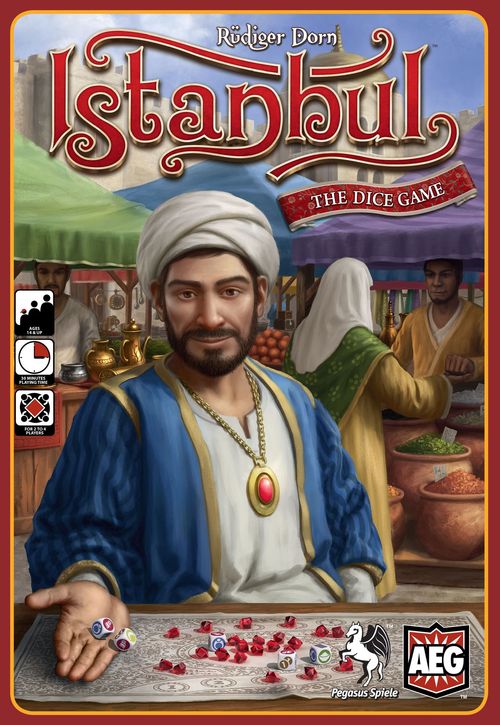
Istanbul: The Dice Game
Istanbul: The Dice Game Rulebook
Table of Contents
Table of Contents
Components
- 1x Game Board
- 42x Goods Markers (8 each in green, yellow, red, blue, and 10 in brown)
- 36x Coins (3x10, 6x5, 27x1 Lira)
- 9x Dice "Assistants"
- 33x Bazaar Cards
- 24x Mosque Tiles
- 31x Rubies
- 12x Crystals
- 4x Action Summary Aids
Overview and Goal of the Game
You are a trader in the Istanbul bazaar with the goal of being the first to acquire 6 rubies (in a 4-player game: 5 rubies).
You will need money and goods to purchase rubies and for those you must depend on your assistants, who are represented by the dice. The 6 icons on these dice indicate what your assistants can procure for you: Bazaar Cards, Lira, and 4 types of goods: cloth (red), fruit (yellow), spices (green), and jewelry (blue).
Each turn you will send out your 5 assistants by rolling 5 dice. With the resulting icons and your previously stored Goods Markers, you can then carry out 2 actions such as collecting and storing resources (goods, coins, and crystals) or acquiring Bazaar Cards or Mosque Tiles to provide additional benefits.
Game Setup
- Place the game board in the center of the table with the side face-up corresponding to the number of players (2–3 players or 4 players).
- Place rubies in all of the circular fields marked with a red dot in the various ruby trade areas on the game board. Don't use the circular fields with this mark in a 2-player game. Return any remaining rubies back to the box, as they will not be used.
- Shuffle the Mosque Tiles face-down, reveal 6 of them as a display, and place the rest as a face-down stack.
- Shuffle the Bazaar Cards and place them face-down as a draw deck.
- Place the Dice, Coins, Goods Markers, and Crystals ready near the game board.
- Give each player 1 Action Summary Aid and 1 Crystal.
- Choose a start player and give them 5 Dice and no Coins. In clockwise order from the start player each player receives 1 Coin more than the player to his right.
Sequence of Play
Each round players take their turns in clockwise order beginning with the start player.
The game ends at the end of the round in which a player has collected a total of at least 6 rubies (in a 4-player game: 5 rubies).
Turn Summary
- Take income from your Mosque Tiles (if applicable). Depending on the Mosque Tile this could be 3 Lira, 1 Crystal, or 1 Bazaar Card. (See the details on the Mosque Tiles below.)
- Roll the Dice. Normally players roll 5 dice, although Mosque Tiles may add additional dice. In this phase you may discard 1 Crystal to reroll as many dice as you want. You may discard Crystals as many times as you like to reroll again.
- Carry Out Actions. Normally players can carry out 2 actions, although Mosque Tiles may add additional actions. All available actions are explained in the next section.
- Pass the 5 Dice to the next player clockwise.
Actions
Use the face-up dice icons, your Goods Markers, and your Coins to carry out your actions.
The following general rules apply:
- You can only use each die once per turn for 1 action.
- You may discard Goods Markers to use them as dice icons of their respective color.
- A brown Goods Marker is considered "wild" and can be discarded to be used for any color.
- You can carry out the same action multiple times in the same turn.
- You must complete an action before you can start another.
- If you want to take Goods Markers, Crystals, or Lira and there are not enough in the general supply, then each player who owns at least 1 resource of the type required must discard 1 resource of this type back to the general supply (repeat if necessary). Then you may take your resources.
The Action Summary Player Aid gives an overview of all possible actions.
In General:
- On the left side is what you must discard in order to receive what is on the right of the arrow.
- On the left side you usually need the indicated dice icons, with the striped icons indicating any of the 4 types of goods. Different letters stand for different types of goods.
NOTE: When talking about "goods", you can always use the commodity icons on the dice as well as your Goods Markers.
The following actions are available
Discard 2 identical goods: Take 1 Goods Marker of that same color.
Discard 2 different goods: Take 1 Crystal.
Discard 3 different goods: Take 1 brown Goods Marker.
Discard 4 different goods: Take 2 Goods Markers of your choice (non-brown).
Discard all coin icons rolled: Take 2 Lira for each.
Discard as many card icons as you like: Reveal 1 Bazaar Card from the draw deck for each card icon discarded (see the Bazaar Cards section for details). Select and use 1 Bazaar Card and then discard all of the revealed Bazaar Cards to the discard pile. If the Bazaar Card draw deck is exhausted, shuffle the discard pile and create a new draw deck.
Take 1 face-up Mosque Tile from the display. Discard goods equal to those shown on the top of the tile.
Refill the display by drawing and revealing a new Mosque Tile from the top of the draw pile.
Important: If you now have exactly 5 Mosque Tiles (in a 4-player game: 4 Mosque Tiles) immediately, and one time only, take 1 Ruby from the Mosque area on the game board.
Discard the required number and type of goods, depending on the Ruby trade areas of the game board: Take 1 Ruby from that area.
Ruby trade areas for the 4 types of Goods: The open field next to the ruby shows the required number of goods of that type.
Example: For the next ruby you must discard 5 green goods.
Ruby trade area on the left-side carpet: Discard all goods shown on the carpet that are not covered by a ruby.
Example: For the next ruby you must discard 1 of each type of good plus any 2 goods of your choice.
Ruby trade area on the right-side carpet: The open field next to the ruby shows the required number of Lira you must discard.
Example: For the next ruby you must discard 14 Lira.
Game End
As soon as any player has collected at least 6 rubies (in a 4-player game: 5 rubies), complete the current round so that each player has taken an equal number of turns and then end the game.
The player with the most rubies wins!
If there is a tie for the most rubies, the tied players sell their Goods Markers for 3 Lira each and their Crystals for 2 Lira each and add those Coins to their saved Lira. The tied player with the most Lira wins. If there is still a tie, the tied players with the most Lira share the victory.
Mosque Tiles
Mosque Tiles offer a lasting advantage until the end of the game. You may have more than one Mosque Tile of the same type.
When you acquire a Mosque Tile you may not use its ability until the beginning of your next turn.
- 3 Lira tile: Take 3 Lira at the beginning of your turn.
- Crystal tile: Take 1 Crystal at the beginning of your turn.
- Bazaar Card tile: Reveal 1 Bazaar Card at the beginning of your turn, carry out the action, then discard it.
- Additional action tile: You may carry out 1 additional action on your turn.
- Goods Marker tile: When you carry out the action "Take Lira", take 1 Goods Marker of the color shown.
- Extra die tile: Take 1 Die when you acquire this tile. Beginning with your next turn, add this die to your roll each turn.
Bazaar Cards
General Rules
- Green figure icon: Areas with this icon apply only to the current player.
- Blue figures icon: Areas with this icon provide an additional action that only applies to players who are not currently taking their turn. For cards that show both a green figure and a blue figures area, both actions are applied.
- Red arrow: One time only, discard the resources before the red arrow to take the resources after it.
- White/grey arrow: You must possess (not discard) the resources depicted before the arrow to take the resources displayed after it, one time only.
- Slash with 1 Lira: If you cannot or do not want to fulfill the condition on the upper region of this card you may take 1 Lira instead.
- Mosque Tile icon: Before a red arrow: Discard one of your Mosque Tiles. After a red arrow: Take 1 of the face-up Mosque Tiles from the display.
The Cards
Lira cards (4 Lira / 1 Lira with a resource shown):
- Current player: Take 4 Lira.
- Other players: If you discard the depicted resource: Take 3 or 4 Lira (as shown).
Brown Goods Marker cards:
- Current player: Take 1 brown Goods Marker.
- Other players: Take 1 depicted Goods Marker.
Goods Marker cards (2 Lira):
- Current player: Take the depicted Goods Marker.
- Other players: If you discard 2 Lira: Take 1 depicted Goods Marker.
Resource-and-Lira cards:
- Current player: Take 1 depicted resource and 3 Lira.
- Other players: Take 1 depicted resource or 3 Lira.
Ruby cards:
- If you discard the depicted resources: Take the next ruby from one of the ruby trade areas on the game board (except the Mosque area).
- Otherwise: Take 1 Lira.
Card-icon cards:
- If you have used at least 2 dice with card icons for the current action: Take the depicted resource.
- Otherwise: Take 1 Lira.
Note: If you reveal 1 of these cards as a bonus card at the beginning of your turn, you cannot fulfill the conditions and therefore you can only take 1 Lira.
Brown Goods Marker requirement cards:
- If you possess the number of brown Goods Markers depicted: Take the depicted resources.
- Otherwise: Take 1 Lira.
Exchange cards:
- If you discard the resources shown before the red arrow: Take the resources indicated after the arrow.
- Otherwise: Take 1 Lira.