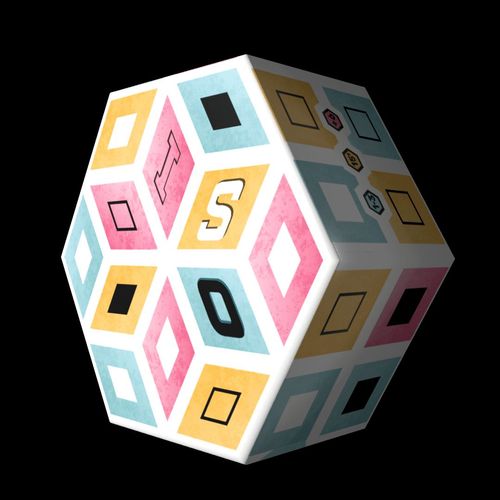
ISO
ISO Rulebook
Table of Contents
Table of Contents
Components
18 hexagonal tiles.
Each tile has 2 faces: BLOCK (front) and OBJECTIVE (back).
Block (front)
These faces resemble cubes from an isometric perspective. The three faces of the cube will have different wall colors and 3 different indicators.
Wall colors: pink, yellow, blue.
Indicators: black, white, void.
Objective (back)
These faces contain objectives to be completed in order to win.
Each objective shows:
- Stars (1 - 5)
- The objective figure
- A reference number
About This Rulebook (1-3 / 15 min / 10+)
In the following pages, the rules for the competitive 2 and 3 player games are explained. If you already know these rules, you may go straight to the "alternative game modes" section to see other ways to play ISO.
Game Preparation
- Flip all the tiles so that they show their BLOCK face.
- Each player chooses one of the identifiers (black, white or void). The chosen identifier will be your identity in the game.
- Shuffle the tiles and form a pile.
- Reveal 3 objectives, taking, flipping and placing the first 3 tiles from the pile as shown below.
[Diagram: the pile is placed above three revealed objective tiles, labeled OBJECTIVES.]
- Randomly determine the first player. The turn order will be followed clockwise.
How to Play
Each turn has 3 different phases:
- Play an available tile.
- Check if you have completed any of the available objectives.
- Replenish and end of turn.
Play a Tile
Choose and play one of the 3 available tiles showing their BLOCK side.
When playing a tile, it must be placed next to one or more tiles from the play area (except for the first player's first tile played).
You may rotate the tile as much as you want before placing it but you may not flip it or place it covering other tiles fully or partially.
[Diagram: a valid placement (checkmark) and an invalid placement (cross).]
Complete Objectives
After placing a tile during your turn, check if, using the tile you have just placed, you complete any one or many objectives available in any of the three perspectives. If so, take the objective tiles and place them near you.
Remember this golden rule: you may only complete an objective with the tile you just placed. If an objective is completed without you placing that tile, said objective cannot be claimed.
And remember that all perspectives matter but each objective is completed in only one perspective!
[Diagrams: examples A, B and C of objectives completed with the tile just placed.]
End of Turn and Refill
After checking for completed objectives, the turn will go to the player on your left (clockwise) but first make sure you replenish the tiles in the following order:
- If no objective has been completed in this turn, keep playing. The turn will go to the player on your left.
- If one or more objectives have been completed this turn and there is more than one tile on the pile, reveal a new objective and fill the empty space.
End of the Game
The game will finish at the end of the turn where there are no more tiles available to be placed showing their BLOCK side. Any remaining objectives not completed will be disregarded.
Add the points of your completed objectives: 1 point for each star.
The player with the most points wins! In case of a tie, the player with the most amount of completed objectives wins. If the tie remains, the player holding the objective with the higher reference number wins.
Alternative Game Modes
Solo & Coop Mode
Solitary and cooperative modes have the same rules as the competitive mode, but in this case the completed objectives will be shared and the final scoring is to be compared against the following table:
- 0-5: Escher's Disgrace...
- 6-12: Good, just good.
- 13-19: Well, not too bad!
- 20-26: Escher would be proud!
- 26+: You transcend into a superior plane. You are the 4th dimension.
Area Control Mode
Separate the tiles numbered 10-13 and setup the game following the usual rules, but only use the reserved tiles for scoring.
You will play following the rules described on this manual, but you will not score any objectives until the game is over.
Annex / Objectives
Figure (blue background objective, 1 to 2 points)
Complete the figure shown in any of the 3 perspectives. The white walls of the objective tile demand the same color, this is why all walls have to be of the same color regardless of their indicator.
[Diagrams: the blue objective tile and examples A, B and C.]
Area (yellow background objective, 2 to 3 points)
Control one 3 or more / 5 or more group of walls with the color shown on the objective tile in any of the 3 perspectives. For them to be considered a group, the walls have to be united orthogonally. To control a group you need more indicators than each other player (in 2 players games, you also need to overcome the third indicator even when it does not represent anybody).
[Diagrams: the yellow objective tile and examples A, B and C.]
Conditioned Figure (pink background objective, 3 to 5 points)
Complete the figure shown in any of the 3 perspectives fulfilling its conditions.
- All the white walls need to be of the same color.
- The colored walls must have the indicated color.
- The marks must match your indicator.
[Diagrams: the pink objective tile and examples A, B and C.]