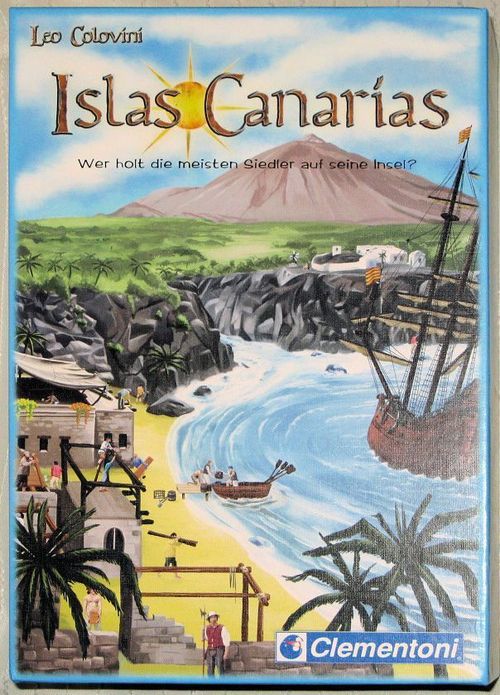
Islas Canarias
Islas Canarias Rulebook
Table of Contents
Table of Contents
Contents
- 6 islands
- 66 cards: 54 settlers (with their occupation in Spanish), 6 pirates, 6 privileges
- 48 houses
- 36 palaces
- 12 town tiles
- 1 start-player ship
Aim
Each player gains points for the houses, palaces and towns on his island. The winner is the player who has the most points at the end of the game.
Preparation
- Starting with the youngest, each player takes one of the islands and places it in front of him. Surplus islands are put back in the box.
- Take out the 6 privileges and put them on the table. Shuffle the remaining cards and place them as a face-down deck next to the privileges. Each player draws a hand of 5 cards from the deck.
- The top card of the deck is then placed, still face-down, next to the deck. This is the first card in the ship which will arrive at the end of the first round.
- Put the houses, palaces and towns on the table, ready for use.
- The youngest player takes the start-player ship.
Playing the Game
The game takes place in rounds. A round consists of each player, beginning with the start player, taking one turn in clockwise order. At the end of each round, a ship arrives and the start player is changed.
On your turn, you carry out the following 2 actions in order:
1. Build, or draw cards
The player chooses either to build 1 house or to take the top 3 cards from the face-down deck and add them to his hand.
In order to build a house, you play one of your cards and place a suitable house from the supply on to your island.
The colour of the house must be that shown by the icons to the left and right of the settler on the settler card (in the picture: a blue house). The priorities of the settler, shown along the upper edge of the card, determine the area of the island on which the house must be built. This is explained in the section 'How to build'. The card is placed face-up on a discard pile. If the face-down deck is used-up, shuffle the discard pile to make a new face-down draw-pile.
Note: If at the start of his turn a player has no cards, 1 card only, or only pirate cards in his hand, he cannot build a house this turn, but must draw 3 cards instead. Otherwise he would have no cards available for the 2nd action of his turn.
2. Add a settler to the ship
The player must place one of his cards face-down in the middle of the table next to the face-down draw-pile. In this way, the number of settlers on the ship increases.
How to Build
To build, you must place a house on an empty area (dark brown square) of your island. You cannot build on the village or the farmland. Building must be carried out in accordance with the settler's priorities. The settler's highest priority is the one at the far left; next to it is the second priority, etc.
- The different priorities are: coast, village, river, mountain, farmland, and road.
- There are 6 house colours: orange, brown, green, blue, beige, and red.
You must first attempt to build the house next to whatever feature is the settler's 1st priority. If there are no empty areas there, you try to build next to whatever feature is the 2nd priority, etc. If there is not even an area available next to the 4th priority, you can build the house on any empty area. Roads and rivers do not split up the areas; so two areas, one on either side of a road, are still counted as being next to each other.
Example: The reaper builds a red house. He wishes to build next to farmland (1st priority). However, there are no empty areas adjacent to farmland, and so he wishes to build next to a green house (2nd priority). His island does not have any green houses so he cannot build next to a green house. There are no empty areas next to the beige house (3rd priority) so he must build the red house on an empty area next to the village (4th priority).
A Ship Arrives
A ship arrives at the end of each round. The current start player shuffles the face-down ship cards and first puts one of these cards, still face-down, next to the draw-pile. This is the first card of the next ship. He then turns over the other cards one at a time, and these settlers each build a house on the player's island of their choice. Each settler builds his house on the island that best meets his priorities; and as usual, builds a house of the colour indicated by the card. The owner of the island decides where the house is built.
All the players look to see which island has the most empty areas next to the areas of the settler's 1st priority. The settler's house will be built there. If the 1st priority is non-decisive (there is a tie between players for the most empty areas next to areas of the 1st priority, or none of the islands have an empty area next to a 1st priority house of a particular colour), the decision is based on how the tied players provide for the settler's 2nd priority, etc. If the 4th priority still brings no decision, none of the players can build the house and it stays in the supply.
The house must always be built next to a 1st priority area if possible, even when the decision was made on the 2nd, 3rd or 4th priority. The normal building rules (see 'How to build') apply. More than one settler from a ship can build on the same island.
Example: The basket weaver disembarks from a ship and will build a beige house. His 1st priority is blue buildings. Islands A and B both have 4 empty areas next to blue buildings, island C has only one empty area. The 2nd priority (village) must be used to decide between islands A and B. Both islands have one empty area next to their village. With the 3rd priority (coast) island A has 3 empty areas, and island B has only 1, so the beige house will be built on island A. It must be built on an empty area next to a blue house.
IMPORTANT: upgrading houses to Palaces & Towns is not allowed during the Ship Arrives Phase!
Once all the cards from the ship have been turned over (but not the one which stays face-down as the start of the next ship) and put on to the discard pile, the current start player gives the start-player ship to his left-hand neighbour. The new start player begins the next round.
Palaces and Towns
You may build a palace or town on your island at any time during your turn. To build a palace, you choose 2 houses of the same colour on your island, then place a palace of the same colour on one of those two areas and return both houses to the supply. To build a town, you require 3 houses of the same colour. You return them to the supply and build the town on one of the 3 areas. A town cannot be built by returning 1 palace and 1 house. The houses used for building palaces and towns do not need to be next to each other! You may only build one palace or town per turn, even if you have enough houses to build more!
When a ship arrives and the players are looking at the empty areas next to houses of a particular colour, palaces and towns are counted in exactly the same way as houses. If you are about to build a house, palace or town and there are no more available of the colour required, you can build a house, palace or town of any other colour instead.
Privileges
The first player to have 3 points in a colour, takes the privilege of that colour. He puts it, clearly visible, next to his island. The owner of a privilege can use its special power, as described on the card, from the moment he takes it. As soon as another player has more points in that colour (see 'End of the Game'), he takes the privilege from its current owner. If another player only has as many points, rather than more points, the privilege stays with its current owner. If you have more than one privilege you can use the special powers of all the privileges you own.
NOTE: If a player gains a privilege (e.g. by having 3 houses in a color) and then, due to the Pirate, ever drops below 3 points in the relevant color, he loses the privilege immediately.
There are the following six privileges:
- You win all ties. When a settler arrives on a ship and you are tied with one or more other players for the most areas next to his 1st priority, you win the tie and the settler comes to your island. Further priorities are not taken into consideration. You must be one of the players initially tied to use this privilege.
- Draw 5 cards (instead of 3), when you do not build. You draw 5 cards from the deck (instead of 3), when you do not build on your turn. [Note: the card actually calls for drawing 4 cards, but the designer has confirmed 5 is the correct number for balance.]
- You may use houses of 2 different colours when building a palace. You can remove houses of 2 different colours to build a palace. The colour of the palace must be the colour of one of the two houses. The palace must be placed on the area where the house of the same colour was stood. This privilege cannot be used if building a town.
- Build wherever you want. When you build houses, palaces or towns, you do not need to observe the rules determining where these must be built on your island.
- Take 1 extra card every turn. Regardless of whether you build or not, you may take an additional card from the deck each turn.
- You are protected against pirates and divert the attack to another player. You are overlooked when there is a pirate attack (see 'Pirates'). If a pirate attacks and you own the corresponding privilege, you can decide which other player must put a house back into the supply.
Pirates
Pirates never build houses; they can only be used as a face-down card in a ship. When a pirate lands with a ship, the player who currently owns the privilege that is the same colour as the pirate card, must put a house of any colour from his island back into the supply. If the privilege has not yet been taken by anyone, the player with the most points in this colour must put a house back; if there is a tie, each of the tied players must put a house back. If a player has no houses, he puts nothing back (see the Variant section at the end of these rules for a less forgiving variation).
End of the Game
At the end of each round, after the settlers have left the ship and have chosen their islands, the players count their points. If at least one player has reached 19 or more points, exactly one more round will be played, after which the game will end. The player with the most points after the final round is the winner.
You score points as follows:
- 1 point per house
- 3 points for your first palace of each colour
- 2 points for each further palace of a colour
- 5 points for each town
Scoring Example:
- 4 houses (brown, blue, beige, beige) = 4 points
- First red palace = 3 points
- Further red palace = 2 points
- 1 orange palace = 3 points
- 1 green town = 5 points
- Total = 17 points
Variant
For a less forgiving game, if a player must lose a house to the Pirate and has no houses, he must lose a Palace or Town instead.