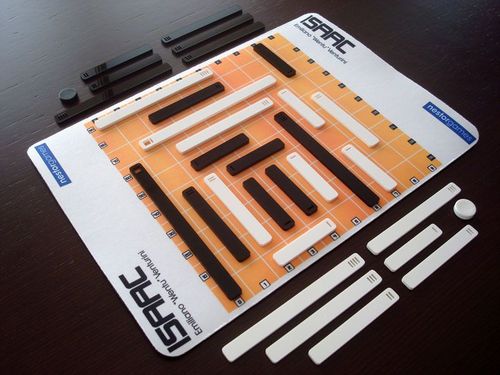
Isaac
Isaac Rulebook
Table of Contents
Table of Contents
COMPONENTS
ISAAC includes:
- A 10x10 board
- 2 sets (light and dark) of 15 rectangular pieces with the following distribution and values (indicated on the pieces):
| Quantity | Piece value (length in cells) |
|---|---|
| 1x | 6 |
| 2x | 4 |
| 3x | 3 |
| 4x | 2 |
| 5x | 1 |
- One light counter and one dark counter
- Carrying case
SETUP
Each player receives a set of pieces and a counter in the same color. The board is placed between the players, with the sides with black numbers from 0 to 9 facing the player with black pieces and counter.
PLAY
The game consists of two phases: the placement phase and the scoring phase.
PLACEMENT PHASE
The placement phase begins with an empty board.
Starting with the Dark, players take turns placing one of their pieces per turn onto unoccupied cells of the board.
If a player cannot put any of his remaining pieces on his turn then he passes and the other player puts any pieces he can.
The placement phase ends when both players don't have space to put any of their pieces on the board. All the remaining pieces are set apart and serve the role of the tiebreaker (see below).
SCORING PHASE
At the beginning of the scoring phase both players have 0 points. To indicate this both players put their score counter on the 00 square according to their own coordinates (i.e. on the leftmost square of the line in front of them). If the mentioned square is under some piece, the score counter goes on top of this piece.
The first player that passed in the Placement phase begins the Scoring phase. The players take turns removing one of their pieces from the board. The removed piece must be at least as long as any piece previously removed by the same player (e.g. if a player has previously removed a 4-cells piece then he can't remove his 3-cells pieces anymore). A player may not remove a piece lying under a score counter (of any colour).
For each removed piece a player scores points in the following way:
- Count the total number of pieces left lying on or crossing the line from which the piece was removed;
- Multiply this number by the number written on the removed piece.
- If there is a single score counter (of either colour) lying on this line then multiply the result by 2. If both score counters are lying on this line then multiply the result by 4.
The final result is the score earned by the removal of the piece. It indicates the maximum number of squares that the player's score counter may be moved. E.g. if the player's score counter is located on 45 and the player earned 24 points then he may move his score counter to any square from 45 (i.e. to leave it where it is) to 69 (45+24).
The counter may be placed over a piece (of any colour) still on the board but not in the same cell as the opponent's counter.
The game ends when any player scores at least 100 points. If a player cannot remove any of his pieces on his turn, he passes and is out of the game. The game ends when both players have passed.
If both players get the same score by the end of the scoring phase, each player forms a line with all his unplayed pieces and the player with the longest line of the unplayed pieces wins the game. If the lines are of equal length, the player who started the game wins (Dark). Note that the length of each piece is not a round number of board squares but a little bit shorter.
On the next page we show examples of scoring moves.
NOTES AND ACKNOWLEDGEMENTS
Isaac is the winner of the "Tutto è numero" Caldè Mathematical Festival 2011 Abstract Game Design Contest and the 10th winner of the "Nestorgames continuos abstract game design contest".
The author wishes to thank: Katja, Ivan and Nicola for their patience; papà Giorgio for his mastery of woodworking; Danilo Bersani, Paolo Mori, Bruno Cathala, the many testers at the Circolo Argonne in Parma and during IDEAG 2011 in Turin and PL>Y 2011 in Modena for their help and their great support.
Finally, a big Thank You to all the voters: janus, Jefforama, Senso, Ohmnibus, magaolimpia, Pa°L°, Francescopela, zefquaavius, daniloparma, mic helesommi, UanarchyK, il_dominio, Javest, Axum, magicsiro, buzzlightyear, schwarzspecht, ddyer, Maccheek, spesknight, caselpd, aoc_, Jugular, MENAREUS2000, Rev Robbo 1, metalchorus, makropulos, Tickman, paulfuni, kristopherjwolff, J0n4s, Pepo, ASutherland, pillolo, Oecolampad, Gundadin, panteo, MadAx, Izraphael, TinuZ, tocoking, dave doma, raist_idg, Favar, oxon, MagoBaol, Paxcow, fantavir, Rugerfred, Mariov, KooriNecros, J0tar0Kjo, BoldBoldness, Gibbon27, printgames, mipe, Aiken Drum, lucachiapponi, Markus Hagenauer, MarcoTibaldini, wallover, kurthl33t, dakkar_plus, Pard, LanaDove, Pasquale, f2ilbardo, AndreaP, roscodigital, gbparker, zauk, vmedina, totola, Brichs, Dubbelnisse, Ashitaka, pear, bebe76, indigopotter, lucacerrato, wikayelb, magocharlie, franic_bo, AnnuverScotinExile, alexscarcella, Kilamdil, Saremie, Salkaner, TrentonTron, irene85, allefer, Sarahhh, Emilio85, Matteo7419, Sol Invictus, boudie, lycaone, ffuzz, lucalfieri, dma69, andy, Profesario, mathgrant, ivyco, pak zoubaoum.
ISAAC rules © 2011 Emiliano "Wentu" Venturini. Rulebook © 2011 Néstor Romeral Andrés
EXAMPLE 1
[Diagram: it is the turn of the Light player. The Light player's highlighted piece is placed between the squares 04 and 44.]
It is the turn of the Light player and the player decides to remove his highlighted piece, which is placed between the squares 04 and 44. Note that there are opposite coordinates for both players so the coordinates 04-44 should be checked on the Light edge of the board (top & right).
[Diagram: the highlighted piece is removed from the board, leaving the line it crossed.]
There are 5 pieces (4 light and 1 dark) lying or crossing the line from which the highlighted piece was removed. The number written on the removed piece is 3. In addition the dark score counter is located on the same line (05 using the Dark coordinates). So the final result achieved by the removal is 5 x 3 x 2 = 30. The Light player decides to use all the earned score and moves his score counter from the 00 to 30 (see the Light coordinates).
EXAMPLE 2
[Diagram: it is the turn of the Dark player. The Dark player's highlighted piece is placed between the squares 43 and 93.]
It is the turn of the Dark player and the player decides to remove his highlighted piece, which is placed between the squares 43 and 93 (Dark coordinates).
[Diagram: the highlighted piece is removed, leaving one piece crossing the line.]
There is 1 piece crossing the line from which the highlighted piece was removed. The number written on the removed piece is 4. So the final result achieved by the removal is 1 x 4 = 4. The Dark player has several options to move his score counter:
- He can move his score counter to 38 and let the Light player make his last move. In this case the Light player would remove his last piece and score 12 points (6 x 1 piece on the line x 2 for the dark score counter on the line).
- The Dark player can "sacrifice" the earned points and move his counter to 36 (above illustration) blocking the last Light piece so the Light player is out of the game.
EXAMPLE 3
[Diagram: the black counter is aligned with the black piece before it is removed.]
This time the black counter is aligned with the black piece.
[Diagram: black removes the 4-value piece.]
Black removes the 4-value piece and scores 1 x 4 x 2 = 8. The Dark player has several options to move his score counter:
- He can move his score counter to 41 and let the Light player make his last move. In this case the Light player would remove his last piece and score 6 points (6 x 1 piece on the line).
- He can "sacrifice" the earned points as in the previous example and block White.