IRONDIE
IRONDIE Rulebook
Table of Contents
Table of Contents
Game
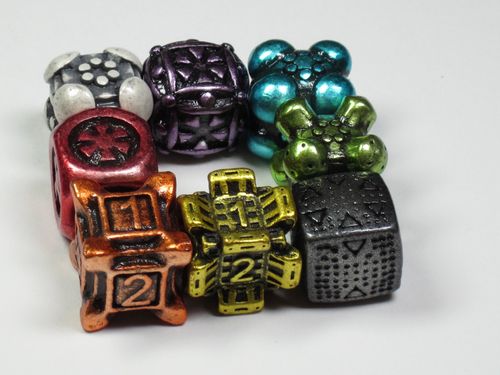
IRONDIE is a tactical dice game. A particular die shape corresponds to its specific function which, combined with the die's color, forms a unique combined effect. Unlike other dice games, in IRONDIE luck is not the deciding factor of the game -- far more important for players is the ability to correctly combine the characteristics of the dice.
By combining the available colors and shapes of dice, each player creates his own set that lets him effectively oppose his opponent. By carefully combining the characteristics of the dice, players can create a variety of sets that let them apply unique game strategies.
Players start with 9 dice in hand. Each decides how many of the 9 dice he will put into play at the start and how many to keep for later stages of the game. Then the players throw the chosen number of dice into battle: an ATTACK die inflicts damage on the opponent, a DEFENSE die protects against the opponent's attacks, and LIFE dice represent the player's level of life energy. If a player has lost all his LIFE dice, he has lost.
Dice that players did not use at the start of the game in the BATTLE PHASE are held in RESERVE and can later be used in the CLASH PHASE, when their various properties can influence the dice used earlier in the BATTLE PHASE.
For example: A player begins the CLASH PHASE by aiming a Shooter die at one of the opponent's dice. If the result of the roll is higher than the target's, 2 points are subtracted from the value shown on the TARGET die. If the Shooter's roll result is lower, only 1 point is subtracted from the TARGET die.
At the end of each turn, the amount by which the sum of the values of all of a player's ATTACK dice exceeds the sum of the values of all of his opponent's DEFENSE dice is subtracted from the sum of the values of the opponent's LIFE dice.
Dice
-
CLASS: The 9 types of dice are divided into 3 CLASSES, which determine how a die can be used in BATTLE: a. ATTACK DICE: their value from 1 to 6 is shown by triangular symbols. Such dice can inflict DAMAGE on the opponent. b. DEFENSE DICE: their value from 1 to 6 is shown by dots. Such dice can protect the player from the opponent's ATTACK dice. c. LIFE DICE: their value from 1 to 6 is shown by numerals. Such dice represent the player's vital force, i.e. the damage that must be inflicted on the player to defeat him. If a player has no LIFE dice left, he has lost.
-
TYPE AND SHAPE: Each TYPE of die has a special SHAPE, which distinguishes it from the others and determines the EFFECT it generates in the CLASH PHASE.
-
SPECIALIZATION: Specialization defines the relation of SHAPE to COLOR. The SHAPE of the die corresponds to its specialization and, in combination with a certain COLOR, makes the die especially effective. If a die has the perfect combination of COLOR and SHAPE (see the color table below), it will win a DUEL even with an equal rolled score. The only exception to this rule is the case when the TARGET die is of an ENEMY color (see the section "Colors").
-
TARGET: Indicates the die/dice at which the EFFECT of the player's die, thrown during a DUEL in the CLASH PHASE, is directed.
-
COMPARISON: To determine the outcome of a DUEL in the CLASH PHASE, the result rolled on the thrown die must be COMPARED with the result of the TARGET. There are 3 ways to determine whether a die thrown during a DUEL won or lost: i. > (greater): if the result rolled on the die is greater than the result of the TARGET, the die wins; otherwise it loses. ii. if the result rolled on the die is less than the result of the TARGET, the thrown die loses; otherwise it wins. iii. the effect of the throw takes place regardless of the result rolled.
Key Characteristics (Table 1)
Columns: Class / Type / Specialization (color) / Target / Comparison / Effect of winning / Effect of losing.
ATTACK
| Type | Color | Target | Comparison | Effect of winning | Effect of losing |
|---|---|---|---|---|---|
| Crusher (Крушитель) | Black | 1 die in play | > | Move the target die to the ABYSS | Move the CRUSHER to the ABYSS |
| Assault die (Штурмовой кубик) | Red | 1 ATTACK die in play | > | Add/subtract the value of the ASSAULT die to/from the value of the target die | Add/subtract 1 point to/from the value of the target die |
| Shooter die (Стрелковый кубик) | Purple | 1 die in play | > | Subtract 2 points from the value of the target die | Subtract 1 point from the value of the target die |
DEFENSE
| Type | Color | Target | Comparison | Effect of winning | Effect of losing |
|---|---|---|---|---|---|
| Annulator (Аннулятор) | Blue | 1 die in play | > | Place the target die in the STORAGE | - |
| Barrier (Барьер) | Green | 1 DEFENSE die in play | > | Add/subtract the value of the BARRIER to/from the value of the target die | Add/subtract 1 point to/from the value of the target die |
| Power Booster (Нагнетатель мощности) | White | 1 die in play | > | Add 3 points to the value of the target die | Add 1 point to the value of the target die |
LIFE
| Type | Color | Target | Comparison | Effect of winning | Effect of losing |
|---|---|---|---|---|---|
| Absorber (Поглотитель) | Orange | Each of the opponent's DEFENSE dice in the BATTLE phase | < | Subtract 2 points from the value of each target die | - |
| Fortress (Крепость) | Yellow | Each of the opponent's ATTACK dice in the BATTLE phase | < | Subtract 2 points from the value of each target die | - |
| Regenerator (Регенератор) | - | 1 die in the STORAGE | Ø | Place the target die in the BATTLE zone with the value rolled on the REGENERATOR | - |
(The table's "Effect of winning" for Assault die and Barrier is printed as "Add/subtract the value of the ASSAULT die (BARRIER) to/from the value of the target die", as in the source.)
Colors
There are 8 different die colors, divided into 3 CATEGORIES:
- 3 PRIMARY COLORS (RED, BLUE, YELLOW),
- 3 SECONDARY COLORS (PURPLE, GREEN, ORANGE),
- 2 COLORLESS (BLACK, WHITE).
NOTE: Combining two primary colors gives a secondary color (blue and yellow give green). In this case the base colors are called the source colors, and the resulting color, which in our case is green, is called the derived color.
There are two important aspects of die colors that players must remember -- AFFINITY and COLOR BONUSES.
Affinity
Every color has ALLIED, ENEMY and NEUTRAL colors.
- ALLIED colors:
- Any of the PRIMARY colors is ALLIED to itself and to the SECONDARY colors that it can form.
- Any SECONDARY color is ALLIED to itself and to the PRIMARY colors that form it.
- Black and White are ALLIED only to themselves.
- ENEMY colors: These are colors that are ENEMY to the other colors of their CATEGORY, namely:
- Each PRIMARY color is ENEMY to the other PRIMARY colors.
- Each SECONDARY color is ENEMY to the other SECONDARY colors.
- BLACK is ENEMY to WHITE, and vice versa.
- NEUTRAL colors: Colors that are neither ALLIED nor ENEMY are considered NEUTRAL to each other.
Color Table
Allied (C) / Enemy (B). All dice of one color are considered ENEMY to each other. A color that is neither ALLIED nor ENEMY is NEUTRAL.
Color bonus (granted by a die showing "1"):
- Orange: +1 to an ALLIED ATTACK die and +1 to an ALLIED LIFE die.
- Red: +2 to an ALLIED ATTACK die.
- Purple: +1 to an ALLIED ATTACK die and +1 to an ALLIED DEFENSE die.
- Blue: +2 to an ALLIED DEFENSE die.
- Yellow: +2 to an ALLIED LIFE die.
- Green: +1 to an ALLIED DEFENSE die and +1 to an ALLIED LIFE die.
- Black: +3 to an ALLIED DEFENSE or ATTACK die and -1 to one of your LIFE dice.
- White: +1 to an ALLIED or NEUTRAL die and +1 to one of your LIFE dice.
Color Bonuses
If a "1" is rolled on a player's die (both in the BATTLE PHASE and in the CLASH PHASE), the player, if possible, immediately receives the BONUS corresponding to the color of that die, applied in addition to one (or two) of the player's dice already IN PLAY.
- The TARGET of applying the BONUS cannot be the die on which the "1" was rolled.
- The TARGET of applying the BONUS can only be a die that is an ALLOWED TARGET, i.e. a die meeting the requirements of CLASS and COLOR specified in the COLOR TABLE.
- If there are no ALLOWED TARGETS IN PLAY, the BONUS cannot be counted.
- If a die's BONUS can be applied to several dice at once (see SECONDARY colors) but there are fewer ALLOWED TARGETS than possible BONUS effects, only the effects able to affect ALLOWED TARGETS are counted.
See the section "Phase 1: Battle" below for more on applying BONUSES in the BATTLE PHASE.
Rare Dice
RARE dice can be found in three-die packs, so-called "expansions" (Expansion Kits). RARE dice differ from ordinary ones by their laser engraving. Unlike ordinary dice, which give a COLOR BONUS only when a "1" is rolled on them, RARE dice also give a COLOR BONUS on a value of "2". No more than three RARE dice may be included in any set.
EXAMPLE: If a "1" is rolled on a thrown red die, 2 points can be added to the value of any ATTACK die. On the other hand, 2 points can be added to the value of an ATTACK die if both a "1" and a "2" is rolled on a RARE red die.
The Game Board
The game board is divided into the following zones:
- A) BATTLE zone: the dice used in the BATTLE PHASE are placed here. The zone is divided into 3 sectors, where the ATTACK, DEFENSE and LIFE dice are placed.
- B) CLASH zone: the dice used in the CLASH PHASE are placed here until the end of each DUEL.
- C) STORAGE: dice that will return to the player's hand at the END OF THE TURN are placed here. These are: a. dice used in a DUEL in the CLASH PHASE; b. ATTACK and DEFENSE dice from the BATTLE zone after the DAMAGE PHASE.
- D) ABYSS: dice that have left the game are placed here. These are: a. dice destroyed in the CLASH PHASE (for example, by use of a CRUSHER); b. LIFE dice from the BATTLE zone after their value became less than or equal to zero.
NOTE: To keep track during play, it is better to arrange the dice on the GAME BOARD by their rolled value, from higher to lower or vice versa. ATTACK and LIFE dice can be arranged by value from higher to lower left to right, and DEFENSE dice from higher to lower right to left.
How to Play
Setup
IRONDIE is first of all a game for two, although it is also interesting to play with more players. The rules below are for two players. Rules for more players are found in the section "Playing with More Players".
Players assemble dice sets for each game. Each set must contain 9 dice, with at least one die of each class, i.e. at least one ATTACK die, one DEFENSE die and one LIFE die.
Before the game begins, each player shows his set to his opponent for at least 30 seconds.
Game
The game consists of TURNS, and each turn is divided into 4 PHASES:
- BATTLE,
- CLASH,
- DAMAGE,
- END OF TURN.
Phase 1: Battle
A) Players divide their sets into two parts (for BATTLE and for CLASH) in such a way that the opponent cannot see how the dice were distributed. Note that players have the right to put all their dice into one of these groups, ignoring the other.
B) Players simultaneously throw one part of their dice, keeping the second in RESERVE (i.e. in hand). The thrown dice are considered to have entered PLAY. The remaining dice will be used later in the CLASH PHASE.
C) The dice IN PLAY are placed in the corresponding sectors of the game board in the BATTLE zone: ATTACK dice in the attack sector, DEFENSE dice in the defense sector, LIFE dice in the life sector.
D) After the dice are arranged, players check the results of their throws. Dice that show "1" (and RARE dice that show "1" or "2") give COLOR BONUSES (see the COLOR TABLE). The player with the ADVANTAGE (see the note below) receives his COLOR BONUSES first (if he has any); his opponent receives his COLOR BONUSES (if he has any) second.
If a die's COLOR BONUS is used to increase the value of the very die that gives that BONUS, the size of its COLOR BONUS remains unchanged, even if its value now equals "2" or more points. For example, if "1" is rolled on two BLUE BARRIER dice, the COLOR BONUS of each of them may be applied to the other.
E) After all COLOR BONUSES are received, the BATTLE PHASE ends and the CLASH PHASE begins.
F) If neither player kept dice in RESERVE, skip the CLASH PHASE and go to the DAMAGE PHASE.
ADVANTAGE: This is the right of a player to act first in a given PHASE of the game, regardless of the order of his turn. ADVANTAGE applies in particular in the CLASH PHASE and when receiving COLOR BONUSES. The player who gets ADVANTAGE is the one:
- who has more dice in RESERVE;
- who, with an equal count, has more life energy points;
- who, if the players are equal on the first two points, rolls the higher value on a thrown die (the die is re-rolled on a tie).
Phase 2: Clash
During the CLASH, players may use the dice remaining in their RESERVE (in hand) and apply the EFFECT of these dice (see the section "Key Characteristics" above) to TARGET dice of the opponent.
Alternation of duels in the Clash
- Each CLASH may consist of one or several DUELS. In a DUEL each player may use no more than 2 dice.
- The player who throws a die first in a DUEL is the ATTACKER, and the other player is the DEFENDER. After each DUEL ends, players are allowed to swap roles; the DEFENDER has the right to become the ATTACKER in the next DUEL.
- If a player declines the right to be the ATTACKER, i.e. the right to throw a die first in a DUEL, he loses the right to be the ATTACKER for the duration of the current CLASH PHASE. Until it ends, this player is allowed to be only the DEFENDER.
- The player who has the ADVANTAGE (see "Phase 1: Battle") at the start of the CLASH PHASE gets the right to be the ATTACKER in the first DUEL of this PHASE.
- The CLASH PHASE ends in one of two ways:
- either all players have declined the right to ATTACK;
- or the players have no dice left in RESERVE.
- When the CLASH PHASE ends, the DAMAGE PHASE begins.
Order of conducting a duel
- The ATTACKING player takes one die from RESERVE, shows it and declares which of the opponent's dice (one or several) he will attack; the TARGET of the attack is chosen from dice IN PLAY that meet the requirements of the section "Dice" (item "Target"). The ATTACKING player then throws his die and places it on the game board in the CLASH zone.
- The DEFENDING player may: a. take a die from RESERVE and, showing it to the opponent, declare a TARGET for it. The player may declare as TARGET only dice that are in the CLASH zone, choosing all of them or one. The player must then throw his die and place it in the CLASH zone on his game board; or b. decline the first throw in the DUEL. In that case, in this DUEL the player will be able to throw only one die instead of the allowed two.
- The ATTACKING player, and after him the DEFENDING player, may: a. use a second throw in the duel (according to item 2a); or b. decline the second throw.
Example: The ATTACKING player begins a DUEL by throwing his first die. The DEFENDING player refrains from throwing, because he wants to find out whether the ATTACKING player will make a second throw. The ATTACKING player keeps his second die in RESERVE for the next DUEL and declines the second throw. Only now does the DEFENDING player use his second throw to counter the ATTACKING player's first throw.
Note: It may happen that a player wants to respond to the opponent's thrown die in the DUEL above but cannot, because he has no dice left in RESERVE that by the rules can be aimed at the dice participating in the DUEL, or has no dice in RESERVE at all. A player whose opponent has no dice in RESERVE may continue the DUEL and/or start a new DUEL, even though his opponent has no ability to respond.
Result of a duel
- The current DUEL is considered finished after all players have made two throws and/or refrained from throwing, and a decision has been made on the results of all throws of dice (from the last to the first) placed in the CLASH zone according to the LIFO rule (Last In First Out). To determine whose result is greater, compare the result of the thrown die with the result of the TARGET die/dice; then, if the result of the thrown die is higher, consult the "Key Characteristics" table to determine the EFFECT of the thrown die.
Note: When using the LIFO method, a situation may arise in which the TARGET die has left play before the EFFECT is applied to it (this can happen if an ANNULATOR or CRUSHER was used earlier in this phase). In that case the EFFECT is not applied, since there is no TARGET to apply it to.
- After the EFFECTS of all dice thrown in the DUEL have been applied, players place the dice remaining in the CLASH zone into the STORAGE (during the DUEL some dice may already be outside the CLASH zone because of the application of an EFFECT to them; for example, they may have gone to the ABYSS after a CRUSHER was applied to them).
- When all DUELS of the CLASH PHASE are completed, the DAMAGE PHASE begins.
Phase 3: Damage
- Each player adds up the results rolled on his ATTACK dice and DEFENSE dice that are in the BATTLE zone.
- If the sum of the values of all of a player's ATTACK dice is greater than the sum of the values of all of his opponent's DEFENSE dice, damage equal to the difference of these sums is inflicted on the opponent.
- The damage received by the players is simultaneously subtracted by them from the sum of the values of the LIFE dice in their LIFE zones. Players distribute the damage they received among their LIFE dice themselves. If the value of a player's LIFE die becomes equal to zero, the die is placed in the ABYSS.
- After all damage has been counted, players move their ATTACK dice and DEFENSE dice from the BATTLE zone to the STORAGE.
Phase 4: End of Turn
- Each player has the right to return to his hand one LIFE die from the BATTLE zone of his board.
- Each player must return to his hand all dice from the STORAGE.
- The game continues -- the next turn begins again with the BATTLE PHASE.
End of the Game
- The game ends at any moment (after the first BATTLE PHASE) if one of the players has no LIFE dice left in his LIFE zone. The player who still has LIFE dice in his LIFE zone is declared the winner.
- If both players are simultaneously left without LIFE dice in their LIFE zones (for example, after the DAMAGE PHASE), the game is ended by throwing a die to determine the winner.
Playing with More Players
More than two players can play Irondie -- such a game is called a "game with more players".
- Players are divided into 2 teams with an equal number of people. The teams sit opposite each other.
- Each player's set must consist of 9 dice, among which there must be at least one die of each class and no more than three RARE dice.
- The BATTLE PHASE and the DAMAGE PHASE are carried out simultaneously by all players.
- Each DUEL still consists of 4 throws, 2 for each team (just as in the game for two). Any member of a team may take part in such a DUEL.
- To place his dice IN PLAY each player uses his own game board.
- All rules of the game for two apply to the game with more players (i.e. a team loses if none of its players has LIFE dice left in the LIFE zone; also, FORTRESS or ABSORBER dice used in the CLASH PHASE always target the ATTACK or DEFENSE dice of all opponents).
- In a game with more players, when a player loses all LIFE dice in the LIFE ZONE, that player remains in the game as long as any player of his team has at least one LIFE die in the LIFE ZONE.
Golden Rules
A short "reminder" for players, helping to remember some of the rules of the game:
VISUAL RULES: Symbols on the dice
- On ATTACK dice the value is shown by triangles.
- On DEFENSE dice the value is shown by dots.
- On LIFE dice the value is shown by numerals.
RULES NOT TO FORGET
- If an EFFECT or COLOR BONUS changes the result rolled on a die:
a) increasing it to a value greater than six, the value remains six.
b) lowering its value below one:
- the die's value equals 1 if it is an ATTACK or DEFENSE die, or if it is a LIFE die in the CLASH zone;
- the die is placed in the ABYSS if it is a LIFE die in the LIFE zone.
- A COLOR BONUS can be obtained only if a "1" is rolled on the die (or "2" if it is a RARE die). A COLOR BONUS cannot be obtained if the die's value became "1" (or "2") because of some EFFECT or COLOR BONUS that changed the previously rolled result.
- When a "1" is rolled on a die (or "2" if it is a RARE die), the COLOR BONUS is applied immediately, provided an ALLOWED TARGET receives it.
Tournament Rules
In tournaments, in addition to the basic rules, the following additional rules apply:
The tournament is held in 2 stages: the first stage is played by the "Swiss system". After the first stage is finished, the players with the best results meet in knockout contests (the number of players in each round of these contests depends on the number of tournament participants).
Matches consist of several rounds. The first player to win 2 rounds wins the match. The maximum duration of a match is 45 minutes.
By the rules each round must last no more than 20 minutes. A turn that exceeds 20 minutes is considered finished, and in all subsequent turns the rules below apply:
- In the CLASH PHASE players do not throw dice.
- LIFE dice cannot be returned to hand at the end of the turn.
- At the start of each turn, the value of each LIFE die in the LIFE ZONE decreases by one.
In a tournament, besides his playing set, each participant may use an ADDITIONAL SET of three dice. After each game, players have the right to swap one or more dice of their playing set for one or more dice from the ADDITIONAL SET.
The ADDITIONAL SET may include RARE dice (in addition to the 3 RARE dice of the playing set); however, after the swap of dice in the playing set no more than three RARE dice must remain.
The swap of dice takes place secretly, but players must show the resulting playing set to the opponent before the start of the next round.