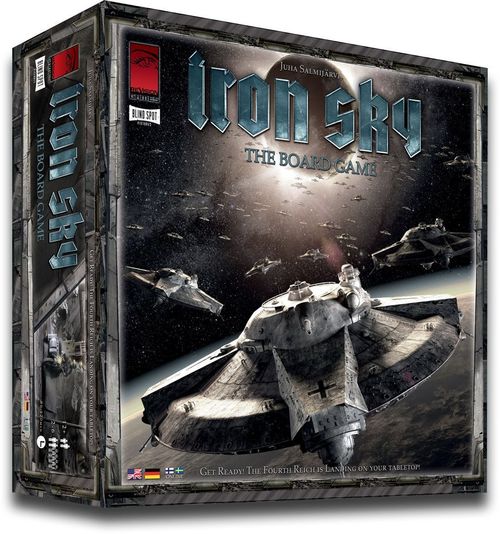
Iron Sky: The Board Game
Iron Sky: The Board Game Rulebook
Table of Contents
Table of Contents
Overview
General
Iron Sky the Board Game is based on the full length feature film Iron Sky, a dark sci-fi comedy set in the year 2018. The Fourth Reich have completed the construction of a massive invasion fleet of flying saucers and space zeppelins, and arrive at Earth's door with only one thing in their mind: total world dominance!
Iron Sky the Board Game pits players in charge of the most epic battle in all of history. The objective is to gather as many Victory Points for your faction as possible. Both the attacking and the defending players command a specific sector of the battlefield, and each player is awarded with a personal score based on how they fare in the battle.
The Goal
Attacking from the orbit, the armies of the Reich attempt to seize as many Territories as possible before the game ends, while the United World Confederacy, UWC, tries to fend off the surprise assailants.
Players try to do their best for the team. Every player is responsible for a single continent, in which his or her armies operate. Helping a second Commander is, however, necessary at times. The game lasts from 7 to 10 rounds. In the end, the score is calculated. The faction with most points wins the game. The score is affected by Territories controlled in the end, the casualties inflicted and the Commanders' own secret operations.
The Course of the Game
Players pile up resources each according to the current situation in their continent. The more Territories you control, the more resources you accumulate. The Players use their Command Cards to perform actions on the board. All players on the same side play their Commands at once, after which the turn is passed on to the opposing team.
Command Cards add and move Unit Tiles on the board. When an Army moves to an enemy Territory, a combat begins and it is immediately resolved with Combat Cards. Combats are over quickly and when the control over a Territory is changed, the resources for the next turn change as well.
Game Variants
The game requires an even amount of players. The default number of players is six. Exceptions to this are noted with symbols 2 for two players or 4 for four players.
Additional Optional Rules are introduced in the Game Setup chapter. If you are playing for the first time it is recommended that you learn the game without the Optional Rules. In that case skip all Optional Rule steps in Game Setup.
This symbol marks Optional Rules in this rulebook.
- Special Commands
- Random Game Length
- Initiative
- Controlled Combat
- Secret Operations
- Elite Forces
- Eventful Times
Difficulty levels:
- Rookie: No Optional Rules in play.
- Experienced: Special Commands, Random Game Length, Initiative, Secret Operations.
- Veteran: All Optional Rules in play.
Components
- Boards (3 pcs): Each board represents a continent. The UWC players look at the board from the southern side while the Reich players play their game from the northern side.
- Commander Sheets (3 pcs per faction): Player's cards and tokens are set up around the Commander Sheet.
- Command Cards (15 pcs per Commander): The Command Cards are used to affect the board. There are differences between each Commander's Command Deck.
- Special Commands: The Special Commands are single use cards with powerful effects.
- Combat Cards (48 pcs per faction): Combat Cards are used to resolve a combat on a contested Territory.
- Secret Operation cards (8 pcs per faction): Secret Operations may change the player's focus on the board, providing another goal to pursue.
- Unit Tiles (for each continent: 15 pcs UWC and 20 pcs Reich): Unit Tiles are the workhorse on the board. A pile of 1-3 Unit Tiles is considered an Army. No area can be controlled or conquered without an Army.
- Terror Tokens (3 pcs): The Territories the Reich has driven into chaos are marked with a Terror Token.
- Electronic Warfare Tokens (3 pcs): Electronic Warfare prevents the Reich's movement to and from orbital sectors, and is represented with this token.
- Time Tokens (10 pcs): The Time Tokens track the progress of the game.
- Resource Tokens (3 pcs each): Resource Tokens indicate the players' remaining resources.
Commanders
The UWC
- Politician: A versatile commander capable of turning money into political power.
- General: A straightforward commander focused on recruiting and deploying armies.
- Agent: A balanced commander with connections to both politics and arsenal.
The Reich
- General der Infantrie: Blitzing the surface of Earth is the strength of the infantry general.
- General der Artillerie: Orbital bombardment is the speciality of the artillery general.
- General der Einsatzgruppen: The Intelligence general is best in performing unexpected raids.
Common Tokens
- Time Tokens
- Loan Tokens (two or four player games)
- Guidance Tokens (two or four player games)
Game Setup
1. Board Setup
- Place the board pieces on the table in the order "America - Europe - Asia."
- Choose or randomise a board piece per two players. Boards which are left out of the game are Neutral Continents.
- Place two Loan Tokens on the Neutral continent's board edge.
- Place one Guidance Token on the Neutral continent's board edge.
- In case of 2 Neutral continents, both of them yield tokens.
2. Commanders
- Shuffle the Commander Sheets face down.
- Each player draws a Commander face down. The Commander Sheet can be revealed after drawing.
- Take the Command Card deck with Class symbol matching the drawn Commander Sheet. Class symbols are shown on the face of Command Cards.
If the third Commander of a faction is drawn, it is skipped and the player draws a new one. The first player draws a Commander randomly, the other player shuffles the Commanders of the opposing faction and takes one of those.
3. Randomizing Continents
- Shuffle the UWC Commander Sheets and deal them face down on the south side of the boards.
- Shuffle the Reich Commander Sheets and deal them face down on the north side of the boards.
- The Commanders are revealed and players should sit down next to the continent his or her Commander is deployed to. Players can check their Commander Sheets from matching class symbol on the face of their Command Cards.
4. Command Cards
- Shuffle all Command Card decks and place them on the Commander Sheet.
Special Commands Optional Rule in play:
- Shuffle the UWC and the Reich Special Commands as separate decks. Deal two random Reich Special Command Cards to each Reich player and two random UWC Special Commands to each UWC player. Remaining Special Commands cards should be removed from the game.
- Each player shuffles the Special Command Cards into his or her Command deck without looking at the card faces.
5. Combat Cards
- Shuffle the UWC Combat Card deck and deal ten cards face down to each UWC player.
- Shuffle the Reich Combat Card deck and deal ten cards face down to each Reich player.
- Place the remaining Combat Cards in the Combat Card bank near the boards.
- Each player takes the top card of the deck and places it face down next to the deck. This is called a Reserve Combat Card. When a combat occurs, the top deck and the Reserve Combat Card are available to choose from.
Controlled Combat Optional Rule in play:
- Each player draws top two Combat Cards before placing the Reserve Combat Card. In this variant the players know the Combat Cards they are playing.
6. Units the UWC
- Each UWC player takes 15 Unit Tiles matching the colour of his or her continent.
- A Unit Tile is placed on each Headquarters marked with the Flag symbol.
- All remaining Unit Tiles are placed next to the Commander Sheet.
- Place two of the Neutral continent's Unit Tiles on the board edge.
Black Ops Optional Rule in play:
- Take one Black Ops Tile for each UWC player and place it next to the Commander Sheet.
Territories (diagram key):
- A. Territory number: The Territories are numbered for the use of Secret Operations and cooperative play. If you are playing for the first time, you can ignore the Territory number.
- B. Victory Point value: The player controlling the Territory at the end of the game scores this amount of Victory Points.
- C. Territory name.
- D. Battlefront: The Army trying to conquer the Territory is placed on this square.
- E. Headquarters: The Army controlling the Territory is placed on this square.
- F. Sector number: Sectors are used in Optional Rules.
- G. Surface route: The orange routes are used for surface movement. They are usable by both Reich and UWC armies.
- H. Intercontinental route: White routes are used to move onto another board piece. These are usable for both Reich and UWC armies.
- I. Orbital route: The red routes are only used for movement between the orbit and the surface. They are only usable by the Reich.
7. Units the Reich
- Each Reich player takes 20 Unit Tiles with artwork matching the colour of his or her continent.
- A Unit Tile is placed on each orbital sector.
- All remaining Unit Tiles are placed next to the Commander Sheet.
8. Resources
- UWC players take their Money Point and Political Point Resource Tokens and place them on the Commander Sheets into the squares marked with a triangle. UWC Commanders have varying starting resources.
- Reich players place the Command Point Resource Token into square zero.
Bagging the Components: It is advisable to bag the tokens for each player to make the next Game Setup easier.
9. Terror and Electronic Warfare Tokens
- Each UWC player takes an Electronic Warfare Token and places it next to his or her Commander Sheet.
- Each Reich player takes a Terror Token and places it next to his or her Commander Sheet.
10. Time Tokens
- Place the red Ending Token on the table. Pile seven random Time Tokens on it. This way the Ending Token will be revealed after the eighth round.
Random Game Length Optional Rule in use:
- Three random Time Tokens and the Ending Token are set aside. These are shuffled and piled up randomly. The remaining six Time Tokens are piled on the four shuffled tokens. This way the Ending Token will be revealed after the seventh round at the earliest and at the tenth round at the latest.
11. Blitz-meter
- The Occupation Token is placed on the X-shaped space closest to the orbit. The token should be placed with blue and red sides matching on the Blitz-meter's blue and red sides.
- The square shaped Destruction Token is placed right below the Occupation Token from the UWC player's view.
12. Secret Operations
Secret Operations Optional Rule in play:
- Shuffle the UWC and the Reich Secret Operations separately.
- Deal one card face down to each player. Players may look at their Secret Operation without revealing it to other players.
- Remaining Secret Operation cards should be removed from the game.
Detailed information about their unique goals are explained in the Optional Rules - Secret Operations chapters.
13. Starting Cards
- Each player draws 5 Command Cards.
14. The Game Begins
- The Reich starts the first round.
The Course of the Game
During the game the players focus on their own board piece - the continent they are competing for. Planning with other players on the same faction provides a deeper and more interactive experience. The whole side plays all the Phases at the same time. After every player on the active faction has finished a Phase, they all move together to the next Phase. When all players have finished their turn, the other faction begins their turn and becomes the active faction. The Reich is the first active faction. They play their whole turn before the UWC players can play any of their Commands.
When playing for the first time it is advisable to play one player at a time to prevent chaos amidst the gaming session. Players may watch and react on the activities of other players on the same side. It is possible to take a look at the other continents before deciding what to do on the player's own continent. If all the players have good knowledge of the rules it is possible to start playing a Phase simultaneously.
During the turn players can give Money and Units to other players on the same faction. The resources and armies can be used on the same turn.
1. The Resource Phase
- The amount of resources gained is indicated in the Blitz-meter, next to the Occupation Token.
- The Resource Tokens are moved to the correct square on the Commander Sheet.
- Maximum amount of a single resource is eight.
Blitz-meter
This meter indicates the situation on the continent. The amount of resources generated in the beginning of the turn depends on the placement of the X-shaped Occupation Token. In case the players are not sure if the Occupation Token has moved correctly, they can easily check this during the game. Empty X-shaped spaces between Occupation Token and player should be equal to the Territories he or she controls.
- The white triangle on the X-shaped space (the Occupation Token's position).
- UWC players generate resources equal to the number on the Blitz-meter next to the blue side of the Occupation Token.
- UWC players' resources are shown on the blue side of the Occupation Token.
- This amount of resources is added to the Money Points and Political Points remaining from previous turn.
- Reich players generate resources equal to the number on the Blitz-meter next to the red side of the Occupation Token.
- Reich players' resources are shown on the red side of the Occupation Token.
- The Command Point Resource Token is placed on the corresponding square on the Commander Sheet. The Reich Commanders do not retain unused Command Points from previous turn.
- The Occupation Token indicates Victory Points for the UWC player at the end of the game. The square shaped Destruction Token indicates Victory Points for the Reich side at the end of the game.
Checking Blitz-meter (example): In this example the Reich controls three Territories and has the Terror Token on the board. There are four empty steps between the player and Occupation Token.
Checking Blitz-meter (example): The UWC controls only two Territories. The uncontrolled Territory is counted towards UWC, and there are three empty steps between Occupation Token and UWC player.
2. The Command Phase
During the Command Phase players use their Command Cards to control the course of the game. In addition to cards the players may use Orders during the Command Phase. The player can continue using Commands and Orders as long as he or she has resources available. Player can end his or her Command Phase even if there are available resources. It is sometimes advisable for the UWC players to conserve resources for the next turn.
Orders
Order: Regroup
- UWC players can regroup their Units by paying one Money Point or Political Point per Unit. The army is moved to any adjacent Territory which is not in a state of war. Units can still leave from such a Territory. UWC regroups cannot be made to another continent. Limit for the Army size is maximum of three Units.
- Reich Units can regroup on the orbit by paying one Command Point per Unit. The Unit is moved one orbital sector. The Reich can regroup to another continent's orbit. Limit for the Army size is maximum of three Units.
- Reich Units may also move back to the orbit without cost. This can be done multiple times during the turn.
Order: Request Help
- UWC players may request help from a Neutral continent. This is usable only in games with one or two boards in play.
- The Neutral Army pile may be added to the game by playing a Recruit Command.
- Both Units are recruited to a Territory connected with a white route to the edge of the Neutral board.
- The Units may be added to a Territory which is in a state of war, has Terror Token, is under Reich control or is uncontrolled. Requesting help does not start a combat, even if the Units are recruited to a Territory with a Reich Army.
- The Neutral Units are removed from the game when they are destroyed.
Playing Commands
- The player chooses a Command Card from his or her hand and plays it on the table.
- The cost shown on the upper edge of the card must be paid by moving the according Resource Token on the resource track towards zero.
- The Command Card is resolved immediately before playing another card or using an order.
- During his or her turn the player may play as many cards as possible with the available resources.
- The resolved Command Cards are placed on the discard pile next to the Command Card deck.
- Effects of the Commands are explained thoroughly in the Optional Rules - Special Commands chapter, page 10.
Card anatomy (Command Card callouts):
- Cost: The player pays the cost by moving the corresponding Resource Token on his or her Commander Sheet towards zero. The Commanders have differing costs in the Commands. This represents the Commanders' special area of expertise and the course of the war. Sometimes it is harder to get your plans in execution. Sometimes, the UWC cards have the option to pay either with Money or Political Points. The player may choose which one to use when playing a card with a dual cost.
- Command symbol: This symbol indicates the actions of the Command Card. Explanations of symbols and the according Commands are found in the chapter Commands.
- 2a. Dual Commands: When playing a Dual Command the player may choose between the two different Commands represented on the card. The cost is paid normally and only one of the Commands may be used. Dual Commands are recognisable from the white line dividing the centre of the circle and two different Command symbols.
- Modifier: At the moment this modifier can be ignored. In future the full use of modifiers will be introduced.
- Commander symbol: Each Commander has a signature Command deck. Before the game begins it is wise to check that each player has a correct Command deck. A Commander may only use Command Cards with matching symbol.
Sharing Resources
Lending Money
- UWC players may give any amount of Money to each other during the turn. Transaction is done instantly and the Money is usable immediately.
- The player giving the Money Points decreases his or her Money Points by moving the Money Resource Token left. The player receiving the Money moves his or her Money Resource Token right, adding the same amount to his or her Money track.
- Note that Political Points may not be given to other players.
- In two or four player games there are non-player Loan Tokens at the side of the board. A player may remove any amount of Loan Tokens from the game during his or her turn to add one Money Point per token used.
Tactical Guidance
- Reich players may give one Command Point to another player. In a game with three Reich players, two players can both give one point to the third player resulting in two additional Command Points for the third player.
- In two or four player games there are non-player Guidance Tokens at the side of the board. A player may remove one Guidance token from the game during his or her turn to add one Command Point.
Tip: When a player has finished his or her Command Phase, it is advisable to clearly announce it to other players. After all players in the active faction have finished their Command Phase, they all move to the End Phase and announce the opposing faction that it is their turn to start playing. Game keeps flowing more systematically when everyone knows which Phase is being played.
Special Commands
- Special Commands are unique, and playable only once during the game. These cards are illustrated and have a symbol for the effect in the bottom of the card.
- Used Special Commands are removed from the game instead of placing them on the discard pile.
- If a player voluntarily discards a Special Command Card, it is placed on the discard pile.
Unique effects of the Special Commands are explained thoroughly in the chapter Optional Rules - Special Commands, page 20.
3. End Phase
The active faction's turn ends when all players have used their resources or do not want to play more Commands or Orders. At this point all the players on the active faction resolve the End Phase steps.
- Discard a Command Card
- A player may discard one Command Card and put it on his or her Command Card discard pile.
- Resource check
- UWC players leave the Resource Tokens where they ended up.
- The Reich players move their Command Point Token to zero if they had any remaining points.
- Draw cards
- The player draws from the Command deck until there are five cards in his or her hand.
- If the Command deck runs out, the player shuffles the discard pile into a new Command deck. This is done right before the player draws a new card.
- Used Special Commands should not be on the discard pile, but if there are any they are removed from the game.
- Time Tokens
- If it is the Reich turn, skip this step and continue with the next UWC turn.
- If it is the UWC turn, flip the top Time Token on the pile face up into a new pile.
- If this token has the red End Game symbol, the game ends immediately and players start calculating their points. More on this in the Ending the Game chapter. If the token was anything else, the game continues with next Reich turn.
- Ignore all other symbols on Time Tokens in normal play.
Eventful Times - Optional Rule in play:
- Symbols shown on the Time Token affect the following Reich and UWC turns. The next face up Time Token will override its effects.
- -1 symbol gives all Reich players a one Command Point discount which can only be used on a Command played on the Sector the Time Token indicates. Similarly UWC players will get a one Money Point discount which is usable on the same Sector.
- +1 symbol forces the players to pay one extra Command Point or Money Point when they are playing the first Command on that Sector.
- The affected sector is shown at the bottom of the token.
Mobilization
Mobilization is the Command to advance on the board. It is used to move armies on the board or to start a combat on a Territory.
- The player chooses a Territory or Orbital sector with his or her Army on it.
- The player may start a combat on this Territory or move any amount of Units from this Territory to an adjacent Territory.
- Moving Units are placed on top of existing friendly Army pile at that Territory.
- Limit for the Army size is a maximum of three Unit Tiles.
- If the Headquarters is empty, the player places moving Army on it. If a Reich player moves an Army on empty Headquarters, the Occupation Token on the Blitz-meter is moved one step in favour of the Reich on that continent.
- If there is an opponent's Army in the Headquarters at the destination, the moving Army is placed on the Battlefront.
- If an opponent's Army is at the destination, a combat occurs immediately after moving.
- After the combat is resolved, the player may continue with his or her Command Phase.
- It is possible to fight several combats in a single Territory during a single turn.
- An Army which has moved may be moved again with another Mobilization Command.
- If the Headquarters is left empty, the Army in the Battlefront conquers the Territory immediately and it is moved to the Headquarters. The Occupation Token is also moved in favour of the conquering player.
- Mobilization is the only way to start combat if a Territory already contains an active player's three Unit Tiles.
Commands
Mobilization from the Orbit
Reich Armies on the orbit may move to Earth's surface along the red routes. They can also move two Sectors sideways in the Orbit. This can be used to move to another board. In this case the Units join the friendly player's Army and will obey his or her Commands from now on.
Mobilization from a Continent to Another
Armies on the Earth's surface may move to another continent using the white Intercontinental routes. These are usable for both the UWC and Reich Armies.
- Moving follows all the rules of the Mobilization Command.
- The moving Units join the friendly player's Army and will obey his or her Commands from now on.
- The limit for the Army size is a maximum of three Units.
- If an Army of an opposing player is at the destination Territory a combat occurs. This time the player who played the Mobilization takes the role of the Attacker and opposing player at the destination takes the role of the Defender.
- The top Unit Tile is considered as the Leading Unit. The owner of the Leading Unit may play Mobilization Commands on Armies on other continents. A Commander can always command Armies on his continent regardless of the owner of the Leading Unit. Order of the Unit Tiles may not be changed.
- The player who played the Mobilization Command is the one who will play the Combat Card.
In other words this means that two players can command Armies on one continent, as long as the top Unit Tile belongs to a player from another continent.
Tip: Order of the Unit Tiles may not be changed during the game. This is usually important in a situation in which Units have moved from a continent to another one. When Units are moved or destroyed the Units will be taken from the top of the pile.
UWC movement to another continent:
- The UWC armies cannot simply march to another continent. A simple political negotiation must take place. This is done by paying one extra Political Point in addition to the cost of the Mobilization. This can also be paid by the player at the destination, as he requests help from another player. As with normal Mobilization any number of Units may move, as long as the size of the Army at the destination does not exceed the limit of three Units.
- Some of the UWC's Mobilization Commands generate a Political Point when played. This point can be used immediately when moving to another continent.
- Destroyed UWC Units are returned to the original owner.
Regroup: Moving Without Command Cards
Players can move Units with Regroup orders. This is a limited version of moving and the use is restricted to Territories which are not in a state of war. Orders are explained in chapter Course of the Game - Command Phase.
Recruit
Recruit is possibly the most important Command during the game. With this Command the player adds Unit Tiles to the board. A pile of 1-3 Unit Tiles form an Army.
- Player adds the indicated amount of Unit Tiles to his or her board.
- The Unit Tiles may be divided between two Territories.
- Limit for the Army size is maximum of three Units.
- The UWC Units may be placed on Territories under the player's control (at least one friendly Unit in the Headquarters).
- The Territory may not be in a state of war; there may not be opponent's Army on the Battlefront.
- Newly recruited Units are placed on top of an existing Army in the Headquarters.
- There must not be a Terror Token in the Headquarters.
- The UWC players may not recruit on empty Territories. They always need to have at least one Unit in the Headquarters to use the Recruit Command.
- The Reich Units are always placed on the orbital sectors, never directly on the surface of the Earth.
Raid
Surprise attacks and rapid deployment forces allow the Commander to conquer Territories quickly.
- The player adds one Unit Tile on the board, following all the rules and restrictions of the Recruit Command.
- After placing the Unit Tile the player makes a move from this Territory, following all the rules and restrictions of the Mobilization Command.
- If three Units are already in a pile, Raid Commands cannot be played there. The player must be able to place the Unit to use the movement part of this Command.
- If there is an opposing Army at the destination, a combat occurs.
- The Reich Raids always start from the orbit.
Change of Strategy
The player can change the contents of his or her Combat Card deck with this Command. It is possible to adjust the chances to get a preferred card later on. Sometimes it is required to change the strategy from aggressive to defensive or just to ensure that aggressive tactics are available when attacking.
The player can either shuffle his or her Combat Card deck or switch the contents of his or her Combat Card deck.
Shuffling Combat Deck
- The player takes all of his used and unused Combat Cards and shuffles them face down.
- The player shuffles these cards into his or her Combat Card deck and draws a Reserve Combat Card.
Switching Combat Cards
- The player takes all of his used and unused Combat Cards and shuffles them face down.
- After shuffling the player chooses from one to five cards he or she wants to discard. The tactical colour coding helps in deciding what cards to discard. These cards are moved aside for a while.
- The player chooses the same amount of cards from the Combat Card bank of his or her faction.
- The player shuffles these cards into his or her Combat Card deck and draws a Reserve Combat Card.
- Finally, the cards which were discarded and moved aside earlier are now shuffled into the Combat Card bank for later use.
Tip: All Combat Cards should be pointing in the same direction, especially when the player is performing the Change of Strategy Command. This is to avoid marking desired cards by flipping their direction from rest of the Combat Deck.
Commands Unique to the Reich
Terror
Surprise attacks, propaganda or bombs falling from the sky are usually enough to drive a Territory into chaos. No matter what is actually causing the Terror, the earthlings will have a hard time establishing full control.
- The player places a Terror Token on any Headquarters on his or her continent.
- If the Terror Token was not on the board already, the Occupation Token is moved one step in favour of the Reich player.
- When the Terror Token is removed from the board, the Occupation Token is moved one step in favour of the UWC player.
- The Terror Token is returned from the board when the Reich conquers the Territory containing a Terror Token. In this case the Occupation Token doesn't move as the Reich took control of a Territory which was already counted in their favour.
- The UWC players cannot recruit to a Territory with a Terror Token on it.
- A Terror Token can be moved into another Territory by playing a new Terror Command. In this case the Occupation marker doesn't move, because the Terror Token stays on the board.
- Each Reich player only has a single Terror Token and it can only be played on his or her own continent.
Bombing
Orbital bombardment is a real threat to Earth. Cities are levelled with massive boulders hitting the surface. This is an effortless way to destroy army bases and troops. The Reich troops on the surface will easily take control over the pre-bombarded Territories.
- The player chooses a Territory on his or her continent. Immediately destroy UWC Units equal to the number indicated on the Command.
- If all of the Units are destroyed, the player's Army in the Battlefront will automatically move to the Headquarters. This counts as conquering and the Occupation Token is moved accordingly.
- Bombing will only destroy an opponent's Units.
- Bombing can only be played on the player's own continent.
Commands Unique to the UWC
Anti-Terror
Police patrols on the streets, calming speeches of the politicians and elimination of any parties supporting the Reich will usually help taking control of a Territory under the effects of Terror.
- Return a Terror Token on your continent to its owner.
- When a Terror Token is removed from the board, the Occupation Token is moved one step in favour of the UWC player. The Destruction Token is not moved and stays where it has ended up.
- You can only return a token on your own continent.
Politicking
A good speech in the right time at the right place boosts the Commander's actions and ego.
- The player adds one Political Point on the Commander's Political Point track.
- There are cards with a Political Point symbol beneath the card's normal action. When playing this type of card the player immediately adds the Political Point to his or her resource track. The Political Point is added before resolving the Command.
- Do not confuse this with Dual Commands which have the divided centre of the circle. Those cards only activate one of the Commands on the card.
- Extra Political Point on a Mobilisation card may be used as the Political Point cost when moving onto another continent.
Electronic Warfare
Disrupting communications and jamming radars can buy the United World Confederacy valuable time to organise its defences.
- The player places the Electronic Warfare Token on any orbital sector on his or her continent.
- Red orbital routes cannot be used to move to the surface or back on the sector this token is played on.
- Each UWC player has a single Electronic Warfare Token and it can be only played on his or her own continent.
Reboot (AKA Anti Electronic Warfare)
Electronic warfare can easily jam navigation and communication systems of the UFO fleets. Usually a well placed rebooting can solve most problems.
- Return an Electronic Warfare Token on your continent to its owner.
- You can only return a token on your own continent.
Information and Secrecy
- Command Cards: Players may look at each other's discard piles. Players may not look at other players' hand of cards (not even the cards of a friendly player).
- Combat Cards: Players may look at the backs of Combat Cards in the decks. Players may look at the faces of used Combat Cards.
- Secret Operations: Players may only look at their own Secret Operation card.
- Time Tokens: Players may look at face up Time Tokens and count the number of unused Time Tokens.
Combat
Combat starts after the active player has played a Mobilization Command to a Territory with an opposing Army. The Raid Command also uses the rules of Mobilization and is a valid way to start a combat. The active player's role in this combat is the Attacker. The role of the opponent is the Defender. It doesn't matter who is the controller or conqueror in the Territory.
Anatomy of a Combat Card
- Defence squares: Defence squares are on the left side of the card.
- Attack squares: Attack squares are on the right side of the card.
- Attack role symbol: While attacking, this red arrow symbol on the back of the card is pointed at the opponent's Defence symbol.
- Defence role symbol: While defending this green shield symbol on the back of the card is pointed at the opponent's Attack symbol.
- Tactics: The bottom edge of a Combat Card is colour coded for tactics. The tactic is the expectation of the card's actions in Combat. All cards are usable as the Attacker and as the Defender.
- Green - Cautious tactics: Defence-oriented card with mostly defending Repel symbols on the first two squares.
- Red - Aggressive tactics: Attack-oriented card with mostly Hit symbols on the first two squares.
- Yellow - Balanced tactics: Versatile card with almost equal amounts of Repel and Hit symbols mostly located at the last two squares.
1. Choosing Combat Cards
- Both players have two Combat Cards available for each combat: the card on top of the Combat Card deck and the Reserve Combat Card. The red cards are aggressive ones and most likely to produce Hits, the green ones are the most defensive in all situations and yellow cards are balanced to provide Hits and Shields regardless of the role in the combat.
- The Defender chooses his or her card first and points the green Shield towards the Attacking player. The card is held face down.
- After the Defender's pick the Attacker chooses from his or her two available Combat Cards and points the red Arrow towards the green Shield on the back of Defender's card.
- When the cards are ready; Attacker's red Arrow pointing at Defender's green Shield, both cards are flipped around the long axis.
2. Comparing Combat Cards
Hit: Destroys one Unit Tile. Double Hit: Destroys two Unit Tiles. Repel: Negates all Hits.
- The comparison of the cards starts from the largest square which is marked by a Roman I.
- a. If there is a Hit in the first square, one Unit is destroyed from the opposing player's Army. This Unit is removed from the top of the Army pile. b. If there is a Repel symbol in the first square of the opposing player's card, the Hit is negated and nothing happens. A Repel symbol also negates Double Hits.
- After the first square the second one is compared (marked with a Roman II). Again, a Hit symbol destroys one Unit from the opponent and a Repel symbol prevents this.
3. Casualties
- UWC players return their destroyed Units back to their Unit pool.
- The Reich Units are taken as a Trophy by the opposing UWC player. These trophies are placed in piles of three Units.
- When the third Unit Tile is placed on a pile it is turned face down to indicate that the UWC player has been rewarded.
- The UWC player immediately gains one Resource Point dependent on his or her Commander.
- The next Trophies should be placed onto a new pile to ease scoring Trophies in the end of the game.
- Each finished pile of three Trophies is worth one Victory Point in the End of the Game.
- The player who played the Combat Card gets the rewards. This happens when a player is commanding an Army on another continent.
4. Result of a Combat
- Each time a successful Hit is scored, the opponent's Unit is destroyed immediately before comparing the next squares. Double Hit immediately destroys two Units.
- The combat continues until all three squares have been compared or all Units on either faction are destroyed. In this case the rest of the squares are ignored.
- If both players have a Hit in same square, a Unit is destroyed from both sides at the same time. This way it is possible that both Armies from a Territory are destroyed.
Example:
- There is a Hit symbol on the first square of the Reich Combat Card. The first square on the UWC Combat Card is empty and the Hit goes successfully through. The Defender loses a Unit Tile.
- There is also a Hit symbol on the second square of the Reich card, but this time the UWC card has a Repel symbol in the corresponding square. Nothing happens.
- The Defender's Repel symbol in the third square has no effect, as there are no Hit symbols on the Attacker's card.
Both Armies Survive
- If both factions have an Army remaining at the Territory after resolving the Combat Cards, the Territory goes to a state of war. New combat starts only by playing a new Mobilization on the Territory.
- The UWC players can't play Recruit Commands on a Territory in a state of war.
- The Territory stays under the control of the original player.
Controller's Army is Destroyed
- If the conqueror manages to destroy all of the controller's Units, he or she takes control of the Territory. The remaining conquering Units are moved to the Headquarters.
- The Occupation Token on the Blitz-meter is moved in favour of the conquering player. The token moves one X-shaped space away from the player.
- When a Reich player conquers a Territory the token moves towards the UWC player. The Destruction Token is pushed along with the Occupation Token if they were in contact before moving the Occupation Token. The Destruction Token moves only when the Occupation Token pushes it further.
- When an UWC player conquers a Territory the Occupation Token is moved towards the Reich player. The Destruction marker stays where it has ended up.
- Special Command Improvement cards are removed from the game when the Territory is conquered.
Conqueror's Army is Destroyed
- If the controller of the Territory destroys all Units on the Battlefront, the Territory is no longer in a state of war. If the Territory is controlled by the UWC player, he or she is again permitted to play Recruit Commands on the Territory.
Both Armies are Destroyed
- If both factions lose their last Unit at the same time the Territory is uncontrolled.
- This Territory is counted towards the UWC in the Blitz-meter. Move the Blitz-meter accordingly if the Territory was in control of the Reich before.
- UWC players cannot play Recruit Commands on empty Territories.
- At the end of the game uncontrolled Territories yield no points. Please note that the Territory is counted towards the UWC on the Blitz-meter and points are scored accordingly.
5. Ending the Combat
- Used Combat Cards are placed on top of the Combat Card discard pile next to the player's Commander Sheet.
- A new Reserve Combat Card is drawn if it was used.
- If the player has used all but one of his or her Combat Cards, he or she must draw a new personal Combat deck. The last card is never revealed.
- The player takes his or her Combat Card discard pile and the last unused card on the table and moves them aside for a moment.
- The player draws the top ten cards from the Combat Card bank and shuffles them into a new deck. The deck is placed next to the Commander Sheet and a new Reserve Combat Card is drawn.
- The player's used deck is shuffled into the Combat Card bank.
- Editor's note: the printed rules do not say where the card moved aside in step 1 goes afterwards; it is transcribed as printed.
- The player may continue playing his or her Command Phase.
Ending the Game
The game ends when the Ending Token is drawn from the Time Token pile after the UWC's turn. A normal game lasts eight full rounds. Games with Random Game Length Optional Rule last from seven to ten rounds.
The Victory Points are calculated when the game ends. Points of all the players on one faction are summed up and the faction with most points wins the game.
Ending the game proceeds in this order:
- Score from Territories
- Score Blitz-meter
- Score Trophies
- Score Secret Operations
Scoring Trophies
- UWC players score 1 Victory Point for each full pile of three Reich Units taken as Trophies.
- If the Black Ops Optional Rule is in play, the Reich players score 3 Victory Points for each destroyed Black Ops.
In case of tie, the faction with most winning continents wins the game. If this is tied, the faction controlling most of the 4 Victory Point Territories wins the game.
Scoring from Territories
- The players score points for each Territory they control. The amount of Victory Points is shown on the Territory between the Battlefront and the Headquarters.
- Being in a state of war doesn't affect the points. The player controlling the Territory scores the Territory's points.
- Terror Tokens in play do not affect the points scored, as the Reich needs to have an Army controlling the Territory to score from it.
- If the Territory is empty, no points are scored for controlling the Territory.
Scoring the Blitz-meter
- The UWC players will score Victory Points adjacent to the continent's Occupation Token on the Blitz-meter.
- The Reich players will score Victory Points adjacent to the continent's Destruction Token on the Blitz-meter.
- Empty Territories are counted towards the UWC on the Blitz-meter, and the Occupation Token should end in the space equivalent to this.
- Terror Tokens in play affect the placement of the Occupation Token.
Scoring Secret Operations
If the Secret Operations Optional Rule is in play, they are also scored.
- Each player reveals his or her Secret Operation. The player scores Victory Points from the Secret Operation if he or she succeeded in meeting the operation's requirements at the end of the game.
- The requirements of the Secret Operations vary and they are detailed in chapter Optional Rules - Secret Operations.
Optional Rules
Initiative
Players who wish to have more control over the randomness of Combat Cards can introduce Initiative Tokens into their games. This token is used once per turn to adjust the combat's outcome when attacking.
- If the player's Initiative Token is face up (yellow side) player can flip it face down (grey side) to activate Initiative.
- The player may move his or her Combat Card one square to left or right.
- Only the two pairs of opposing squares are compared.
- The Initiative Token refreshes during the Resource Phase, and is again turned face up.
- This action is only usable when the player is the Attacker.
Black Ops
If the Black Ops Optional Rule is in play the UWC players may add their Black Ops Unit Tile on the board. This is done by playing a Recruit Command. No other normal Unit Tile is added on the board when recruiting the Black Ops. The Black Ops follows all rules of recruiting excluding the Army size. Black Ops may always exceed the normal limit of three Unit Tiles.
- The Black Ops Tile is placed on the top of the Army pile when additional normal Units are moved or recruited to the Territory.
- The Black Ops are only destroyed when the opponent scores two successful Hits with a single Combat Card. It is not necessary to get a Double Hit to kill the Black Ops. If only one Hit is scored the Unit beneath the Black Ops is destroyed.
- The Black Ops can not be destroyed with Bombing Commands.
- Destroyed Black Ops Tile is given to the player who destroyed it. It is worth three extra Victory Points. If it was destroyed with the Nuke Special Command it is given as a Trophy to the opposing Reich player on the continent.
- The Black Ops may not move to other continents.
Eventful Times
In this version Time Tokens are used to randomize effects on different sectors. The top Time Token is flipped face up after the UWC turn and its effects start from the Reich turn and last until the next Time Token is flipped. Symbols on the face of the token indicate the effect and the affected Sector.
- When the Time Token shows -1, all Reich players get a one Command Point discount which can only be used on a Command played on the Sector the Time Token indicates. Similarly UWC players will get one Money Point discount which is usable on the same Sector.
- When the Time Token shows +1, the players must pay one extra Command Point or Money Point when they are playing the first Command on that Sector.
- Discounts and extra costs are counted if the movement with Mobilization or Raid starts from affected Sector. If Units move from another Sector to the affected sector, the Command's cost is normal.
- When playing Recruit Commands, all Units must be recruited to the affected sector to gain the discount. On the event of the sector being affected by a -1 Time Token, no Units can be added to that sector without paying the added cost.
Controlled Combat
The players hold two Combat Cards in their hands. In this variant the players know better their possibilities in combat. When the player plays a Combat Card he or she may choose to draw a new card from his Combat Card deck or take the Reserve Combat Card. If the Reserve Combat Card is used, the top card from the player's Combat deck is placed as a new Reserve Combat Card.
- If the player has two cards in his or her hand and only one Combat Card on table, he or she must draw a new personal Combat deck. The last card is never revealed.
Special Commands
- Some of the Special Commands have ongoing effects on the game, while others are single use only.
- Some Special Commands are left on the table as a reminder of an upcoming effect. After the effect is resolved the card is removed from the game.
Single Use Command
- Single use Special Commands are removed from the game after they are played.
Improvement
- Improvement Special Commands are played normally during the Command Phase. The Improvement card is placed on the board underneath the Army on the Headquarters. The ongoing effect at the bottom of the card should be left visible as a reminder.
- If the Territory is conquered by opposing Army, the Improvement card is removed from the game. The improvement is not destroyed if the Territory is uncontrolled.
- There can only be a single Improvement on a Territory.
- The player who controls the Territory also controls the Improvement on that Territory.
Attack Enhancements
- Attack Enhancements are played when a player attacks. There are differences on when the Attack Commands are played. Please check the correct timing from the Command's details.
Unusual Costs
- The Reich has Special Commands with conquering as its activation cost. These cards are played immediately after successfully conquering a Territory. There is no Command Point cost to play these cards.
The UWC
- Emergency Conference (Improvement): The player controlling the Emergency Conference will gain one additional Political Point during his or her Resource Phase.
- Tax Increase (Improvement): The player controlling the Tax Increase will gain one additional Money Point during his or her Resource Phase.
- Martial Law (Improvement): The player controlling the Martial Law may pay Political Point costs with Money Points. One Money Point for one Political Point.
- Fortifications (Improvement): While defending this Territory, the player may change the revealed Combat Card to the top card on his or her Combat Card deck. The Reserve Combat Card may not be used. Note that a new Reserve Combat Card is drawn only at the end of the combat.
- Elite Operation (Attack Enhancement): The Elite Operation Command is played in the beginning of the combat, before any Combat Cards are chosen. A repelled Hit destroys one Unit Tile. An additional Unit is destroyed with a successful Hit.
- Nuke (Single use Command with ongoing effect):
- The player can target any one Territory in the game, also from other continents.
- All Units are destroyed from the targeted Territory. Any Reich Units destroyed this way are given as a reward to the player using the Nuke.
- Instead of removing the Nuke card from play, it is placed on the Territory. Recruit Commands cannot be played on this Territory any longer and Units cannot move into this Territory.
- The destroyed Territory counts toward the Reich on the Blitz-meter.
- Because this Territory is not controlled by any players, no Victory Points are given from controlling this Territory.
The Reich
- Cadre (Improvement): The player controlling the Cadre will gain one additional Command Point during his or her Resource Phase.
- Fortifications (Improvement): While defending this Territory, the player may change the revealed Combat Card to the top card on his or her Combat Card deck. The Reserve Combat Card may not be used. Note that a new Reserve Combat Card is drawn only at the end of the combat.
- Elite Operation (Attack Enhancement): The Elite Operation Command is played in the beginning of the combat, before any Combat Cards are chosen. A repelled Hit destroys one Unit Tile. An additional Unit is destroyed with a successful Hit.
- Reich Gold (Attack Enhancement):
- Card is played after conquering a Territory.
- The opponent instantly loses one Money Point.
- During the next Resource Phase the player gets one additional Command Point.
- This card is left on the Commander Sheet as a reminder of the upcoming effect. The card is removed from the game after gaining the extra Command Point.
- The extra Command Point is gained even if the opponent did not have any Money Points to lose.
- Political Affairs (Attack Enhancement):
- Card is played after conquering a Territory.
- The opponent instantly loses one Political Point.
- During the next Resource Phase the player gets one additional Command Point.
- This card is left on the Commander Sheet as a reminder of the upcoming effect. The card is removed from the game after gaining the extra Command Point.
Secret Operations
Secret operations may change the player's focus on the board, providing another goal to pursue. Detailed information about their unique goals is given below. Each player reveals his or her Secret Operation at the end of the game (see Scoring Secret Operations under Ending the Game).
Territory of Interest (both factions)
- The hexagons with a number on the bottom of the card indicate which Territory the player should control at the end of the game. The player looks at the hexagon with the colour matching to his or her continent (America - green, Europe - blue or Asia - yellow).
- If the player is controlling the Territory at the end of the game he or she scores the Victory Points shown on the "Territory of Interest" Secret Operation. This Secret Operation scores more Victory Points from originally weaker Territories and less from originally more valuable Territories.
- 5 points from I-class Territory (Territory's own points 1).
- 4 points from II-class Territory (Territory's own points 2).
The UWC
- Border Guard: At the end of the game the player scores one Victory Point for each bordering Territory. The bordering Territories are the ones with outgoing white routes. The amount of outgoing routes or the amount of Units doesn't affect the amount of Victory Points. 0-5 points.
- World Police: The player scores one Victory Point for each Unit Tile on continents other than his or her own. The order of the Unit Tiles may not be changed during the game. These Units cannot be hidden beneath the original Units on other continents. 0-15 points.
- The World Police Secret Operation is not used in two player games because there is only a single continent in play and the Units cannot be moved away from the player's own continent. The World Police card is removed from the game before shuffling the Secret Operations.
The Reich
- Mastery of Space: At the end of the game the player scores one Victory Point for each Unit Tile in orbit of his or her continent. 0-9 points.
- Dominion: If the player controls three adjacent Territories in the end of the game, he or she scores four Victory Points. The Territories may be in line. 4 points.
Command Symbols
| Symbol | Command | Rules |
|---|---|---|
| Mobilization | Mobilization | Commands, pg. 10 |
| Recruit (+2 helmets) | Recruit | Commands, pg. 12 |
| Raid (+1 helmets) | Raid | Commands, pg. 12 |
| Change of Strategy | Change of Strategy | Commands, pg. 13 |
| Bombing | Bombing | Commands, pg. 14 |
| Terror | Terror | Commands, pg. 13 |
| Anti-terror | Anti-terror | Commands, pg. 14 |
| Electronic Warfare | Electronic Warfare | Commands, pg. 14 |
Glossary of Terms
- Active player: The player whose faction is playing at the moment.
- Army Pile: The pile of Unit Tiles. The maximum size of an Army is three Unit Tiles. Even one Unit is considered an Army.
- Attack: The event of moving onto a Territory with an Opposing Army.
- Attack Enhancement: Special Command Card played when Attacking.
- Attacker: Active player moving to a Territory with an Opposing Army. The Combat Card played by the Attacker is pointed with the red arrow (Attacker Role) at the Opponent.
- Battlefront: Part of a Territory where the Conqueror's Army is.
- Combat: The event of playing Combat Cards after active player's Attack.
- Conquer: The event of destroying the last Unit Tile on a Territory's Headquarters and moving player's Army there.
- Conqueror: The player with an Army in the Territory's Battlefront.
- Controller: The player with an Army in the Territory's Headquarters.
- Defender: Passive player who has an Army at the Territory the Active player moved to. The Combat Card played by the Defender is pointed with the green shield (Defender Role) at the Opponent.
- Destroy: The event of removing a Unit Tile from the board.
Summary
The Course of the Game
The whole side plays all the Phases at the same time. When all players have finished their turn, the other faction begins their turn and becomes the active faction. The Reich is the first active faction.
- The Resource Phase: Gain resources as indicated in the Blitz-meter.
- The Command Phase (used in any order, as long as you have enough Resources):
- Play Command cards.
- Use Order: Regroup.
- Use Order: Request Help (UWC only).
- Share resources.
- The End Phase:
- Discard a Command Card (optional).
- Resource check.
- Draw back to five Command Cards.
- Time Tokens (UWC turns only).
- Game ends if End Token is revealed.
Combat
- Choose your Combat Card using the tactical colour coding. The Defender chooses his or her card first.
- Point the symbol of your role on the Combat Card at your Opponent.
- Flip the cards around the long axis.
- Compare:
- Hit: One Unit is destroyed.
- Double Hit: Two Units are destroyed.
- Repel: Negates all hits.
- The UWC player takes all Reich Units as trophies.
Combat results:
- Both Armies Survive: The Territory stays under the control of the original player. The next Combat is fought when either player plays another Mobilization command.
- The Controller's Army is destroyed: Army in the Battlefront is moved to the Headquarters. The Occupation token is moved one step in favour of conquering player.
- The Conqueror's Army is destroyed: The Territory stays under the control of the original player.
- Both Armies are destroyed: Area is uncontrolled but it is counted towards the UWC on the Blitz-meter and Occupation token is moved accordingly.
Ending the combat: A new Reserve Combat Card is drawn if it was used. If player used all but one Combat Card, he or she takes 10 new cards from Combat Card Bank and after that shuffles his old cards in to the Combat Card Bank.
Commands
- Mobilization (1a or 1b): 1a. Start a Combat in a Territory with your Army on it. OR 1b. Move 1-3 Units to adjacent Territory. Start a Combat if there is an Opposing Army at the destination.
- UWC: When moving onto another Board piece, either giving or receiving player must pay additional one Political Point.
- The Reich: Units may move two Orbital Sectors sideways with Mobilization.
- Raid: 1. Add one Unit Tile on your continent following all the rules of Recruit Command. 2. Make a move from this Territory following all the rules of Mobilization Command. Both parts of this Command must be made in this order.
- Change of Strategy (1a or 1b): 1a. Shuffle your Combat Card deck. OR 1b. Change 1-5 Combat Cards in your deck.
- Recruit: 1. Add two Unit Tiles on your continent. The Reich: to the Orbit. The UWC: Headquarters you control. May not be in a state of war, or affected by a Terror token. Two units may be divided on different Territories / Orbital Sectors. Maximum Army pile size is three Units.
- Terror (Reich): 1. Place the Terror Token on one Headquarters on your board. This may move the Occupation token.
- Bombing (Reich): 1. Choose a Territory on your board. 2. Destroy the number of UWC Units indicated on the command.
- Anti-terror (UWC): 1. Remove a Terror Token from your board piece.
- Electronic Warfare (UWC): 1. Place the Electronic Warfare Token on one Orbital Sector on your board.
- Reboot (UWC): 1. Remove an Electronic Warfare Token from your board piece.
Ending the Game
- Score from Territories.
- Score Blitz-meter.
- Score Trophies.
- Score Secret Operations.