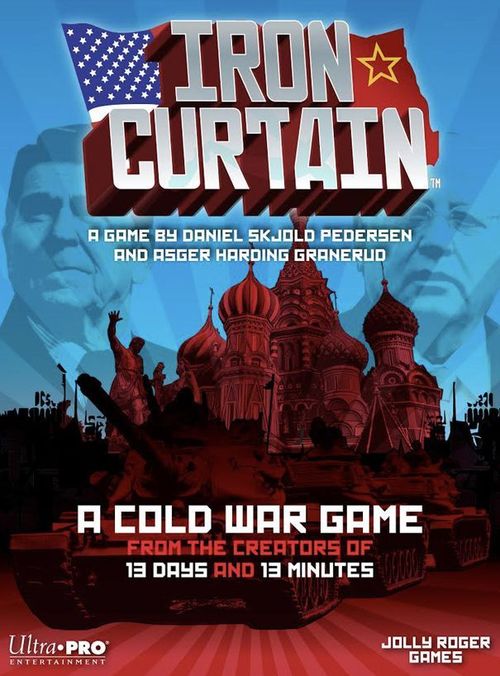
Iron Curtain
Iron Curtain Rulebook
Table of Contents
Table of Contents
Components
- 18 strategy cards (10 US & 8 USSR)
- 1 starter card
- 1 scoring card
- 24 red & 24 blue Influence cubes
- 1 yellow scoring marker
Setting Up the Game
- Distribute the Influence cubes so the US player gets the 24 blue, and USSR the 24 red cubes.
- Place the starter card in the middle of the table, and the scoring card off to a side. Put one blue and one red Influence cube on the starter card.
- Put the yellow scoring marker disc on the yellow spot in the middle of the Ideology points track, found on the scoring card.
- Shuffle the 18 strategy cards and deal 5 strategy cards face down to each player.
- The remaining deck of 8 strategy cards is put to the side for now (still face down).
- In the 1st round USSR chooses the starting player. In the 2nd round whoever is behind on Ideology points decides (still USSR if tied).
How to Play the Game
The game is played over 2 rounds. You have 4 turns in each round. In the 1st round both players get 5 strategy cards, in the 2nd round 4 cards each.
When it is your turn you must take exactly one strategy card from your hand and play it. Once played, the turn passes to your opponent. In the 1st round you will play 4 of your 5 strategy cards this way. The 5th strategy card that is left over after you've had your 4 turns is put aside face down for the "aftermath" in the final scoring when the game ends (together with your opponent's 5th strategy card). It doesn't matter who played which strategy card, so just put them on top of each other. Place these "aftermath" cards next to the scoring card.
Then deal 4 new strategy cards to both players for the 2nd round. In this round you play all 4 strategy cards you were dealt (still alternating taking one turn at a time). Once both players have played all their strategy cards, you do a final scoring of the aftermath & ALL regions.
The game ends immediately if a player at any time reaches the final space (as shown by the US/USSR flag) at the end of the Ideology points track (this is effectively the same as leading by 8 points). The game also ends immediately during the final scoring, if the final space is reached.
Taking a Turn
On a turn players play exactly one strategy card from their hand and follow these 3 steps in order: 1) Place the strategy card, 2) Check for scoring, 3) Event and/or Command action.
1) Place the strategy card face up on the table and expand the active countries
For now ignore all other aspects of the strategy card than the region it belongs to. Note that each region has a specific color (e.g. Europe is blue). Place the strategy card face up on the board, adjacent to a neighboring card of the same color/region (diagonals are NEVER considered neighbors in this game). If there are no adjacent neighbors available, either because they have been blocked off by other strategy cards, or simply because you are placing the first card of that color/region, then you may place the card adjacent to any card already on the table.
Example A: If playing the Vietnam card, it can only be placed at either A or B.
2) Check for regional scoring
This step doesn't happen so often, but it is very important when it does, so make sure you familiarize yourself with it. Ignore all other aspects than the color/region and regional size of the strategy card you JUST played. The regional size shows how many of the 19 cards in the game are of that color/region (18 strategy cards + 1 starter card). If the strategy card you JUST played was the last card of its kind in its specific color/region, the region now scores. Take for example the Asia region (Example B), it has a size of 3. If there were already two Asia cards face up on the table and you just played the third one, then Asia would score.
There are two elements to a region scoring, the basic scoring and the bonus.
The basic - dominating cards
Your aim is to dominate face up cards on the table. You dominate a card by having more Influence cubes on it than your opponent (one extra Influence cube is enough to dominate). For each card you dominate in the region at the time it is scoring, you gain 1 Ideology point. Each time you gain 1 Ideology point, move the yellow scoring marker 1 step closer to your flag on the scoring track. If tied on Influence cubes neither player scores the card.
Example B: Vietnam has just been played. US dominates Pakistan, and is tied in Japan and Vietnam. US gains 1 Ideology point.
The bonus - dominating regions
The player who dominates the most cards, across all the cards in the region when it scores, gains additional Ideology points equal to that region's bonus value. If tied, neither player scores the bonus. In Example B, the US dominated in Asia 1 card more than the USSR. This means that US gains the bonus for Asia which is +2 Ideology points (and thus bringing his total score for the region to 3 Ideology points).
Continue playing unless one player has won at this point by reaching the end of the score track (8 Ideology points). Note that it is entirely possible for your opponent to score in your turn, since regional scoring is mandatory. All steps of a regional scoring are calculated simultaneously.
3) Event and/or Command action
The primary purpose of actions is to get your Influence cubes onto cards lying face up on the table, so you can gain Ideology points at a later stage. At this point your focus is on three elements of the strategy card: the flag, the number of cubes shown and the text explaining an Event.
If the strategy card is of the opponent's alignment (if it has their flag in the upper left corner), then before you do anything, they choose if they want to activate the Event. This effectively means your opponent could take actions during your turn. However, if the strategy card is of your own alignment (it has your flag), then you can choose freely if you want to activate the Event (the card text) or use it for Command (the Influence cubes shown).
Strategy card overview:
- Country
- Region
- Command cubes
- Bonus Points for regional dominance
- Total number of cards in that region
- Event text
Command Action
This is the core action of the game, and you generally use it to place as many Influence cubes onto the table as shown on the card. Using less Influence cubes than shown is allowed, and if you ever run out you can freely pick up your own cubes from elsewhere. If the card played was of your opponent's alignment, then you can never activate the Event yourself, and thus must always play it for the Command.
However, there are some restrictions when you place Influence cubes:
a) You can only place them on cards that already have your own Influence cubes, or on cards that are neighbors to cards that have your own Influence cubes on them (never diagonally). This also counts for the card you just placed. You must have Influence cubes on a neighboring card to reach it! b) Chaining is not allowed. Only Influence cubes that were already on the board before your Command action count. In other words, if you Command 2 Influence cubes, you cannot place the first one on a card, and then use that first cube to get access to a second card. c) You may split the Influence cubes between cards as you wish.
Example C: USSR can Command Influence cubes onto all cards, except the blank card this turn. USA would have access to all cards, also blank card C. USA is also controlling South Africa in this picture.
Controlling a Card
Controlling a card is a very important element of Iron Curtain, as it limits the room your opponent can maneuver and makes it harder for him to contest your domination of the card. You control a card if you have at least 2 Influence cubes MORE than your opponent on that card. When you want to use a Command action to place influence on a card your opponent controls, you must use 2 Influence cubes to place 1. The 2nd cube is wasted and put back in the supply. You place Influence cubes one at a time so may 'break' control on the first placed Influence cube by reducing the lead to less than 2, and then Command subsequent Influence cubes there as normal without wasting further.
Event Action
Events are either stronger but somewhat restricted Command actions (and then always follow the rules from the Command action above), or break rules in different ways. The Event on a card is the written text explanation. Remember that you can only ever play a card for either the Event or the Command, though your opponent may activate his Event when you play his cards. Each Event is unique and you will learn them as you play.
One of the ways in which an Event may break the core rules explained above, is by the keyword "Infiltrate." If an Event allows you to Infiltrate cubes, then you can place them freely as described on that card. Here you are not restricted by having access through neighbouring cards. Equally importantly, you also ignore control when Infiltrating. If you are out of Influence cubes at some point late in the game you may always pick them up freely from any card and put them where your current Command/Event action allows.
End Game Scoring
During the game the yellow scoring marker moves back and forth on the scoring track when regional scoring or specific Events make it happen. When both players are out of cards in round 2 the end game scoring is triggered. Go to aftermath scoring and then a final regional scoring. Note that if any of these steps brings the yellow score marker to the final flag of either player, the game ends immediately with a win to that player.
Aftermath Scoring
Reveal the two facedown strategy cards that were put aside in round 1. Count the number of Influence cubes on US and USSR associated Events on these two strategy cards only (It doesn't matter who played which strategy card). The side with the highest total scores Ideology points equal to the difference in cubes (to a maximum of 3 Ideology points).
Regional Scoring
All regions score in the following order: Europe / Middle East / Asia / Africa / South America / Central America. At this point a region scores even though not all of its cards are on the table (e.g. Europe would score even if there are only 5 Europe cards on the table because one was saved for the aftermath). Beware that this means some regions will score twice per game, while others will not.
The player with the most Ideology points wins. If tied the US wins.