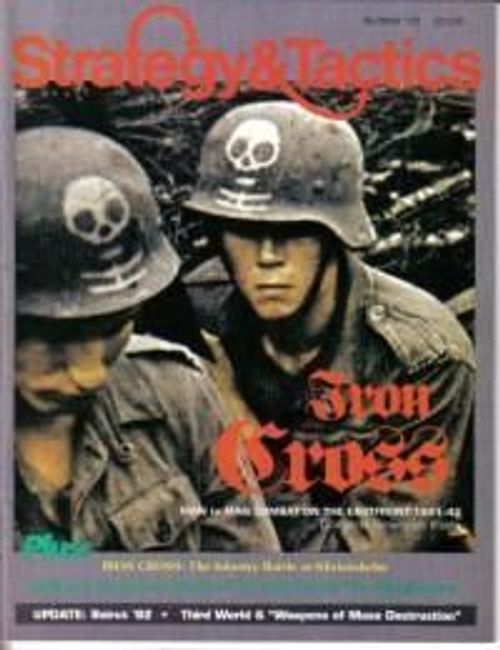
Iron Cross
Iron Cross Rulebook
Table of Contents
Table of Contents
- 1.0 Introduction
- 2.0 Components
- 3.0 Unit States
- 4.0 Performance
- 5.0 Leaders
- 6.0 Sequence of Play
- 7.0 Morale
- 8.0 Movement
- 9.0 Overrun
- 10.0 Fire Combat
- 11.0 AP Fire
- 12.0 AT Fire
- 13.0 Opportunity Fire
- 14.0 Mortars
- 15.0 Grenades
- 16.0 Flamethrower Attacks
- 17.0 Assault
- 18.0 Improved Positions (IP's)
- 19.0 Mines
- 20.0 Crew Replacements
- Advanced Rules
- 21.0 Machine Gun Modes
- 22.0 Ammo Depletion
- 23.0 Observation
- 24.0 Scenarios
- Terrain Clarifications and Errata
- Charts and Tables
1.0 Introduction
Iron Cross is a man-to-man wargame covering infantry battles, on a tactical level, between German and Soviet forces in Russia during 1941-42.
2.0 Components
2.1 Map
The mapsheet is subdivided into three smaller maps. Scenarios 1, 2, 3, 4 and 5 use one of these smaller maps. Scenario 6 uses two of the maps.
Map 1 (hex columns 10xx to 30xx) portrays a built-up, semi-urban area. Map 2 (hex columns 30xx to 50xx) has more open terrain with fewer buildings. Map 3 (hex columns 50xx to 70xx) represents terrain obstructed by woods, marshes, gullies and hills.
Each hexagon represents 10 meters from hexside to hexside. Each turn represents about 2 minutes of real time.
2.2 Counters
The 200 piece countersheet includes the two general types of counters used in the game: combat units and markers. Combat units are of three basic types: Infantry, Armored Fighting Vehicles (AFV's), and Crew Weapons (CW's).
2.21 Infantry
Each infantry unit represents one man. Infantry units have the following information on them:
- Unit Name
- Initial Range
- Weapon Type
- AP Factor
- Assault Rating
- Performance Rating
- Squad or Commander Designation (AP = Anti-Personnel)
Infantry Weapon Types:
- R: Russian 7.62mm bolt action rifle. German Gewehr K98k 7.92mm bolt action rifle.
- MP: Russian PPsh 41 7.62mm machine pistol. German MP40 9mm machine pistol.
- LMG: Russian DP 1928 7.62mm light machine gun. German MG 34 7.92mm light machine gun.
- FT: German M42 flamethrower.
Each unit has either a letter for a Squad Designation or, if the unit is a commander, it will have a PL (Platoon Leader), APL (Assistant Platoon Leader) or PS (Senior NCO).
2.22 AFV's
An AFV (armored fighting vehicle) counter represents one tank or assault gun vehicle and its crew. Each AFV counter contains the following information:
- AFV Type
- AP Range
- Initial ID Number
- Frontal Modifier
- AT Factor
- AP Factor
- Overrun Factor
- Flank Modifier
- Performance Rating
AFV Unit Types:
- Russian: BT7M, T34a (T34/76a), T34b (T34/76b), KV1A, T26S.
- German: IId (PzKfw IId), IIIe&j (PzKfw IIIe & j), IVd&f2 (PzKfw IVd & f2), Stug IIIb.
2.23 CW's
A CW (crewed weapon) unit represents the weapon and the number of men required to operate it. The number of crew members is indicated on the counter. The crew may never be separated from the weapon. Crew members lost to combat results may be replaced by infantry units. Each CW counter contains the following information:
- Weapon Type
- AP Initial Range
- ID Number
- Crew Size
- AP Factor
- Assault Rating
- Performance Rating
- Movement Factor
CW Types:
- MMG: Russian Maxim PM1910 medium machine gun. German MG34 tripod mounted machine gun.
- ATR: Russian PTRS 41 anti-tank rifle. German Pzb 39 anti-tank rifle.
- Mor: Russian 50mm PM40 mortar. German 50mm LeGr w 36 mortar.
- 45AT: Russian 45mm/146 M-32 anti-tank gun.
- 76AT: Russian 76.2mm anti-tank gun.
- 37AT: German 37mm/145 Pak 35/36 anti-tank gun.
- 50AT: German 50mm/160 Pak 38 anti-tank gun.
The front of infantry and CW units is in BLACK print which represents an unconcealed, potentially vulnerable state (referred to in the rules as the UP state). The back of the unit is in WHITE print and represents a semi-concealed state (referred to in the rules as the DOWN state). The front of AFV counters is in BLACK print representing its crew in an exposed or UP state. The back of the counter is in WHITE representing its crew in a "buttoned up" or DOWN state.
NOTE: Not all unit types are used in the scenarios. These extras are available for players who wish to construct their own scenarios.
2.24 Markers
Markers are used to indicate the status of combat units and for other game functions.
2.3 Crew/Ammo Roster
This roster is used to keep track of CW unit crew strengths, crew replacements, grenade availability, ammo supply and machine gun modes. Copies should be made of this roster and when making notations on them pencil should be used since some of the information is temporary.
3.0 Unit States
All units will be in one of two combat states; UP or DOWN state. The front of a combat unit counter (black print) represents its UP state and the back (white print) the DOWN state. All units will also be in one of three morale statuses; NORMAL, PINNED, or SUPPRESSED. PINNED and SUPPRESSED morale statuses are indicated by the presence of a 'P' or 'S' marker stacked with the unit.
3.1 Combat States
3.11 A unit in the UP state retains its full movement and fire capabilities, while a unit in the DOWN state is subject to movement and fire limitations.
3.12 A unit may start the game or enter the map in either state as desired by the owning player.
3.13 NORMAL status units (see 3.21) may change their combat states voluntarily during their Movement and Reaction Movement Phases at a cost in movement points (MP's). Infantry and CW units pay 2 MP's per change. AFV's pay 5 MP's per change. Both players may change the combat states of any of their units once at the end of any Assault Phase at no MP cost.
3.14 Combat results can cause a unit to involuntarily change its combat state (from UP to DOWN).
3.15 A unit may assault (17.0) while in either combat state.
3.2 Morale Status
3.21 A unit that is neither PINNED nor SUPPRESSED is in a NORMAL morale status. A unit stacked with a 'P' marker is in a PINNED morale status. A unit stacked with an 'S' marker is in a SUPPRESSED morale status.
3.22 NORMAL status units perform regular movement and combat without penalty. PINNED units have a lower movement rate (see Movement Allowances 8.1) and SUPPRESSED units may not move at all. Neither PINNED nor SUPPRESSED units may fire or assault.
3.23 Combat results can cause a unit's morale status to change from NORMAL to PINNED or SUPPRESSED.
3.24 During the Morale Phase a player may attempt to change his PINNED or SUPPRESSED unit to a NORMAL status.
3.25 When a unit becomes PINNED or SUPPRESSED it must immediately go into the DOWN combat state, if it is not already.
3.26 PINNED and SUPPRESSED units must remain in the DOWN state until the units return to a NORMAL morale status (the 'P' or 'S' marker is removed).
3.27 Only a NORMAL status unit may change its combat state voluntarily.
4.0 Performance
Each combat unit has a Performance Rating (PR). Each time a unit attempts to perform certain game functions it must make a Performance Check (PC). Whenever a PC is required, two dice are rolled and added together (this total is occasionally modified). If the result is less than or equal to the PR of the unit in question, the PC has been passed. Only if the PC is passed can the unit perform the action desired. If the PC is not passed, the unit cannot perform the action and cannot do anything else in that phase.
Very Important: Anytime a unit takes a PC, regardless of the result, IT IS CONSIDERED TO HAVE PERFORMED THAT ACTION. In the balance of these rules, rather than constantly repeating the phrase "move or have attempted to move" when referring to a unit, the terms MOVE, FIRE, and ASSAULT will refer to units that have taken a PC for the action regardless of the outcome of the PC, pass or fail, and the action of the unit. (Example: A player wants to move his unit X but it fails its PC. The unit is considered to have MOVED for the remainder of that Player Turn.)
4.1 Summary of PC Types
4.11 Regular PC's (two dice rolled, results added together):
- MOVEMENT (8.0)
- FIRE COMBAT (10.0)
- INDIRECT MORTAR FIRE OBSERVATION (14.22)
4.12 Modified PC's (same as regular PC but a number is added to the result):
| Circumstance | Modifier |
|---|---|
| Morale Recovery (7.0) | +2 |
| Leader Directed Movement (8.3) | +2 |
| Opportunity Fire (13.17) | +1 |
| Grenade Attacks (15.3) | +2 |
| Assault (17.12) | +1 |
4.2 Moved/Fired Markers
Players may wish to construct a number of Moved/Fired markers to place on units that have performed (or attempted to perform) these functions. Moved/Fired markers are especially useful to players who are new to the system. As their experience grows the need for them will be less frequent.
5.0 Leaders
Leaders are used to enhance the movement, fire and observation capabilities of other units.
5.1 All commanders, i.e. units with a PL, APL, or PS on their counters, are leaders and may affect any friendly infantry or CW unit.
5.2 Any other infantry unit (not CW, FT, or AFV unit) with a Performance Rating (PR) of 9 or greater and in NORMAL status may function as a leader and is termed an 'acting leader'. An acting leader may only affect the units belonging to his own squad plus any one CW unit.
5.3 Units from different squads that are stacked together may not move together or combine fire unless the stack also contains a commander.
6.0 Sequence of Play
The game is played in a series of Game Turns. Each Game Turn is divided into two Player Turns. The player whose Player Turn is in progress is the PHASING Player; the other player is the NON-PHASING Player. Each Player Turn consists of seven phases which must be performed in the following sequence:
A) MORALE PHASE (both players participate): PINNED markers are automatically removed and SUPPRESSED markers may be removed (see MORALE 7.0). The statuses of hidden units (24.2) and machine gun modes (21.0) are determined.
B) SUPPORT FIRE PHASE: The Phasing Player may attempt to fire any of his NORMAL status units (see FIRE COMBAT 10.0). Mortar attacks (14.0) are resolved before any other type of fire.
C) MOVEMENT PHASE: The Phasing Player may attempt to move any of his units (see MOVEMENT 8.0). Units that performed SUPPORT FIRE may not move. SUPPRESSED units may not move. PINNED unit movement is limited. The Non-phasing Player may attempt opportunity fire (13.0). Moving AFV units may overrun (9.0). At the end of this phase the Phasing Player designates which of his units will assault which hexes in the Assault Phase (17.0).
D) REACTION MOVEMENT PHASE: The Non-Phasing Player may attempt a limited movement with his units (see MOVEMENT 8.0). SUPPRESSED units may not move. PINNED unit movement is even more limited. The Phasing Player may attempt opportunity fire (13.0). At the end of this phase the Non-Phasing Player designates which of his units will assault which hexes in the Assault Phase (17.0).
E) DEFENSIVE FIRE PHASE: The Non-phasing Player may attempt to fire any of his NORMAL status units (see FIRE COMBAT 10.0). Units that performed REACTION MOVEMENT and/or opportunity fire may not fire.
F) MOVING FIRE PHASE: The Phasing Player may attempt to fire any of his NORMAL status units (see FIRE COMBAT 10.0). Units that have already fired in this Player Turn may not fire in this phase. Infantry and AFV units which have moved may fire but with a penalty modifier. CW units that have moved may not fire.
G) ASSAULT PHASE (both players participate): A player may attempt to assault adjacent hexes. All Phasing Player's assaults are performed first, followed by all Non-phasing Player's assaults (see ASSAULT 17.0).
H) FREE UP/DOWN STATE CHANGE (both players participate): Each player (Phasing Player first) may change the UP/DOWN states of any of his units within the restrictions of rule 3.0 UNIT STATES, at no cost in Movement Points.
This ends a Player Turn. The Non-phasing Player now becomes the Phasing Player, repeating steps (A) through (H). After completing this, one Game Turn is completed.
7.0 Morale
During the Morale Phase, each player has the opportunity to return all his PINNED and SUPPRESSED units to NORMAL status. This is accomplished by the following procedure:
a) All "P" (PINNED) markers are automatically removed from both players' units.
b) For each unit with an "S" (SUPPRESSED) marker roll two dice and add two (+2) to the result. If this final number is equal to or less than the unit's PR, the "S" marker is removed. Otherwise, the "S" marker is replaced with a "P" marker.
8.0 Movement
The Phasing Player may attempt to move his units during the Movement Phase. The Non-phasing player may attempt to move his units during the Reaction Movement Phase. Units expend their movement points (MP's) moving from hex to adjacent hex. Units are always moved individually except when affected by a leader (8.3) and AFV/Infantry movement (8.4). During all movement phases some types of units must be moved before others. The movement sequence is:
- First: All AFV's moving alone.
- Second: All AFV and infantry stacks moving together (see 8.4).
- Third: All other infantry and CW units.
8.1 Movement Allowances
8.11 Infantry: NORMAL status infantry units may spend SIX MP's in the Movement Phase and THREE MP's in the Reaction Movement Phase. PINNED infantry units may spend up to THREE MP's in the Movement Phase. They may move ONE HEX, regardless of terrain costs, in the Reaction Movement Phase.
8.12 CW's: NORMAL status, full strength CW units may spend up to the number of MP's listed on their counters in the Movement Phase. They may move ONE HEX, regardless of terrain costs, in the Reaction Movement Phase. CW units with a Movement Allowance of zero and units without a full crew may never move. PINNED full strength CW units may move ONE HEX, regardless of terrain costs, in the Movement Phase. They may not move in the Reaction Movement Phase.
8.13 AFV's: NORMAL status AFV units may spend up to TEN MP's in the Movement Phase and up to FIVE MP's in the Reaction Movement Phase. EXCEPTION: The Russian BT7M AFV has TWELVE MP's in the Movement Phase and SIX MP's in the Reaction Movement Phase. AFV's are never PINNED, therefore they have no Movement Allowance for that morale state.
8.14 Flamethrowers: NORMAL status flamethrower units may spend FOUR MP's in the Movement Phase and TWO MP's in the Reaction Movement Phase. PINNED flamethrower units may move ONE HEX, regardless of terrain costs, in the Movement Phase. They may not move in the Reaction Movement Phase.
8.15 Suppressed units of any type may not move.
8.16 The UP/DOWN states of units do not affect their Movement Allowances. These states determine the terrain costs to move into a hex as shown on the Movement and Combat Effects Chart.
8.2 Movement Restrictions
8.21 Any of the Phasing Player's units that fired in the Support Fire Phase may not move in the Movement Phase.
8.22 Anytime a unit attempts to move it must take a PC. Leaders may be used to increase a unit's chances of moving (see Leader Directed Movement 8.3). EXCEPTION: At the beginning of a game no units are required to pass a PC for movement until either side rolls the dice to resolve combat (the first shot). PC's for movement must be taken by the next Phasing Player. Mine detonations (see MINES 19.0) do not count as combat for this purpose.
8.23 Only friendly units performing an overrun (9.0) may move into an enemy occupied hex during the Movement Phase. Wrecked AFV's do not count as enemy units.
8.3 Leader Directed Movement
When a leader is stacked with other units the leader's PR may be used (the player's option) for the movement PC to move the units with which he is stacked.
Procedure:
A) The leader takes a PC. If he fails no unit in the hex may move but ALL are considered to have moved for the remainder of their turn.
B) If he passes, he may move and any other units stacked with him may move provided they remain with the leader throughout the entire movement. They do not take a PC.
C) If there are units in the stack that wish to move, but not with the leader (either because the leader has moved to another hex or has chosen to remain stationary), each unit takes a modified PC (+2) using the leader's PR. If it passes it may move but has its Movement Allowance reduced to 4 MP's (2 MP's if in the Reaction Movement Phase). If it fails it does not move but is considered to have moved for the remainder of its turn. Several units moving together to the same hex take a single modified PC. A modified PC is taken for EACH and EVERY unit or group, even if some fail and others pass.
8.31 Only NORMAL status Infantry/CW units may use leader directed movement. If an "acting" leader (see 5.2) is used he may lead units from his own squad plus one CW unit. A commander may lead any infantry and CW units.
8.32 Not all units in the stack are required to move nor are they required to move together.
8.33 If a leader moving with a stack becomes a casualty due to enemy opportunity fire (13.0), the group may continue its movement without him.
8.34 If a stack contains multiple leaders, the owning player must designate which units will move with what leaders and which leaders will take the PC for which units. A unit may have only one leader take the PC for it.
EXAMPLE: A hex contains a stack of units composed of one commander (PR10), three infantry men, and an ATR CW unit (two man crew). The owning player wishes to move the commander and one of the infantry men to the same hex (by the same route), one of the infantry men to a different hex, the ATR to a third hex and leave one infantry alone in its present hex. The player wishes to use leader directed movement. On a roll of 7 the initial leader PC is passed, so units may move out of the hex. The commander and the infantryman move together. The second infantryman takes a modified PC using the leader's PR (die roll of 6 + 2 = 8 which passes) and he moves to a different hex. The ATR crew also takes a PC (9 + 2 = 11 which fails) and may not move. The infantryman that was not designated to move is unaffected. Had the commander become a casualty during his movement due to opportunity fire, his PR would still be used by the other units in the original hex.
8.4 AFV/Infantry Movement
AFV/infantry movement is performed after AFV's that are moving alone have moved and before infantry and CW units moving without AFV's move. AFV/infantry stacks may perform combined overruns (9.3) and the infantry may use the AFV for cover (11.33) in fire combat.
8.41 If an AFV begins its movement stacked with infantry units the owning player may attempt to move the entire stack together. The regular movement PC is made for each infantry unit to accompany the AFV. Those units that pass the PC may move with the AFV.
8.42 A player may use leader directed movement (8.3) but the leader and any moving infantry must accompany the AFV.
8.43 Each type of unit moves at its own movement rate and terrain costs. The infantry units may cease movement in any hex either voluntarily or when they exhaust their MP's (the AFV may continue its movement). If an AFV ceases its movement all infantry accompanying it must end their movement also.
8.44 CW units may not move with AFV's.
8.5 Terrain Effects
Certain terrain features (summarized on the Movement & Combat Effects Chart) affect movement by increasing or decreasing the Movement Point cost for a unit entering a hex or crossing a hexside.
8.51 Terrain costs are affected not only by the type of terrain but by the UP/DOWN state of the unit.
8.52 Units expend only 1/2 MP per hex, regardless of the terrain, when moving from one road hex to another road hex along the road. Only NORMAL status units in an UP state may use this road movement rate.
8.53 When a unit moves uphill (i.e., from a non-Hill hex to a Level 1 Hill, or from a Level 1 Hill hex to a Level 2 Hill hex) it must expend one additional MP in addition to all other costs for entering the hex. This additional MP applies only if the unit is moving uphill.
8.54 AFV's may be immobilized by Woods hexes (hexes with 2 or more Tree symbols). When an AFV enters a Woods hex, 2 dice are rolled. If the sum is greater than the number of Trees in the hex, the AFV may continue moving. If it is equal to or less than the number of Trees, the AFV must end its movement there. It is immobilized for the remainder of the game. It may not change facing although it may still fire.
8.55 AFV's may be immobilized by Marsh hexes. When an AFV enters a Marsh hex, 2 dice are rolled. If the sum is greater than 4, the AFV may continue moving. If it is equal to or less than 4, the AFV must end its movement there. It is immobilized for the remainder of the game. It may not change facing although it may still fire.
8.6 Stacking
8.61 CW and infantry units may move through other friendly units without penalty. AFV units may not enter a hex containing another AFV unit. An AFV may push a Wreck out of a hex (8.65).
8.62 At the end of any friendly Movement Phase or Reaction Movement Phase a player may have no more than six men plus one AFV in a hex.
8.63 Each infantry unit counts as one man and each CW represents two to four men. The exact number of men in a CW is indicated on its counter and it may be reduced due to combat. Only one CW counter may be in a hex regardless of the size of its crew.
8.64 Units from different squads may stack together but may not move together or combine fire unless the stack also contains a commander.
8.65 Pushing Wrecks: To push a Wreck, an AFV must spend its entire Movement Phase (not Reaction Movement Phase) in a hex adjacent to the Wreck. At the end of the Movement Phase, the AFV takes a PC. If it passes, the Wreck is placed in an adjacent hex and the AFV enters the hex previously occupied by the Wreck. If it fails, the Wreck does not move.
8.7 Facing
Only ATG's, MG's (both MMG and LMG) and AFV's must face a hexside. The hexside adjacent to the front (top) of the unit is termed its frontal hexside (see diagram). Facing restricts the number of targets at which the unit may fire and, for AFV's, the type of target they present to enemy units. Infantry units other than LMG's and other CW units not listed above have all round facing and may be oriented toward any hexside.
8.71 A facing change is considered movement and a PC is required by the unit before the facing change can be made (Exception: 8.75). Any unit that changes facing is considered to have moved for all purposes. A facing change does NOT trigger opportunity fire (13.0).
8.72 ATG's with a crew strength of 3 or 4 may change facing to any hexside and fire, in that order, within the same Player Turn. ATG's that fired may not change facing later in the same Player Turn. ATG's with a crew strength of 1 or 2 may never change facing.
8.73 MG's may change facing to any hexside and fire, in any order, within the same Player Turn regardless of their crew strength.
8.74 An AFV must maintain its current facing when moving from hex to hex. After it moves into EACH new hex it may freely change its facing ONE hexside left or right. It may then turn additional hexsides at a cost of 1 MP per hexside.
8.75 AFV's that change facing during movement are not required to take a PC each time they do so. The PC for movement covers any facing changes also. AFV's that wish to change facing without leaving the hex must still take the PC and pay the MP costs for each hexside after the first one.
9.0 Overrun
An AFV may overrun enemy units by moving into the enemy occupied hex, expending one extra MP in addition to the terrain cost of the hex, and exiting the hex. An enemy occupied hex may only be overrun if the AFV has sufficient MP's to enter and exit the overrun hex and no hex entered by the AFV is prohibited. If there are insufficient MP's the overrun may not be performed.
9.1 Overrun Restrictions
9.11 An AFV may perform only one overrun per Player Turn and only in the friendly Movement Phase.
9.12 Overruns are resolved when the AFV enters the hex it wishes to overrun. After resolving the overrun and the AFV exits the overrun hex it may continue to move if capable of doing so.
9.13 Hexes containing enemy AFV's or any Wreck markers may not be overrun.
9.14 A hex may be overrun any number of times in a Movement Phase but each time by a different AFV.
9.2 Overrun Resolution
A) Defensive AT Fire. When the overrunning AFV is about to enter the overrun hex from an adjacent hex, all NORMAL status ATR and ATG units in the hex may fire at the AFV unit. This special AT fire may be tried regardless of the firing unit's facing or if it has already fired during the Player Turn. It may only occur ONCE in the Movement Phase and only at the FIRST AFV moving into the hex. The AT fire is directed at the AFV's frontal armor. This fire is resolved as normal anti-tank fire (see FIRE COMBAT 10.0). If the AFV is destroyed place a Wreck marker in the hex adjacent to the defending units.
B) Defensive Infantry Fire. If the overrunning AFV has not been destroyed by AT fire, infantry units in the overrun hex may attempt to destroy it with the following procedure:
-
Take a PC for the highest PR NORMAL status infantry unit in the hex. If the PC is passed, go on to (2). If it is failed or there is no NORMAL status infantry unit, go to (C) below.
-
Total the number of MEN (not COUNTERS) of all NORMAL status infantry and CW units in the overrun hex. (CW units add their current crew strengths to the total even if they participated in (A) above.) Add to this total 1 for:
- each Tree symbol;
- each IP point (see IMPROVED POSITIONS 18.0);
- each NORMAL status commander (Commanders are counted twice, once as a commander and once as an infantry unit).
Two is added to the total if the hex is a Marsh hex.
- The defending player rolls three dice and totals the result. If the total is less than or equal to the number from (2), the AFV is destroyed and a Wreck marker is placed in the overrun hex. If the AFV is destroyed the overrun is completed with no loss to the defenders. If it is not destroyed proceed to Step C.
Step B is performed for EVERY AFV that attempts to overrun the hex, not just the first one.
C) AFV Attack.
- For each defending unit the owning player rolls two dice and adds to their sum:
- one for each Tree symbol in the hex;
- one for each IP point in the hex;
- one if ALL the units in the hex are either PINNED or SUPPRESSED. (Design note: Men who are trying to keep as low a profile as possible are less likely to be noticed by an enemy vehicle intent on killing moving targets.)
If the total is less than or equal to the AFV's Overrun factor the unit is ELIMINATED. Otherwise, the unit is SUPPRESSED and placed in a DOWN state. The SUPPRESSED result is in addition to the current status of the unit. The cumulative effects of these results are shown on the Cumulative Combat Results Table (see Charts & Tables). (Exception: see 18.4.)
- The AFV exits the overrun hex and may continue its movement if it has any MP's remaining.
9.3 Combined Overrun
Infantry units that begin their movement with an overrunning AFV (see AFV/Infantry Movement 8.4) can participate and affect the overrun resolution by nullifying defensive infantry fire (9.2.B). The combined overrun may not be attempted if, at the moment the AFV is about to enter the overrun hex, that hex contains more men (not units) than there are overrunning infantry. In this case the infantry ends its movement in the adjacent hex and the AFV proceeds with its overrun.
9.31 Defensive AT fire (9.2.A) is performed normally. If the AFV is destroyed the accompanying infantry are immediately placed in the DOWN state in the adjacent hex (with the Wreck marker). They have completed their move. They may Assault (17.0) normally in that Player Turn. The infantry are not affected by the special AT fire.
9.32 Defensive infantry fire (9.2.B) is skipped when infantry units accompany the AFV into the overrun hex.
9.33 If the AFV succeeds in the overrun, accompanying infantry units do not exit with the AFV, they remain in the overrun hex. If any SUPPRESSED enemy units are still in the hex the overrunning infantry conduct an IMMEDIATE assault (17.0) and the attackers do not take a PC to do so.
9.34 Infantry units that perform an assault as part of the overrun are considered to have completed their participation in this Player Turn, although they may defend normally if assaulted in the Assault Phase.
10.0 Fire Combat
There are two basic types of fire combat: Anti-Personnel (AP) and Anti-Tank (AT). Units use their fire combat factors to pin, suppress, or eliminate enemy units. AP fire is used against infantry and crew units. It may also be used against AFV's, although AP fire will not destroy an AFV but it may render it ineffective for a time. AT fire combat may only be used against AFV's.
Fire combat does not have to be predesignated; a player may allocate and resolve his attacks in any order he wishes.
Basic Fire Combat Resolution Procedure for AP & AT Fire:
a) Designate a target hex (10.2) and all the eligible units (10.1) that will fire at it.
b) (ADVANCED RULE) Determine if the units can observe the enemy units in the target hex (OBSERVATION 23.0).
c) PC's are taken for units that will attempt to fire at the target hex. Only those that pass the PC will participate in the combat resolution.
d) Determine the final firepower strength of the attack: AP Firepower (11.1) or AT Firepower (12.1).
e) Determine the number of dice required for the resolution: AP Dice Determination (11.3) or AT Dice Determination (12.2).
f) Roll the dice and apply the result: AP Fire Combat Results (11.4) or AT Fire Combat Results (12.3).
Steps (e) and (f) are repeated for each enemy unit in the target hex subject to AP fire. Mortars (14.0), grenades (15.0) and flamethrowers (16.0) are covered in their own sections.
10.1 Which Units Can Fire
10.11 Any NORMAL status unit that has not already fired in the Player Turn is considered eligible to perform fire combat. PINNED/SUPPRESSED units are not eligible to fire. Units that have already attempted to fire in the Player Turn are not eligible to fire. (Exception: MACHINE GUN MODES 21.0.)
10.12 Any unit which attempts to fire must pass a PC.
10.13 Units eligible to fire may do so in the Game Turn phases described below. (Remember: The player whose Player Turn is underway is the PHASING Player; the other player is the NON-PHASING Player.)
- Support Fire Phase: the Phasing Player may attempt to fire with any of his eligible units.
- Movement Phase: the Non-phasing Player may attempt to fire at a moving enemy unit with any eligible friendly units capable of opportunity fire (13.0). Non-phasing ATG and ATR units about to be overrun (9.0) may make a special AT fire.
- Reaction Movement Phase: the Phasing Player may attempt to fire at a moving enemy unit with any eligible friendly units capable of opportunity fire (13.0).
- Defensive Fire Phase: the Non-phasing Player may attempt to fire with any eligible units that did not move in the Reaction Movement Phase or use Opportunity Fire.
- Moving Fire Phase: the Phasing Player may attempt to fire any of his eligible units. Infantry and AFV units that have moved in the Movement Phase are eligible to fire but with a penalty (see 11.32). CW units that moved in the Movement Phase may not fire.
10.14 A German Stug that moved earlier in the Player Turn may not fire in that turn. If it changed facing only, it may still fire but with a penalty (see AT Fire Combat 12.0).
10.15 An ATG with a reduced crew strength of only 1 or 2 may fire only ONCE in a GAME TURN.
10.16 An ATR without a full crew may not fire at all.
10.17 The AP fire factors of different units may be combined against one target hex under certain conditions (see AP Firepower Strength 11.1). The AT fire factors of different units may never be combined.
10.2 Target Hex
10.21 A target hex is any enemy-occupied hex to which the firing units can trace an unblocked line of sight (10.3). Units which cannot trace an unblocked LOS may not fire at that target hex.
10.22 As long as there are eligible firing units, a hex may be designated as a target hex any number of times in a Player Turn and the enemy units in that hex may be subject to any number of attacks.
10.23 ATG's, MG's and German Stugs may only fire through their frontal hexsides at target hexes in their frontal area. An AFV (except Stugs) may fire through any hexside regardless of its facing.
10.24 Every enemy unit in the target hex is subject to AP fire combat (see AP Fire Combat Results 11.4) but no unit may be fired upon more than once in an individual fire combat.
10.3 Line of Sight (LOS)
Line of sight is a straight line from the center of the firing unit's hex to the center of the target hex. An unblocked LOS must exist for fire combat to take place.
10.31 If both hexes are on the same elevation, LOS is blocked if:
a) the line crosses or touches a Building symbol or Hill hex of a higher elevation;
b) the line passes through hexes containing more than three Tree symbols, AFV units, or Wreck markers, in any combination (if the line passes along a hexside, count the Trees/AFV's/Wrecks in the adjoining hex with the greater number of Trees/AFV's/Wrecks);
c) if the firing unit is in the DOWN state and the line passes through a Marsh hex.
Example: The LOS passes through one hex containing two Tree symbols, a Clear hex, a hex with an AFV and a Tree. The LOS is blocked as per (b) (3 Trees and an AFV).
10.32 If the units are not on the same elevations:
a) Determine the level of the units and any possible blocking hexes by referring to the potential obstacle's level number found on the Movement & Combat Effects Chart.
b) Use the Sighting Chart to see if the LOS is blocked:
-
Place a straight edge on the Sighting Chart so that one unit is represented at its correct level on the far left side, and the other unit is represented at its correct level the correct distance away in hexes.
-
Locate any obstruction at its correct distance from the two units in question. If any obstruction is found touching or crossing above the line between the two units, the LOS is blocked.
10.33 LOS will extend INTO a blocking hex but it will not extend THROUGH the blocking hex.
10.34 A hex that contains two different elevations is considered to be at the lower of the two.
11.0 AP Fire
AP factors may be fired at any type of enemy unit. AFV's with both AP and AT fire factors may fire either their AP or AT factors, not both in a Player Turn. AP and AT factors may not be combined.
11.1 AP Firepower Strength
AP firepower strength is determined by taking the total number of AP factors of the firing unit or units, if several are capable of combining factors. The AP firepower strength may be reduced by terrain, location of target hex and range attenuation (11.2). Modifications to AP firepower are applied in the following sequence:
- Reductions for range attenuation;
- All doubling, halving, thirding, quartering of firepower;
- Any other reductions (such as terrain effects).
11.11 AP factors are indivisible, i.e. they cannot be divided among various targets. (Exception: MACHINE GUN MODES 21.0.)
11.12 AFV's and ATG's firing their AP factors may NOT combine them with any other unit's AP factors. Each of these units must resolve its AP fire separately, unit by unit, with one unit's AP factors as the total AP firepower strength.
11.13 Infantry units may combine their AP factors into one total AP firepower strength under these conditions:
a) infantry units of the same squad stacked together;
b) infantry units of different squads stacked together with a commander in NORMAL status;
c) GROUP FIRE: infantry units of the same squad in two adjacent hexes with a NORMAL status leader in one of the hexes.
GROUP FIRE may ONLY be performed during the Support Fire and Defensive Fire Phases. In any other circumstances infantry units may not combine their AP factors with other infantry units.
11.14 MMG units stacked with or adjacent to infantry units and/or other MG units may combine their AP factors into one total AP firepower strength. MG units may participate in Group Fire (11.13, c) provided they are in one of the two hexes.
11.15 MG Intensive Fire: MG (MMG & LMG) units may fire double their AP factors, this is called Intensive Fire. Each time an MG unit uses Intensive Fire there is a possibility the machine gun will become disabled. After each use of Intensive Fire the firing player rolls two dice and applies the result from the Intensive Fire Table to the MG unit.
11.16 An AP firepower total may be reduced for each of the following conditions:
a) minus one for each Tree symbol, AFV unit and Wreck marker in the target hex;
b) minus one for each Tree/AFV/Wreck along the LOS (10.3);
c) minus one if the target hex is on a Level higher than the firing unit(s);
d) MMG's that are not fully crewed have their AP factors halved.
When the firing units are in two hexes as in Group Fire (11.13, c) and/or MG assisted fire (11.14) the reductions for (b) are determined by the LOS for each of the hexes. The reduction for (c) is made if either hex is lower but not minus two if both are lower.
Example: The AP firepower of units in hex A is 12 and of hex B, 10. The units in A fire through a hex with 1 Tree symbol into a higher level target hex with 2 Tree symbols. The units in B fire through a hex with 3 Tree symbols at the same target hex. The combined AP firepower total is 22 (12+10) reduced by 7 (6 Trees + 1 for higher level) resulting in a final AP firepower total of 15.
11.2 Range Attenuation
A fire combat's range is the shortest distance, counted in number of hexes, between the firing unit's hex and the target hex. When counting, include the target hex but exclude the firing unit's hex. The greater the range the more likely a firing unit's factors will be reduced. A unit's initial range (see Units 2.2) indicates the increment, in hexes, in which the unit's factors decrease. Because some units have different initial ranges, range attenuation must be determined by individual units.
11.21 A unit suffers no reduction in its factors when firing at targets within their initial range (the range number printed on the counter).
11.22 When firing at targets beyond the range, a unit's factor is reduced by one for each multiple (or fraction) of the initial range.
11.23 All AP fire is subject to range attenuation. ATR AT fire is subject to range attenuation.
Example: A Russian infantry unit has an AP factor of 4 and an initial range of 7. Its AP firepower strength against any target within 7 hexes would be 4. Its AP firepower strength against any target within 8 to 14 hexes would be 3; within 15 to 21 hexes, 2 and so forth.
11.3 AP Dice Determination
11.31 The number of dice required to resolve each AP fire combat is determined by the target hex terrain, the UP/DOWN state of the target unit and whether or not the firing unit has moved. The number of dice required is listed on the Movement & Combat Effects Chart.
11.32 If the firing unit moved at any time during the Player Turn an additional die is added. When multiple units are combining factors, the additional die is added if ANY of them moved.
Example: An attack against a DOWN unit in a Marsh hex by 2 units (1 of which has moved this Player Turn) would require 4 dice to be rolled.
11.33 AFV/Wreck Cover: When infantry and AFV/Wrecks are stacked in the same hex the AFV/Wrecks will provide the infantry cover (1 extra die rolled) under either of these conditions:
a) if the AFV/Wreck has not moved in the Player Turn;
b) if the infantry moved with the AFV unit throughout its movement and ended movement stacked with it. (This also applies to opportunity fire resolution.)
CW units never receive cover benefits from AFV/Wrecks.
11.34 AP Fire Against AFV's: If the target AFV is in an UP state, two dice are rolled. If it is in a DOWN state four dice are rolled. An additional die is added if any of the firing units moved as in 11.32.
11.4 AP Fire Combat Results
There are three levels of combat results: PINNED (P), SUPPRESSED (S), and ELIMINATED (E). The attacking AP firepower strength defines the chance of each result occurring. The dice roll determines the exact result achieved.
11.41 When there are several units in the target hex every unit must be attacked. Determine and roll the required number of dice for each unit in the target hex separately.
NOTE: The number of dice may vary from unit to unit depending on their UP/DOWN states.
11.42 Result Level Calculation:
a) Start with the final AP firepower total (from 11.1). This is the PINNED (P) level;
b) Halve the P level number, rounding it up to the nearest whole number; this is the SUPPRESSED (S) level;
c) Halve the S level number, rounding it up to the nearest whole number; this is the ELIMINATED (E) level.
11.43 The attacker rolls the number of dice (from 11.3) and totals their results. This number is compared to the three possible result levels.
- If the number rolled is equal to or less than the P level but greater than the S level the result is PINNED.
- Infantry & CW: Place the unit in the DOWN state and mark it with a "P" counter.
- AFV: Pinned has no effect.
- If the number rolled is equal to or less than the S level but greater than the E level the result is SUPPRESSED.
- All types: Place the unit in the DOWN state and mark it with an "S" counter.
- If the number rolled is equal to or less than the E level the result is ELIMINATED.
- Infantry: The unit is immediately removed from the map.
- AFV: Treat as a SUPPRESSED result; in addition the AFV must remain in the DOWN state for the remainder of the game (the tank commander has been killed).
- CW: Roll two dice for each crew member. If the dice result is 8 or less that crew member is killed and one crew box for the CW unit is checked off. If any crew members survive, the CW unit is SUPPRESSED.
- If the number rolled is greater than the P level the attack had no effect on the target unit.
Example: A unit fires with an AP firepower total of 8. Its possible result levels are: Pinned: 8; Suppressed: 4; Eliminated: 2. Its fire dice result is a 5 and its target is Pinned.
11.44 If more than one die is rolled and all "1's" are rolled the result is an automatic ELIMINATED, regardless of the AP firepower total.
11.45 Units may suffer more than one adverse combat result. The cumulative effects of these results are shown on the Cumulative Combat Results Table.
12.0 AT Fire
12.1 AT Firepower Strength
12.11 An attack's AT firepower strength is equal to the firing unit's AT factors. AT factors of different units may not be combined.
12.12 A unit's AT factors are used against AFV's only.
12.13 A unit's AT factors are indivisible; i.e., they cannot be divided among various targets.
12.14 A unit's AT factors may NOT be combined with any other unit's factors. All AT fire is resolved separately, unit by unit, with each unit's AT factors used as the total AT firepower strength.
12.15 An AT firepower total is never modified for terrain.
12.16 All AT fire, except by ATR's, has an unlimited range. Only ATR's are subject to range attenuation when they fire (see Range Attenuation 11.2).
12.2 AT Dice Determination
If the firing unit has not moved during the Player Turn two dice are rolled. If it moved, three dice are rolled. German Stug units that have changed facing without moving out of the hex roll three dice. (Stugs that have moved may not fire.)
12.3 AT Fire Combat Results
12.31 The attacker rolls the number of dice (from 12.2) and totals them. This number will be modified as follows:
- If the firing unit is in the target AFV's frontal area, add the target AFV's frontal armor factor to the dice total. Otherwise, add the target AFV's flank armor factor to the dice total.
- If the target AFV is on a level higher than the firing unit, add one to the dice total.
12.32 If the final result is equal to or less than the AT firepower total (from 12.1), the AFV is destroyed. The AFV is removed from the map and replaced with a Wreck marker (12.4).
12.33 On a dice roll of all "1's" no modifiers are added to the dice roll and the AFV is automatically destroyed.
12.34 When an AFV that is stacked with friendly infantry is destroyed, the infantry are immediately SUPPRESSED.
12.4 Wrecks
A Wreck marker replaces a destroyed AFV. Wrecks are identical to AFV's except that they may not move or fire. They are considered friendly to NEITHER side. AFV's may not enter a hex containing a Wreck marker. Wreck markers affect LOS and can provide cover for infantry (see 11.33). Wrecks may be pushed out of a hex by an AFV (see 8.65).
13.0 Opportunity Fire
During the Movement and Reaction Movement Phases the Non-phasing Player and the Phasing Player, respectively, may perform opportunity fire against moving enemy units. When a moving unit or stack enters a hex within the opportunity fire range and LOS of an enemy unit, the enemy player may interrupt the movement to perform fire combat. Other than the limitations and restrictions noted in this section, opportunity fire is resolved in the same manner as normal Fire Combat (10.0).
13.1 Which Units May Fire
13.11 During the Movement Phase all Non-phasing infantry, AFV, MG, ATR, and ATG units which are eligible to fire (see 10.1) may perform opportunity fire.
13.12 During the Reaction Movement Phase all Phasing ATR and ATG units which are eligible to fire (see 10.1) and have not moved in the preceding Movement Phase may perform opportunity fire. (ADVANCED RULE: MG's in the Spray or Fire Lane modes may opportunity fire in this phase.)
13.13 Only hexes into which enemy units are moving may be designated as target hexes for opportunity fire. All units in the target hex, moving or not, are subject to the fire as in normal fire combat.
13.14 AFV's may only opportunity fire (AT or AP) into hexes within their frontal area.
13.15 A unit may perform opportunity fire only once in a Player Turn regardless of the number of targets with which it may be presented. Units may combine their AP factors for opportunity fire as per 11.13. (Exception: An MG in Spray or Fire Lane Mode. See Advanced Rule 21.0.)
13.16 Each time a moving unit enters a hex against which opportunity fire may be performed, it may be fired upon.
13.17 Infantry units and AFV's attempting opportunity fire in the Movement Phase have their PC dieroll modified by +1. MG's, ATR's and ATG's do NOT have their PC dieroll modified in this phase. Each unit attempting opportunity fire in the Reaction Movement Phase has its PC dieroll modified by +1.
13.18 Combat results from opportunity fire have their normal effects. Moving units which become PINNED may move no further in that phase. Moving units unaffected by opportunity fire may continue to move.
13.2 Opportunity Fire Ranges
- Infantry: three hexes.
- MG's: initial range printed on the counter. MG's may not opportunity fire beyond their initial range.
- ATR's, ATG's: normal ranges. (Remember, ATR's are subject to range attenuation.)
- AFV's: AT factors use normal unlimited range. AP factors (4 factors maximum) up to a maximum range of ten hexes. Range attenuation applies.
14.0 Mortars
Mortars are CW units and are subject to all general CW rules. To perform fire combat, mortars like all other units must be eligible to fire (see 10.1) and must pass a PC. Mortars may be fired in the Support Fire Phase and the Defensive Fire Phase. They may fire in the Moving Fire Phase but, like other CW units, may not fire in this phase if they moved earlier in that Player Turn. Their AP factors may not be combined with any other units. Mortars may not fire from building hexes. Mortar fire resolution takes place before any other type of fire combat in a phase.
If a mortar fires more than once (up to the five rounds maximum, see 14.1) in a fire phase, each round is resolved separately and completely before the next round. The firing player must declare how many times a mortar unit will fire and at what target hex before any of its rounds are resolved.
Mortar Fire Resolution Procedure:
a) Declare the number of rounds to be fired (14.1) and at what target hex (14.2).
b) Determine if the round hits the target hex or scatters (14.3).
c) Roll the number of dice required for the resolution (14.4) and apply the result (14.5).
14.1 Rate of Fire
14.11 A mortar may fire up to five times (or rounds) per Player Turn but all within the same fire phase of that Player Turn. It may fire fewer than five times, if the player wishes. The mortar's full AP factors are used each time it fires, i.e. they are not divided by the number of times it fires.
14.12 A mortar must be fully crewed to fire five rounds in a Player Turn. If it is reduced to two crew members it may fire up to three rounds per Player Turn. If the crew is reduced to one member it may fire a maximum of two rounds in a Player Turn.
14.13 Mortars using indirect fire (14.22) may fire a maximum of two rounds per Player Turn.
14.2 Mortar Target Hexes
The firing player places the 'TARGET HEX' marker in the desired target hex. The target hex must be within the mortar unit's LOS (10.3) unless the unit is using indirect fire (14.22). If a mortar fires more than one round in a phase all rounds must be fired at the same target hex. It is possible that not all rounds will hit the target hex; some of them may scatter into other hexes.
14.21 Mortar Range: Mortars have an unlimited maximum range. The range printed on the unit's counter is the MINIMUM range a mortar may fire without a decrease in accuracy. Rounds fired at target hexes under this minimum range have an increased chance of scattering. A mortar may not fire into its own hex, although rounds may scatter into the firing unit's hex. Mortars do not suffer from range attenuation.
14.22 Indirect Fire: A mortar unit may fire at a target hex to which it cannot trace an LOS under these conditions:
a) There is a NORMAL status commander who has not moved or fired in the Player Turn within two hexes of the mortar unit and this commander CAN trace an LOS to the target hex.
b) The commander must pass a PC to spot for the mortar unit. If he fails the mortar may not use indirect fire. Indirect fire increases the chances of scatter.
14.3 Scatter
The firing player performs the following procedure for each mortar round fired:
a) Place an Impact marker on the target hex and roll one die and modify the result in the following manner:
- subtract 1 if the mortar unit has not changed its target hex from the last Player Turn in which it fired.
- add 1 if indirect fire is being used.
- add 1 if more than three rounds are being fired.
- add 1 if the target hex is under the minimum range.
Find the result on the Scatter Table.
b) If the result is a "T" the round has hit the target hex. If the result is an S# the round has scattered and the number is distance in hexes away from the target hex. Roll one die and consult the Scatter Diagram (see map). Move the Impact marker in the direction indicated by the number of hexes stated in the result. This is the hex the round hits.
14.4 Mortar Dice Determination
The number of dice required is determined the same way as AP fire combat (11.3), except that Trees, AFV's, Wrecks, and elevation differences are ignored. All other terrain and unit conditions affecting the number of dice used are applied.
14.5 Mortar Fire Results
The procedure for determining the effects of each mortar round fired is the same as for AP fire combat results (11.4). The manner in which the results are applied to the target unit(s) is also the same.
14.51 The final AP firepower total for a round is always the number of AP factors printed on the mortar unit. This number is never modified for any reason.
14.52 If the mortar unit is firing several times, each round is resolved separately and completely before the next round is fired. This means that a target unit may be subject to successive mortar fire attacks in the same phase.
15.0 Grenades
15.1 A friendly infantry unit (except flamethrowers) may throw a grenade at an occupied hex in any Support Fire, Defensive Fire, or Moving Fire Phase.
15.2 If grenades are available, all infantry units are assumed to be carrying them. Only infantry units may throw grenades. CW and AFV units do not carry and may not throw grenades.
15.3 The unit must be eligible to perform fire combat (as defined in 10.1) and must pass a modified PC (PC + 2). All units in the hex in which the PC was made are considered to have performed fire combat that Player Turn (Exception: see 17.14). Only one unit may throw (or attempt to throw) a grenade from any one hex during a Player Turn.
15.4 A grenade may be thrown up to a distance of two hexes if neither hex contains a Building. Grenades may be thrown at hexes containing Buildings only if the Building is in an adjacent hex.
15.5 Grenade attacks are resolved separately from all other attacks, including other grenade attacks.
15.6 Each grenade attack is resolved by the attacking player rolling one die on the Grenade Table for each enemy unit in the target hex. (EXCEPTION: AFV's are not affected by grenade attacks.) The type of target hex determines which line on the table is used.
15.7 Grenade attack results affect enemy infantry units in the same manner as AP fire combat results (11.43).
15.8 If the enemy unit is a CW unit and the result is an 'E', the owning player rolls two dice for each crew member. On a roll of ten or less, the crew member is eliminated. If any crew members survive, the CW unit is SUPPRESSED. PINNED and SUPPRESSED results are applied normally as per rule 11.43.
15.9 Grenade Availability: The scenario being played will list the number of grenades each side has available to it. Each time a grenade is actually used (attempts to use don't count), one grenade box is marked off that side's roster chart. Once the number of boxes marked off equals the total number of available grenades for that side, that player may not perform any more grenade attacks in the game. Enemy grenades may not be captured and used.
16.0 Flamethrower Attacks
Flamethrower units (FT's) may attack in the Support Fire, Defensive, and Moving Fire Phases with the same eligibility and PC requirements as other units. They have no AP factors and may not be combined with other units in fire combat.
16.1 FT's may fire at infantry and CW units up to a range of two hexes. They may not fire at AFV's.
16.2 FT's may fire only from the UP state.
16.3 FT attacks are always resolved by rolling two dice (regardless of any terrain, unit states, improved positions, or moving fire modifiers) on the Flamethrower Attack Table. The result is cross-indexed with the range and the effects are applied as in AP fire combat (11.43).
17.0 Assault
At the end of the Movement and Reaction Movement Phases the Phasing and Non-phasing Players (respectively) place Assault markers on their infantry units with whom they intend to perform assault in the Assault Phase. The arrow on the marker must point toward the adjacent hex to be assaulted. This hex does NOT have to be enemy occupied; it can be empty of enemy units. During the Assault Phase, the Phasing Player conducts all his assaults first, then the Non-phasing Player. Assaults are resolved one hex at a time; i.e., each unit (or stack) completely resolves its assault before the next assault is resolved.
Assault is voluntary. Units stacked with an Assault marker are NOT required to assault, but a unit must be stacked with an Assault marker to be eligible to assault.
Assault Resolution Procedure:
a) Designate an assaulting unit or stack and make the PC for each one (17.1). Units that pass are moved into the assaulted hex.
b) Place to one side of the map all the units in the assaulted hex, both attacking and defending.
c) Initial Round: Determine the sequence of fire and perform assault fire in that order (17.21).
d) If opposing units remain in the hex return all SUPPRESSED and PINNED defenders to NORMAL status, go to (e). If only one side's units remain, go to (f).
e) Subsequent Rounds: Perform one assault fire for each unit. Effects are simultaneous; no fire sequence is used. If opposing units remain, repeat another round of assault fire with each unit and do so until only one side is left.
f) Place all surviving units in the DOWN state.
17.1 Which Units May Assault
17.11 Only infantry units stacked with an Assault marker are eligible to assault and only into the hex indicated by the marker.
17.12 Each unit must pass a modified PC (+1 to the dice roll) to assault. Even if the assaulted hex is not enemy occupied the units must take this PC. Units that fail may not assault. If the stack contains a leader, his PR may be used for the entire stack. If the leader passes the entire stack may assault. (Exception: 17.32.)
17.13 Only NORMAL status units may assault. A hex containing an enemy AFV may not be assaulted. CW units may not assault although they defend normally if assaulted. AFV's do not assault (they perform overruns 9.0) nor may they be assaulted.
17.14 Units that fired in the Moving Fire Phase may not assault in the Assault Phase of the same Player Turn. Units may throw grenades in the Moving Fire Phase and still assault but only if the grenades are thrown into the hex being assaulted.
17.15 Due to combat results, units may lose their ability to assault between the time they were marked with an assault marker and the Assault Phase. Units which were designated to assault in the Movement Phase are not prohibited from firing in the Moving Fire Phase but then they may not assault.
17.2 Assault Fire
Assaults are resolved in fire rounds. Each attacking and defending unit gets one shot per fire round, except in the initial round in which firing is done in a set sequence. In subsequent rounds, all fire is simultaneous. Units use their printed Assault factors for assault fire; AP factors are NOT used.
17.21 Sequence of Fire (initial round only): Only the initial fire round is performed in the following sequence:
a) All NORMAL status defenders fire and the results are applied immediately.
b) All PINNED defenders and all attackers fire; the results are applied simultaneously at the conclusion of all fire.
c) All SUPPRESSED defenders (that have not already fired) fire and the results are applied immediately.
17.22 After the initial round all surviving PINNED and SUPPRESSED defenders are placed in NORMAL status. Any subsequent rounds are resolved simultaneously.
17.23 When a unit fires in any fire round the owning player rolls one die. If the result is less than or equal to the firing unit's Assault factor an enemy unit is eliminated. The owning player decides which of his units he will remove from play. If fire is being resolved simultaneously, eliminated units do get the opportunity to fire (if they have not already done so) before being removed.
17.24 Although a CW unit may have more than one crew member it will fire only once per fire round.
17.3 Multiple Assaults
17.31 A hex may be assaulted several times in the Assault Phase (by all six adjacent hexes); each assault is completed before the next is initiated.
17.32 If several assaults are designated against a hex and one of them eliminates all the defenders, units from the remaining assaults may be moved into the assaulted hex up to the normal stacking limit. These units are NOT required to take a PC.
18.0 Improved Positions (IP's)
IP's represent defensive positions from foxholes to small built-up fortresses, depending on the number of IP points and placement. IP's are rated in points (1, 2 or 3). These points affect overrun (9.0) and fire combat (10.0) resolutions. Also, Observation (23.0).
18.1 Players receive IP's at the beginning of a scenario. They may be placed in any hex that can be occupied by infantry and CW units. IP's are not created during a scenario and, once placed, may never be moved or removed.
18.2 Only infantry and CW units may benefit from IP's. When in an IP hex these units should be placed under the IP counter. Any number of these units, up to the stacking limit, will benefit from the IP hex regardless of the number of points. Either side's units may use any IP's.
18.3 Each IP point adds one extra die to enemy fire combat attacks against the IP hex. Each IP point adds one to the defensive infantry fire number (9.5,B) against overruns and to the overrun resolution dice roll (9.5,C). (Printed as "9.5"; the overrun procedures are 9.2 B and 9.2 C.)
18.4 If a hex is overrun, NORMAL status units in IP's are not SUPPRESSED but are only PINNED instead. PINNED units are still SUPPRESSED and SUPPRESSED ones remain so.
19.0 Mines
Depending on the scenario being played, players will receive a certain number of mines which will be secretly deployed around the map. Mines are represented as some number of AP and/or AT factors and the number of factors a player can use is listed in the scenario instructions.
19.1 Mine Deployment
19.11 If a player receives mines in a scenario, he secretly writes down the hex numbers he wishes to mine along with the type of mine in the hex (AP or AT) and the number of factors there.
19.12 A maximum of four AP and seven AT factors may be placed in a mined hex. A hex mined with AT factors must have AT LEAST two factors in the hex.
19.13 Both types of mines may occupy the same hex.
19.14 Mines may be deployed in any terrain except Buildings.
19.15 Mines are never eliminated. The number of factors deployed in a hex is never depleted throughout the game regardless of whether they are detonated or not.
19.2 Mine Detonation
During movement a mine detonation occurs the instant a player's unit (or stack) enters a mined hex. In an overrun, AT factors attack the AFV after the overrun resolution and before the AFV leaves the hex. In an assault, the mine detonation occurs after the completion of the assault resolution.
19.21 If enemy Infantry/CW units enter a friendly AT mined hex, the number of AT factors is NOT revealed to the enemy player NOR do they detonate. Infantry/CW units do not reveal their own AT mined hexes when they enter them.
19.22 If any type of unit belonging to either side enters ANY AP mined hex the number of factors is revealed and they are detonated.
19.23 If an AFV unit belonging to either side enters ANY AT mined hex the number of factors is revealed and they are detonated.
19.24 AP Mine Attacks: If an Infantry/CW unit detonates an AP mined hex, one die is rolled for EACH Infantry/CW unit in the hex. If the result is:
a) 1/4 the number of AP mine factors or less, that unit is ELIMINATED.
b) greater than 1/4, but less than or equal to 1/2 the number of factors, the unit is SUPPRESSED.
c) greater than 1/2, but less than or equal to the number of factors, the unit is PINNED.
d) more than the number of factors, the unit is not affected.
All fractions are rounded up. These results are applied to units in the same manner as in AP Fire Combat Results (11.4).
19.25 AT Mine Attacks: If an AFV unit detonates an AT mined hex, two dice are rolled. If the result is equal to or less than the number of AT factors, the AFV is destroyed and replaced with a Wreck counter. Any infantry accompanying the destroyed AFV are immediately SUPPRESSED.
19.26 If an AFV detonates an AP mined hex, no dice are rolled. The number of AP factors is simply revealed. If infantry are moving with the AFV, they undergo an AP Mine Attack (19.24).
19.27 Only units in NORMAL status after a mine attack may continue moving.
20.0 Crew Replacements
If a CW unit is not fully crewed (it has crew boxes checked off), then regular infantry units may be assigned to that CW unit as replacements.
20.1 At the end of a friendly Movement Phase an infantry unit stacked with a CW unit may become a replacement. The infantry unit is removed from the map and its unit designation is noted next to that CW unit's crew boxes. The infantry unit is now considered part of the CW unit's crew for the remainder of the scenario and may no longer function as an infantry unit in any way. (Exception: 20.3.)
20.2 CW units may not take replacements if all of its original crew members have been eliminated.
20.3 If, at any time, all the original crew members are eliminated and only replacements remain in the crew, the replacements revert to being infantry units. The CW unit is removed and the appropriate infantry units are placed in that hex in a SUPPRESSED morale status.
Advanced Rules
The following rule sections add a substantial amount of realism to the game at the expense of some additional paperwork and extra dicerolling. The Machine Gun Mode rule gives MMG & LMG units two new dimensions which makes them much more versatile than the standard AP type weapon. Ammo Depletion removes the artificial feel of units simply blazing away at each other without regard for their ammo supply. Observation gives greater depth to the terrain within the hex and makes the "sure kill" of an enemy unit less certain.
Players new to the game system should have a comfortable working knowledge of the basic game rules and should play several of the scenarios using them alone before incorporating these advanced rules. Once ready to use the advanced rules, all the advanced rules should be used together.
21.0 Machine Gun Modes
MG's (MMG's & LMG's) have three modes of fire: Direct Fire (DF), Fire Lane (FL), and Spray (SP). On the roster chart, there is a box for each mode beside each MG and the current mode of the MG should be marked in the appropriate box. Both players may alter the modes of any of their MG's at the end of any Morale Phase. A change to SP mode may be attempted in any phase in which the unit is eligible to fire. A unit's mode need not be revealed until the unit fires. Under the basic game rules all MG's are considered to be in the DF mode.
21.1 Direct Fire
21.1 MG's in the DF mode may only attack one hex in the Player Turn. Non-Phasing MG's in this mode may participate in opportunity fire only during the enemy Movement Phase if they have not already fired. Intensive fire (11.15) may only be used by MG's in the DF mode.
21.2 Fire Lane
21.2 FL's represent an MG's ability to fire a sustained burst along a line of fire such that any unit in that line is subject to attack.
FIRE LANE EXAMPLE: In the example above, the shaded hexes represent the area covered by the Fire Lane Attack. Hex A is the target hex of the Fire Lane. The Fire Lane would not penetrate beyond hex A as four tree symbols are encountered. (Diagram not reproduced.)
21.21 If a player chooses an FL mode, he must write down next to the MG's place on the roster chart the target hex for that FL during the upcoming Player Turn. This target hex can be any hex within the MG's unblocked LOS and within its initial range. All hexes touched by a straight line from the center of the MG's hex to the center of the target hex are subject to attack by the MG. A fire lane only applies to hexes that are on the same level as the MG.
21.22 If there is an enemy unit in the MG's fire lane during the Support Fire or Defensive Fire Phase the MG may fire. If a unit enters one of these hexes during any Movement or Reaction Movement Phase, the MG may perform opportunity fire. The MG must be eligible to fire as per 10.1.
21.23 If an MG executes an FL attack against an enemy unit and there are several units in different hexes along the fire lane, each of those units (including friendly ones) must undergo a separate FL attack.
21.24 The normal fire PC is taken the first time an FL attack is made in a phase. If the MG passes it need not take another PC for any subsequent FL attacks made in that phase; if it fails it will never fire during that Player Turn.
21.25 FL attacks are resolved normally with the MG's full AP firepower (subject to terrain reductions per hex) being used for EACH attack.
21.26 FL attacks may never be combined with any other AP attacks. If a unit is in more than one MG's fire lane, each FL attack against it is resolved separately.
21.27 An MG in FL mode is still restricted to one fire combat in a Player Turn even though it can make multiple FL attacks against several units when it fires. These attacks are considered part of the one fire combat.
21.3 Spray Fire
Spray represents an MG's ability to sweep an area with fire and attacks any or all of the units in its area of fire.
21.31 If a player chooses an SP mode, the MG has a spray fire area which covers the same hexes as its frontal area. These hexes can be any hex within the MG's unblocked LOS and within its initial range. All hexes within this area and within the MG's LOS are subject to attack by the MG. The spray fire area applies to hexes that are on the same level as the MG.
21.32 If there is an enemy unit within the MG's spray fire area during the Support Fire or Defensive Fire Phase the MG may fire. If a unit enters one of these hexes during any Movement or Reaction Movement Phase, the MG may fire. The MG must be eligible to fire as per 10.1.
21.33 If an MG executes an SP attack against an enemy unit and there are several units in different hexes within the fire area, any or all of these units will undergo a separate SP attack. Which units are attacked and which are not is the player's option.
21.34 The normal fire PC is taken the first time an SP attack is made in a phase. If the MG passes, it need not take another PC for any subsequent SP attacks made in that phase; if it fails it will never fire during that Player Turn.
21.35 SP attacks are resolved normally with only one-half (rounded down) the MG's full AP firepower (subject to terrain reductions per hex) being used for EACH attack.
21.36 SP attacks may never be combined with any other AP attacks. If a unit is in more than one MG's spray fire area, each SP attack against it is resolved separately.
21.37 An MG in SP mode is still restricted to one fire combat in a Player Turn even though it can make multiple SP attacks against several units when it fires. These attacks are considered part of the one fire combat.
21.4 Changing Modes
21.41 At the end of any Morale Phase, each player is permitted to change the mode of their MG's. Only a NORMAL status unit may change its mode. In the Morale Phase modes may be changed freely and any mode may be chosen.
21.42 An MG may change to the SP mode ANYTIME it is eligible to fire subject to these restrictions:
-
It has not already fired in the Player Turn;
-
It takes a PC to make the mode change. If it fails it may not change modes although it may still fire from its current mode and must take the normal fire PC to do so.
-
If it succeeds in switching to SP mode, its AP factors are halved for the remainder of the Player Turn. This means that when it fires it will do so at one-quarter its AP firepower (halved once for the mode change and half again for SP mode).
22.0 Ammo Depletion
Combat units did not go into battle with unlimited ammunition. To reflect this, scenarios will limit the number of times weapons may be fired. This is indicated by the ammo point number in parentheses beside the units in the scenario force selections. If a unit has such a number beside it, then it is subject to ammunition depletion. In the basic game rules only grenades are subject to depletion.
22.1 A unit's ammo point number is the maximum number of times the unit can fire in the game. When this number is expended the unit is out of ammo and may fire no more in the game. There is no resupply, and taking ammo from other units, enemy or friendly, is not allowed. Ammo points are expended only if it actually fires; a failed PC attempt to fire does not cost an ammo point.
22.2 The number of ammo points expended in a fire combat can vary depending on the weapon and its type of fire as listed below:
- MG in DF mode (non-intensive fire): 1 point
- MG in DF mode (intensive fire): 3 points
- MG in SP mode (attacks only 1 hex): 1 point
- MG in SP mode (attacks multiple hexes): 2 points total
- MG in FL mode: 2 points regardless of the number of hexes
- ATR: 1 point
- Mortar: 1 point per round
- ATG: 1 point
22.3 Each time a point is expended, one of the boxes on the roster next to the appropriate firing unit is marked off. When the number of boxes marked off equals the unit's maximum ammo points (as listed in the scenario instructions) it is out of ammo.
23.0 Observation
An unblocked LOS does not necessarily mean that the firing units can clearly see the individual enemy units in the target hex. Units in adjacent hexes always automatically observe each other. Observation of the target enemy unit is required for AT fire combat. Target hexes subject to AP fire need not be observed and if they are not observed, the final AP firepower total is reduced by one-half (i.e., to use full strength AP firepower a target hex must be successfully observed).
23.1 Which Units Can Observe
23.11 In the fire combat procedure, observation is determined after the unblocked LOS is established but before any fire PC's are taken by firing units.
23.12 Only one unit in a hex can attempt to observe another hex. If there are two units in a hex they may attempt to observe different hexes, but may not attempt to observe the same hex.
23.13 If one unit in a hex successfully observes an enemy unit in the target hex, all units in the observer's hex are considered to have seen the enemy units.
23.14 When attempting group fire (11.13,c), only the leader may be used to observe.
23.2 Observation Procedure
For each observation attempt roll two dice and add the results together. This number is compared to the Observation Base number for the type of terrain found in the target hex (Observation Base numbers are listed with the terrain on the Terrain Effects Chart). If the dice result is equal to or less than the base number, all the enemy units in the hex are considered observed.
The observation dice roll result can be modified up or down by the various conditions listed below. All modifiers are cumulative.
Modifiers Favoring the Target
a) +1 for every five hexes, beyond an initial five hexes, from the observing unit's hex to the target hex.
b) +1 for each improved position point (18.0) in the target hex.
c) +1 for each Tree symbol in the target hex (this is in addition to the lower base number for Woods).
d) +1 for each Tree/AFV/Wreck in the hexes along the LOS to the target hex.
e) +1 for each Marsh hex along the LOS to the target hex.
f) +1 if the target is a non-AFV unit in the DOWN state.
g) +2 if the observing unit moved within the last three phases. *
Modifiers Favoring the Observer
a) -1 if the target hex was successfully observed on a previous Player Turn and neither the observer nor the units in the target hex have moved since that observation.
b) -1 if the target hex is two or more levels lower than the observing unit (this does not apply if the target hex is a Woods or Building hex).
c) -2 * if any unit in the target hex moved within the last three phases.
d) -4 if there is an AFV in the target hex.
e) -2 if the observer is a commander.
f) -1 if the target hex has four or more men (not units) in it.
g) -2 * if any non-MG unit in the target hex used AP fire within the last three phases.
h) -3 * if any LMG or ATR unit in the target hex fired within the last three phases.
i) -4 * if any MMG or Mortar unit in the target hex fired within the last three phases.
j) -5 * if any ATG, AFV or MG, using intensive fire, in the target hex fired within the last three phases.
- Exclude the Morale Phase when counting the last three phases.
A failed observation attempt does not always prevent the units in the observing hex from firing (see 23.3). If there are at least two units in the hex a second unit may attempt to observe another hex.
Optional Penalty: Before the game begins players may choose to tack on this additional penalty to observing units if they so wish. When there were NO modifiers to the observer:
a) if the observing units have not yet moved, all of the units in the observing hex are considered to have moved for that Player Turn. They may still fire normally.
b) if the observing units have already moved, the observation attempt may NOT be made.
23.3 Observation Effects
23.31 AT fire must always be directed at an observed target.
23.32 Units using AP fire are not required to observe. If firing AP firepower into an unobserved hex, the firepower total is halved (rounded up).
23.33 Mortars may be fired at unobserved hexes but with increased chances of scattering their rounds (see Mortars 14.0).
23.34 AFV's and MG's do not have to observe target hexes that are Buildings to fire their full AP fire factors. For all other terrain types they are subject to 23.32 when using their AP factors.
23.35 MG's using FL or SP attacks never have their AP firepower halved because of unobserved target hexes.
23.36 Infantry units do not have to observe a hex to throw a grenade into it.
24.0 Scenarios
24.1 Scenario Instructions
There are six scenarios in Iron Cross. Scenario 1 is the easiest and should be played first by those new to the game system. Scenarios 2 through 5 progress in size and complexity. Scenario 6 which is the largest and most complex is ideally suited for team play.
Each scenario has the following information:
- The scenario's historical background.
- The map which is used and the placement of the NORTH indicator.
- The number of Game Turns.
- The units, improved positions, and number of grenades each side will have in the game. The units are either identified by their squad designation, weapon type and ID number, or AFV type and ID number. An under-strength squad is indicated by listing the type and Performance Rating (PR) of the units to be removed from the squad before the game begins. If a squad has more than one unit with the same PR the owning player randomly determines which unit will be left out.
EXAMPLE: A scenario calls for Russian Squad D less R PR9. This means that a Rifle unit in Squad D with a Performance Rating of 9 is not used in the scenario. Since there are several rifle units with a PR of 9 in the squad the Russian player blindly chooses the one to remove.
If a squad has a list of men with the word "ONLY" after them, then only these units from the indicated squad are used.
The number and strength of improved positions (IP) is listed, e.g. IP2 x 1 means one 2 point IP marker. The number of grenades available is listed and should be noted on the roster.
AMMO POINTS: This is used only if the Advanced Rules are being played. If a squad has a number in parentheses beside it, this is the number of ammo points available to that squad's LMG. If a CW unit has a number in parentheses beside it, this is the number of ammo points available to it. If the CW unit has no ammo point number it has unlimited ammo for the game. Ammo points should be noted on that side's roster before the game begins.
EXAMPLE: A scenario calls for Russian Squad D (10). This means the LMG of Squad D starts the game with 10 ammo points available.
-
The side that will move first is indicated. This player has the first Player Turn of each Game Turn in the scenario.
-
The set-up instructions for each side indicate which side places its units on the map first, whether there are any hidden hexes, unit deployment restrictions, and Russian Infiltration. If a player's units are not deployed on the map but enter through one of the map edges, the map edge or hexes to be moved through is listed. Units which enter the map during the course of the game always do so in the Movement Phase of their side's Player Turn, unless noted otherwise.
-
The victory conditions for each side.
24.2 Hidden Hexes
In each scenario, one side will have a number of hidden hexes available to it. Hidden hexes allow a player to conceal the location of some of his units from his opponent.
24.21 The player receiving the hidden hexes secretly chooses and records the hex numbers of his hidden hexes and the ID's of the units in them. Hidden hexes may only be selected from that area of the map in which the player is permitted to deploy. Stacking restrictions apply to the units deployed in the hidden hexes. AFV's may not be deployed in hidden hexes.
24.22 Units deployed in hidden hexes are not revealed until one of the following occurs:
- They are voluntarily revealed by the owning player.
- If any unit (friendly or enemy) moves into or out of the hidden hex, all units in the hex are revealed.
- If a hidden unit in a hidden hex fires, it (and only it) is revealed.
- If a NORMAL status enemy unit begins its Morale Phase in a hex adjacent to a hidden hex, all units in the hex are revealed.
24.23 If an enemy unit is about to enter a hidden hex, the units hidden there are immediately placed on the map. If an enemy unit is designated to assault what turns out to be a hidden hex, the hidden units are not placed on the map until the assault is resolved.
24.3 Russian Infiltration
Even in the early years of the war the Russian Army was particularly adept at infiltrating German positions as a prelude to an attack. Aggressive reconnaissance, personal toughness, and the desire to drive out the hated invader (not to mention the gentle persuasion of a pistol wielding commissar) allowed small groups of Russian soldiers to penetrate into and sometimes beyond German defensive lines. These pre-play rules give the Russian player the option of infiltrating the German player's unit set up but with some risk of being discovered and losing units of his own. Infiltration may only be used if the option is present in the scenario instructions.
24.31 After the German player sets up his units including the notation of any hidden hexes and mines, the Russian player may designate ONE squad PLUS, if he wishes, one commander from his order of battle to attempt an infiltration. The Russian player may choose not to infiltrate if he so wishes. CW and AFV units may not infiltrate.
24.32 The Russian player indicates any hex on the map within the scenario's infiltration restrictions as his Infiltration Hex and announces it to the German player. This hex may not be occupied by an on-map German unit, though it may be adjacent to one. The hex may contain any type of terrain.
If the German player has a hidden hex closer to the Infiltration Hex than the nearest German on-map unit, he may voluntarily reveal the hidden hex and place ALL the units deployed there on the map.
24.33 After the Infiltration Hex has been selected the success of the infiltration is determined. The Russian player rolls two dice and the result is modified by terrain, leadership and proximity to the nearest visible Germans. This modified result is cross-referenced with the correct Infiltration result.
24.34 Infiltration Results:
- SN (Successful, Normal Status): All infiltrating units are deployed on the map within two hexes of the Infiltration hex (inclusive) but no closer to any German unit than the Infiltration hex is. Each unit may be placed in either the UP or DOWN state and in NORMAL status. Units must be placed within stacking limits. The scenario begins with the Russian player turn Support Fire Phase.
- SP (Successful, Pinned Status): Same as SN except that all the units are deployed in the DOWN state in PINNED status.
- SS (Successful, Suppressed Status): Same as SN except that all the units are deployed in the DOWN state in SUPPRESSED status.
- F# (Failed, Number of Casualties): The infiltration attempt is discovered and the squad may suffer some losses before regaining their lines. # is the number of randomly selected infiltrating Russian units that are removed from the infiltrators. The survivors participate in the scenario as though no infiltration attempt has been made and the scenario begins normally.
24.35 If the Infiltration Hex is also a German hidden hex the German player must reveal this fact and the infiltration mission automatically fails. The Russian player rolls one die and the result is the number of casualties suffered as in the "F#" result. The German units in the hidden hex are permanently revealed and a Grenade Attack (15.6) is performed against it. Pinned and Suppressed results are ignored.
24.36 After all infiltrating units have been deployed the German player announces any German hidden hexes that are stacked with or adjacent to infiltrating units. If infiltrating units are stacked with a hidden hex each Russian unit is immediately SUPPRESSED and placed in an adjacent hex (which in turn could reveal other hidden hexes). The German units in the hidden hex are subject to a Grenade Attack as in (24.35). Russian units adjacent to revealed hidden hexes are immediately PINNED in that hex. The German units are not affected. These PINNED and SUPPRESSED results are in addition to any suffered as a result of an "SP" or "SS" Infiltration Result. (See the Cumulative Combat Results Table.)
24.37 Any infiltrating units placed on AP (only) mined hexes, including the Infiltration Hex itself, reveal the presence of the mine AFTER any hidden German units are revealed. Each Russian unit on such a hex is subject to a normal mine attack and any status result is in addition to the Infiltration Result and/or German hidden hex result (See the Cumulative Combat Results Table).
24.4 Scenario 1: Demyansk Pocket
BACKGROUND: During the last week of February, 1942 units of the Russian 34th Army attempted to penetrate the northeast sector of the German line around the Demyansk pocket. German strongpoints consisting of troops from the 30th Infantry Division held important roadways in what was a successful effort to forestall a collapse of the pocket.
MAP: Map 2 (hex columns 3001/3027 to 5001/5027) is used.
NORTH INDICATOR: Place in hex 5001 pointing to hex 5002.
GAME LENGTH: 7 Game Turns
GERMAN SET-UP: Squad C (10); MMG #1 (12); PL; IP1 x 2; Grenades (6).
RUSSIAN SET-UP: Squad A (8) less LMG PR8; Squad B (8) less LMG PR8; Squad C (8) less R PR9; MMG #'s 1 & 2 (14 each); PL PR10; APL PR9; Grenades (10).
German player notes: 1. German player sets up first. 2. May have 2 hidden hexes. 3. Deploy in any building or tree hex adjacent to the road running from hexes 4001 to 5014 or on Hill K.
Russian player notes: 1. Russian player moves first. 2. May infiltrate any hex north and east of road 4001-5014. 3. Non-infiltrating units enter on turn 1 on the north mapedge or on the east mapedge north of hex 3014.
VICTORY CONDITIONS: The player who has at least one unit in both hex 4307 and hex 4308 at the end of the game, wins. Any other result is a draw.
24.5 Scenario 2: Infantry Fight at Khristishche
BACKGROUND: Following the successful defense of Moscow the Soviets launched a winter offensive in the Ukraine hoping to catch the Germans in winter hibernation. In late January a Siberian division of the Russian 57th Army was stalled against the fortified town of Khristishche occupied 1st Battalion of the German 196 Regiment/68th Division. On the night of January 25, 1942 the Siberians attempted to establish a foothold in the town in preparation for a larger attack. (See accompanying S&T article.)
MAP: Map 1 (hex columns 1001/1027 to 3001/3027) is used.
NORTH INDICATOR: Place in hex 1002 pointing to hex 1001.
GAME LENGTH: 9 Game Turns
GERMAN SET-UP: Squad C (12); Squad E (12) less LMG PR10 and 2 FT's; MMG #'s 1 & 2 (14 each) with Squad C; PL with Squad E; PS with Squad C; IP3 x 1 on any building hex; IP2 x 2 on any building hex; IP1 x 3 on any building hex; Grenades (15).
RUSSIAN SET-UP: Squad A (10) less LMG PR8; Squad G; PL 11; APL 9; Grenades (10).
German player notes: 1. German player sets up first. 2. May have 3 hidden hexes. 3. Squad D must deploy in any type building hex south of road 1014-1315-1715-2215-2613-2913-3014. 4. Squad E must deploy in any type building hex north of Squad D's deployment area.
Note (transcriber): the printed German set-up list for this scenario does not list Squad D, although German set-up note 3 deploys it. Transcribed as printed.
Russian player notes: 1. Russian player moves first. 2. May infiltrate any hex south of road 1014-1315-1715-2215-2613-2913-3014, exclusive. 3. Non-infiltrating units enter on south map edge on turn 1.
VICTORY CONDITIONS: The German player wins if no Russian units occupy any building hexes at the end of the game. The Russian player wins if he is the sole occupant of at least 1 multi-hex building at the end of the game. Any other result is a draw.
24.6 Scenario 3: Closing the Ring
BACKGROUND: During the month of September 1941, the German Army was closing the ring on the Russian Armies in the Kiev pocket. One hundred miles east of Kiev in the Romny area Guderian's Panzergruppe was racing south to link with Kliest's Panzergruppe to seal the fate of the encircled Russian forces. On September 14, 1941 an advance group of the 3rd Panzer Division (panzergrenadiers from the 394th Inf. Reg. with tanks from the 6th Panzer Reg.) smashed the Russian defenders at Lokvista thus closing one of the last Russian escape routes to the east. Later that day the advance group would link up with the 16th Panzer division from the south.
MAP: Map 2 (hex columns 3001/3027 to 5001/5027) is used.
NORTH INDICATOR: Place in hex 5002 pointing to hex 5001.
GAME LENGTH: 7 Game Turns
RUSSIAN SET-UP: Squad C less LMG PR8; Squad D (10) less R PR8; MMG #2 (12); ATR #2 (6); 45AT #'s 1 & 2; MOR #1 (21); IP2 x 1; IP1 x 2; Grenades (6).
GERMAN SET-UP: Squad B (10); Squad C (10); Squad D; MMG #2 (14); PL; PS; IIIe #'s 1 & 2; Grenades (12).
Russian player notes: 1. Russian player sets up first. 2. May have 3 hidden hexes. 3. Deploy in any hex south of hexrow xx06.
German player notes: 1. German player moves first. 2. All units except Squad D and PS enter on the north mapedge on turn 1. 3. Squad D and PS enter on turn 3 from hexes 3001 to 3013 or from hexes 5001 to 5012 (this choice must be made prior to the start of the game).
VICTORY CONDITIONS: The German player wins if there are no Russian units on Hills J and K at the end of the game. Any other result is a Russian victory.
24.7 Scenario 4: Tula
BACKGROUND: During the end of November, 1941, Panzergruppe Guderian loses the remaining strength from some of the best German units in futile attempts to capture Tula during the Moscow Campaign. Assault teams from the Grossdeutschland Regiment supported by tanks attempt to clear the outskirts of Tula. The initial attacks go well but it is soon stopped by units of the Russian 50th Army, leaving Tula in Russian hands, thus blunting the drive for Moscow.
MAP: Map 1 (hex columns 1001/1027 to 3001/3027) is used.
NORTH INDICATOR: Place in hex 1026 pointing to hex 1027.
GAME LENGTH: 6 Game Turns
RUSSIAN SET-UP: Squad A (7) less LMG PR8; Squad D (7) less R PR8; Squad F (3 units, MP PR9, PR8, PR6 only); APL PR9; MMG #2 (10); 45AT #'s 1 & 2; IP1 x 3; IP2 x 1; 10 AT Mine Factors; Grenades (10).
GERMAN SET-UP: Squad B (6); Squad C (6); Squad D; Squad E (4 units, MP PR10, LMG PR9 (10), R PR8, FT PR9 (4) only); PL; MMG #1 (11); IVe #1; IP2 x 1; Grenades (24).
Russian player notes: 1. Russian player sets up first. 2. May have 3 hidden hexes. 3. Deploy anywhere north of road network bounded by hexes 1014 - 1315 - 1608 - 2108 - 2106 - 2608 - 2703 - 2913 - 3014. (Printed errata: in point 3, '2703' should read '2613'; see Terrain Clarifications and Errata below.)
German player notes: 1. German player moves first. 2. Deploy anywhere south of the road network listed in the Russian set-up.
VICTORY CONDITIONS: The German player wins if there are no Russian units south of the east-west road (hexes 1014 - 1315 - 1715 - 2215 - 2613 - 2913 - 3014) and no Russian units in either Building 1 or Building 2 at the end of the game. The Russian player wins by having at least three units south of the east-west road, described above, at the end of the game. These three units must be any commander unit(s) or non-commander units from the same squad.
24.8 Scenario 5: Through the Marshes
BACKGROUND: Seeking to establish a bridgehead across the Luga River and to envelope the Russian positions at Luga, Hoepner sends the XLI Panzer Corps through the marshes north of Luga. Advance elements of the 6th Panzer Division forge through the swampy terrain, many times restricted by a single road. During July 13, 1941, they ward off numerous Russian attacks intended to bog down the German advance. The next day the 6th Panzer Division captures two bridges at Porietchye on the Luga River. The road to Leningrad is now within reach.
MAP: Map 3 (hex columns 5001/5027 to 7001/7027) is used.
NORTH INDICATOR: Place in hex 7002 pointing to hex 7001.
GAME LENGTH: 6 Game Turns
RUSSIAN SET-UP: Squad A (9) less LMG PR9, R PR8, PR7, PR6; Squad C (9) less R PR9, PR8, PR7, PR6; Squad D (9) less R PR9, PR9, PR6, PR5; MMG #'s 1 & 2 (12 each); MOR #1 (24); ATR #'s 1 & 2 (10 each); 45AT #2; BT7m #'s 1 & 2; T34a #1; IP1 x 3; 12 AT Mine Factors; Grenades (12).
GERMAN SET-UP: Squad A (10); Squad B (10); Squad C (10); PL; PS; MMG #1 (15); MOR #1 (30); ATR #'s 1 & 2 (10 each); IId #1; IIIe #'s 1 & 2; Grenades (15).
Russian player notes:
- Russian player sets up first.
- May have 6 hidden hexes.
- Deploy anywhere north of gully hexes 6723 to 5521, and north of hexes 5122, 5222, 5322, 5422, 6824, 6924, 7024.
- The two BT7m's must deploy north of gully hexes 5403 to 6410 and they may not move until Russian Player Turn 2.
- The T34a enters on the north mapedge during the Russian Reaction Movement Phase of turn 4.
German player notes:
- German player moves first.
- Enter all units on the south mapedge on turn 1.
- EXCEPTION: Up to 1 squad, 1 commander, 1 CW, 1 AFV may enter the map between hexes 5115 and 5127 (inclusive) on turn 2. (Printed errata: '5115' and '5127' should read '5015' and '5027' respectively; see Terrain Clarifications and Errata below.)
- The German player must record which units, if any, will enter on turn 2 prior to the initial Russian set-up.
VICTORY CONDITIONS: The German player wins if there are no Russian units on any of the bridge hexes (5806, 6410, 6521, 6815) and no Russian units on any of the Hills (M, N, O, P) at the end of the game. Any other result is a Russian victory.
24.9 Scenario 6: Spartakovka
BACKGROUND: At the end of October, 1942, units of the 16th Panzer Division and the 94th Infantry Division are ordered to clear Spartakovka, a northern suburb of Stalingrad. Though badly understrength, the German units succeed in clearing the outskirts of the city but become entangled with units of the Russian 124th and 148th Rifle Brigades inside the city proper. Combat engineers from the 16th Panzer Division supported by the 177th Stug Bn. attempt to enter Spartakovka while divisional troops and tanks hold the 149th Rifle Brigade to their positions. The Russians save the day by committing T34's from their only tank battalion in the sector. The tanks, along with fresh supporting infantry, succeed in stopping the Germans in the city.
MAP: Maps 1 and 2 (hex columns 1001/1027 to 5001/5027) are used.
NORTH INDICATOR: Place in hex 5001 pointing to hex 5002.
GAME LENGTH: 12 Game Turns
RUSSIAN SET-UP:
GROUP 1: Squad A (18) less R PR9, PR7, PR6, PR5; PL PR10; IP2 x 1.
GROUP 2: Squad B (20) less R PR9, PR8, PR6, PR5; Squad C (20) less R PR8, PR7, PR6, PR5; APL PR9; MMG #'s 1 & 2 (22 each); 45AT #'s 1 & 2; 76AT #1; IP3 x 1; IP2 x 1; IP1 x 1; 38 AT Mine Factors; 38 AP Mine Factors.
GROUP 3: Squad D (22) less R PR9, IP1 x 2; 12 AT Mine Factors; 12 AP Mine Factors.
GROUP 4: Squad F; Squad G; PL PR11; APL PR10; T34b #'s 1 & 2; Grenades (32).
GERMAN SET-UP:
GROUP 1: Squad A (24); Squad B (24); Squad C (24); PL; PS; MMG #'s 1 & 2 (28 each); 50AT #1; IId #1; IIIe #'s 1 & 2; IVe #1; IVf2 #1.
GROUP 2: Squad E (20 each); Stug III 6's 1 & 2.
GROUP 3: IIIj #1.
Grenades (32).
Russian player notes:
- Russian player sets up first.
- May have 12 hidden hexes.
- Group 1 deploys anywhere on Map 1 east of the north-south road (hexes 2001 to 2027).
- Group 2 deploys anywhere on Map 1.
- Group 3 deploys anywhere on Map 2 east of hex column 35xx (exclusive), on Hill J, and anywhere on Map 1.
- Group 4 may enter on the east mapedge of Map 1 on turn 9, or on the north or south mapedge east of hex column 21xx, on turn 10.
German player notes:
- German player moves first.
- Group 1 deploys in any building or tree hex adjacent to the road running from hex 4001 to 5014, and on Hill L.
- SPECIAL: One squad, one commander, one MMG and two AFV's from Group 1 may enter on the west mapedge of Map 2 on turn 1, instead of deploying as in 2 above.
- Group 2 enters on turn 4 on the north mapedge of Map 2 or on the south mapedge, west of hex 3901. Choose before the game begins.
- Group 3 enters on hex 5014 on turn 9.
VICTORY CONDITIONS: The German player receives victory points (VP's) for controlling buildings on Map 1. To "control" a hex the German player must have been the last player to occupy the hex by the end of the game. The German player receives 1 VP for control of each hex comprising Building 1 (13 hexes total), Building 3 (5 hexes total), and Building 4 (7 hexes total). The German player receives an additional 3 VP's for every other building he controls at the end of the game. To control a building he must have "control", as defined above, of each hex that comprises the building at the end of the game. Victory is determined at the game's end according to the following schedule:
| German VP Total | Result |
|---|---|
| 0-13 | Russian Victory |
| 14-18 | Draw |
| 19-34 | German Victory |
Terrain Clarifications and Errata
As printed on the Terrain Clarifications and Errata page of the magazine insert.
Trees. The following hexes should only have ONE tree (i.e. do not count as tree hexes): 1307, 1627, 1725, 1825, 2021.
The following hexes should have TWO trees (i.e. do count as tree hexes): 1121, 1222, 1625, 1724, 1826, 6319, 6325, 6418, 6615, 6720, 6824, 6919.
Hex 6618 should have three trees.
Levels. The following are level 1 hexes: 2125, 3615, 3715, 3816, 5409, 5508, 5607, 5701, 5708, 5710, 5903, 5919, 5920, 6019, 6220.
Hex 6020 should be a level 2 hex.
Note that in all cases rule 10.34 is the overriding rule.
Buildings. Hex 1322 is not a building hex. Hex 2513 is a multi-building hex. Hex 2714 is a multi-building hex. Hex 4109 has a one-hex building.
Other. Ignore the word 'crest' on the map.
ERRATA
- Scenario 4: In the Russian deployment instructions, point #3, the map reference '2703' should read '2613'.
- Scenario 5: In the German deployment instructions, point #3, the map references '5115' and '5127' should read '5015' and '5027' respectively.
Charts and Tables
The printed charts follow. Tables are reproduced as printed; the blank Crew/Ammo Roster forms, the unit roster and counter-art sheets, and the Sighting Chart's grid graphic are not reproduced (the Sighting Chart is described below).
Turn Sequence Summary
- Morale Phase
- a. Reveal adjacent hidden units (24.2)
- b. Recover Pinned and Suppressed units (7.0)
- c. Select Machine Gun Modes (optional, 21.0)
- Support Fire Phase
- a. Announce attack
- b. Determine LOS (10.3)
- c. Attempt Observation (optional, 23.0)
- d. PC's to fire (4.0)
- e. Total & modify Firepower (AP 11.1, AT 12.1)
- f. Determine number of dice required (AP 11.3, AT 12.2)
- g. Roll dice and apply results (AP 11.4, AT 12.3)
- Movement Phase
- a. Check Performance (4.0)
- b. Move units (8.0)
- c. Conduct Opportunity fire (13.0)
- d. Conduct Mine attacks (19.0)
- e. Conduct Overruns (9.0)
- f. Announce Assaults (17.0)
- Reaction Movement Phase
- a. Check Performance (4.0)
- b. Move units (8.0)
Movement and Combat Effects
| Type (Level) | Move cost INF & CW UP | Move cost INF & CW DOWN | Move cost AFV UP | Move cost AFV DOWN | Nbr. of AP Combat Dice | AP Firepower Modifier | Observe Base |
|---|---|---|---|---|---|---|---|
| Clear (0) | 1 | 2 | 1 | 2 | 1 die | None | 10 |
| Road (a) (0) | 1/2 | 2 | 1/2 | 2 | 1 die | None | 10 |
| Gully (0) | 2 | 3 | 5 | 7 | 2 dice |
| Modifier | Effect |
|---|---|
| Target unit in DOWN state | +1 die |
| Firing unit moved this turn | +1 die |
| AFV cover (11.33) | +1 die |
| Improved position | +1 die per IP |
- P: The hex is prohibited to that unit type. T: # of trees in the hex.
- a: A Bridge hex is a Road hex that crosses a Gully and is treated as a Road hex.
- b: +1 to Observation dice roll per Tree symbol in target hex and along the LOS.
- c: +1 to Observation dice roll per Marsh hex along the LOS.
- d: Use the Observation base of the other terrain in the hex.
- e: When entering a Level 1 Hill hex from a non-Hill hex, 1 additional MP is expended. A hex that contains both non-Hill and Level 1 Hill terrain is treated as a non-Hill hex.
- f: When entering a Level 2 Hill hex from a Level 1 Hill hex, 1 additional MP is expended. A hex that contains both Level 1 Hill and Level 2 Hill terrain is treated as a Level 1 Hill hex.
Movement Point Allowance Chart
| Unit | Morale state | Movement Phase | Reaction Movement Phase |
|---|---|---|---|
| Infantry units (MP, R, LMG) (FT, see 8.14) | UP/DOWN | 6 | 3 |
| PINNED | 3 | 1 hex | |
| SUPPRESSED | 0 | 0 | |
| Crew weapons (MMG, AT, ATR, MOR) | UP/DOWN | 0, 3, 4, 5 (a) | 1 hex (b) |
| PINNED | 1 hex | 0 | |
| SUPPRESSED | 0 | 0 | |
| AFVs (BT, T34, KV, T26) (II, III, IV, STB) |
- a: exact movement allowance is found on the counter.
- b: CW's with a movement allowance of "0" may never move.
- c: Russian BT7m movement allowance.
Cumulative Combat Results Table
| State of Target Before the Attack | Result of the Attack | Final State of Target |
|---|---|---|
| Pinned | Pinned | Suppressed |
| Pinned | Suppressed | Suppressed |
| Suppressed | Pinned | Suppressed |
| Suppressed | Suppressed | Special Roll |
Special Roll: Make a PC for the unit, if it fails it is eliminated; if it passes it remains SUPPRESSED.
(Optional Special Roll) When using the Observation rules, the attacker rolls two dice. If the result is equal to or less than the Observation Base number of the target hex, the unit is eliminated. On any other result the unit remains SUPPRESSED.
Grenade Combat Table (15.6)
| Target Hex | Max Range | Die Roll and Effect |
|---|---|---|
| Building | 1 hex | 1 = E; 2,3 = S; 4,5 = P; 6 = NE |
| Non-Building | 2 hexes | 1 = E; 2 = S; 3,4 = P; 5,6 = NE |
E = Eliminated; P = Pinned; S = Suppressed; NE = No Effect.
Flamethrower Combat Table (16.0)
| Range to Target | Dice Roll |
|---|---|
| 1 hex | 2-8 = E; 9-12 = S |
| 2 hexes | 2-6 = E; 7-12 = S |
E = Eliminated; S = Suppressed.
Intensive MG Fire Effects (11.15)
Dice roll:
- 6, 8 = No Effect
- 2-4, 10-12 = Weapon Jammed: may not fire during the remainder of this player turn and the next player turn (one half turn).
- 5, 9 = Major Weapon Malfunction: may not fire the remainder of this player turn and the next TWO player turns (one full turn).
- 7 = Weapon Broken: may not fire for the remainder of the game.
Mortar Round Scatter Table (14.3)
Die roll: 1-3 = T; 4,5 = S1; 6 = S2.
- T: Round hits target hex.
- S#: Round scatters # hexes away from the target hex (refer to the Scatter Diagram for direction).
Die roll modifiers (cumulative):
- -1 Same target hex fired at in the previous player turn
- +1 Mortar using Indirect Fire (14.22)
- +1 Mortar firing more than three rounds
- +1 Target hex under the minimum range (14.21)
Die rolls modified to less than 1 are treated as 1. Die rolls modified to more than 6 are treated as 6.
Infiltration Resolution Table (24.3)
Russian infiltration die roll modifiers:
| Best PR in the Infiltrating Squad | Die Roll Modifier |
|---|---|
| 8 or less | 0 |
| 9 | -1 |
| 10 | -2 |
| 11 | -3 |
| Infiltration Hex Terrain Type | Die Roll Modifier |
|---|---|
| Multi-hex building | -3 |
| Single-hex building | -2 |
| Gulley | -1 |
| Trees | minus the # of Trees |
| # of hexes from infiltration hex to closest on-map German unit(s) | Die Roll Modifier |
|---|---|
| 1 | +6 |
| 2 | +5 |
| 3 | +4 |
| 4 | +3 |
| 5 | +2 |
| 6 | +1 |
| 7+ | 0 |
DO NOT count the infiltration hex; DO count the closest German unit's hex.
| Modified Die Roll | Infiltration Result (see 24.34) |
|---|---|
| less than 1 | SN |
| 1 or 2 | SS |
| 3 or 4 | SP |
| 5 | F0 |
| 6 or 7 | F1 |
| 8 or 9 | F2 |
| 10+ | F3 |
Sighting Chart
The Sighting Chart (rule 10.32) is a graphic grid used with a straight edge. Its horizontal axis is headed "Range to lower hex," with range marks from 1 to 20 hexes (marked 1, 10, 15 and 20 along the top). Its vertical axis is marked with levels 0, 1/2, 1 and 2 on the right-hand side, with a row for each level.