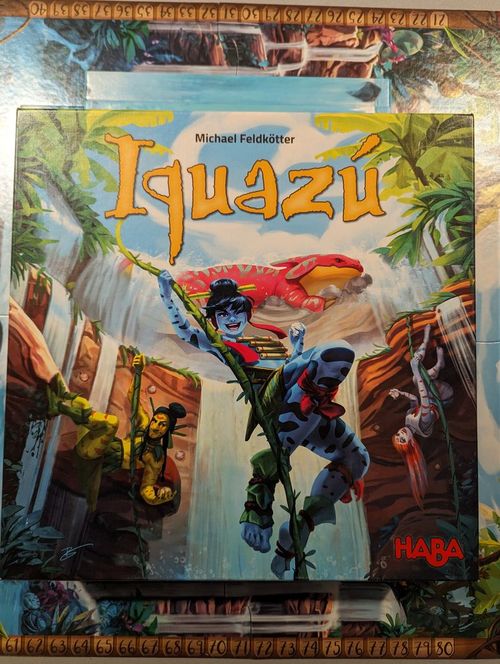
Iquazú
Iquazú Rulebook
Table of Contents
Table of Contents
Contents
- 1 game board made up of 4 parts, with 5 interchangeable rock strips
- 2 point boards
- 2 plastic rails
- 60 cards
- 45 bonus tiles (35 light backs, 10 dark backs)
- 1 water frame
- 8 water strips
- 140 gemstones (35 in each of 4 colors)
- 1 gemstone box
- 50 water drops
- 1 water box
Before the first game, put the two boxes together as follows: the side section with the arrow must be stuck into the slanted slot in such a way that the arrow is visible on the inside of the box.
Setup
1. Game Board, Rails, Rock Strips, Point Board
Game board: Piece the game board together and align it in such a way that each player sits on one corner of the game board.
Rails: Place the plastic rails in the two long slits. The higher edge of the plastic rails should be on the outside.
Rock strips: Place the rock strips in a random order on the game board. The water snakes should be at the bottom.
Point board: Place the point board that matches the number of players on the game board (2 players, 3 players, or 4 players).
2. Bonus Tiles
The bonus tiles are shuffled face-down. Place the bonus tiles with the dark blue back on the dark fields of the game board. Place the bonus tiles with the light blue back on the light fields of the game board and on the adjacent rock strips, as pictured.
3. Water Frame and Water Strips
Water frame: Place the water frame to the far left of the plastic rails.
Water strips: Place all the water strips to the right of the plastic rails.
Face-up bonus tiles: One row of bonus tiles is visible inside the water frame. Turn these bonus tiles over.
4. Scoring Markers, Gemstones, Cards, Water Drops
Scoring markers: The game board corners show who plays with which color. Each player takes one gemstone of their color and places it in front of the first field of the points track. These are your scoring markers.
Gemstones: Place the rest of the gemstones in the gemstone box. Agree on a starting player and place the gemstone box in front of them.
Cards: Shuffle all the cards face-down and distribute them as follows: the starting player receives 4 cards, the next player in a clockwise direction receives 5 cards, the next player in a clockwise direction receives 6 cards, the next player in a clockwise direction receives 7 cards. (Similarly with 2 players: 4 / 5 cards, with 3 players: 4 / 5 / 6 cards.)
Everyone can pick up their cards without letting the other players see them. Place the remaining cards face-down in a draw pile. A discard pile will be created next to the draw pile as the game progresses.
Water drops: Place all the water drops in the water box and place this in front of the player to the right of the starting player.
How to Play
Play in a clockwise direction, taking it in turns. The starting player goes first.
A player's turn consists of three parts.
1 of 3 — Draw Cards or Place a Gemstone
At the start of your turn you must select and carry out one of two actions:
A. Draw four more cards
Draw 4 cards from the draw pile and put them in your hand without showing the other players.
At the end of your turn there is a limit of 12 cards that you may have in your hand. If you have more cards than this then you must place the surplus cards face-up on the discard pile. You are free to choose which cards you discard.
Is the draw pile empty? Then shuffle the discard pile and turn it into a new draw pile.
B. Place one gemstone
There are light and dark columns inside the water frame. Each column has gaps in the rock marked with various colors.
Gemstones can be placed in these gaps. To do this you need the cards in your hand:
-
Select gap: Look for an empty gap in the rock.
-
Lay down cards: The colored edge of the gap indicates the color of the card(s) that you must lay down. The column in which the gap is located indicates how many cards in this color you must lay down: Column 1 = 1 card, Column 2 = 2 cards, Column 3 = 3 cards, Column 4 = 4 cards, Column 5 = 5 cards.
Substituting cards: Any card can be substituted by two other identical cards.
Place the required cards face-up on the discard pile.
-
Place gemstone: Now you may take one gemstone of your color from the gemstone box and place it on the gap in the rock.
Tip: What's the point of putting gemstones in the "expensive" columns? In the "expensive" columns you generally have more of a choice of gaps, and you can cleverly place your gemstones with regard to the upcoming, increasingly valuable interim scoring rounds — before another player snaps up the good spots. Also: gemstones in the "expensive" columns stay in the game longer, while gemstones in the first column disappear into the waterfall after the next interim scoring round.
2 of 3 — Place a Water Drop
Is the water box currently in front of you?
No? Then skip this step.
Yes? Then you must now place a water drop from the water box on the following gap in the rock: in the first column within the water frame — on the first empty gap in the rock when counting from the top. Note: Water drips from the top to the bottom.
Nobody can place a gemstone here now. The water box stays in front of you.
3 of 3 — Passing on the Gemstone Box
Pass the gemstone box to the next player in a clockwise direction (see arrow in the box). This ends your turn.
Then the next player takes their turn.
Interim Scoring Round
As soon as the last free gap in the first column within the water frame is filled with a gemstone or a water drop, the scoring of this column takes place:
1 of 2 — Rock Points
First the points on the rock underneath this column are assigned (see point board). It's a question of majorities:
With 4 players: The player with the most gemstones (of their color) placed in this column receives the top rock points, the player with the second most receives the middle points, the player with the third most receives the bottom points (move the scoring markers forward accordingly on the points bar). The fourth player goes away empty handed (as does anyone who didn't place any gemstones in this column).
With 3 or 2 players the same ranking applies, but there are correspondingly fewer points to assign. In each case at least one player goes away empty handed.
Tie: If there is a tie in the number of gemstones then the player (of the tied players) who has a gemstone placed further down (closer to the dangerous water snakes) has priority.
2 of 2 — Distribution of the Bonus Tiles
The bonus tiles are distributed according to majorities in the horizontal rows: the player who has the most gemstones (of their color) placed in the row of the bonus tile receives this bonus tile and places it in front of them (face-up or face-down, as they wish).
Tie: In the event of a tie, the player (of the tied players) who has a gemstone placed further to the right (closer to the bonus tile) has priority. If there is still a tie then the player whose gemstone is lower down in this row receives the bonus tile.
If there is no gemstone in a row then the bonus tile is taken out of the game.
An interim scoring round is only triggered once all the gaps in the first column in the water frame are filled with gemstones or water drops. It is possible that the second, third, fourth or fifth column is already full, but there are still gaps in the first column. In this case play is continued until the first column is completely full and the interim scoring round for the first column is triggered.
Note: Only the first column in the water frame is scored before the end of the game.
After the Interim Scoring Round
a) Take the water strip to the far right of the plastic rail out and place it back in on the far left. This moves the water frame by one column. What used to be the second column is now the first, and so on.
b) There are now 5 new bonus tiles visible in the water frame. Turn these bonus tiles over.
c) The water box is passed on to the next player in a counter-clockwise direction (see arrow in the box).
d) The gemstone box is passed on to the next player in a clockwise direction (see arrow in the box). This player is the next to take their turn.
Example
The first column in the water frame is full and is scored as follows:
Rock points: The green player has the most gemstones in this column and receives 8 points. The yellow and red players are tied. The red player receives 5 points because they have a gemstone placed further down. The yellow player receives 2 points. Because the purple player has the least gemstones in this column, they go away empty handed.
Distribution of the bonus tiles:
- 1st Row: The yellow, red and purple players are tied. The purple player receives the bonus tile because they have their gemstone further to the right.
- 2nd Row: This bonus tile is removed from the game.
- 3rd Row: The yellow player has the majority and receives the bonus tile.
- 4th Row: The green player has the majority and receives the bonus tile.
- 5th Row: The green and red players both have 2 gemstones in this row. And with the question of who has a gemstone placed further to the right there is still a tie. Therefore the player whose gemstone is lower down receives the bonus tile: the green player.
Special case: It may happen that after a) (moving of the water frame) what is now the first column is already full. In this case there is immediately another scoring round before c) and d) are carried out.
Special case: If the column is completed with a gemstone placed by the player who has the water box, then they do not place a water drop, but rather pass the water box on to the next player after the scoring as described here.
Special case: The player with the gemstone box wants to use one (or more) "double move" bonus tiles? They have their chance now before they pass on the gemstone box. The bonus tiles are explained in the next section.
Bonus Tiles
There are 4 types of bonus tiles.
These bonus tiles are used at the end of the game:
- These bonus tiles yield additional points. Collect these bonus tiles in front of you. You receive the corresponding points at the end of the game.
These bonus tiles can be used when it is your turn:
- Use one of these bonus tiles and receive 2, 3, or 4 cards from the draw pile. The 12 card limit in your hand applies at the end of your turn (or you must use the cards, the choice is yours).
- If you want to place a gemstone then you can use this bonus tile. You may use any cards of your choice instead of the colors requested. This means: only the number of cards is relevant to you, not their color.
- If you use this tile then you may — after you have carried out one action — immediately carry out another action: draw 4 cards or place 1 gemstone, regardless of what your first action was. This is the "double move" bonus tile.
Within your turn you may use as many different, or identical, bonus tiles as you like — both at the start or at the end of your turn. Only after this, with placement of a water drop or passing on of the gemstone box, does your turn end.
End of the Game
The game ends with the scoring of the column that belongs to the third-last rock: now there are no more turns played and the final scoring is carried out:
Final Scoring
First the points on this column's rock are assigned as usual, and the bonus tiles are distributed.
Immediately after this the second-last and last columns are scored — regardless of whether they are full at this point in time or not. Only the points on the rocks are assigned. There are no more bonus tiles.
Now move the scorers forward on the points track by the number of points on the collected bonus tiles.
The player with the most points wins the game. There can be multiple winners in the event of a tie.
FAQ
Why don't all the players get the same number of cards at the start of the game?
The starting player has a slight advantage because all the gaps in the rock are still empty and they are the first to have the chance to place a gemstone in a gap. This advantage is balanced by letting the other players start with more cards. As well as this, the round is not completed at the end of the game.
Are you allowed to place more than one gemstone in a turn?
No, you may only place one gemstone per turn. Only by using a "double move" bonus tile can you place another gemstone.
Why does the gemstone box need to be passed on from player to player?
Passing on the gemstone box helps you keep track of whose turn it is next — especially after the interim scoring rounds.
What happens if all the players are tied in the scoring?
Then all the points on the rock are assigned according to the tie rule. With four players as follows: The player with the lowest gemstone receives the top score on the rock. The player with the next highest gemstone receives the middle score. The player with the next highest gemstone receives the bottom score. The fourth player goes away empty handed.
What happens if the water drop box is emptied during the game or there are no more gemstones of my color in the gemstone box?
In this rare case you should take a couple of the water strips to the very left of the plastic rail out. Fill the corresponding box with the water drops and gemstones from the already scored columns. Then place the water strips back on the plastic rail.
What happens if a player scores more than 80 points?
Simply move their scoring marker past 1 and add 80 points to their score at the end.
What happens if I have a question that isn't answered in these game rules?
Then we'll be happy to help. Send your question to [email protected].
Author: Michael Feldkötter. Illustrator: Stephanie Böhm. Editor: Miriam Koser. © HABA-Spiele Bad Rodach 2017, item no. 303441.
Warning: Choking hazard — small parts. Not for children under 3 years.
Brief Rules
Aim of the game: The player with the most points at the end wins the game.
Setup:
- Set up the game board with rock strips, plastic rails and the point board that corresponds with the number of players.
- Each player sits at one corner of the game board.
- Bonus tiles are shuffled face-down and laid out.
- Place water frame and water strips on the plastic rails, turn over the first 5 bonus tiles.
- Each place 1 gemstone as a scoring marker in front of the points bar.
- Shuffle the cards face-down and distribute them: with 4 players 4/5/6/7 cards, with 3 players 4/5/6 cards, with 2 players 4/5 cards. Place the rest of the cards as a draw pile.
- Give the gemstones in the gemstone box to the starting player, and the water drops in the water box to the player to their right.
- Keep the points bar ready.
How to play:
Play in a clockwise direction, taking it in turns.
- Draw 4 cards, or lay down cards and place 1 gemstone (card color according to the selected gap in the rock, number of cards according to the column).
- Player with the water box: place a water drop (in the first empty gap in the rock from the top in the first column).
- Pass on the gemstone box.
Interim scoring round:
As soon as the first column in the water frame is full:
- Rock points are assigned based on majorities in the column. In the event of a tie the player who has a gemstone placed further down has priority.
- Bonus tiles are distributed according to majorities in the row. In the event of a tie the player who has a gemstone placed further to the right has priority.
After the interim scoring round:
- Take the water strip from the right; put it back in on the left.
- Turn over 5 new bonus tiles.
- Pass on the water box in an anti-clockwise direction.
- Pass on the gemstone box in a clockwise direction.
Other rules:
- Substituting cards: 2 identical cards substitute any other card of your choice.
- Hand limit: 12 cards.
End of the game:
The game ends with the scoring of the column that belongs to the third-last rock:
- Score the column, then immediately also score the second-last and last column.
- Move the scorers along the points track by the points on the bonus tiles.
The player with the most points wins the game. (Tie? Multiple winners.)