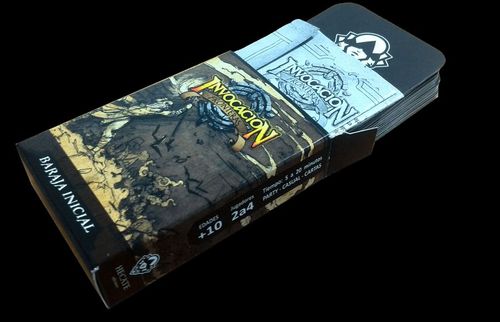
Invocación Fronteras
Invocación Fronteras Rulebook
Table of Contents
Table of Contents
Game Objective
The objective of Invocación is to proclaim yourself lord of the frontier between the worlds. To do so you must gather the greatest number of victory points (VP) from trophies and accumulated Mana.
Cards obtained as trophies grant their Power value as VP. Mana grants 1 VP for each one you have in reserve. These points are counted at the end of the game, which occurs when the card deck runs out.
Setup for the First Round
Each player receives 1 summary card. On one side is the diagram showing how cards are arranged in your play area; on the other side is a summary of the game rules.
Each player draws a card from the deck. The player with the card of highest Power will be the starting player, who from now on is called the Guardian (in case of a tie, the tied players draw another card).
The Guardian shuffles the deck (which from now on is called the Portal) and sets it aside for the Start phase (see page 3).
Card Anatomy
The following elements appear on a card:
- Element: Fire, Earth, Water or Air.
- Name.
- Cost: the icons shown are Conjuring card (spiral icon) and Support card (shield icon).
- Invocation Power / Victory Points.
- Mana.
- Support Value.
- Phase icon: Preparation or Combat.
- Card Effect.
- Legend (flavour text).
- Collection data.
Round Structure
An Invocación round is divided into three phases: Start, Preparation and Combat.
In the Start phase, new cards are dealt to all players. During Preparation, players must carefully plan their strategy, which will then, in the Combat phase, determine whether their invocation is the most powerful.
Play Area
The play area is divided into the following zones:
- Mana Area: In this zone, cards representing mana points are accumulated. Mana cards are always kept face down, since their information has no use.
- Invocation Area: In this zone one single card is placed, which will be used in full during combat. The Invocation card is mandatory, and all players must place one if they can.
- Victories Area: In this zone the cards that players obtain by winning a combat are accumulated.
- Support Area: In this zone up to 3 cards may be placed, which can add their Support value to the Invocation. It is important to remember that cards in support position only use this value; no effect or other aspect of the card applies.
- Conjuring Area: In this area up to 5 cards are placed and held as conjurings. In addition, these may trigger their effects during the combat round, provided they bear the Combat icon. No other aspect of the card is used.
Start Phase
If it is the first round of the game, the Guardian deals 4 cards from the Portal to each player (including themselves). Finally, the Guardian places the Portal to their right.
From the second round onward, the Guardian chooses how many cards from the Portal to deal to every player, which must be exactly the same number for all players. The number must be between 2 and 6 cards, and NO player may be left receiving fewer than the chosen number. The Guardian may count the cards in the Portal in order to choose an exact number that is divisible by the number of players present.
If it is impossible to deal at least 2 cards to each player, the game immediately passes to the End of the Game.
If the cards can be dealt, the round passes to the Preparation Phase.
Preparation Phase
During this phase, all players at the same time must prepare their combat plan by placing cards from their hand, face down, in the different areas of their play zone (see the diagram above).
Any card may go into any play zone. There are no restrictions or conditions for putting a card onto the table. Likewise, all cards already placed, or placed from earlier rounds, may be picked up and moved to a different place.
Important to Remember
The card chosen as the Invocation uses ALL of the information on the card: from the Element, the Sacrifices, Power, Mana, Support value and effect.
Cards in the Conjuring zone only consider their Effect text, but cards without an effect may be placed there.
Some cards contain story text. It is distinguished from the Effect text by its small print.
Cards placed in Support only use their support value.
Not all cards in hand need to be used, but cards in hand cannot be used during Combat.
The only mandatory card is the Invocation; all other cards are optional.
Preparation Effects
During this phase it is possible to play cards from hand that bear the symbol (*) in their lower right corner, in order to apply their Effect. It is not necessary to wait for a turn to do this: simply discard the card and announce clearly what the card's Effect indicates, then carry out the action indicated.
(*) Preparation icon.
Ending the Preparation
Once a player is satisfied with their Preparation, they must announce clearly that they are finishing this phase by placing the Power Counter on their Invocation. This prevents them from making changes to their play area or playing cards from their hand, and at the same time prevents other players from using it as a target for Effects that they use.
The first player to finish receives 1 Mana, takes the top card of the discard pile and places it face down in their Mana zone. If there is no discard pile, then they receive no mana. If in doubt, the Round Priority is used (see below).
When all players have finished their preparation, the game proceeds to the Combat Phase.
Combat Phase
The Combat phase must be resolved in the following order:
-
Simultaneous reveal. The Invocations of all players are revealed simultaneously.
-
Sacrifices. Everyone must pay the Sacrifices of their Invocation card. This is done by moving to the discard pile from their Conjurings and/or Supports the number indicated by each card in the upper right corner (not all cards have a cost).
If the complete Invocation sacrifice cannot be paid, the player does not pay, and is immediately out of the round; they cannot win the combat. Their Invocation card remains in play, since it may still be the target of other effects or be considered a Trophy.
-
Mana from the Invocation. If the Invocation had one or more Mana icons located below the Power, the player must take that number of cards from the discard pile (always respecting the order of the pile) and place them face down in their Mana zone. If there is no discard pile, the player gains no Mana. (It is important to remember that cards placed as mana are considered a Token and have no further use face up.)
-
Starting with the Guardian and continuing to the left, all Invocations activate their Effect (if they have one). Activating an Invocation's effect is mandatory.
-
Next, the card that opens the Combat must be announced: the winning card, which is the one whose Power is highest after applying the effects.
It is recommended that, if you do not have the Power Counter, you use dice or notes to keep track of the power of the Invocations at all times. It must always be clear which is the most powerful Invocation (and therefore the winner of the round) and its total Power value.
Retiring from the Round
Players may retire from the round at any moment by declaring aloud that they are defeated. From that moment they can no longer influence the outcome of the combat in any way, but effects previously applied continue.
Combat Effects
During this phase it is possible to use the Effect of Conjurings, or the Invocation, that bear the Combat symbol in their lower right corner.
For Invocations, these are activated in the order of Priority. For Conjurings, you simply need to REVEAL the Conjuring and announce clearly what the card indicates in its Effect, and carry out the action indicated. Conjurings remain in place unless they state otherwise; these revealed cards continue to count as Conjuring cards.
Conjurings
Once a Conjuring card is revealed there is no going back: its effect must be applied. If the card has no effect, or cannot be applied for any reason, the card is turned face down again. (A Conjuring that has no action to perform may not be revealed.)
Once applied, Conjurings stay face up until the end of the round. They continue to count for all effects that require spaces used by Conjurings.
The effects of Conjurings that modify the Power of Invocations are CONSTANT and STACKABLE, unless they state otherwise. (Effects that say "At this instant" or "At this moment" only apply once, when revealed.)
The only way to undo constant effects is to eliminate the Conjuring card.
Effects that are clarified as "your power is equal to" do not take into account the current Power value of the Invocation; instead they change it to a new specific value. However, after applying the effect, the value must be recalculated if it is affected by other persistent Conjurings. As with other Conjurings that modify Power, these cards are updated if their conditions are changed. If the condition of a Conjuring is modified, its effect is also modified.
Example 1: "Your power is equal to your Conjurings x2", with 4 Conjurings on your table, updates the power of the Invocation to 8. But if a card reading "all Fire creatures reduce their power by 3" is in play and your creature is Fire, you must update its value to 5. If at some point the initial Conjuring is destroyed, the Invocation again has its printed value on the card minus 3 for the penalising Conjuring.
Example 2: "Add to your power the amount of Mana in reserve." If during the round the amount of Mana in reserve varies, then the value this card contributes to your Power also varies. Effects that apply to a power value are constantly updated.
Mana
There are two possible positions for Mana:
- In Reserve: the pool where each player keeps the Mana they acquire.
- In Play: when it is used during the Combat.
Mana has several uses with direct results on THE INVOKER during combat:
-
Priority: Once per combat, you may gain priority in the round for the application of Invocation or Conjuring effects by spending 1 Mana. Any player may make the same payment to gain that priority again and rewrite the order of the round. If the Guardian makes the payment, it is irrevocable and irreplaceable, that is, no one can gain priority over them.
-
Mana Barrier: A player may, at any moment, pay 1 Mana to protect a revealed Conjuring. Place 1 Mana from their reserve on the Conjuring to be protected. This prevents that card from being the target of other Conjurings until the end of the round.
-
Empower the Invocation: Place X amount of Mana from the reserve, as much as you wish, on the Invocation. Add that amount of Mana to the Total Power of the Invoker. This action may only be performed once per combat.
-
Invoke Support: A player may, once only, pay 2 Mana to reveal a support. Place 2 Mana from their reserve on one of their Cards in the Support zone, reveal it, show its Support Value, and this is added to the Total Power of the Invoker.
Total Power of the Invoker
Total Power = Power printed on the Invocation card + Conjuring effects + Power added with Mana + Support invoked.
Example: If a player applies the effect "Ataraxia: Equal to the Highest Power at This Moment", they will equal the highest Power considering the effects and Mana already applied.
WARNING: The Archangel card only exchanges the printed Power of the card between two players. Effects, power and support are applied to the exchanged value, but it is not transferred.
Winning the Combat
Once all players have withdrawn, accepting that one player's Invocation is the most powerful, the winner takes the Invocation whose printed Power on the card is the highest, and places it face up in their Trophies zone. If only some of the players decide to no longer take part in the combat, they may withdraw, but their card will always remain on the table.
Ties
If there is a tie, it is decided by comparing the Support value of the Invocations. If the tie persists and there is no way to break the balance, then no one wins the victory and all the Invocations are discarded.
End of the Round
When a winner or a complete tie is declared, the round is considered finished. All Mana used is shuffled back into the Portal; all cards that were used (those face up) are placed on the discard pile; and the Guardian passes the deck to the player on their left, who will be the Guardian of the next round.
End of the Game
When the minimum number of cards cannot be dealt to all players, the game ends.
The Victory Points are counted, adding the Power of their Trophies plus the amount of Mana in reserve they have.
The player with the most points is the absolute winner.
If there is a tie, the Support values of the Trophies are added. If the tie persists, all cards are shuffled into the Portal and the tied players play one last round, with 10 cards dealt to each.
Important to Remember
Each Mana in reserve is 1 Victory Point at the end of the game.
At the end of the Round, all Mana used is shuffled back into the Portal; this is also a strategy for regulating the end of the game.
Effects
Round Priority
Invocación is a game that does not follow turn order, so it is possible that, during the Preparation or Combat phase, several players want to activate contradictory Effects simultaneously, or that they need an order in which to be executed. In these cases, the cards are resolved starting with the Guardian and continuing to the left; once a card has been completely resolved, the next one is resolved, if it can still be resolved.
Chain of Effects
A single player may not activate another effect until the first one has finished and all of their opponents' responses have been carried out. Any player may stop the Combat to request that the cards be resolved in order if they feel that there are effects that were resolved incorrectly. Game actions cannot be undone; however, a player may undo an action if it immediately conflicts with something another player was about to do, closer to the Guardian.
Action and Reaction
To execute and resolve actions, Invocación is based on the concept of "Action and Reaction".
While cards do not come into conflict, that is, while no order is required to resolve them, all cards are considered Actions.
Whenever a player takes an action (plays an effect), any other player may React: respond with another card. As explained earlier, they are resolved in Priority order, which means that one goes first and then, if it can still be resolved, the reactions are activated.
Example: A player who is losing plays "Swap the Power between two players", which is considered an Action. Their opponent, who happens to be the Guardian, decides to declare a reaction and plays "Block 3 Conjurings of a player". This Effect applies first and blocks the card played by their opponent, which is rendered useless.
In another scenario, the turn order would give priority to the other player, so the block would have occurred late (as another action) and would not have had influence over effects already resolved. The Guardian therefore always has a tactical advantage with this type of card that influences others.
Alternative Rules
Once the players are familiar with the basic rules of Invocación, they may try some alternatives to modify the game. More information on these and other game modes can be found on our page http://www.hecateediciones.com.ar
Extended Game (3 or More Players)
In games of 3 or 4 players it is recommended that, when the condition for the last round of the game is met, all of the discard pile be shuffled into the Portal and played until it runs out again.
Timed
The Preparation has a maximum duration of 30 seconds. A stopwatch or hourglass may be used to control it. When that time has elapsed, the players immediately move to the Combat phase. Once that time has passed, if any player has been left without an Invocation, the Guardian will take at random a card from the table or from that player's hand and place it as their invocation.
The Combat has a maximum duration of 60 seconds. When that time has elapsed, the winner is defined with the current potential of the Invocations.
Armageddon (5 to 8 Players)
By adding an extra deck, up to 8 players may play. In this game mode the Guardian does not take part in the round, but acts as referee. Their function is to keep order, manage the Portal and the chaining of effects. At the end of the round, the Guardian takes the first card of the deck and adds it to their Trophies.
When the deck runs out, the discard pile is shuffled again and placed as the Portal. This is repeated until all players have been Guardian of the Portal the same number of times.
Constructed Play
If several players each have an Invocación deck, each may build in advance the deck with which they will play.
Each deck must contain 30 cards, of which 10 must be cards without effects. A deck may not contain any card more than 2 times. Only 1 copy of the promotional cards (marked with a star in their numbering) may be included.
When either of the two decks runs out, the End of the Game is triggered.
Legends
Among the players a deck of 15 cards of their choice must be built, which will be considered the Legends deck; this is placed apart from the Portal. The Legends deck must always have its top card revealed. To take the first card of the Legend deck, 1 Mana must be paid during the Preparation phase. If several players want the same card, the round priority is respected. Each player may take only 1 Legend per round. When 1 Legend is taken, the next one is revealed. Legends discarded during the game go to the normal discard pile, so they may end up being shuffled together.
Summary
Start Phase: The Guardian deals between 2 and 6 cards to all players. If there are not at least 2 cards for each player, the game passes to the End of the Game.
Preparation Phase: Players prepare their play area, placing cards face down in any of the 3 positions: Invocation (mandatory), Supports, or Conjurings. They may use effects marked with the Preparation icon.
Combat Phase:
- All Invocations are revealed.
- One by one, pay the Invocation's sacrifice cost if it has one. If it cannot be paid, the player leaves the round but leaves their cards in play.
- Gain the Mana indicated on the Invocation.
- Activate the effects of the Invocations in order.
- The player with the most Power is the one currently winning.
- From now on, players may use cards in their Conjurings (reveal them and apply their effect), or the Mana in reserve, to improve their Invocation.
- When all players have decided no longer to take part in the combat, the winner takes the card with the highest printed Power to their Trophy zone.
Mana:
- Place Mana from your reserve on your Invocation to increase its Power by the amount placed. This may only be used once.
- Place 2 Mana on one of your own Supports to reveal it and increase the Support value added to the Power of your Invocation. (This action may only be performed once.)
- Place Mana on Conjurings to prevent them from being destroyed by other effects.
End of the Round: All Mana used is shuffled back into the Portal. All used cards are discarded. The Guardian passes the deck to their left, so that they become the Guardian of the next round.
End of the Game: Add the Power of each Trophy plus the amount of Mana in reserve. The player with the most points is the winner. In a tie, add the Support values of the Trophies; if the tie persists, play one last hand with 10 cards each.
Glossary
Support (Apoyo): The value printed at the bottom of the card, printed sideways so that it is not confused with any other. This value is used in case of a tie between Invocations. If a card placed in the Support Zone is revealed by spending 2 Mana, the Support value of this card is added to the Power of the Invocation.
Conjuring (Conjuro): Cards placed face down to be sacrificed or activated during Combat, if the card bears the Combat Effect icon. These activated cards remain in play until the end of the round or until they are destroyed.
Discard pile (Descarte): A place on the table that does not belong to any player in particular, where discarded cards are placed in a stack. When a player gains Mana, they must take the top card of the discard pile and move it to their Mana Reserve.
Element (Elemento): Water, Air, Earth and Fire are the 4 elements. Some cards may have two or more elements, or none. Elements are used to increase Power or for specific effects that affect the Invocation according to this characteristic.
Effect (Efecto): A descriptive text that indicates, step by step, the actions to be carried out. Some effects may contradict the rules or add new actions or conditions. Cards with an effect also bear an icon showing at which stage of the round they may be applied: if it is a Preparation icon, the card is discarded; if it is a Combat icon, the card must be revealed from the Conjurings or be the Invocation.
In play (En juego): Cards that are taking part in the combat.
Phase (Fase): The game has 3 phases, each with its own rules: the Start, Preparation and Combat phases.
Invocation (Invocación): The card placed face up so that it can show off its power before the other invokers. This card uses all of its characteristics, including its Element.
Exchange (Intercambio): If only values are involved, the cards remain in their place, but the numbers indicated change as if they belonged to the other card. When cards are exchanged, they swap place and state: if one card was face down and the other was not, the card that was not face down must be placed face down after the exchange.
"Equal to" (Igual a): An effect that replaces the value printed on the card with the value indicated in the effect. This calculation is constant: if there is any change to the elements, the value is updated, unless the effect states otherwise, such as "at this instant" or "at this moment".
Mana (Maná): Cards that come from the discard pile to the Mana Zone, face down. They may be used to activate a Support, protect a Conjuring or empower the Invocation.
Power (Poder): The top value of a card placed as an Invocation. The Power printed on the card is the one shown on the card, while the Power of the invoker (the one that will make them win the combat) is made up of the Power of the card + effects + Mana power + Support activated.
Portal (Portal): The game deck. When the deck runs out, the game ends.
Victory Points (Puntos de Victoria): At the end of the game, the Power of the cards and the number of Mana cards are added to determine who is the winner.
Reserve (Reserva): Mana cards on a player's board that are NOT in play.
Round (Ronda): Begins with the Guardian taking the deck and entering the Start Phase. When the 3 phases have been completed, a round ends.
Trophy (Trofeo): Invocation cards accumulated by winning combats. Their Power counts as Victory Points at the end of the game.
Support Zone (Zona de Apoyo): Cards placed face down to be sacrificed or invoked, adding their Support to the combat.