Inverted Dice
Inverted Dice Rulebook
Table of Contents
Table of Contents
Inverted Dice Sums
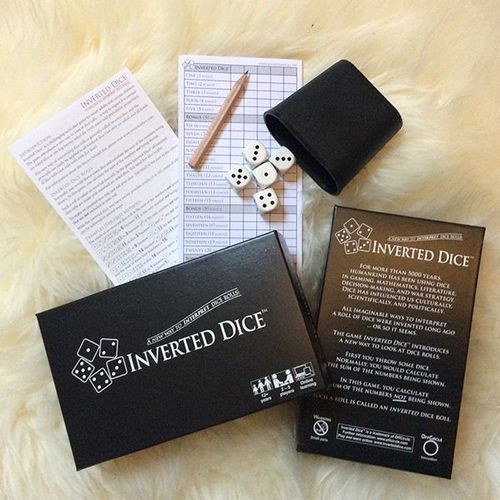
Often, you throw some dice and calculate the sum of the values being shown. In this game, you calculate the sum of the values not being shown.
Such a sum is called an inverted dice sum, and the corresponding roll is sometimes called an inverted dice roll. The rolls are made with standard dice (six-faced). To make an inverted dice roll, just roll your dice. The result is the sum of the values that are not included in your roll.
You need five dice to play Inverted Dice™. This means there are twenty possible results (1 to 20), most of which can be achieved in many different ways.
Calculating Inverted Dice Sums
When calculating the result of an inverted dice roll, remember these two facts:
- The result is the sum of the dice values that are not included in the roll.
- The sum of all numbers from 1 to 6 is 21.
This gives us two smart ways of calculating an inverted sum.
The first method (sum of values that you do not see) is straightforward. Simply add the dice values that are not present in the roll.
The second method (21 minus values that you do see) is often a quicker way. First, add all values that are present in the roll (but only count each value once). Then, subtract this sum from 21.
For beginners, a few examples are needed (below).
Examples (The First Method)
The result of an inverted dice roll is the sum of the values not being shown.
- Dice showing 1, 2, 3, 4, 5 is 6, because 6 is the only value not being shown.
- Dice showing 1, 2, 4, 5, 6 is 3, because 3 is the only value not being shown.
- Dice showing 3, 3, 4, 5, 6 is also 3, because 1 and 2 are not shown, and 1 + 2 = 3.
- Dice showing 3, 3, 4, 5, 5 is 9, because 1, 2, 6 are not shown, and 1 + 2 + 6 = 9.
- Dice showing 1, 1, 4, 4, 4 is 16, because 2, 3, 5, 6 are not shown, and the sum of these four values is 16.
- Dice showing 1, 1, 1, 4, 4 is also 16, because again 2, 3, 5, 6 are not shown.
- Dice showing 2, 3, 4, 5, 6 is 1, because 1 is the only value not being shown (this is the only way to achieve 1).
- Dice showing 1, 1, 1, 1, 1 is 20, because 2 + 3 + 4 + 5 + 6 = 20 (this is the only way to achieve 20).
Examples (The Second Method)
The result can be calculated as 21 minus the values being shown. Only count each shown value once.
- Dice showing 2, 3, 4, 5, 5 is 7, since 2 + 3 + 4 + 5 = 14 (count each value once), and then 21 − 14 = 7.
- Dice showing 1, 3, 4, 5, 5 is 8, since 1 + 3 + 4 + 5 = 13, and then 21 − 13 = 8.
- Dice showing 3, 3, 4, 5, 5 is 9, since 3 + 4 + 5 = 12, and then 21 − 12 = 9.
- Dice showing 1, 2, 4, 5, 5 is 9, since 1 + 2 + 4 + 5 = 12, and then 21 − 12 = 9.
- Dice showing 2, 2, 4, 6, 6 is 9, since 2 + 4 + 6 = 12, and then 21 − 12 = 9.
- Dice showing 3, 3, 5, 5, 5 is 13, since 3 + 5 = 8, and then 21 − 8 = 13.
- Dice showing 1, 1, 2, 3, 3 is 15, since 1 + 2 + 3 = 6, and then 21 − 6 = 15.
- Dice showing 1, 1, 5, 5, 5 is 15, since 1 + 5 = 6, and then 21 − 6 = 15.
- Dice showing 2, 2, 2, 4, 4 is 15, since 2 + 4 = 6, and then 21 − 6 = 15.
- Dice showing 6, 6, 6, 6, 6 is 15, since 21 − 6 = 15.
- Dice showing 5, 5, 5, 5, 5 is 16, since 21 − 5 = 16.
- Dice showing 1, 1, 1, 1, 4 is 16, since 21 − 5 = 16.
- Dice showing 1, 1, 3, 3, 3 is 17, since 21 − 4 = 17.
- Dice showing 1, 1, 2, 2, 2 is 18, since 21 − 3 = 18.
- Dice showing 2, 2, 2, 2, 2 is 19, since 21 − 2 = 19.
More examples can be found at www.simonjensen.com/InvertedDice.
How to Play the Game
The structure of the game is very similar to Yahtzee (or variants such as Yatzy), with a similar score sheet, five dice, and three rolls (or fewer) per turn.
There are twenty rounds in the game. In each round, players take turns rolling five dice, trying to reach one of the inverted dice sums 1 to 20 (it has to be a result that the player has not previously achieved or zeroed out).
After each roll, the player chooses which dice to keep, and which to reroll. A player may reroll some or all of the dice up to two times on a turn, making a maximum of three rolls each turn.
If a player achieves an available result, it is registered in the score chart. If the player fails (after three rolls), a number must be recorded as zero points. Every player must put either a score or a zero into a score box each turn.
The game ends when all score boxes are used. The player with the highest total score wins the game.
Bonuses
Players can receive maximum three bonuses by achieving all scores in one or more bonus sections.
- Top bonus section is the scores 1 to 5. These five numbers will earn you 50 points in the upper bonus row.
- Middle bonus section is the scores 6 to 15. These ten numbers will earn you 50 points in the middle bonus row.
- Bottom bonus section is the scores 16 to 20. These five numbers will earn you 50 points in the bottom bonus row.
Counting the Final Score
Keep in mind that the sum of all numbers from 1 to 20 is 210. When you count your final score, you only have to subtract the scores that were zeroed out from 210. After that, you add the bonus points (either 0, 50, 100, or 150 points).
Inverted Master & Inverted Grandmaster
A player who reaches 290 points (or more) earns the title Inverted Master. To succeed with this, one must get two bonuses and zero out less than 21 points.
The highest possible total score is 360 points. A player who achieves this is awarded with the rare, lifelong and prestigious title Inverted Grandmaster. Only the very best players succeed with this since without a proper strategy, there is a vanishingly small chance of getting both 19 and 20 in one game.
Tips
It is rather easy to get the middle bonus. The top bonus is also within reach, but so are the scores 16, 17 and 18 (that's 51 points right there), so it might be a good strategy to go for the large numbers at the expense of the top bonus.
- To achieve 20, you need to roll 1, 1, 1, 1, 1 (which is hard to get).
- To achieve 19, you need to roll 2, 2, 2, 2, 2 (same probability as 20).
- The easiest way to achieve 18 is to roll only ones and twos.
- The easiest way to achieve 17 is to roll only ones and threes.
- The easiest way to achieve 16 is to roll either ones and fours or twos and threes.
- The easiest way to achieve 15 is to roll only ones, twos and threes.
- The only way to achieve 1 is to roll 2, 3, 4, 5, 6.
- The only way to achieve 2 is to roll 1, 3, 4, 5, 6.
- The easiest way to achieve 3 is to roll all values except ones and twos.
- The easiest way to achieve 4 is to roll all values except ones and threes.
Play the Game Online
Use the free version at www.simonjensen.com/InvertedDice to learn the game. On this website you can also download extra score sheets, and study the mathematics behind inverted dice sums.
There is also a multiplayer version available at boardgamearena.com. Are you the next Inverted Grandmaster?
Copyright Notice
This work is protected by Swedish Law (1960:729) and international laws concerning copyrights of literary and artistic works. Editing the document (including extending and/or reducing its content) is prohibited. The document may be printed and used freely for non-commercial purposes. The document may also be printed in connection with education, and its content may be used as instructional material provided that the author (Simon K. Jensen) is credited and applicable rules regarding compensation for the use of copyrighted works are applied. Other forms of redistribution are prohibited.