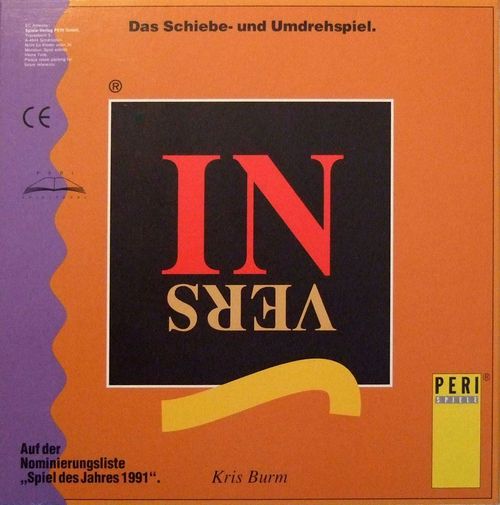
Invers
Invers Rulebook
Table of Contents
Table of Contents
Contents
Board that allows the pieces to be slid. Yellow and red pieces; player A uses the yellow ones and player B the red ones. The front side of the pieces is completely colored, while the back side shows only a yellow or red dot.
The Game
To begin, place all the pieces with the front side up on every space of the board, always alternating yellow and red so that it looks like a 6x6 chessboard. One piece of each player's color will be left over. Flip these remaining pieces so that the dot faces up.
Player A slides his piece with the dot facing up, pushing it into the playing field so that another piece comes out of the opposite side of the board. The piece pushed off the board must be flipped. Once this is done, player B must do the same.
The Rules
- Each player may push off the board, and flip, pieces of his own color that have not yet been flipped.
- Each player may push off the board, and flip, pieces of his opponent's color that have not yet been flipped.
- Each player may push off the board his own already-flipped pieces, but will not flip them again (they remain with the dot facing up).
- A player may not push off the board an opponent's piece that is already flipped (dot facing up).
The Winner
The first player to flip all of his pieces is the winner. If no more valid moves are possible, the winner is the player who has managed to flip the greater number of pieces. The loser starts the next game.
Tips for Learning INVERS
A careful introduction to INVERS can be done as follows:
- Always follow rule number 4.
- Play using only rule number 1 until no more moves are possible.
- Then introduce rule 2 until no more moves are possible.
- Finally, add rule 3 and play until there is a winner.
Additional Considerations
- Moves under rule 1 change the number of strategic positions of the flipped pieces of the player whose turn it is.
- Moves under rule 2 change the number of strategic positions of the flipped pieces of the opposing player. This move is recommended when it helps future strategy (for example, a move that seems to help the opponent in the short term by flipping one of his pieces may be right if it achieves a favorable strategic placement in the following turns).
- Moves under rule 3 only change the strategic position of the pieces. The same number of pieces remains flipped, but the position changes.
- A flipped piece of your opponent on a space at the edge of the board blocks a row for you in one direction, since you cannot push it off the board. If, in addition, another flipped piece of the opponent is on the opposite side, the row is completely blocked for you.