Invector
Invector Rulebook
Table of Contents
Table of Contents
Play
The two players, Black and White, take turns moving stones of their own color, one stone per turn, starting with Black. Passing is not allowed, but if you don't have a legal move available, your turn is skipped. Invector uses the pie rule. White, on his first turn, has the option of switching colors and becoming Black, claiming the first move as his own, instead of moving a white stone.
Capturing Moves
You can move to capture an orthogonally (horizontally or vertically) adjacent enemy stone in any direction.
Non-Capturing Moves
You can move to an orthogonally adjacent, unoccupied pit, closer to center, Manhattan distance. That is, your stone must be closer, via a series of orthogonally adjacent pits, to a center pit after your move than it was to a center pit before your move. There are two center pits.
Object of the Game
The goal is to capture all enemy stones. When you have removed all enemy stones from the board, you win.
Design Notes
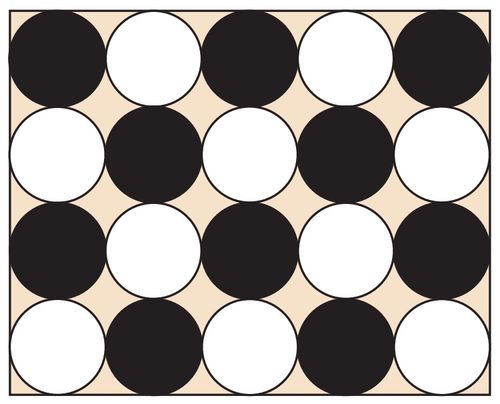
Invector was inspired by the ancient, Hawaiian game of Kōnane. True to the spirit of Kōnane, Invector begins with a checkerboard pattern of stones, has short range captures, and is extremely simple. Invector simply combines two basic, off-the-shelf ingredients: orthogonal, adjacent capturing moves, and orthogonal, adjacent moves closer to center. Nothing fancy, but it works. Gameplay is finite, decisive, and robust. Flour and water wins the day.
Invector is ultimately its own game. Kōnane is more violent. Every move involves at least one capture. But Invector is more lethal. Armies don't just come to a standstill, shake hands, and part amicably. One of the armies must be destroyed to the last man.