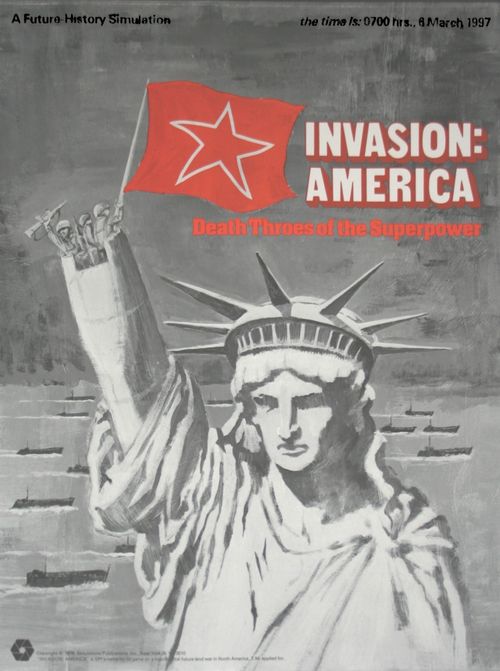
Invasion: America – Death Throes of the Superpower
Invasion: America – Death Throes of the Superpower Rulebook
Table of Contents
Table of Contents
- 1.0 Introduction
- 2.0 General Course of Play
- 3.0 Game Equipment
- 4.0 Sequence of Play
- 5.0 Naval Movement
- 6.0 Naval Unit Stacking
- 7.0 Naval Transport Units
- 8.0 Replacements
- 9.0 Supply
- 10.0 Land Movement
- 11.0 Land Units Zones of Control
- 12.0 Stacking of Land Units
- 13.0 Land Combat
- 14.0 Air Combat
- 15.0 Amphibious Assaults
- 16.0 Special Unit Types
- 17.0 Special Rules
- 18.0 How to Set Up and Play the Game
- 19.0 Scenarios
- 13.8 Terrain Effects Chart
- 13.9 Combat Results Table
1.0 Introduction
Invasion America is a corps level simulation for two or more Players of a hypothetical amphibious invasion of the North American continent. The aggressor forces are the European Socialist Coalition (ESC), the South American Union (SAU), and the Pan Asiatic League (PAL). The defenders are the armed forces of the United States and Canada.
2.0 General Course of Play
Invasion America can be played as either a two-Player game or as a multi-Player game. In each of these versions, each Player moves his units and executes attacks on Enemy units in turn, attempting to fulfill the conditions of victory. To move from one hex to another, each unit expends a portion of its Movement Allowance. Combat is resolved by comparing the total Combat Strength of opposing units and expressing the comparison as a simplified probability ratio (odds). A die is rolled and the outcome indicated on the Combat Results Table is applied to the units involved.
3.0 Game Equipment
3.1 The Game Map
The 35" x 42" two-piece mapsheet portrays the North American continent from the Baffin Islands to Venezuela. A hexagonal grid is superimposed over the mapsheet to regularize movement and combat of the playing pieces. Terrain, communications and demographic considerations significant to the game are delineated.
How to Assemble the Map: The "North" map section is overlapped onto the "South" map section so that the partial hexes on the South map section are entirely covered by the North section. This will result in the edge of the North section exactly bisecting the northernmost hexrow of the Southern section. Players may wish to use small pieces of masking tape (not cellophane tape) to secure the map to the table at the four corners and in the middle of the top and bottom.
3.2 Game Charts and Tables
Various visual aids are provided for the Players to simplify and illustrate certain game functions. These are the Combat Results Table, the Terrain Effects Chart and the Turn Record Track. These are explained in the appropriate rules sections.
3.3 The Playing Pieces
The differently colored playing pieces represent the units of the different armed forces involved in the game. They are henceforth known as units. Many of the units are printed on both sides. One side is up when a unit has not been "tried" in combat; the other side is used when the unit has either attacked or defended and its Strength has become known. It is strongly recommended that the Players sort the units by type and color into the trays in the base of the game box, as this greatly facilitates setting up and playing the game.
3.31 Unit Types
There are three types of units in Invasion America: Land Units, Air Units and Naval Units. Each of these types of units is further subdivided into several categories. Each specific type and subtype has specific limitations and uses, which are outlined in the rules section dealing specifically with each type.
3.32 Sample Units
A land unit shows its nationality (e.g. USA), unit type, Combat Strength and Movement Allowance (e.g. 4-8). An air unit shows nationality, unit type, Combat Strength and Range. A naval unit shows nationality, unit type and Combat Strength; an aircraft carrier also shows a Range.
3.36 Summary of Unit Types
Each unit has a tried (front) and untried (back) side.
- Land units: armor (a), mechanized infantry (mi), infantry (i), militia (m), railroad (rr), special infantry (si), hovercraft (h), supply (s).
- Air units: close air support (cas), long-range bomber (lrb).
- Naval units: aircraft carrier (cv), amphibious (am), transports (t).
3.37 Definition of Terms
- Combat Strength is the basic strength of the unit quantified in Combat Strength Points. The same strength is used for both attack and defense.
- Movement Allowance is the basic movement ability of a unit quantified in Movement Points; in most cases a unit expends one Movement Point of its Movement Allowance for each hex entered.
- Range is the ability of an Air Unit to project its Combat Strength for attack across a given number of hexes. Range is calculated from the Air Unit's hex (exclusive) to the defending unit's hex (inclusive).
- Parenthesized Strength may be used only for defense; units with parenthesized strength may not attack.
- Tried Strength is the true value of a unit, revealed only after that unit has participated in combat.
- Untried Strength is an approximation of strength for units of a certain type. Units set up showing only their Untried Strength.
3.4 Game Equipment Inventory
A complete set of Invasion America includes: One Game Map (two 22" x 35" sections); One Rules Booklet; One Set of Die-Cut Counters (400 pieces); One Die; One Game Box.
3.5 Game Scale
Each Game-Turn represents one month, and each hexagon on the map is equivalent to 130 kilometers from side to side.
4.0 Sequence of Play
4.1 The Game-Turn
Invasion America is played in turns called Game-Turns. Each Game-Turn is composed of four Player-Turns, the first three of which are Aggressor Player-Turns. In two-Player games, the Aggressor Player must move the distinct national forces separately during their own individual Player-Turns only. In some Scenarios, there are no P.A.L. forces, and thus no P.A.L. Player-Turn.
The term "Friendly" refers only to units of the same national force. Aggressor units of two different national forces are not Friendly. Canadian and U.S. units are considered to be of the same national force; they are always controlled by the same Player. S.A.U., E.S.C. and P.A.L. units are not considered to be of the same national force, although they may be controlled by the same Player. Each of these forces is a distinct and separate national force, and has a separate supply network and a separate Player-Turn (except for Canadian and US forces).
Each Player-Turn is composed of a number of discrete Phases. The Player whose Player-Turn is in progress is termed the Phasing Player.
All actions must be executed in sequence; actions taken out of sequence constitute a violation of the rules. Each Game-Turn proceeds as follows:
4.2 Sequence Outline
A. S.A.U. Player-Turn
- Naval Movement Phase. The Phasing Player may move any or all of his Naval Units within the restrictions outlined in the Naval Movement Rules. No Land or Air units (except those being transported by Naval units) may be moved.
- Replacement Phase. The Phasing Player places his replacements as called for by the Scenario being played.
- Primary Supply Judgment Phase. The Phasing Player determines which of his units are out of supply and which are in supply.
- Land Movement Phase. The Phasing Player may move all of his Land and Air units in any direction, up to the limit of their Movement Allowances, within the restrictions outlined in the Movement and Supply Rules. Naval units may not be moved.
- Combat Phase. The Phasing Player may attack Enemy units and conduct Amphibious Assaults. These activities are resolved as outlined in the respective rules sections.
- Secondary Supply Judgment Phase. The Phasing Player determines which of his units are in supply and which are out of supply.
- Mechanized Movement Phase. The Phasing Player may move his Armored and Mechanized Infantry units again. No other units may be moved in this Phase.
B. E.S.C. Player-Turn
- Naval Movement Phase
- Replacement Phase
- Primary Supply Judgment Phase
- Land Movement Phase
- Combat Phase
- Secondary Supply Judgment Phase
- Mechanized Movement Phase
C. P.A.L. Player-Turn
- Naval Movement Phase
- Replacement Phase
- Primary Supply Judgment Phase
- Land Movement Phase
- Combat Phase
- Secondary Supply Judgment Phase
- Mechanized Movement Phase
D. US/Canada Player-Turn
- Replacement Phase. The Phasing Player places replacements on the map as called for by the Scenario being played.
- Primary Supply Judgment Phase. The Phasing Player determines which of his units are in supply and which are out of supply.
- Rail Movement. The Phasing Player may load and transport units with his Rail units within the restrictions outlined in the Rail Movement Rules.
- Land Movement Phase. The Phasing Player may move all of his units in any direction or combination of directions within the restrictions outlined in the Movement and Supply Rules.
- Combat Phase. The Phasing Player may attack Enemy units. Combat is resolved according to the Combat Rules.
- Secondary Supply Judgment Phase. The Phasing Player determines which of his units are in supply and which are out of supply.
- Mechanized Movement Phase. The Phasing Player may move his Armor and Mechanized Infantry units again. No other units may be moved in this Phase.
E. Game-Turn Indication
The Game-Turn Marker is advanced one space on the Game-Turn Record Track to signal the start of a new Game-Turn.
4.3 Game Length
Repeat Steps A through E for eight Game-Turns (unless the Campaign Game is being played). At the end of the final Game-Turn, the Players' performances are evaluated in light of the Victory Conditions for the Scenario being played.
5.0 Naval Movement
General Rule: During the Naval Movement Phase, the Phasing Player may move as many or as few of his Naval units as he wishes. During any Friendly Naval Movement Phase, each unit may be moved as many all-sea and/or coastal hexes as the Phasing Player desires. Naval units have an unlimited Movement Allowance.
Procedure: Move each Naval unit (or stack of Naval units), tracing the path of movement through the hexagonal grid. Naval units may only be moved through sea and/or coastal hexes.
5.1 How to Move Naval Units
5.11 During the Naval Movement Phase of a specific force, only the units of that force are moved. All, some or none of these Naval units may be moved. No Land units (except those being transported), and no non-Phasing units may be moved, nor may any form of combat take place during the Naval Movement Phase.
5.12 Naval units have an unlimited Movement Allowance. They may move through any number of all-sea and/or coastal hexes. Units may move in any direction or combination of directions.
5.2 Restrictions and Prohibitions
5.21 Naval units may neither exit the map, nor enter all-land hexes, nor cross all-land hexsides.
5.22 Zones of Control never affect Naval units.
5.23 Naval units may never enter a coastal hex containing Enemy units, except to execute an Amphibious Assault.
5.24 Units may freely move through hexes containing other Friendly units.
6.0 Naval Unit Stacking
General Rule: A maximum of three Naval units may be in any one hex at the end of any Naval Movement Phase.
6.1 Effect on Movement
6.11 The stacking limit applies only at the end of the Movement Phase. A Naval unit may move through hexes already containing three Naval units.
6.12 Naval units may move as a stack or stack and unstack freely during movement, as long as no more than three Naval units end the Movement Phase in a given hex.
6.2 Effect on Combat
6.21 All units stacked in a single hex must be attacked as one combined Combat Strength; all their Combat Strengths are totalled when attacked.
6.22 Land, Air and Supply units being transported by Friendly Naval units never add to the defense of a given hex under attack. They do, however, suffer all results rolled against the Naval units transporting them.
6.23 Land, Air and Supply units' Strength Points are never calculated in an Exchange Combat Result in an attack against the Naval units transporting them; the attacking units lost must equal only the Strength of the defending Naval units.
6.24 Land, Air and Supply units being transported by Naval units do not count against the Naval unit stacking limit of three units.
6.25 Land, Air and Supply units being transported by Naval units are destroyed if the unit transporting them is destroyed, and must retreat if the unit transporting them is forced to retreat, into the same hex as the transporting unit, even in an Amphibious Assault.
7.0 Naval Transport Units
General Rule: During the Naval Movement Phase, Naval Transport and Amphibious units may transport up to three Friendly units through all-sea hexes. Transport units may transport only Land combat units and Air units. Amphibious units may transport only Land combat and Supply units. Transport units may load and unload in hexes with Friendly Supply units or in Friendly-occupied port hexes (or in the P.A.L. Holding Box). Amphibious units may load and unload units in hexes with Friendly Supply units, in Friendly-occupied port hexes, in amphibious hexes (or in the P.A.L. Holding Box). To load onto or unload from a Naval Transport or Amphibious unit costs the Land or Air unit two Movement Points. There is no Movement Point cost for loading to the Amphibious or Transport unit.
Procedure: During the appropriate Movement Phase, units of a national force may expend 2 MP in a port hex containing Transport or Amphibious units of that national force. These Land units are then considered to be loaded on the Naval units and may be transported by them in the following Naval Movement Phase. The Land or Air units being transported are placed under the Naval unit transporting them. The procedure is reversed for unloading units from Transports or Amphibious units. Additionally, Amphibious units may load and unload Land units of the same national force (only) in amphibious hexes, and assist these units in attacks on Enemy units.
7.1 Restrictions on Naval Units
7.11 Transports and Amphibious units have a maximum capacity of three units of the same national force.
7.12 Naval units may transport only units of the same nationality; for example, E.S.C. Transport and Amphibious units may only transport E.S.C. units, etc.
7.13 Only Transport and Amphibious units may transport units. CV units may never transport units (not even Air units).
7.2 Naval Transport of Supply Units
Amphibious units of a national force may transport Supply units (during the Naval Movement Phase) of the same national force. To load or unload a Supply unit requires that the transporting Amphibious unit remain in the coastal hex with the Supply unit for an entire Naval Movement Phase. After loading, the Supply unit may be transported in the following Naval Movement Phase. After unloading, the Supply unit may be used as a Port and Supply base for units of the same national force in the subsequent Land Movement Phase. After a Supply unit is placed, it continues to provide Supply as long as it remains in the hex. It may be transported by any Amphibious unit of the same national force that fulfills the requirements for transport.
7.21 Supply units may only be transported by Amphibious units (which may simultaneously transport Friendly Land units).
7.22 Supply units may never be transported by an Amphibious unit in the same Game-Turn that the Amphibious unit is conducting an Amphibious Assault.
7.3 Naval Units and Zones of Control
Naval units (and units they are transporting) have no Zones of Control. Naval units (and units they are transporting) are unaffected by Land units' Zones of Control.
7.4 Naval Combat
Only the Aggressor forces have Naval forces. Amphibious units may conduct Amphibious Assaults against amphibious hexes. Land units may not attack Naval units. CV units may make attacks in the same manner as Air units; for purposes of combat, CV units are considered Air units. They may attack any Land or Air units within their range. (See 14.0 for procedure.) Air units may attack Naval units in the same manner that they attack Land units. Naval units never have an "untried" Combat Strength. Their strength is always known. (In multi-Player games, CV units may attack other Naval units; other Naval unit types may not attack Naval units.)
8.0 Replacements
General Rule: Listed in each Scenario are the number of replacement units received by each force during their respective Replacement Phases for each Game-Turn. Replacement units are always removed from the Destroyed Units Boxes.
Procedure: When a unit is destroyed, it is placed in the Destroyed Units Box for units of its own force. There are five boxes, one for each force. During each Replacement Phase, the specified number of units may be removed from the Destroyed Units Box and brought into play.
8.1 Removal of Destroyed Units
8.11 When a unit is destroyed as a result of combat, it is immediately placed in the proper Destroyed Units Box.
8.12 When a Land Combat or Air unit is placed in the Destroyed Units Box, it is placed face-down, showing its untried Strength (as it was at the beginning of the game). These units should then be thoroughly mixed in with the other units in the Destroyed Units Box.
8.2 Replacement Units
8.21 If a force is to receive replacement units, that force may only receive replacements if there are, during the appropriate Replacement Phase, sufficient units in the Destroyed Units Box to bring back into the game as replacements. Unclaimed replacements may not be accumulated.
8.22 When forces are being replaced, only the destroyed unit-types listed are replaced.
8.23 American and Canadian replacements appear in any Supply hex currently controlled by the Phasing Player.
8.24 Aggressor replacements appear in any coastal hex occupied by a Supply unit of the same national force, or in any port hex occupied by units of the same national force.
8.25 All replacements may move normally the Game-Turn in which they appear.
8.26 Replacements may appear in any Enemy controlled hex, but they may move no further in the following Land Movement Phase.
8.27 If no replacement hex is available, replacements scheduled for that Turn may not be received.
8.28 "Constant" replacements listed in the Scenarios may be received in each Game-Turn. "Variable" replacements require certain conditions to be met.
9.0 Supply
General Rule: Land units and Air units are considered to be "in supply" or "out of supply." Units are considered to be in supply if they can trace a line of hexes unblocked by Enemy units or Zones of Control to a Supply hex (in the case of American and Canadian units), or to a Supply unit, occupied port hex, or Amphibious unit (in amphibious hex) of the same national force as the unit to be supplied, for the Aggressor force.
9.1 Supply Sources
9.11 American and Canadian units are considered to be in supply if they can trace a line of hexes of any length, unblocked by Enemy units or Enemy-controlled hexes to any Supply hex in their own respective countries. Aggressor units are considered in supply if they can trace a line of hexes of any length unblocked by Enemy units or Enemy-controlled hexes to a Supply unit of their own national force on a coastal hex, or a port hex occupied by a unit of their own national force. Friendly units negate Enemy Zones of Control for supply purposes.
9.12 Aggressor units are also considered to be in supply if they can trace a path no longer than three hexes to an amphibious hex occupied by a Friendly Amphibious unit. This path must not be blocked by Enemy units or Zones of Control.
9.13 Naval units are always in supply.
9.14 Supply hexes may not be used as supply sources for Aggressor forces, unless the supply hex is in a coastal hex.
9.2 Supply Effects
9.21 Land units that are out of supply attack and defend at one-half their printed Combat Strength. The Movement Allowance of such units is also halved.
9.22 The Combat Strength and Movement Allowance of Air units that are out of supply are halved; however, their Range Allowance is unaffected by supply considerations.
9.23 Units that are out of supply may remain so indefinitely. Units are never eliminated as a result of being out of supply.
9.24 Rail units are always in supply. They always retain their full Movement Allowance.
9.3 Judging Supply
9.31 Supply, for purposes of movement, is judged during the appropriate Supply Judgment Phase (Primary or Secondary). Units which are out of supply at that time have their Movement Allowance cut in half (fractions are rounded up).
9.32 Supply, for purposes of combat (either attack or defense), is judged at the instant of Combat. Units which are out of supply at the instant of combat have their Combat Strength cut in half (fractions are rounded up).
9.4 Blocking Supply
Units are considered to be out of supply if their supply path is blocked by (1) an Enemy occupied hex, or (2) an Enemy-controlled hex not occupied by a Friendly unit, or (3) blocked hexsides. Land and Air units may never trace supply through all-sea or lake hexes. Naval units are always in supply.
9.5 Supply Units
Only Aggressor forces have Supply units. A Supply unit can supply any Friendly units, and its supply capacity is never expended.
9.51 Each Supply unit counts as one unit for stacking purposes.
9.52 Supply units may never attack; they may only defend.
9.53 A Supply unit may be used as a source of supply to all units of the same national force which can trace a Line of Supply to it in all Game-Turns subsequent to its landing (see Case 7.2).
9.54 Once placed, Supply units can never be moved over land, although they may be moved by Amphibious units.
9.6 Ports
Some hexes on the map are designated as Port hexes. These hexes supply all units of a national force that can trace a Line of Supply to them, if occupied by a unit of that force.
9.61 Port hexes function as supply centers immediately upon being occupied by Land or Air units, at any point in the Game-Turn.
9.62 Port hexes may only function as supply centers for units of the same national force as the unit currently occupying them. If Port hexes are unoccupied, they may not function as a Supply center for any units. All Coastal-Urban hexes and Supply hexes function as ports for all purposes.
10.0 Land Movement
General Rule: During the Land Movement Phase of a Player-Turn, as many or as few of the Land and Air units of that national force may be moved as the Controlling Player wishes. Units may be moved in any direction or combination of directions. During the Mechanized Movement Phase, Armored and Mechanized Infantry units, only, may be moved again.
Procedure: Units are moved one at a time, tracing a path of contiguous hexes through the hex grid. As a unit enters a hex, it pays one or more Movement Points from its total Movement Allowance.
10.1 Movement Restrictions and Prohibitions
10.11 Movement may never take place out of sequence. Units of a national force may be moved only during the Movement Phase of their own Player-Turn. During the Combat Phase, a unit which is either attacking or defending may be called upon to advance or retreat after combat is resolved. During the Movement Phases of other Player-Turns and during all Combat Phases (except when advancing or retreating as a result of combat), units of a national force must not be moved.
10.12 A Friendly unit may never enter a hex containing an Enemy unit (exception: see 15.0).
10.13 A unit may never expend more Movement Points than its total Movement Allowance in any one Movement Phase. A unit may expend all, some or none of its Movement Points in any one Movement Phase, but unused Movement Points may not be accumulated until another Movement Phase or transferred to another unit.
10.14 Once a unit has been moved and the Player's hand taken from the piece, it may not change its move without the consent of the opposing Player.
10.2 Effects of Terrain
10.21 Movement is calculated in terms of Movement Points. Basically, each unit expends one Movement Point from its Movement Allowance to enter a clear terrain hex. To enter other types of hexes, a unit must expend more than one Movement Point. When the Terrain Effects Chart calls for a Movement Point expenditure to cross a terrain hexside, this cost is in addition to the terrain cost for entering the hex.
10.22 Units may never exit the map, or enter or cross prohibited terrain. Units forced to do so as a result of combat are eliminated instead.
11.0 Land Units Zones of Control
General Rule: The six hexagons surrounding a hex constitute the Zone of Control of any Land Combat units in that hex. Hexes upon which a unit exerts a Zone of Control are called controlled hexes, and inhibit the movement of Enemy Land units and block the supply path of Enemy units. All Land units must cease movement when they enter an Enemy controlled hex.
11.1 Effectiveness of Zones of Control
11.11 All Land Combat units exert a Zone of Control at all times during the entire Game-Turn.
11.12 Units do not pay any additional Movement Points to enter Enemy controlled hexes.
11.13 Units may leave an Enemy controlled hex at the beginning of their Movement Phase, but must cease movement immediately upon subsequently entering any other Enemy controlled hex. Units may move from one Enemy controlled hex directly into another Enemy controlled hex, but if a unit does so it may move no further that Phase.
11.14 Friendly Zones of Control never affect Friendly units; only Enemy units.
11.15 If a given unit is in an Enemy controlled hex, the Enemy unit is also in that given unit's controlled hex. The Enemy and Friendly units are equally and jointly affected.
11.16 Zones of Control extend into all six hexes adjacent to the controlling unit's hex, with the following three exceptions: Zones of Control do not extend across Blocked hexsides, Major Rivers, or into all-sea hexes.
11.17 There is no additional effect of having more than one Land Combat unit casting its Zone of Control into a given hex.
11.18 Land units may not retreat as a result of combat into or through an Enemy controlled hex. This is true even if the Enemy controlled hex is occupied by a unit of the same national force or if a Zone of Control of a unit of the same national force is cast into the hex.
11.19 Supply paths may not be traced through Enemy Zones of Control. The occupation of a hex by a Friendly Land unit, however, negates the Zone of Control for purposes of tracing a Line of Supply.
11.2 Zone of Control Restrictions
11.21 While being transported by Naval units or Rail units, units have no Zone of Control.
11.22 Zones of Control do not extend through Blocked hexsides, nor do they extend into all-sea hexes, or across Major Rivers.
11.23 Air units and certain types of Land units do not have Zones of Control. The Land units without Zones of Control are: Hovercraft units, Militia units, Rail units and Supply units. Enemy units moving adjacent to these types never have to observe any Zone of Control effects. These units are, however, subject to all effects of any Enemy Zone of Control.
12.0 Stacking of Land Units
General Rule: A maximum of three Friendly Land units may be stacked in one hex at the end of any Friendly Movement Phase. All types of Land units, except Rail units, count towards the stacking restrictions.
12.1 Stacking Inhibitions and Prohibitions
12.11 Naval units never count against Land stacking limits when in the same hex with Land units (either Enemy or Friendly).
12.12 Land units and Naval units may be combined as a single Strength Point total when attacking or defending, except when Land units are being transported (see 6.22 and 15.0).
12.13 All types of Land and Air units, except Rail units, count towards the three-unit stacking limitation.
12.14 Land units of differing Aggressor forces may not stack together, nor may they combine their Combat Strengths when attacking or defending.
13.0 Land Combat
General Rule: Combat occurs between adjacent opposing Combat units. The Phasing Player is the attacking Player and the non-Phasing Player is the defending Player, regardless of the overall strategic situation.
Procedure: All attacking units are committed to an attack, and once committed may not be withdrawn or reallocated to another attack. All defending units must also be specified. The "tried" strength of all units in the combat are then revealed (see Case 18.34).
Total the Combat Strengths of all the attacking units involved in a specific attack and compare it to the total Combat Strength of the units in the hex under attack. State the comparison as a probability ratio: Attacker's Strength to Defender's Strength. Round off the ratio in favor of the defender to conform to the simplified odds found on the Combat Results Table, roll the die and read the result on the appropriate line under the odds. Apply the result immediately, before resolving any other attacks being made during the Combat Phase. Friendly units may not attack each other.
13.1 Which Units May Attack
13.11 Land Combat Units may only attack during their own national force's specific Combat Phase. They may then attack any and all Enemy units adjacent to them. Only those Land Combat units directly adjacent to a given Enemy unit may participate in an attack on that unit.
13.12 Attacking is completely voluntary; units are never compelled to attack, and not every unit adjacent to an Enemy unit need participate in any attack. A unit that is not participating in an attack by other units in the same hex is never affected by the results of the attack.
13.13 An Enemy occupied hex may be attacked by as many units as can be brought to bear in the six adjacent hexes, plus any number of Air units that can attack from non-adjacent hexes (see 14.0).
13.14 No unit may attack more than once per Combat Phase and no Enemy unit may be attacked more than once per Combat Phase. A unit may be attacked more than once per Game-Turn (once in each Enemy Combat Phase).
13.2 Multi-Unit and Multi-Hex Combat
13.21 All units in a given hex must be attacked as a single combined Combat Strength. The defender may not "withhold" a unit in a hex under attack. Different units in a hex may not be attacked separately.
13.22 Other units in a hex that contains an attacking unit need not participate in that same attack or any other attack. Thus, when one unit in a stack is attacking a given hex, the other units in the stack could attack a different hex, or not attack at all.
13.23 If a stack of units is adjacent to more than one Enemy occupied hex, it could attack all, some or none of them in a single combat. Thus, units in a single hex may attack more than one hex. The only requirement is that all attacking units must be adjacent to all defending units. (Air units, when adjacent, must be adjacent to all defending units.)
13.24 A given unit's Combat Strength is always unitary. That is, a unit's Combat Strength may not be divided among different combats, either for attack or defense.
13.3 Effects of Terrain
A unit defending in certain types of terrain may have its Combat Strength increased. This increase is always expressed as a multiple of the Combat Strength. These multiples are summarized on the Terrain Effects Chart.
13.31 A defending unit may obtain the doubling or tripling effect of rivers only if all the attacking units are attacking across river hexsides. If even one attacking Land Combat unit is attacking across a non-river hexside, or if one of the attacking units is an Air unit or a Naval unit in any location, then the defending unit does not obtain any defensive advantage from the river hexside.
13.32 The effects of terrain on defense are not cumulative. The defender benefits only from the most advantageous terrain type. Thus, if a unit is behind a river and in mountainous terrain, its Combat Strength for defense would only be tripled, not quadrupled (see Case 14.16).
13.4 Combat Resolution
13.41 Combat Odds are always rounded off in favor of the defender. For example: An attack with a combined Combat Strength of 26 against a defender with a Combat Strength of 9 (26 to 9) would round off downward to the next lowest Odds Column on the Combat Results Table, "2 to 1." That column would be used for resolving the attack. Odds lower than 1-4 are treated as 1-4; odds higher than 7-1 are treated as 7-1.
13.42 Explanation of Results
- D1, 2 or 3 = Defender Retreats the indicated number of hexes (1, 2, 3). Each Player retreats his own units. He must retreat his units in accordance with the Retreat Rules. Units may not retreat across Blocked hexsides (see Terrain Key).
- A1, 2 or 3 = Attacker Retreats the indicated number of hexes (1, 2, 3).
- Ae = Attacker Eliminated. All attacking units are eliminated. Defender may advance into the hex.
- De = Defender Eliminated. All defending units are eliminated. Attacker may advance into the hex.
- Dx = Defender Exchange. All of the defending units are eliminated first, then an equal or greater number of the attacking Combat Strength Points are lost. For example: A unit with a Combat Strength of 3 is attacked by Enemy units with Combat Strengths of 6 and 4, and a "Dx" is rolled. The defending unit is removed from the board, then either attacking unit (at the Owning Player's discretion) is removed from the map. Note that all exchanges take place using the printed Combat Strength of the units involved.
- Ax = Attacker Exchange. All attacking units are eliminated, and then a number of defending Combat Strength Points equal to or greater than the Combat Strength of the attacking units are lost. Note that this result is calculated in exactly the same manner as a Defender Exchange, except the attacking units are eliminated first, after which an equal or greater number of defending Combat Strength Points are eliminated.
13.5 How to Retreat
When the Combat Result requires units to be retreated, the Owning Player must immediately move those units the indicated number of hexes away from their combat position. This movement is not normal movement, and is subject to the following restrictions. If the unit is unable to retreat within these restrictions, it is eliminated instead.
13.51 In retreating, a unit may initially leave an Enemy controlled hex; thereafter it may not enter an Enemy controlled hex. Friendly units do not negate Enemy Zones of Control for purposes of retreat.
13.52 A retreating unit may not cross a Blocked hexside or enter a prohibited hex (see Terrain Effects Chart). Terrain Movement Point costs are ignored.
13.53 Where possible, a retreating unit must retreat into and through vacant hexes. If no other route is available, the retreating unit may move through Friendly occupied hexes, displacing every Friendly unit whose hex it moves into or through. Retreating units may not stack with other units. However, units stacked initially before retreating must remain stacked throughout their retreat.
13.54 In all cases, the retreating unit must terminate its retreat the Combat Result-indicated number of hexes away from its former combat positions. If it cannot, and can retreat only a portion of the number of obligated hexes, it is eliminated instead, in the last hex it was able to retreat into.
13.6 Displacement
13.61 If Friendly units occupy hexes in the only possible retreat route available to the retreating unit, those Friendly units are displaced (moved out of their hexes) by the retreating unit. The displaced unit is moved one hex (by the Owning Player) as if it were, itself, retreating. Then the retreating unit enters the vacated hex, and, if necessary, continues its retreat. The retreating unit may displace as many units as necessary to retreat the indicated number of hexes.
13.62 If the displacement would cause any of the displaced units to be eliminated, the retreating unit is eliminated instead. Displaced units can themselves displace Friendly units in a sort of chain reaction of displacement, if that is the only permitted path of displacement open to them. A unit may be displaced more than once per Combat Phase, if that is the only alternative. Units may not displace other Friendly units if they have other paths open to them.
13.63 Note that stacking may never take place as a result of retreat. Retreating units are never stacked with other Friendly units; they are always displaced.
13.7 Advance After Combat
13.71 Whenever an Enemy unit is forced to retreat (or is eliminated) as a result of combat, it will leave a path of vacant hexes behind it called the Path of Retreat or Retreat Path (this includes any hexes left vacant pursuant to displacement). Any or all Friendly victorious units which participated in the combat and were adjacent to the retreated unit are allowed to advance along the Enemy Path of Retreat.
13.72 The advancing victorious units may cease advancing in any hex along the Path of Retreat.
13.73 Advancing victorious units may ignore Enemy Zones of Control.
13.74 Only victorious units which were adjacent to the retreating unit during the combat and participated in that combat may advance. Non-adjacent Air units may not advance after combat (see Case 15.16).
13.75 An advancing unit may not stray from the Path of Retreat (the path the retreating unit just moved through).
13.76 The option to advance must be exercised immediately, before any other combat resolution. Units are never forced to advance after combat. After advancing, units may neither attack nor be attacked in that Phase, even if their advance places them next to Enemy units whose battles are yet to be resolved, or who were not involved in combat. However, advances are useful in cutting off the retreat of Enemy units whose combat has not yet been resolved.
13.77 Units may stack and unstack freely as a result of advance after combat, as long as there are no more than three units in a hex at the end of the Combat Phase.
14.0 Air Combat
General Rule: Air units may participate in combat from non-adjacent as well as adjacent hexes. The Air unit's Combat Strength may be used to attack Enemy units within range. When attacked, an Air unit defends itself with its own Combat Strength. Air units are treated as ranged Land units; they must pay terrain costs when moving and engage in combat just as Land units do.
14.1 Air Strike Attacks
14.11 Air units may make air strike attacks against any non-adjacent Enemy units, up to the extent of their Range Allowance, at the Owning Player's option; Air units may attack Naval units.
14.12 Range from the attacking Air unit to the defending unit is counted by including the target hex (defending unit's hex), but not the attacking unit's hex. Range is counted in terms of hexes.
14.13 A single Air unit may only attack a single Enemy-occupied hex when attacking from a non-adjacent hex, except when making a combined attack with Friendly Land units (see 14.2).
14.14 Air units may only attack once per Friendly Combat Phase.
14.15 Attacking Air units always suffer all Combat Results as shown on the Combat Results Table, regardless of range, when attacking or defending.
14.16 Units defending against attacks by Air units (and any units making a combined attack with them) never receive any benefit for Terrain Effects on combat. They defend against attacks involving Air units using only their printed Combat Strength.
14.2 Combined Attacks
14.21 Air units may attack alone, in concert with other Air units or in a combined attack with any Friendly units which are adjacent to Enemy units within range, adding their Combat Strength to the attack.
14.22 If, in a combined attack, Friendly units are attacking Enemy units in more than one hex, the Air units need only be in range of one of the defending hexes to add their Combat Strength to the combined total of attacking Strength Points.
14.3 Adjacent Attacks
14.31 When adjacent to an Enemy unit, an Air unit may attack either the adjacent Enemy units or any Enemy units within range. Air units are never forced to attack a unit merely because it is adjacent to them.
14.32 When attacking from an adjacent hex, Air units may attack as many units as they are adjacent to, but may not attack adjacent and non-adjacent units in the same Combat Phase.
14.4 Defense
14.41 Air units never add their Combat Strength for defense purposes to any Friendly units except those stacked with them.
14.42 Air units suffer all Combat Results when defending and when attacking.
14.43 If Air units not stacked with Friendly Land Combat units are attacked by Enemy Land Combat units, they defend at half their printed Combat Strength.
14.44 Air units never receive any benefit for terrain; their Combat Strengths are never doubled or tripled for purposes of defense.
14.5 Air Superiority
For Friendly Air units to attack any given hex occupied by Enemy Land Combat units, two conditions must be met: 1) The attacking Air unit must be within range of the hex in question, and 2) The Phasing Player must have gained Air Superiority over that hex.
To gain air superiority over a hex, all Enemy CV and LRB units within range of the hex containing the Enemy Land Combat units must be attacked, before any Air units may attack the Enemy Land Combat units. These attacks against Enemy Air units need not be successful attacks; any result will do. CAS units do not dispute air superiority.
14.51 Any Friendly unit with a Combat Strength may fulfill the required attack, including CAS and Land units. The Combat Strength of the unit must simply be applied within the normal restrictions of combat for that unit type against any Enemy LRB or CV units disputing Air Superiority over a given hex.
14.52 It is never necessary to gain Air Superiority over any hex containing an Enemy Air unit. Any hex containing an Enemy Air unit of any kind may always be attacked by any units without regard to Air Superiority.
15.0 Amphibious Assaults
General Rule: An Amphibious Assault is a special attack made by Aggressor Amphibious units and the Land Combat units they transport during the Combat Phase. Amphibious Assaults are made on Enemy units in amphibious hexes only. They are the only type of attack in which opposing units occupy the same hex.
Procedure: During the Naval Movement Phase, an Amphibious unit and the Land Combat units it is transporting must end the Phase in an amphibious hex occupied by Enemy units in order to make an Amphibious Assault. During the subsequent Combat Phase, the Amphibious unit and its passengers must attack the Enemy units in the hex, according to the rules governing Land combat (13.0). The defending units have a defense Combat Strength Point multiple as shown in the hex. After the units' adjusted Strengths are determined, the appropriate Odds Column on the Combat Results Table is consulted, the die is rolled and results are applied.
15.1 Restrictions on Amphibious Assaults
15.11 Only one Amphibious unit and the Land Combat units it is transporting may make an Amphibious Assault against a given amphibious hex in a given Combat Phase.
15.12 Any number of Friendly units that can be brought to bear may assist the units in making an Amphibious Assault. Adjacent Land Combat units, CV units, and Air units may all assist an Amphibious Assault, observing normal restrictions.
15.13 Units defending in an Amphibious Assault always (even in a combined attack with non-assaulting units) have their Combat Strength supplemented by the appropriate multiple as shown in the hex. The second value shown in the hex is the Defense Multiple. Example: If "3/2" is shown in the hex, the defending Combat Strength is doubled. Assaulted units do not receive any additional terrain benefit.
15.14 If a "Defender Exchange" is rolled as a result in an Amphibious Assault, the attacking Player must take his losses with participating Land Combat units first; if their elimination fails to satisfy the exchange, then the Amphibious unit involved in the Assault is eliminated. If there are still losses to be taken to satisfy the exchange and there are surviving non-assaulting, attacking units, the Owning Player must satisfy the remaining losses from among them.
15.15 If an Amphibious unit and its Land unit passengers end the Naval Movement Phase in an unoccupied Amphibious hex, the Land units may move off the Amphibious unit in the subsequent Land Movement Phase. The Land units pay the cost shown in the hex for unloading from the Amphibious unit. If the number in the hex is "3/2," the Land units being transported by the Amphibious unit pay three Movement Points to unload and may continue moving in the Land Movement Phase according to all restrictions. If the Amphibious hex is occupied by defending units, the Land units conducting the Amphibious Assault may move no farther in the subsequent Land Movement Phase, but must instead conduct an Amphibious Assault.
15.16 The Land units conducting an Amphibious Assault have no Zone of Control in that Player-Turn. Thus, the defending units are not prohibited from retreating. The Land units conducting the Amphibious Assault may advance along the Path of Retreat of the defending units. The Amphibious units themselves may not advance after combat. Infantry unit(s) must be the first attacking units to be eliminated.
16.0 Special Unit Types
16.1 P.A.L. Special Infantry
P.A.L. Special Infantry units represent large masses of infantry which employ Wave Assault tactics. Units using these tactics are effective, but the cost for using them is potentially very high.
16.11 P.A.L. Special Infantry may never be transported by Amphibious units.
16.12 In any attack utilizing Special Infantry in which a Defender Exchange is rolled, the Special Infantry unit(s) must be the first attacking unit to be eliminated.
16.13 In all other ways, P.A.L. Special Infantry units are treated normally with no other special restrictions.
16.14 Special Infantry units' Combat Strengths are always known; they don't have "untried" Strengths.
16.2 Hovercraft
Hovercraft units represent special combat detachments equipped with, and trained in the use of Hovercraft (cushioned air vehicles).
16.21 Hovercraft units have no Zones of Control.
16.22 Hovercraft units pay 1 MP per hex entered, regardless of terrain, but may not enter Broken, Rough, Urban or Supply hexes.
16.23 Hovercraft units may enter and pass through all-sea hexes to the extent of their Movement Allowance, but may never end the Movement Phase in an all-sea hex. If they do, they are eliminated immediately, before play proceeds to the next Phase.
16.24 Hovercraft units may ignore any Blocked hexsides on the map for purposes of Movement, Combat and Retreat.
16.25 Hovercraft units are subject to all supply restrictions and function in all other ways as normal Land Combat units.
16.26 Hovercraft units' Combat Strengths are always known; they don't have an "untried" Strength.
16.3 Militia
The US and Canadian forces (only) receive Militia. Militia function exactly like all other Land Combat units, within the following restrictions.
16.31 Militia exert no Zone of Control at any time.
16.32 When their Strength is revealed, some Militia units will show a Combat Strength of "zero." When these units are revealed they are immediately removed from the map and are placed in the Destroyed Units Box. In addition, all units stacked with the "zero" Strength Militia units immediately retreat (as if they were retreating as a result of combat) two hexes. No combat is resolved against these units, but the attacking units may advance along the Path of Retreat.
16.33 Within the above restrictions, Militia units operate as outlined in the rules dealing with Land Combat units, with no other special restrictions.
16.4 Rail Units
In each Scenario the American and Canadian forces are given a certain number of Railroad units. The sole function of Rail units is to transport Land Combat and Air units. The Rail units have a Transport Capacity of one Land Combat or Air unit. Rail units are moved during the Rail Movement Phase of the Player-Turn. Rail units may not enter or leave an Enemy Zone of Control.
16.41 Transporting Units by Rail
A Rail unit may load or unload a unit at any time during its Movement Phase. There is no additional Movement Point cost to load, unload or transport a unit. The Rail unit simply moves into the hex with the unit it is to transport, moves across the map with the Combat unit underneath, and leaves off the Combat unit at any point. Units transported by rail may not move in the subsequent Land Movement Phase.
Any number of units may be transported by a Rail unit in a Movement Phase, so long as they are transported one at a time. A Rail unit may transport only one unit at a time. Rail units may transport any Friendly unit.
16.42 Movement Point Costs
Rail units pay one Movement Point to enter any hex, within the limits of the Rail Net Boundary. They pay only one Movement Point per hex, regardless of terrain, as long as the given hex is south of the Rail Net Boundary. Rail units may not cross Blocked hexsides or enter all-sea hexes.
16.43 Combat
Rail units may not attack. Enemy units may move directly through a hex containing only a Rail unit; the lone Rail unit is eliminated if Enemy units move through or adjacent to its hex. Rail units have no Zone of Control and in no way impede the movement of Enemy units. Rail units in the same hex with Friendly units under attack suffer all Combat Results of the attack; they add nothing to the Combat Strength of the hex under attack.
16.44 Stacking
Rail units are considered to be non-Combat units and do not count towards the stacking limitations in any hex.
16.45 Movement Allowance
The Movement Allowance of all Rail units is 60 Movement Points.
17.0 Special Rules
General Rule: The following are rules that may be used by Players at their option or the rules may be invoked by the Scenario being played.
17.1 Central American Annexation Garrison
In certain Scenarios, Central America is considered to be under the control of, and occupied by the US. When this rule is in effect at the beginning of the Scenario, at least eight Land Combat, non-Militia US units must be deployed south of the Southern US border. If, at any point in the course of the Scenario, the number of US units in Central America drops to six or less, a die is rolled during the Replacement Phase of the US/Canadian Player-Turn. If the number rolled is equal to or greater than the number of US units currently in Central America, all of the US units in Central America are out of supply. From that point on in the Scenario, all US units in Central America are out of supply, regardless of whether or not they can trace a supply line. This applies to US units already present in Central America, as well as any US units that subsequently enter Central America. Supply in Central America may never be reestablished.
17.2 Partisans
(US/Canadian Player Only)
Partisan forces are represented by Militia units when called for in a Scenario or in the Campaign Game. They are considered to be a special type of Militia unit and function in all ways like normal Militia units with the following exceptions.
17.21 Partisan units ignore Enemy Zones of Control for all purposes. They are affected in no way by Enemy Zones of Control.
17.22 Partisan units need never be supplied; their condition in relation to Friendly supply never has an effect on their Strength or value in the game.
17.3 Weather
Weather would have a profound effect on any military operation which took place in North America. During the Campaign Game, the following effects are included.
17.31 During "Weather" Game-Turns, all units which are destroyed in attacks which take place north of the Weather Line are not placed in the Destroyed Units Box, and are not available for replacement.
17.32 During "Weather" Game-Turns, all units operating north of the Weather Line have their Movement Allowance and Combat Strength halved, with fractions rounded up. Any additional effects on unit values, including effects for being out of supply, are additional to this effect; thus, a unit's values may be halved and halved again.
17.33 How Weather is Determined
Four Game-Turns of a Game Year are automatically Weather Game-Turns (November - February). On the Turn Record Track, Game-Turns 1 through 8 are March through October, and Game-Turns 9 through 12 (November, December, January, February) are marked Weather; in the Campaign Game the marker returns to Turn 1 after Turn 12.
18.0 How to Set Up and Play the Game
General Rule: Invasion America is played in Scenarios. Each Scenario is 8 Game-Turns in length and the number of units per side varies with the Scenario. A Scenario is a game in itself. Each Scenario listing contains an Order of Battle for each force in the game, other instructions relating to the initial deployment of forces and later replacements, and Victory Conditions and special rules pertaining to that Scenario.
18.1 Setting Up
The Players must first decide among themselves which Player will control which forces. Then they must decide what Scenario to play. Next, they must seat themselves around the map and select their respective forces from the counter mix according to the Scenario instructions, deploying these forces on the map according to the Scenario instructions. After completing this activity, they may begin the First Game-Turn.
18.2 Initial Orders of Battle
Each Player is given an Order of Battle under the listing of the force (or forces) he has chosen. This Order of Battle lists each playing piece by the unit code and the quantity of that type which begin the game. 3(a) means three armor corps. See section 3.0 for explanation of abbreviations.
18.3 Deployment
A Player's initial forces (those units which he begins the First Game-Turn with) are placed according to the instructions in the Scenario being played. Usually these forces are placed physically on the map surface itself, in Holding Boxes, or in the Destroyed Units Box for that force.
18.31 Initial Deployment on the Map
When a Player is instructed to deploy certain units of a given nationality ("force") on the map, he is normally told to deploy them within a certain (deployment) area, which is bounded by supply sources, cities and national boundaries, as well as coastlines and mapedges. The Owning Player has freedom to place his units as he sees fit, within the deployment area, subject to the normal Terrain and Stacking Restrictions. All Aggressor forces are always deployed first.
18.32 Tried and Untried Units
Invasion America uses a simple and unique system whereby the Combat Strengths of units that have not yet participated in a combat are unknown to both the Owning Player and his opponent. Units are initially placed with their approximate ("untried") Strengths showing. No Player in the game will know the Strengths of any Land Combat Units when the game begins; then, as the game progresses and opposing units have combat with one another, the Strengths of various units will be revealed by inverting the counter.
18.33 How Units Are Chosen
In the instructions for a Scenario, each force receives a certain number of units of a certain type. The Player controlling that force selects the units of that type called for in the Scenario being played. These units are chosen and placed in the initial positions called for in the Scenario being played. At all times during this process, the side of the unit showing its true Combat Strength (its "Tried" Strength) is revealed neither to the Player who owns the unit nor to the opposing Player.
18.34 How Units Are Revealed
Once the units are placed and play begins, units remain showing their Untried Strength until they are involved in combat. Once a unit is committed to attack, it is flipped over, as are all units involved in that attack; then all units which are defending in that combat are revealed. The combat is then resolved. Note that once units have been committed to combat and their Strengths revealed, they may not be withdrawn or reallocated; the combat procedure must continue even though odds may be unfavorable.
18.35 When Units Are Destroyed
Once units are destroyed in combat, they are placed in the Destroyed Units Box, as outlined in the Replacement Rules. When replaced, they revert to their Untried state until they re-enter the game and are again involved in combat. When placed, these units should be thoroughly mixed with units already occupying the Destroyed Units Box.
18.36 Units Which Begin in the Destroyed Units Box
All units of a given force which do not begin the game on the map are placed in the Destroyed Units Box for that force. Available replacements may be chosen from among these units.
18.4 Victory Conditions
Victory Conditions are used to determine the winner at the end of the game. They state Victory Point Levels which must be gained to win. When Victory Conditions refer to control of Urban, Supply or Resource Hexes, "control" is defined as owning the units which occupy, or the last unit to pass through the hex in question. Victory is evaluated at the conclusion of the final Game-Turn in the Scenario. Each Player's Victory Point (VP) total is computed. Victory Points may be gained only by controlling the following hex-types: Urban Hex = 3 VP per hex; Supply Hex = 5 VP per hex; Resource Hex = 5 VP per hex. Resource Hexes have no effect on play; their only effect is in their Victory Point value at the end of the game (see the Terrain Key).
19.0 Scenarios
Each Scenario gives all the information necessary to play a complete game in the following format:
- Initial Order of Battle: Gives the initial units which set up for each force in the Scenario by unit type.
- Initial Deployment: Gives the set-up restrictions for each force in the Scenario.
- Replacement Rates: The Replacement Rates for each Scenario are given for each force involved.
- Victory Conditions: The criteria for determining which Player has won the game.
19.1 Scenario I: Three Pronged Invasion
19.11 Initial Order of Battle
- U.S.A. Units: Land Units: 10(a), 12(mi), 15(i), 15(m), 4(rr). Air Units: 6(cas), 6(lrb).
- Canadian Units: Land Units: 3(a), 4(mi), 4(i), 2(rr). Air Units: 2(cas).
- E.S.C. Units: Land Units: 8(a), 10(mi), 10(i), 6(h), 4(s). Air Units: 6(cas), 2(lrb). Naval Units: 6(cv), 3(am), 6(t).
- S.A.U. Units: Land Units: 8(a), 12(mi), 15(i), 3(s). Air Units: 6(cas), 2(lrb). Naval Units: 3(am), 4(t).
- P.A.L. Units: Land Units: 8(mi), 16(i), 2(si), 3(h), 3(s). Air Units: 4(cas), 2(lrb). Naval Units: 3(cv), 3(am), 6(t).
19.12 Initial Deployment
U.S.A.: All US units must be deployed within the boundaries of the United States (including Alaska) and the Central American Annexation.
Canada: All Canadian units must be deployed within the boundaries of Canada.
E.S.C.: All E.S.C. units must be deployed in Cuba. Land and Air units may be deployed loaded on Naval units in E.S.C. Port hexes, or in Coastal hexes occupied by E.S.C. Supply units.
S.A.U.: All S.A.U. units must be deployed within the boundaries of the S.A.U. Land and Air units may be deployed loaded on Naval units in S.A.U. Port hexes, or in Coastal hexes occupied by S.A.U. Supply units.
P.A.L.: All P.A.L. units must be deployed in the P.A.L. Holding Box. Land and Air units may be deployed loaded on P.A.L. Naval units in the Holding Box.
19.13 Constant Replacements
- U.S.A.: 1(i), 1(a), 1(m), 1(lrb), 1(cas)
- Canada: 1(i), 1(m), 1(cas)
- E.S.C.: 3(i), 1(lrb), 1(cas)
- S.A.U.: 2(i), 2(a), 1(cas)
- P.A.L.: 1(mi), 2(i), 1(cas)
19.14 Variable Replacements
U.S.A.: On every Game-Turn, during the Replacement Phase, the US/Canadian Player receives one unit of his choice for every five Supply hexes which he controls during that Phase. These units are in addition to the Constant Replacement units listed above. None of the Aggressor Forces receive Variable Replacements.
19.15 Special Rules
The Central American Annexation Garrison Rule is in effect.
19.16 Victory Conditions
The U.S.A./Canadian Player must retain control of at least 340 Victory Points of Resource, Urban and Supply Hexes. If so, he is the victor; if not, the Aggressor Player wins. (If a multi-Player game, the Aggressor Player with the highest Victory Point total wins if the US/Canadian Player failed to achieve his Victory Conditions.)
19.2 Scenario II: Early Assault
19.21 Initial Order of Battle
- U.S.A.: Land Units: 10(a), 12(mi), 15(i), 10(m), 4(rr). Air Units: 6(cas), 8(lrb).
- Canadian Units: Land Units: 3(a), 4(mi), 4(i). Air Units: 2(cas).
- E.S.C. Units: Land Units: 6(a), 8(mi), 15(i), 3(h), 3(s). Air Units: 5(cas), 2(lrb). Naval Units: 3(cv), 3(am), 4(t).
- S.A.U. Units: Land Units: 6(a), 8(mi), 12(i), 2(s). Air Units: 6(cas), 2(lrb). Naval Units: 2(am), 3(t).
- P.A.L. Units: Land Units: 6(mi), 10(i), 3(s). Air Units: 4(cas), 2(lrb). Naval Units: 2(cv), 3(am), 4(t).
19.22 Initial Deployment
All forces are set up as in Case 19.12.
19.23 Constant Replacements
- U.S.A.: 1(i), 1(a), 1(m), 1(lrb), 1(cas)
- Canada: 1(i), 1(m), 1(cas)
- E.S.C.: 1(i), 1(a), 1(cas), 1(lrb)
- S.A.U.: 1(i), 1(a), 1(cas)
- P.A.L.: 1(i), 1(cas)
19.24 Variable Replacements
U.S.A.: On every even numbered Game-Turn, the USA/Canadian Player receives one unit of his choice from the Destroyed Units Box for every four Supply hexes he controls during that Replacement Phase. The Aggressor forces receive no Variable Replacements.
19.25 Special Rules
The Central American Annexation Garrison Rules are in effect.
19.26 Victory Conditions
The U.S.A./Canadian Player must retain control of at least 400 Victory Points of Resource, Urban and Supply hexes. If he does not, the Aggressor Player wins. (If a multi-Player game, the Aggressor Player with the highest Victory Point total wins if the US/Canadian Player fails to achieve his Victory Conditions.)
19.3 Scenario III: European Invasion
19.31 Initial Order of Battle
- U.S.A. Units: Land Units: 6(a), 6(mi), 10(i), 25(m), 6(rr). Air Units: 6(cas), 4(lrb).
- Canadian Units: Land Units: 2(a), 2(mi), 3(i). Air Units: 2(cas).
- E.S.C. Units: Land Units: 10(a), 10(mi), 15(i), 3(h). Air Units: 6(cas), 2(lrb). Naval Units: 4(cv), 3(am), 4(t). Supply Units: 3.
- S.A.U. Units: Land Units: 6(a), 8(mi), 12(i). Air Units: 4(cas), 2(lrb). Naval Units: 3(am), 4(t). Supply Units: 2.
19.32 Initial Deployment
Initial Deployment is identical to Case 19.12.
19.33 Constant Replacements
- U.S.A.: 1(i), 1(a), 1(m), 1(lrb), 1(cas)
- Canada: 1(i), 1(a), 1(m), 1(cas)
- E.S.C.: 2(i), 2(a), 1(cas), 1(lrb)
- S.A.U.: 1(i), 1(a), 1(cas)
19.34 Variable Replacements
U.S.A.: On every even numbered Game-Turn, the U.S.A./Canadian Player receives one unit of his choice for every five Supply hexes he controls. The Aggressor forces receive no Variable Replacements.
19.35 Special Rules
- The Central American Annexation Garrison Rules are in effect.
- In two-Player versions, the S.A.U. units may not function until the E.S.C. has achieved at least 15 Victory Points (5 Points of which must be in Supply hexes). In multi-Player versions, S.A.U. units function normally.
- Canadian units may not function until the E.S.C. has achieved at least 15 Victory Points (5 Points of which must be in Supply hexes), or enters Canada.
19.36 Victory Conditions
U.S.A.: The U.S.A./Canadian Player must control hexes worth 400 Victory Points, or the Aggressor Player wins. (In multi-Player games, the Aggressor Player with the highest Point total wins if the USA/Canadian Player fails to achieve his Victory Conditions.)
19.4 Scenario IV: Inland Campaign
19.41 Initial Order of Battle
- U.S.A. Units: Land Units: 8(a), 12(mi), 12(i), 15(m), 4(rr). Air Units: 4(cas), 6(lrb).
- Canadian Units: Land Units: 3(a), 3(mi), 4(i), 8(m), 2(rr). Air Units: 2(cas).
- E.S.C. Units: Land Units: 8(a), 9(mi), 16(i), 4(h). Air Units: 4(cas), 2(lrb). Naval Units: 4(cv), 2(am), 4(t). Supply Units: 3.
- S.A.U. Units: Land Units: 8(a), 10(mi), 18(i). Air Units: 4(cas), 2(lrb). Naval Units: 2(am), 4(t). Supply Units: 3.
- P.A.L. Units: Land Units: 7(mi), 14(i), 3(si), 3(h). Air Units: 4(cas), 2(lrb). Naval Units: 2(cv), 3(am), 6(t). Supply Units: 3.
19.42 Initial Deployment
U.S.A.: Units deploy anywhere within the boundaries of the U.S. as long as they are in supply.
Canadian: Units deploy within the boundaries of Canada, as long as they are in supply.
S.A.U.: Supply units deploy on hexes (s)2437, (s)2334 and (s)2129. All Land and Air units must be deployed anywhere within three hexes of these Supply units, or may be deployed on Transports and Amphibious units in S.A.U. Port hexes.
E.S.C.: Supply units deploy on hexes (s)3043, (n)0146 and (n)1037. All Land and Air units must be deployed anywhere within four hexes of these Supply units, or may be deployed on Transports and Amphibious units in E.S.C. Port hexes.
P.A.L.: Supply units deploy on hexes (s)3011, (s)3410 and (n)0411. All Land and Air units must be deployed anywhere within two hexes of these Supply units, or may be deployed on Transports and Amphibious units in the P.A.L. Holding Box.
19.43 Constant Replacements
- U.S.A.: 1(i), 1(a), 1(mi), 1(m), 1(cas)
- Canada: 1(i), 1(m), 1(cas)
- E.S.C.: 1(i), 1(m), 1(a), 1(lrb), 1(cas)
- S.A.U.: 1(i), 2(a), 1(cas)
- P.A.L.: 1(mi), 1(i), 1(cas)
19.44 Variable Replacements
U.S.A.: On every Game-Turn, during the Replacement Phase, the US/Canadian Player receives one unit of his choice for every three US Supply hexes he holds during that Phase. The Aggressor forces receive no Variable Replacements.
19.45 Special Rules
There are no Special Rules in this Scenario.
19.46 Victory Conditions
The U.S.A./Canadian Player must retain control of at least 240 Points of Resource, Urban and Supply hexes. If he does, he is the winner; if he does not, the Aggressor Player wins. (In multi-Player versions, the Aggressor Player with the highest Point total wins if the US/Canadian fails to achieve his Victory Conditions.)
19.5 Scenario V
19.51 Initial Order of Battle
- U.S.A. Units: Land Units: 14(a), 12(mi), 17(i), 5(m), 4(rr). Air Units: 4(cas), 4(lrb).
- Canadian Units: Land Units: 3(a), 3(mi), 4(i), 8(m), 2(rr). Air Units: 2(cas).
- E.S.C., S.A.U., P.A.L. Units: Identical to Case 19.41.
19.52 Initial Deployment
All initial deployment is the same as in Case 19.42, except that all distance restrictions on Aggressor units from Supply hexes listed there are doubled.
19.53 Constant Replacements
- U.S.A.: 1(mi), 1(i), 1(cas)
- Canada: 1(i), 1(cas)
- E.S.C.: 2(i), 1(mi), 1(a), 1(lrb), 1(cas)
- S.A.U.: 1(i), 1(mi), 1(a), 1(cas)
- P.A.L.: 1(mi), 2(i), 1(cas)
19.54 Variable Replacements
U.S.A.: The US/Canadian Player receives, on every Game-Turn during the Replacement Phase, one unit of his choice for every two Supply hexes he controls during that Phase. The Aggressor forces receive no Variable Replacements.
19.55 Special Rules
There are no Special Rules in this Scenario.
19.56 Victory Conditions
U.S.A./Canadian Player must retain control of at least 80 Points of Resource, Urban and Supply hexes to win. If he does not, the Aggressor Player wins. (In multi-Player games, the Aggressor Player with the highest Point total wins if the US/Canadian fails to achieve his Victory Conditions.)
19.6 Scenario VI: Partisan Revolt
19.61 Initial Order of Battle
- U.S.A. Units: Land Units: 10(m).
- Canadian Units: Land Units: 3(m).
- E.S.C. Units: Land Units: 2(a), 4(mi), 6(i). Air Units: 2(cas), 1(lrb).
- U.S.A. Units Set up by E.S.C. Player: Land Units: 1(a), 1(mi), 2(i).
- Canadian Units Set Up by E.S.C. Player: Land Units: 1(mi), 1(i).
- S.A.U. Units: Land Units: 2(a), 2(mi), 4(i).
- U.S.A. Units Set Up by S.A.U. Player: Land Units: 2(i).
- P.A.L. Units: Land Units: 4(mi), 4(i).
- U.S.A. Units Set Up by P.A.L. Player: Land Units: 1(mi), 2(i).
19.62 Initial Deployment
U.S.A./Canada: All 13 Militia units set up anywhere within the boundaries of the United States or Canada.
Aggressor Forces: All Aggressor forces and the U.S.A./Canadian units which the Aggressor Player controls are set up within two hexes of any Urban or Supply hex within the United States or Canada. No units may be stacked. U.S.A. units controlled by an Aggressor Player must be deployed adjacent to the Aggressor units of the force which controls them.
19.63 Constant Replacements
- U.S.A.: 2(m)
- Canada: 1(m)
- E.S.C.: 1(i)
- S.A.U.: 2(i)
- P.A.L.: 1(i)
19.64 Variable Replacements
U.S.A./Canadian Player receives two Militia units (up to the limit of the counters provided) each time a Friendly Militia unit passes through an unoccupied Urban or Supply hex in their home country. One of these units must remain stationary in the hex in which it appears. These units appear during the Movement Phase, not during the Replacement Phase, and are free to move on the Game-Turn in which they appear.
Aggressor Forces: On Game-Turn Three, all Aggressor forces receive six Land or Air units of the controlling Player's choice. In addition to these forces, each Aggressor force also receives three Transport units with which to transport the Land forces.
19.65 Special Rules
- Militia units (only) not deployed on the map are placed in the Destroyed Units Box.
- Aggressor forces have no Player-Turns on Game-Turn One.
- After being deployed, all American and Canadian forces on the map are controlled by the U.S.A./Canadian Player.
- All Militia units are treated as Partisans.
- Only E.S.C. and Canadian units set-up by Aggressor Players and Militia (Partisan) units may be set-up in Canada.
19.66 Victory Conditions
Aggressor forces achieve victory if they control at least 50 Points of Urban and Supply hexes. (In multi-Player versions, the Aggressor Player with the highest overall Point total wins, as long as that total is over 30 Points of Urban and Supply hexes and the combined Aggressor total is over 50.) If these conditions are not met, the U.S.A./Canadian Player is the winner.
Note that no Points are received for Resource hexes in this Scenario; only for Urban and Supply hexes.
19.7 Constructing Your Own Scenarios
Invasion America is basically a fantasy, so Players should feel free and competent to construct their own versions of the situation portrayed in the game. Anything goes.
19.8 Campaign Game
In the Campaign Game, Players begin with any of the Initial Invasion Scenarios, with set-up and replacement rates listed there. Play continues for five Game-Years (60 Game-Turns), at which point victory is evaluated.
19.81 Special Aggressor Replacements. At the end of each Campaign Year (twelve Game-Turns) Aggressor Players controlling each force may receive five units of their choice. These units are placed as described in the Replacement Rules during the first Game-Turn of the next Campaign Year (March Game-Turn).
19.82 Partisan Warfare. During the course of a Campaign Game, the U.S.A./Canadian Player may invoke the Partisan Rules. From this point on, all Militia units function as described in the Partisan Rules.
19.83 The Partisan Rule may be invoked at the beginning of any U.S.A./Canadian Player-Turn, after the U.S.A./Canadian forces control less than 100 Victory Points of Urban, Supply and Resource hexes.
19.84 Victory Conditions. Aggressor forces win if they control all Urban and Supply hexes on the map at the end of the Sixtieth Game-Turn. If not, the US/Canadian Player wins.
19.9 Multi-Player Games
19.91 Forces Controlled by Each Player
Players set up in the order listed below.
- Two-Player Game: Player One: Controls all Aggressor Forces. Player Two: Controls all US and Canadian Forces.
- Three-Player Game: Player One: Controls E.S.C. Forces. Player Two: Controls P.A.L. and S.A.U. Forces. Player Three: Controls all US and Canadian Forces.
- Four-Player Game: Player One: Controls S.A.U. Forces. Player Two: Controls P.A.L. Forces. Player Three: Controls E.S.C. Forces. Player Four: Controls all US and Canadian Forces.
19.92 When playing a multi-Player game, an additional Phase may be inserted in the Game-Turn Sequence, just before the Replacement Phase of each Player-Turn, which becomes the First Phase in the Player-Turn. During this Phase only, the Phasing Player may initiate diplomacy.
19.93 The Player whose Player-Turn is in progress may initiate diplomacy by "Calling a Summit." A Summit may involve the Phasing Player and any or all other Players in the game at the Phasing Player's choice. In the course of the Summit, the Phasing Player may discuss with the other Players involved in the Summit exactly what activities he would like to initiate in the game. These proposals are either accepted, modified or rejected by those involved in the Summit until some sort of agreement is reached.
19.94 Players in attendance at a Summit may verbally designate all or part of a Summit as secret and use whatever means available to them to keep other Players from hearing the subsequent discussion.
19.95 Only the Phasing Player may initiate discussion at a Summit of any given topic and any Player invited to the Summit may declare it illegal if and when he wishes, at which point the Summit is terminated.
19.96 The Phasing Player may initiate as many Summits as he wishes in the Diplomacy Phase of his Player-Turn, as long as the Diplomacy Phase does not exceed fifteen minutes of real time.
19.97 The Phasing Player may invite, exclude or eliminate Players from a Summit as he sees fit, or simply not hold any Summits at all in a given Diplomacy Phase.
19.98 Players (like the Politicos they represent) should be bound to agreements made at Summits only insofar as their awareness of the possibility of repercussions which may result from violation of any agreements made.
13.8 Terrain Effects Chart
| Terrain Type | Movement Points (MP) to Enter (or Cross) | Effects on Defending Unit's Combat Strength |
|---|---|---|
| Clear Hex | 1 MP | No effect |
| Forest Hex | 1 MP | Doubled when in hex |
| Wilderness Hex | 2 MP | Doubled when in hex |
| Broken Hex | 2 MP. Hovercraft may not enter. | Tripled when in hex |
| Rough Hex | 3 MP. Hovercraft may not enter. | Tripled when in hex |
| Urban Hex | 1 MP. Hovercraft may not enter. | Doubled when in hex |
| Supply Hex | 1 MP. Hovercraft may not enter. | Tripled when in hex |
| Tundra Hex | 4 MP |
Notes: Hovercraft units pay 1 MP to enter any hex, but are prohibited from entering Broken, Rough, Urban or Supply Hexes. Terrain effects are cumulative for movement, but not for combat; the defender benefits only from the most advantageous terrain.
13.9 Combat Results Table
Probability Ratio (Odds): Attacker's Strength to Defender's Strength.
| Die Roll | 1 to 4 | 1 to 3 | 1 to 2 | 1 to 1 | 2 to 1 | 3 to 1 | 4 to 1 | 5 to 1 | 6 to 1 | 7 to 1 |
|---|---|---|---|---|---|---|---|---|---|---|
| 1 | A1 | D1 | D1 | Dx | De | De | De | De | De | De |
| 2 | A2 | A1 | D1 | D1 | Dx | Dx | De | De | De |