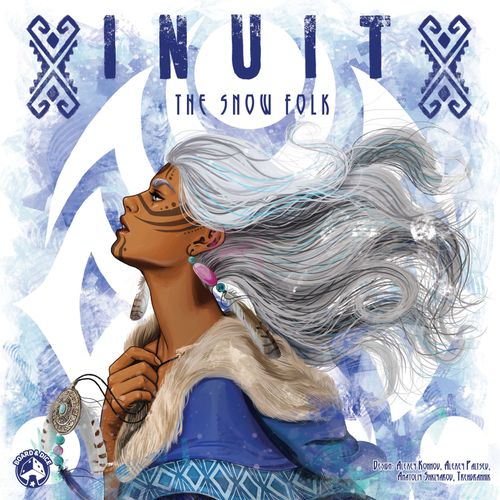
Inuit: The Snow Folk
Inuit: The Snow Folk Rulebook
Table of Contents
Table of Contents
Goal of the Game
As the leader of an Inuit village, your goal is to ensure the growth and prosperity of the village by initiating new members, building up reserves, and pleasing the spirits of nature.
When the polar night comes, the player with the most prosperous village will be the winner of the game!
Components
- 4 Village boards
- 117 Base Game cards:
- 1 First Player card
- 1 Polar Nightfall card
- 10 Polar Bear cards
- 13 Orca cards
- 19 Seal cards
- 7 Spirit cards
- 14 Rite cards
- 28 Inuit (adult) cards
- 24 Inuit (child) cards
- 1 Scoring pad
- 46 Optional Modules cards (detailed in each Module rules)
Optional Modules
Inuit: The Snow Folk includes two expansion modules: The Spirit of the Great White and Rising Sun. For your first game we recommend that you play the game without either of these expansions. The setup below takes into account the base game components only. You can find the detailed rules for each expansion and their setup at the end of this rulebook.
Game Setup
- Find the First Player card and the Polar Nightfall card and set them aside. Shuffle the rest of the cards thoroughly.
- Count out, face down, ten cards from the deck and add the Polar Nightfall card as an eleventh card. Shuffle these eleven cards and then place them near the centre of the table, placing the rest of the deck on top.
- Reveal the top five cards from the deck and lay them out, face up, next to the deck, forming the Great White.
- Give each player a Village board to place in front of themselves. During the game, cards will be placed above and below the Village board, so make sure to leave enough room for those cards.
- The player who enjoys cold weather the most receives the First Player card. Alternatively, determine the first player using a method of your choosing.
You are now ready to play!
Playing the Game
Each player turn consists of exactly 3 steps: Replenish the Great White, Scout, and Occupations.
Step 1 — Replenish the Great White
Reveal the top card of the deck and place it face up in the Great White.
Step 2 — Scout (Optional)
For each Scout you have in your village, you may reveal one additional card from the deck, adding it face-up to the Great White.
Step 3 — Occupations
Choose an Occupation listed on your Village board and resolve its ability. Though the effects of each Occupation vary, they all resolve in a similar way. Each Occupation will identify the type of card you may take from the Great White. You are allowed to take as many cards of that type as the number of Inuit cards you have assigned to that Occupation, plus one (for the Occupation itself depicted on your Village board). Refer to the Occupation Descriptions below for a detailed explanation of each occupation.
IMPORTANT: All cards by each Village board should be clearly visible to the other players.
After resolving Step 3 (Occupations), the player on your left will take their turn.
Occupation Descriptions
Each player starts the game having one Inuit in every Occupation. These starting Inuit are printed on the Village board. As the game progresses, you will assign more and more Inuit to various Occupations, thereby improving the effects of those Occupations.
When resolving an Occupation you must first count how many Inuit you have assigned to that Occupation. Do not forget to include the starting Inuit printed on your Village board! This number gives you the maximum number of cards you are allowed to take from the Great White while the Occupation itself tells you which type or types of cards you are allowed to take. You may not take any cards of other types, though you may choose to take fewer cards than what your number of Inuit allow.
Elder
For each Elder in your village you may take one Inuit card (adult or child) from the Great White. Each new Inuit card may be placed below any Occupation space of your choice.
New members of your village are very important! The more Inuit you have assigned to a single Occupation, the more powerful that Occupation's action becomes!
Each Inuit you take may be placed below the Elder Occupation space — allowing you to take even more Inuit cards in the future — or below any other Occupation spaces to raise their power.
Even though you may take Inuit cards of any colour — the Inuit from different villages perform their functions the same way — you should be aware that any Inuit card that does not match the colour of your village will score you negative points at the end of the game. All male and female Inuit are faithful to just one village and therefore have only one colour.
All children have two colours because they were born to two parents from different villages.
Shaman
For each Shaman in your village you may take a Rite or Spirit (in any combination) from the Great White.
After taking all the cards you wanted to take, immediately resolve the effects of all Rites taken, in any order you choose, and then place them above the Shaman space of your Village board. Spirits are also placed above the Shaman space of your Village board — they will score additional Victory Points at the end of the game.
You can find more information on Rites and Spirits on page 8 of this rulebook.
Warrior
For each Warrior in your village you may take one card (adult or child) from the Great White. Each new Inuit card should be placed face down above the Warrior space — these cards represent the weapons of those defeated.
Weapons bring you Victory Points but are also useful when you want to deprive other players of potential new Inuit cards they would otherwise be able to take from the Great White.
Whaler, Bear Hunter, and Seal Trapper
For each Whaler (alternatively, Bear Hunter or Seal Trapper) in your village you may take one Orca (alternatively, Polar Bear or Seal, respectively) from the Great White.
These three hunters allow you to collect Game cards. Whalers allow you to take Orca cards while Bear Hunters allow you to take Polar Bear cards and Seal Trappers allow you to take Seal cards. Each new Game card (Orca, Polar Bear, and Seal) should be placed above the hunter card of its type. Game cards will score additional Victory Points at the end of the game.
Scout
The Scout functions differently from all other Occupations in the game. This Occupation cannot be activated during Step 3 (Occupations). Instead, during its own separate Step 2 (Scout), before you take any cards from the Great White, for each Scout you have in your village, you may reveal one additional card from the deck, adding it face-up to the Great White.
The cards are revealed one by one, and you can choose to stop drawing at any time.
Scouts allow you to increase the number of cards available in the Great White, thus giving you a greater choice of actions for your other Occupations. However, you also risk giving more opportunities to other players.
End of the Game and Scoring Victory Points
As soon as any player reveals the Polar Nightfall card, the end of the game is triggered. Keep playing until all players have had an equal number of turns (the player sitting to the immediate right of the holder of the First Player card will perform the last turn of the game). Then, calculate the Victory Points for each player.
IMPORTANT: While calculating the Victory Points, do not remove or move cards from any Village board until all players have finished calculating the Victory Points for their village! This is very important, since the scores of some types of cards depend on cards present in other villages.
Any Victory Points awarded for having a given type of card (like scoring 2 Victory Points per Weapon using the Spirit of Might) are in addition to the original Victory Point value of a card.
Inuit Cards of Your Colour
All Inuit cards of your colour will earn you Victory points, even if they are located in a different village.
Every adult Inuit of your colour, in any village, is worth 2 Victory Points.
Every child Inuit that bears your colour, in any village, is worth 1 Victory Point.
Inuit Cards in Your Village
Any Inuit cards in your village that does NOT bear your colour will cause you to lose Victory Points.
Every adult Inuit of a different colour, in your village, will subtract 2 Victory Points from your score.
Every child Inuit where none of its colours match yours, in your village, will subtract 1 Victory Point from your score.
Game Cards
Each Polar Bear card in your village is worth 4 Victory Points, each Orca card is worth 3 Victory Points, and each Seal card is worth 2 Victory Points.
Weapons
Each Weapon you have collected during the game is worth 1 Victory Point.
Rites
Each Rite card, except the Rite of Inspiration, is worth 1 Victory Point. The Rite of Inspiration is worth 4 Victory Points.
Spirits
The number of Victory Points you score for each Spirit depends on that Spirit's ability.
Determining the Winner
The player with the most Victory Points is the winner!
If there is a tie, the tied player with the fewest Inuit cards (adults and children) wins. If there is still a tie, the tied player furthest from the First Player is the winner.
Rites
After taking all the cards you wanted to take from the Great White, the effects of all Rites taken are resolved in any order you choose. It is possible for a Rite to have no effect because of the effect of another Rite you took.
The Rite of Passage
Any player who has more Inuit cards than you must discard one face-up Inuit card from their village. These discarded cards are removed from the game completely. At the end of the game this Rite is worth 1 Victory Point.
The Rite of Fertile Game
Any player who has more Game cards than you must discard one Game card. These discarded cards are removed from the game completely. At the end of the game this Rite is worth 1 Victory Point.
The Rite of Sacrifice
Choose one Inuit card in your village and place it face-down as a Weapon. At the end of the game this Rite is worth 1 Victory Point.
The Rite of Clear Sight
Any player who has more Spirit and Rite cards (combined) than you must discard one Spirit card of their choice (unless that player has no Spirit cards, in which case nothing happens). These discarded cards are removed from the game completely. At the end of the game this Rite is worth 1 Victory Point.
The Rite of Inspiration
Immediately add three more cards from the deck to the Great White. At the end of the game this Rite is worth 4 Victory Points.
Spirits
For purposes of scoring a Spirit card, when counting Inuit cards in your village, do not forget to include the starting Inuit printed on your Village board!
Expansion Modules
Inuit includes two expansion modules you can add to your game to make it more nuanced. It is recommended that you play the base game at least a few times before adding any of the two expansion modules below. Each module can be used separately, or you can use them both at the same time.
Module 1 — The Spirit of the Great White
The Spirit of the Great White module adds an extra layer of interaction to the game by introducing a direct conflict between player villages. If you want a slightly more competitive game, add all components from this module to your game.
Module Components
All cards from this module have a symbol printed in the middle of the right edge of the card.
- 13 Great Game cards
- 4 Rite of Change cards
- 1 The Arctic Wolf - Spirit of Blood card
- 9 Legendary Character cards
- 8 Conflict cards
Game Setup Changes
- Find the The Walrus - Spirit of Might card among the base game cards and remove it from the game (by placing it back in the game box).
- If playing with fewer than four players find all Conflict cards with village colours absent from the game and remove them (by placing them back in the game box).
- After setting aside the First Player card and Polar Nightfall card, shuffle all cards from this module together with the base game cards.
- Proceed with normal setup of the game.
Module Rules
The only changes introduced to the game come from the new types of cards. Below follows a list of new cards included in the Spirit of the Great White module.
Conflict Cards
If a Conflict card is revealed during setup at the beginning of the game, it is removed from the game without effect and a replacement card is drawn. If, on your turn, a Conflict card is revealed and placed in the Great White, you must immediately decide what to do with the card:
- Declare War: place the card face up next to your village board (on the far left side). At the end of the game, each of your Weapons of the player colour depicted on the Conflict card will be worth an additional 2 Victory Points. At the end of the game, compare the number of Warriors you and the other player have (whose colour is depicted on the Conflict card). Out of the two of you, the player with more Warriors scores 4 Victory Points. In case of a tie, the player with more Weapons receives the points. In case of a further tie, the owner of the card receives 4 Victory Points.
- Forge an Alliance: place the card face down next to your village board (on the far right side). At the end of the game, you and the player whose colour is depicted on the Conflict card both score 2 Victory Points.
- Immediately discard the card with no further effect, and draw a replacement.
IMPORTANT: If you draw a Conflict card depicting the symbol of your own village, remove the card from the game and draw another card from the deck as replacement.
Legendary Character Cards
The Legendary Character cards work mostly like regular Inuit cards (including the ability of taking them as Weapons from the Great White). With two exceptions (discussed below) each Legendary Character has one specific occupation. This is the only Occupation that the Legendary Character can pursue if added to your village when resolving the Elder Occupation. Each Legendary Character can also score 8 Victory Points if you fulfil the condition outlined on the card.
There are 2 special Legendary Characters that work slightly differently from the rest:
- Legendary Drum Dancer: You may place this Legendary Character below any Occupation, but you will not be able to place any more cards below that Occupation. Additionally, you are prohibited from resolving this Occupation's ability for the rest of the game. This Legendary Character is worth 6 Victory Points at the end of the game.
- Legendary Healer: This Legendary Character may pursue any Occupation, where the Character counts as 2 Inuit, but may never be taken as a Weapon.
IMPORTANT: Unlike regular Inuit cards (which can add or subtract 1 or 2 Victory Points, depending on their colour), each Legendary Character (apart from the Drum Dancer) subtracts 4 Victory Points from your final score. If you fulfil the Legendary Character's condition (if one exists), you will receive 8 Victory Points, which will (in total) net you 4 Victory Points: +8 for fulfilling the condition and -4 for the Character's base Victory Point value. Please note that the Legendary Healer does not provide you with the ability to score 8 Victory Points, but for all intents counts as 2 Inuit cards in your village.
Great Game Cards
These cards work like regular Game cards for scoring purposes of the Spirit of Ice, Water, and Wind, but they bring more Victory Points at the end of the game than regular Game cards. During your turn, you may take only one Great Game card of each type — but you can still take more regular Game cards.
Rite of Change
This card functions like any other Rite in the game.
The Arctic Wolf – Spirit of Blood
This Spirit scores 1 Victory Point for each Weapon in your village.
Module 2 — Rising Sun
The Rising Sun module adds more seasons to the game, each with its own special effects and influence on the game.
Module Components
11 Rising sun cards:
- 3 Sunrise cards
- 4 High Sun cards
- 4 Sunset cards
All cards from this module have a symbol printed in the middle of the right edge of the card.
Game Setup Changes
- After setting aside the First Player card and Polar Nightfall card and shuffling the deck thoroughly, prepare the Great White by drawing 10 face-up cards to it.
- Choose 1 Sunrise, 1 High Sun, and 1 Sunset card, either randomly or by picking one of each type that all players agree to.
- Create 4 face-down piles: the first by counting 10 face-down cards, and three piles by dividing the remaining cards into three roughly equal decks.
- Shuffle the Polar Nightfall card into the 10-card deck.
- Place 1 of the remaining piles on top of the 11-card deck (containing the Polar Nightfall card), thus forming the main deck. Place the Sunset card face down on top of the main deck.
- Place 1 of the remaining 2 piles on top of the main deck. Place the High Sun card face down on top of the main deck.
- Place the Sunrise card face up near the main deck — this is the current active Rising Sun effect.
Module Rules
The game follows all basic rules, except for the active Rising Sun effect which you must always consider during your turn.
At the beginning of the game the Sunrise effect is active. However, the moment a player reveals a new Rising Sun card, the currently active card is removed from the game, and the newly revealed Rising Sun card becomes the active Rising Sun card. In other words, during any given game, Sunrise will be active first, then High Sun, and finally Sunset. Whenever a Rising Sun card is revealed (and becomes active) you must immediately draw a replacement card.
The effect of each Rising Sun card is outlined on the card itself. Resolving the effect is optional (a player may decide to ignore the Rising Sun card), unless the card states that its effect must be resolved, or if it is the Polar Nightfall card, which ends the game as normal.
If a card requires you to discard a card from your village, the discarded card is removed from the game – place it back in the game box.
Promo Cards
Your copy of Inuit: The Snow Folk came with 2 cards described nowhere else in these rules. These cards are promotional items for 2 other games published by Board & Dice.
If one of the following games ever enters your collection, you will have some extra content to play with! Otherwise, the cards also make great small gifts for any friend who has a copy of Dice Settlers or Dust in the Wings.
This card is a promo item for Dice Settlers, a light civilization game of dice bag building, expansion, and area control, featuring fast gameplay, amazing art, and over 50 custom dice! Simply add the Merchant Routes promo card as an option when setting up your Technology tableau.
This card is a promo item for Dust in the Wings, a light strategy game of clever maneuvering, where you try to position beautiful wooden butterflies on a meadow board in order to take the best photos and score the most points. Add this card to the Gathering deck. To fulfill it, you must end your move on a space that contains 5 butterflies: 1 red, 1 blue and 1 yellow butterfly, and two other butterflies of any color – as long as it is the same color (both are blue, both are red, or both are yellow).