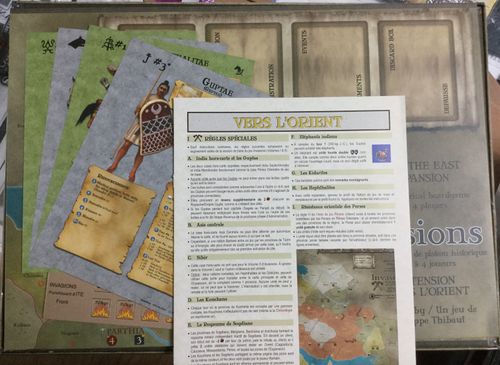
Into the East
Into the East Rulebook
Table of Contents
Table of Contents
Special Rules
Unless stated otherwise, the following rules replace or augment those of the base version of the Invasions game (Volumes I & II).
A. Off-Card India and the Guptas
- The two off-card spaces called India Septentrionalis and India Meridionalis function as the Persia Orientalis space of the base game.
- No unit other than the Guptas may enter these spaces, for whatever reason.
- These spaces are considered adjacent to each other (that is, the Guptas may move their units between them as if they were connected provinces).
- Each of them provides an additional income of 2 [brown disc icon] to the Gupta Kingdom/Empire, as if they were cities. (The brown disc icon is not named on this sheet; it is shown as printed.)
- If the Guptas lose their capital (Sagala in the Punjab at the start), they may freely redeploy their forces to one or the other of these spaces at the end of the Revenue step of the next Administration phase.
B. Central Asia
- The off-card space Asia Centralis cannot be reached by anyone from the map, and it provides no income to anyone.
- However, if a Barbarian nation enters play through the provinces of Tarim or Amyrgia, it may instead choose to arrive through this space. It must leave this space as soon as it first activates a pile.
C. Sibir
- This off-card space is used only for Volume II of Invasions. It is to be ignored in Volume I, unless the option below is used.
- Option: two nomad nations, the Hephthalites and the Göktürks, may use this box to transit between the main map and the Expansion map, counting it as 1 province. No unit may remain there; it may only be crossed. Interception there is forbidden, but retreat and flight may use it.
D. The Kouchans
- Each turn in which the province of Kushania is occupied by a civilized garrison, the Kouchans do not carry out any raid (even if the Chronology calls for one).
E. The Kingdom of Sogdiana
- The provinces of Sogdiana, Margiana, Bactriana and Arachosia form the independent, inactive minor kingdom of Sogdiana. If it becomes a client, its tribute is −2 [brown disc icon] per turn (the patron pays the tribute to the client), and it lends 2 random units, which must remain in the Orient (Cappadocia, Caucasus, Mesopotamia, Persis, and all the zones of the Expansion).
- The Kouchans and the Sogdians share the same origin (their pawns are the same colour), and both are played by the Roman player.
- The Kouchans and the Sogdians are in permanent alliance and can enter (the sentence continues below the photographed edge and is not legible; see gap notes).
F. Indian Elephants
- Starting from turn 1 (350 AD), the Guptas may buy elephants.
- An elephant is a double heavy unit (non-elite) (printed with two heavy-unit icons). It counts as two heavy units when calculating the Heavy advantage, but a single hit is enough to eliminate it.
G. The Kidarites
- These pagan barbarians are mountain nomads.
H. The Hephthalites
- With this expansion, ignore the base game's Nation profile for the Hephthalites and replace it with the profile provided here. Apply all the instructions.
- Gap: the profile referred to here is not on the photographed side of the sheet and is not transcribed.
I. Eastern Persian Resistance
- Rule H of the Persian Player Aid (Aide de jeu Perses) also extends to all the provinces controlled by the Persians in Persia Orientalis: if an enemy enters one of the region's provinces, Persia may immediately place 1 free unit of its choice.
- Elite units are received reduced (see the reverse side).
- The unit received may be placed either in the invaded province, or in a Persian province left vacant by the invader (that is, behind enemy lines).
Gap notes (translation and transcription)
- The photograph cuts off the bottom of the sheet. The sentence at the end of section E (about the Kouchans and Sogdians entering) is cut mid-sentence, and anything below it is not transcribed.
- The Hephthalite nation profile referred to in section H is not visible in the photograph.
- The reverse side of the sheet (referred to in section I for elite units) is not included in this source.
- The brown disc income/tribute icon and the heavy-unit icons are reproduced as printed; the sheet itself does not spell out their names. Check them against the base rulebook before relying on the resource name.
- The sheet's footer credit line and the map artwork are not transcribed.