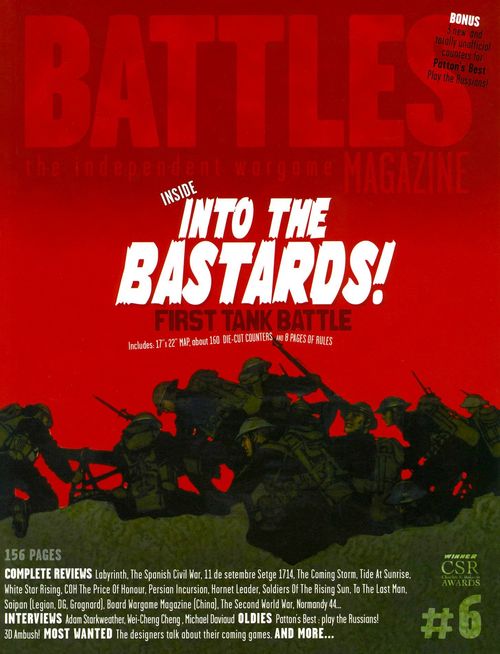
Into the Bastards!: First tank battle
Into the Bastards!: First tank battle Rulebook
Table of Contents
Table of Contents
Scales
- 1 counter = 1 battalion or 1 tank
- 1 hex = 200 m
- 1 turn = 2 or 3 hours
Units
There are two types of units in the game: infantry battalions and tanks.
- Silhouette and historical designation.
- Between 2 and 4 medals, symbolising the number of actions the unit can perform.
- Reverse side: disorganised unit or damaged tank.
Markers: artillery barrage, activation, mechanical breakdown.
Tracks: turn track; battle intensity track and victory points.
Glossary
Movement Points
Movement Points or MPs are used by units to move on the map. The number of MPs of each unit varies according to the number of medals used to move.
Zone of Control
The six hexes adjacent to a combat unit make up its Zone of Control (or ZoC). These hexes are considered to be controlled by that unit. All units, battalions or tanks, exert a ZoC. A ZoC extends into and through all types of terrain. Zones of control extend into hexes occupied by other units, even enemy units. The presence of a friendly unit does not cancel an enemy ZoC. The zones of control of several units can coexist in the same hex. Zones of control have a great influence on unit movement and on combat.
Entering a ZoC can cost extra MPs, depending on the type of unit moving:
| Type of unit entering ZoC | Extra MPs required |
|---|---|
| Infantry battalion with less than 4 medals | +2 MPs |
| Infantry battalion with 4 medals | +1 MP |
| Tank | 0 MP |
A unit entering a ZoC must immediately end its movement.
Leaving a hex in a ZoC cannot be done as part of a normal movement. The unit must use one of the following actions: Assault, Infiltration or Withdrawal.
Line of Sight
Some actions require a clear line of sight between two hexes. Line of sight is checked from hex center to hex center, by tracing a virtual line between these two points. A line of sight is always clear between two adjacent hexes. A line of sight is clear between two non-adjacent hexes if the following conditions are met:
- the line drawn between the two hexes does not cross blocking terrain,
- the line drawn between the two hexes does not cross a friendly or enemy battalion.
Note: a line of sight drawn exactly between a blocking hex and a clear hex is a clear line of sight.
Line of Communication
A line of communication consists of adjacent hexes, of unlimited length, reaching the West edge of the map for the Allied player, the East edge for the German player. The line of communication cannot cross an enemy unit or an enemy ZoC, even if the ZoC is occupied by a friendly unit.
Stacking
Only one unit may be present per hex at the end of each activation. A unit cannot end an activation stacked on another unit. However, a unit may be temporarily stacked with a friendly unit if it uses its remaining activation points to leave the hex (for example to launch an assault from a hex where a friendly unit already is). In other words, the stacking limit is only taken into account at the end of a unit's activation.
Disorganised Battalion
A disorganised battalion has the same number of medals as when at full strength. However, it can only perform certain actions while disorganised (see the Table of Actions). Once rallied, it can perform all types of actions with the medals still available.
Friendly Trenches
A trench is "friendly" if it is marked with a British cockade for Allied units and with a black cross for German units.
Sequence of Play
There are two types of sequence of play during a game:
- the classic sequence of play, where players play one after the other;
- the random sequence of play, where the drawing of a marker indicates which player may play.
The game begins in the classic sequence of play and may change to the random sequence, depending on game turns.
Each game turn is broken down as follows:
- German artillery barrages.
- Allied artillery barrages.
- Activation of Allied units: the Allied player may activate all or some of his units, individually. (Not played on turn 1.)
- Repair of Allied tanks. (Not played on turn 1.)
- Activation of German units: the German player may activate all or some of his units, individually.
- Repair of German tanks.
- Return to play of eliminated battalions.
- Battle intensity test: if the intensity marker on the battle intensity track reaches the space occupied by the confusion marker at the end of a turn, the sequence of play becomes random on the next turn.
- Advance the turn marker.
When the marker on the intensity track reaches the space occupied by the confusion marker at the end of a turn, the sequence of play becomes random and is modified as follows:
- 1st draw of an activation marker and corresponding action
- 2nd draw of an activation marker and corresponding action
- 3rd draw of an activation marker and corresponding action
- 4th draw of an activation marker and corresponding action
- 5th draw of an activation marker and corresponding action
- Return to play of eliminated battalions.
- Advance the turn marker.
The random sequence lasts until the turn marker reaches a "Nightfall" space.
Activation of Units
2.1 Activation of Units in the Classic Sequence
During the activation phase, the phasing player may activate all or some of his units, in the order of his choice. Units are activated individually. A unit must finish all of its actions before another unit can be activated.
An activated unit can perform a number of actions, depending on the number of medals shown on the counter. Each action has a "cost" in medals as shown in the table below. Medals are said to be "spent" or "used" to carry out actions:
Table of Actions
| Action | Cost in medals for battalions | Cost in medals for tanks | Action authorised for a disorganised battalion? |
|---|---|---|---|
| Movement | 2 MPs/medal | 4 MPs/medal | Yes |
| Combat | 1 fire/medal | 1 fire/medal | No |
| Assault | 3 medals | 1 medal | No |
| Rallying | 2 medals ** / § | - | Yes |
| Infiltration | 3 medals * | 2 medals | Yes |
| Withdrawal | 2 medals ** | 1 medal | Yes |
- * : 2 medals if the unit carries out the action from a friendly trench
- ** : 1 medal if the unit carries out the action from a friendly trench
- § : 3 medals if the unit carries out this action in an enemy ZoC which is outside a friendly trench
Example: A battalion with 4 medals can spend 2 medals to move 4 MPs, and use its last two medals to make two fire attacks.
Each action is described in chapter 3. Once a unit has finished its actions, it can no longer be activated for the current turn. Players may indicate units that have finished their activation by turning them 180 degrees in their hex.
2.2 Activation of Units in the Random Sequence
During the random sequence, units are activated by the random drawing of activation markers. Each activation marker allows the activation of a variable number of units of one side or the other, as indicated on the marker. Apart from this procedure, the activation of each unit is identical to that described in 2.1. In particular, a unit that has performed its actions cannot be activated again in the same turn (except by events).
2.3 Arrival of Reinforcements
2.3.1 Arrival of A7V tanks. The 9 A7V tanks arriving as reinforcements on turn 1 enter play along the East edge of the map during the German player's activation phase, via a movement action for their first medal. They spend MPs for the first hex of the map edge through which they enter play.
2.3.2 Arrival of Mark IV tanks. The 3 Mark IV tanks arriving as reinforcements on turn 2 enter play along the West edge of the map during the Allied player's activation phase, via a movement action for their first medal. They spend MPs for the first hex of the map edge through which they enter play.
2.3.3 Arrival of Whippet tanks. The Whippet tanks arriving as reinforcements on turn 3 enter play along the West edge of the map during the Allied player's activation phase, via a movement action for their first medal. They spend MPs for the first hex of the map edge through which they enter play. If the random sequence is already in progress on turn 3, they enter play before the first activation marker is drawn. They are activated one after the other, using their two remaining medals for any type of action. They can no longer be activated via an activation marker for turn 3.
Arrival of Australian reinforcements. The arrival of the Australian reinforcements and the British battalion accompanying them follows a special rule (see Australian Night Assault).
Actions
Each action requires a certain number of medals to be performed. A unit can never use more medals than are shown on its counter.
3.1 Movement Action
To move, a unit must spend medals, as indicated in the Table of Actions. Each medal spent gives the unit a certain number of movement points (MPs) for its activation. For example, a battalion spending 3 medals to move has 6 MPs. A unit subtracts movement points (MPs) from its movement capacity for each hexside it crosses in passing from one hex to another. The MP cost depends on the terrain crossed (see the MP cost table).
MP costs to pass from one hex to another are cumulative. Example: entering a hex containing wooded terrain and an enemy trench costs 3 MPs: 2 MPs for the wooded terrain, +1 MP for the trench.
A unit may move freely through a hex containing other friendly units without spending additional movement points. It may stop its movement on a friendly unit only if it has enough medals left to undertake an action that will make it leave the hex during its current activation. Movement points cannot be saved for a future activation. Nor can they be transferred from one unit to another.
A friendly unit can never enter a hex occupied by an enemy combat unit during a movement action.
A unit that does not have enough MPs to enter a hex (whether because of terrain or an enemy ZoC) cannot move into it. There is no minimum movement in this game.
A unit cannot leave a hex in a ZoC as part of a classic movement. The unit must use one of the following actions to leave an enemy ZoC: Assault, Infiltration or Withdrawal.
A tank cannot enter a hex whose cost is greater than 1 MP if that hex already contains a friendly unit that has already been activated (so as not to create over-stacking in the event of a mechanical breakdown).
Important: A tank cannot spend more than two medals per turn to perform a movement action.
3.2 Combat Action
A combat action allows an enemy unit to be attacked.
A battalion can only attack an adjacent enemy unit. A tank can attack an enemy unit up to 3 hexes away, if the line of sight between the tank and the enemy unit is clear.
Restrictions:
- Allied infantry cannot fight Mark IV tanks.
- Allied infantry, female Mark IV tanks (marked F) and Whippets cannot fight A7V tanks.
- A tank cannot fight an enemy unit in a forest or village hex.
- A tank located in a village or forest hex cannot fight.
For each medal spent, a unit can roll one die to attack an enemy unit. The player rolls a die, which he modifies for terrain (see the terrain table). If several modifiers apply, the defender chooses the one most favourable to him. On a result of 4, 5 or 6, the enemy unit suffers a loss. If the enemy unit was at full strength, it suffers a loss and is flipped to its reverse side, its disorganised side (battalion) or damaged side (tank). If the enemy unit is already disorganised or damaged, it is eliminated when it suffers a loss.
When a tank is attacked, terrain modifiers are ignored. Instead, the player consults the table below to find the modifiers to apply.
Tanks in Combat
Die roll modifiers (rows: attacker; columns: defender):
| Attacker \ Defender | A7V | Mark IV-M | Mark IV-F | Whippet |
|---|---|---|---|---|
| A7V | -2 | -2 | 0 | |
| German Bn | Prohibited | Prohibited | 0 | |
| Mark IV-M | -1 | |||
| Mark IV-F | Prohibited | |||
| Whippet | Prohibited |
(Shaded/blank cells in the player aid's table are not applicable.)
As soon as a battalion is eliminated following a combat, a d6 is rolled to test for its return to play (see Test for Eliminated Battalions).
3.3 Assault Action
An assault action consists of entering a hex occupied by an enemy unit in order to eliminate it. An assault costs 3 medals for a battalion and 1 medal for a tank. Given the cost of an assault, only tanks can launch several assaults in a single activation.
An assault is only possible against a unit that is adjacent at the start of the assault. Exception: a tank cannot launch an assault against another tank.
A disorganised battalion cannot launch an assault. A damaged tank can launch an assault.
If all the above conditions are met, the unit can launch its assault. It is placed in the enemy hex and rolls as many dice as it has medals on its counter.
- It inflicts a loss for each result of 4, 5 or 6 if it has a higher number of medals than the enemy unit.
- It inflicts a loss for each result of 5 or 6 if it has a number of medals lower than or equal to the enemy unit.
A -1 penalty to the dice applies if the assault takes place in an enemy trench hex.
If the loss(es) inflicted eliminate the enemy unit, the assault is successful. If the enemy unit is not eliminated, the assault fails and the unit that launched the assault is eliminated.
Exception: if the assaulting unit is a tank and it has at least one medal left to spend, the tank must re-launch the assault under the same conditions, if it does not suffer a mechanical problem following the first assault (see 4.1). If it suffers a mechanical problem while the assaulted unit has survived, the tank is eliminated.
As soon as a battalion is eliminated following an assault (attacker or defender), a d6 is rolled to test for its return to play (see Test for Eliminated Battalions).
[The French draft here notes that an example will be added.]
3.4 Rallying Action
A disorganised battalion can perform a rallying action, the cost in medals varying according to:
- the existence of a friendly trench in the unit's hex,
- the presence of an adjacent enemy unit.
The battalion spends the number of medals indicated in the Table of Actions and is flipped to full strength.
3.5 Infiltration Action
A unit may move from enemy ZoC to enemy ZoC by spending the number of medals indicated in the Table of Actions. This movement is made regardless of terrain cost.
3.6 Withdrawal Action
A unit may leave an enemy ZoC to an adjacent hex outside enemy ZoC by spending the number of medals indicated in the Table of Actions. This movement is made regardless of terrain cost.
Tanks
Tanks differ from other units (battalions) in several respects:
- If flipped following a first loss, they are damaged (not disorganised). A damaged tank cannot be repaired. [The French draft is incomplete here: "(except...)".]
- A tank can carry out a combat action against a non-adjacent enemy unit.
- A tank can make several assaults in a single activation.
- A tank can neither fight nor launch an assault toward a town or forest hex.
- A tank located in a village or forest hex cannot fight.
- A tank cannot spend more than 2 medals per turn to move.
- Tanks may suffer mechanical problems following a movement or an assault.
4.1 Mechanical Breakdown
A tank that carries out an assault action or enters a hex whose terrain cost is greater than 1 MP may suffer a mechanical breakdown. As soon as the tank has made its assault (and before possibly launching another in the same hex) or as soon as it has entered the hex whose terrain cost is greater than 1 MP, the player owning the tank rolls a die and consults the table below to see whether the tank suffers a mechanical breakdown.
| Tanks | Breakdown due to terrain | Breakdown after an assault |
|---|---|---|
| German tanks in Turn 1 | If d6 = 1 | If d6 = 1 or 2 |
| German tanks in all subsequent turns | If d6 = 1 or 2 | If d6 = 1 or 2 |
| Allied tanks | If d6 = 1 | If d6 = 1 or 2 |
A tank launching an assault in a hex whose terrain cost is greater than 1 MP rolls the die twice: before its assault (for the terrain), and after it, if its first test succeeded. A mechanical breakdown eliminates the tank if the enemy unit subject to the assault is still present in the hex.
An appropriate marker is placed on a tank suffering a mechanical breakdown. As long as the marker is present, the tank can only be activated for a Combat action.
4.2 Repair of Tanks
During this phase, the phasing player MUST attempt to repair his tanks that have suffered a mechanical breakdown. For each tank concerned, the player rolls a die, modified by +2 if the tank is in an enemy ZoC:
- On a result of 1, the tank is repaired and the mechanical breakdown marker is removed from the counter.
- On a result of 6 or more, the tank is eliminated.
Artillery
The turn track indicates, for each turn, the number of artillery markers available to each player during his barrage phase. When the game moves to the random sequence, these indications are no longer taken into account, barrages being able to take place via activation markers (see Activation Markers).
Barrage resolution procedure:
- The phasing player places on the map all the markers he has for this turn. They can be placed on any hex of the map, but only one marker may be placed per hex.
- For each marker, in the order chosen by the player, he rolls a die.
- On a result of 1 to 3, the barrage hits the targeted hex. The die is modified by "-1" on turn 1 (to account for the spotting of the previous days).
- On a result of 4 to 6, the barrage hits an adjacent hex. The player rolls a die again to indicate in which direction to move the barrage marker, referring to the diagram on the map.
- If the hit hex contains no unit, nothing happens.
- If the hit hex contains a tank, the player owning the tank rolls a die. If the result is "5" or "6", the tank takes a loss.
- If the hit hex contains a battalion, the player owning the unit disorganises it, if it is not already. Then he rolls a die, subtracting "1" from the result if the unit is in a trench. If the result is greater than the number of medals, the battalion is eliminated and its return to play is tested (see Test for Eliminated Battalions).
Counter-battery: Only the German player can perform counter-battery fire, given his superiority in artillery. During his barrage phase, the German player may announce that he is performing a counter-battery rather than a barrage. For each artillery marker used for counter-battery, the Allied player reduces his number of artillery markers by "1" for his next barrage phase.
Battle Intensity Track and Confusion
The "Battle Intensity" track determines when in the game the sequence of play is modified (see Sequence of Play). The intensity marker is initially placed on space 0. The confusion marker is placed as indicated by the scenario.
During the game:
- each time an infantry battalion is eliminated, the intensity marker advances one space.
- each time an infantry battalion launches an assault, whatever the result, the intensity marker advances one space.
- When the intensity marker reaches the track space occupied by the confusion marker, the sequence of play is modified for the next turn.
Activation Markers
7.1 Procedure
The activation markers determine which actions will be executed during each turn of the random sequence of play. At the start of the game, all the activation markers are placed in an opaque container.
When the game moves to the random sequence, the classic sequence of play is ignored. Instead, five activation markers are drawn each turn, one after the other. Each marker determines an action or an event for each player (see the two). Each activation is resolved as described below before moving to the next. Drawn markers are not returned to the pool, but placed on the turn track, in the space of the current turn (exception: the Hero marker). Once the fifth marker has been played, the turn ends, the turn marker is advanced one space, and the same procedure resumes until the turn marker reaches the "Nightfall" space.
7.2 Description of the Activation Markers
- Battalion activation: the designated player activates the indicated number of battalions (1, 3 or 5). These units can no longer be activated this turn.
- Tank activation: the designated player may activate up to three tanks. These units can no longer be activated this turn.
- Hero: a hero is placed on a battalion, which can be activated immediately. If the battalion was disorganised, it is returned to full strength for free. The hero increases the unit's number of medals by "1" (to a maximum of 4) as long as the hero is present. At the end of the activation, the hero counter remains on the unit as long as it is not eliminated. If the battalion is eliminated, the hero counter is permanently removed from the game.
- Pause in the fighting: each side may reorganise up to 3 units not adjacent to enemy units.
- Artillery: the designated player may carry out an artillery barrage.
- Rout: the designated player must pull back in a straight line (toward the West for the Allied player, the East for the German player) by 5 hexes all his disorganised battalions toward his map edge. Units leaving the map or having to cross a ZoC are eliminated.
- Mechanic: the designated player may repair a damaged tank or a tank that has suffered a mechanical breakdown and activate it immediately.
- End of turn: the current turn ends immediately, even if the 5 activations have not taken place.
- Reinforcements: the designated player recovers up to two eliminated infantry battalions located on any space of the turn track. They enter play along the West edge (Allied player) or East edge (German player) of the map, via a movement action for their first medal. They spend MPs for the first hex of the map edge through which they enter play. These units can no longer be activated this turn.
Test for Eliminated Battalions and Return to Play
Test for Eliminated Battalions
When a battalion is eliminated following a combat, an assault or a barrage (and only in these cases), the player controlling the battalion rolls 1d6 modified as follows:
- Battalion eliminated as the attacker, following an assault against an enemy battalion: +3
- Battalion eliminated as the defender, following an assault by an enemy battalion: +2
- Battalion eliminated following an attack from an enemy battalion or as a result of a barrage: +1
- Battalion eliminated following an attack or an assault involving a tank: no modifier
- Battalion eliminated during turn 7 (night turn): -2
Design note: battalions eliminated following a clash with a tank are in fact victims of a rout and can return to the fight more easily. The modifier for the night turn takes into account the length of this turn compared to the others.
- If the d6 result is a natural "1" or is greater than "6", the battalion is permanently eliminated.
- If the d6 result is less than or equal to "1" (and the d6 result is not a natural "1"), the result is changed to "2".
- If the result is between "2" and "6" inclusive, the battalion is placed on the turn track, on the space corresponding to the sum of the current turn and the modified d6.
Exception: a unit eliminated on 24 April will return at the latest on turn 8.
Example: on a modified d6 result of "3", a battalion eliminated on turn 2 will be placed on the turn 5 space.
Return to Play of Eliminated Battalions
During this phase, each player recovers the battalions located on the next turn's space of the turn track. Each player brings these battalions into play simultaneously along the West edge (Allied player) or East edge (German player) of the map by a movement action. They spend MPs for the first hex of the map edge through which they enter play.
Restrictions:
- these units can only spend one medal to move.
- These units cannot spend any other medal this turn.
"Nightfall" Turns
The "Nightfall" turns mark the end of a day of fighting. Players follow this procedure:
- All damaged tanks or tanks that have suffered a mechanical breakdown are eliminated.
- All disorganised battalions that are not adjacent to a non-disorganised enemy battalion must pull back in a straight line (toward the West for the Allied player, the East for the German player) by 5 hexes toward their map edge. Units leaving the map or having to cross a ZoC are permanently eliminated. Surviving units are automatically reorganised at the end of this movement.
- All disorganised battalions located in the ZoC of an enemy battalion roll a die. If it is less than or equal to the unit's number of medals, it follows the procedure above. If the die is greater than the number of medals, the unit is permanently eliminated.
- The game then ends if this is the 25 April "Nightfall" turn. If it is the night of 24 April, the procedure continues as follows.
- [sic; no step 5 in the source] The intensity marker is placed on space "0". The confusion marker is placed on space "20" and a player rolls 1d6. The confusion marker is then moved back as many spaces as the d6 result.
- The turn marker is advanced one space.
Australian Night Assault
The "Nightfall" procedure is different for the night of 24-25 April, to simulate the Australian night assault.
Procedure:
- Step "1" of the "Nightfall" procedure is applied (elimination of damaged tanks or tanks that have suffered a mechanical breakdown).
- The Allied player deploys on the map the units indicated in the scenario. He places his units:
- adjacent to a friendly unit (including a unit just deployed), able to trace a line of communication to the West edge of the map;
- at least 3 hexes from an enemy unit;
- West of column "11" inclusive.
- The sequence below is then repeated 3 times:
- Activation of all deployed Allied units (and only these).
- Activation of German battalions (not tanks) located 2 hexes or less from an Allied unit that has just been activated.
- The "Nightfall" procedure is resumed from step "2", ignoring all deployed Allied units and German battalions located 2 hexes or less from a deployed Allied unit.
Victory Conditions
Each scenario has its own victory conditions.
Terrain Table
| Terrain | Effect on movement | Effect on combat | Effect on an assault |
|---|---|---|---|
| Clear | 1 MP | No effect | No effect |
| Road | Cancels other terrain effects, except for enemy trenches | No effect | No effect |
| Trenches | Friendly: no effect. Enemy: +1 MP | -1 DRM to attack an enemy battalion in a friendly trench. -2 DRM to attack an enemy battalion in an enemy trench. A unit attacking from a friendly trench gains an extra medal if the attack is the only action of its activation (despite this, the number of medals may not exceed 4). | -1 DRM to assault an enemy battalion in an enemy trench |
| Urban / Village (dotted hexes) | 1 MP in the player aid; 2 MPs in the French rules text | -1 DRM | No effect |
| Forest | 2 MPs | -1 DRM | No effect |
(The player aid gives Urban as 1 MP; the French rules table gives Village as 2 MPs. The discrepancy is in the sources.)
Scenarios
Scenario 1: First Tank Battle
This scenario replays the main events of the battle: the initial German assault, the first tank battle and the Australian counter-attack. It is also good training before launching into the second scenario.
Map: only the part north of row P (inclusive) is used. Duration: the scenario lasts from turn 1 to turn 7 inclusive.
Setup: The initial placement of units is shown on the counters. Counters whose initial placement is on rows "Q" to "AA" are not used in this scenario.
- Battle intensity marker: space 0
- Confusion marker: space 17
- Activation markers: all activation markers are used, except 2 Allied "3" activation markers and 2 German "3" activation markers.
German reinforcements:
- Turn 1: 7 tanks through any hex of the East edge of the map, as described in 2.3.1. In addition the German player may bring in one or two extra A7Vs at any time during his activation phase. For each extra A7V, the Allied player scores 2 VPs.
Allied reinforcements:
- Turn 2: 2 Mark IV F tanks, 1 Mark IV M tank, through any hex of the West edge of the map, as described in 2.3.2.
- Turn 3: The Allied player has a random number of Whippet tanks. He rolls 1d6 and adds "1" to the result. The result gives the number of Whippet tanks arriving as reinforcements. The tanks enter play through a hex of row N, O or P of the West edge of the map.
- Nightfall turn: the Australian battalions and the British battalion 7 Bn Bedford Rgt, as described in the rule (Australian Night Assault).
Special rule:
- Cachy garrison: The 4th Bn Suffolk must remain at all times within 2 hexes of a hex of the town of Cachy.
Victory conditions:
Players immediately score the following VPs during the game:
- 2 VPs for the German player per captured Allied tank. An Allied tank is captured if it is eliminated following an assault.
- 4 VPs for the player eliminating a tank for the first time following a combat initiated by one of these tanks. If the eliminated tank is a Whippet, the German player scores only 2 VPs.
- 1 VP for the player eliminating a tank following a combat initiated by one of these tanks, after the first time.
- 2 VPs for the German player at the end of each turn in which he is the only one to have, in a hex of Villers-Cotterets [sic], a battalion able to trace a line of communication to the East edge of the map.
- 2 VPs for the German player at the end of each turn in which he has, in a hex of Bois d'Aquenne, a battalion able to trace a line of communication to the East edge of the map.
- 3 VPs for the German player at the end of each turn in which he has, in a hex of Bois l'Abbe, a battalion able to trace a line of communication to the East edge of the map.
At the end of the game, players score victory points for control of hexes as indicated in the following table. These points are scored only if the battalion occupying the hex can trace a line of communication to the West edge for the Allied player, the East edge for the German player.
| Hex | German player | Allied player |
|---|---|---|
| Villers-Bretonneux | 15 VPs if the player is the only one with battalions in the town. Otherwise, 1 VP for each hex occupied by a battalion. | 5 VPs if the player is the only one with battalions in the town. |
| Bois l'Abbe | 3 VPs per hex occupied by a German battalion | |
| Bois d'Aquenne | 2 VPs per hex occupied by a German battalion | |
| Cachy | 3 VPs per hex occupied by a German battalion | |
| German trenches | 1 VP per hex occupied by an Allied battalion |
Scenario 2: The Second Battle of Villers-Cotterets [sic]
This scenario replays the whole battle over two days, including the fighting for Hangard, defended by French troops.
Map: the whole map is used. Duration: the scenario lasts from turn 1 to turn 14 inclusive.
Setup: The initial placement of units is shown on the counters. Reinforcement units are set aside. The two A7V tanks marked "OPT" are not used (see the optional rules).
- Battle intensity marker: space 0
- Confusion marker: space 20
- Activation markers: all activation markers are used.
German reinforcements:
- Turn 1: 9 tanks through any hex of the East edge of the map, as described in 2.3.1.
Allied reinforcements:
- Turn 2: 2 Mark IV F tanks, 1 Mark IV M tank, through any hex of the West edge of the map, as described in 2.3.2.
- Turn 3: 7 Whippet tanks through a hex of row N, O or P of the West edge of the map.
- Nightfall turn: the Australian battalions and the British battalion 7 Bn Bedford Rgt, as described in the rule.
Special rule:
- Cachy garrison: The 4th Bn Suffolk must remain at all times within 2 hexes of a hex of the town of Cachy.
Victory conditions:
Preamble: To validate a victory condition, battalions must be able to trace a line of communication to the East edge of the map for German battalions, to the West edge for the Allied player.
Decisive victory: the German player achieves a decisive victory and the game stops immediately if, at the end of a turn, from turn 7, he is the only one to have a battalion in a hex of Villers-Cotterets [sic], and he fulfils one other of these three objectives:
- he has a battalion in a hex of Bois l'Abbe.
- he is the only one to have a battalion in a hex of Cachy.
- he has a battalion at Domart.
If there was no German decisive victory at the end of turn 14, the winner of the game is determined as follows:
- German Strategic victory: the German player has a battalion at Hangard or Cachy and he is the only one to have a battalion in a hex of Villers-Cotterets [sic].
- German Operational victory: the German player is the only one to have a battalion in a hex of Villers-Cotterets [sic].
- German Tactical victory: the German player has a battalion at Hangard and at Villers-Cotterets [sic], and no German trench hex is occupied by an Allied battalion.
- Draw: no player manages to fulfil a victory condition.
- Allied Tactical victory: the German player fulfils no victory condition. In addition, the Allied player has a battalion at Hangard and occupies with a battalion at least one German trench hex.
- Allied Operational victory: the Allied player is the only one to have a battalion in a hex of Villers-Cotterets [sic].
- Allied Strategic victory: the Allied player is the only one to have a battalion in a hex of Villers-Cotterets [sic] and occupies with a battalion at least one German trench hex.
First tank battle. The player who won the first tank battle between a Mark IV and an A7V shifts the victory level one rank in his favour: a draw becomes a tactical victory, a tactical victory an operational victory, etc.
Note: victory is also what remains for posterity...
Optional Rules
As their name indicates, these rules are not mandatory. They add some realism at the cost of a little complexity. The cohesion-keeping rule is recommended to players who have already played a few games.
1. MG Battalions
Machine-gun battalions, marked MG instead of the NATO symbol, must use at least two medals per activation to perform a combat action. If such an action is impossible, the medals are lost for that activation.
2. Vulnerability of Tanks at Night
Launching an assault on a tank at night costs only one medal for a battalion. In addition, the assault causes a loss on a 4, 5 or 6, whatever the number of medals of the battalion.
3. Maintaining Cohesion
Only the German player may attempt to prevent the switch to the random sequence on the turn when the intensity marker reaches or exceeds the confusion marker. At the end of the turn, the German player announces his attempt. He rolls 1d6, to which he adds the turn number plus the difference between the value reached by the intensity marker and the value of the space occupied by the confusion marker. If the result is greater than 6, the attempt fails. If the result is less than or equal to 6, the attempt succeeds and the next turn will be played in the normal sequence, after which the following turns will be played in random mode.
Example: The players are fighting scenario 2. The German player is finishing his turn 2 and the intensity marker is already on space 19. However, the German player judges it essential to launch one last assault. It succeeds, bringing the value of the intensity marker to 21 (the marker is placed to the left of space 20 to keep track). Wanting to keep as much control as possible over the battle, the German player attempts to maintain cohesion. He rolls 1d6 and gets a "3", modified by +2, the turn number, and +1 (the difference between 21, the intensity value, and 20, the confusion value), for a final result of "6". His attempt succeeds. Turn 3 will be played in the classic sequence, and the players will automatically switch to random mode on turn 4.