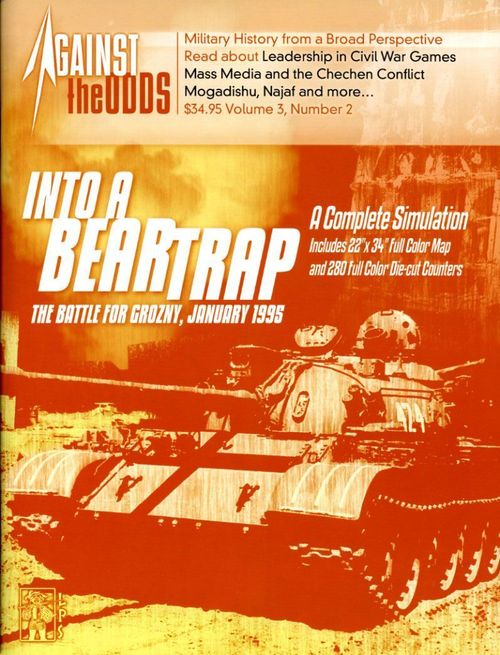
Into a Bear Trap: The Battle for Grozny, January 1995
Into a Bear Trap: The Battle for Grozny, January 1995 Rulebook
Table of Contents
Table of Contents
Read This First
The overall structure of the rules of this LPS simulation game follows this game's sequence of play in introducing concepts. The rules themselves are written in a format known as the Case System. This approach divides the rules into Modules (each of which deals with a major important aspect of play). Modules are numbered sequentially as well as possessing a title. Each Module is divided into Sections (that deal with a major sub-topic inside the Module) which are also numbered sequentially. Modules and Sections are introduced by some text that briefly describes the subject covered by that particular Module or Section. Finally, the majority of each Section consists of Cases. These are the specific, detailed rules that govern play. Each Case is also numbered sequentially. The numbering follows a logical progression based upon the number of the Module of which the Cases are a part. A Case with the number 7.51, for example, is the first Case of the fifth Section of the seventh Module of the rules. Each Module can have as many as ninety-nine Sections and each Section can have as many as ninety-nine Cases. The numbering system is designed as an organizational aid. Use it to determine where a Case is located in the rules.
Example: 3.1.4 is the number of the fourth Case of the first Section of the third Module of the rules.
Learning to Play the Game
Begin by familiarizing yourself with all of the components listed for this game. Then skim through the charts and rules, reading all the titles of the Modules and Sections. Set up a game scenario or portion of a scenario (after reading the applicable Module) and play a trial game against yourself. During this trial game, try referring to the rules only when you have a question and remember the numbering system we employ makes it easy to look up rules when you do. While a trial game may take you an hour or two, it is the quickest and most pleasant way to learn (short of having an experienced friend teach you). We also don't recommend attempting to learn the rules word-for-word. Memorizing all the details is an effort that few can do. We've written these rules to be as comprehensive as possible – but they are not designed to be memorized. Taking in the rules in this way (as you play along) is the best approach to mastering this game.
1.0 Introduction
Players are cast in the roles of the commanders of each side's forces (see the introduction above).
1.0.1 Game Scale The map scale is about 100-150 yards per hex. Each combat unit is a platoon (25 to 30 men), one leader, 2 tanks or 6 APCs (Armored Personnel Carriers, the BTR and BMP units). A game turn represents 2 hours of time.
2.0 Game Components
Your copy of Into a Bear Trap should contain the following components:
- One 23" x 34" map depicting the terrain the battle was fought over.
- One set of 280 die cut 1/2" playing pieces.
- 2 pages of charts and tables.
- This rulebook.
Not supplied with this game but needed for play are a ten-sided and six-sided dice. Players will also need 2 opaque containers (mug, envelope, etc.) to play the game.
2.1 The Game Map
The game is played on a stylized map divided into hexagons (hexes). The map portrays the area of the city of Grozny (which translates to "terrible" in English) and its environs over which a hexagonal grid has been superimposed to regulate the movement and positioning of game pieces. Each hex contains a terrain type that is referenced on the Terrain Effects Chart. A hex is also individually designated with a four-digit number, which is used in set-up. Fractional hexes without numbers are unplayable and may not be entered. North points to the top edge of the map.
2.1.1 Map Features Various types of terrain and certain features are denoted on the game map. These are defined and their effects explained on the Terrain Effects Chart. Some of these terrain types and features are: Clear, Built-up, Landmark, River. In addition, Roads run through many of these terrain features. Bridges are present wherever a road crosses a river hex side.
2.1.2 Map Charts and Tables Also printed on the map are a Turn Record Track, Terrain Key and Holding Boxes for eliminated units.
2.2 The Playing Pieces
The cardboard playing pieces (or counters) in the game should be carefully separated before play. The pieces are of different types depending on the information that appears on each. In general the pieces represent one of three types of counters: combat units, leaders, and informational markers (Suppressed, etc.).
Combat units represent the actual historical units that fought, or could have fought, in the battle. The front side of each combat unit shows the combat unit at full strength while the back of the counter (usually) represents the same combat unit in its "Activated" side. Each face of a combat unit presents information that determines its capabilities in the game.
Infantry and vehicle unit counters show: the Unit Type symbol, Combat Factor, Movement Factor, and Formation (Un-Activated front, Activated back). Off-map artillery (Russian only) counters show a Combat Factor and Unit Type. Leader counters show Unit Type, Name, Combat Factor, Movement Factor and Formation.
The various information appearing on the counters is explained in the notes following.
2.2.1 Nationality Unit counters, referred to as units in the rules, are printed in various colors for national identification:
- Russian Russian combat units are red, blue, tan and orange with white and black text printing. Russian infantry units have icons of their formation's unit ID printed upon them, as well as their combat factors (CF), movement point (MP) allowance, and historical designation.
- Chechen Chechen combat units are green with white printing. Chechen combat units have an icon designating the unit type, as well as CF and MP factors.
2.2.2 Combat Unit Type Symbol There are 6 different types of combat units: Infantry, Heavy Weapon, Schmel, RPG, tank and APC. There are marker units for Russian off-map artillery and Buratino strikes, as well as Activation Markers. The Unit Type Symbol is printed in the center of the counter and identifies both the kind of unit the piece represents, its principal weapons, and its degree of mobility as follows:
Unit types shown: Sniper, Leader, President, Infantry, Heavy Weapons Infantry, RPG, Tank (T-80 and T-62), APC (BMP and BTR), Schmel, Artillery, Buratino.
Graphics Note: The unit type symbols in Into a Bear Trap are based on map marks of the Soviet military. The arrows rising from facing capable units mimic this tradition's indicator of march or attack direction.
- Infantry (Russian and Chechen) The "ground pounders" who are charged with most of the fighting and dying. Most are armed with the ever-present AK-47 assault rifle, grenades, and some light machine guns also are present.
- Heavy Weapons Heavy caliber machine guns, mortars and satchel charges. The following units are considered equipped with heavy weapons: all vehicle units; Schmels, RPGs, Heavy Weapons Infantry, Russian off-map artillery and the Buratino.
- Tank T-80 (Russian) and T-62 (Chechen) armored fighting vehicles (AFV). Usually the queens of the modern-day battlefield, these weapons would be seriously challenged in the built-up landscape of Grozny.
- Armored Personnel Carriers (APC) BTR and BMP armored vehicles used to carry 5-10 soldiers into battle. Soldiers had a very limited/restricted ability to fight while inside the APCs.
- Schmel A hand-held air-fuel weapon. The Schmel delivered a warhead filled with fuel that was atomized when it burst in or over the target. A second shape-charged warhead then detonated the mixture creating a devastating shock wave and fireball. These weapons were very deadly in the building to building fighting in Grozny.
- Buratino (nicknamed "Pinnochio") Delivered by rocket artillery shells, the Buratino was another air-fuel weapon system. As with the smaller Schmel, the Russians deployed these with devastating effect against the Chechens. Buratinos are an optional force in this game.
2.2.3 Command The military designation or the name of the commander the combat unit belongs to. During the game, Russian combat units are activated (allowed to move and fight) by command. Commands can be identified easily by the formation ID at the bottom of the counters. Russian commands are led by (you guessed it) Leaders.
Chechen leaders are treated as combat units and do not have subordinate formations.
2.2.4 Movement Allowance Printed in the lower portion of the counter, a unit's Movement Allowance is the maximum number of Movement Points (MPs) a unit may expend in a single Activation Phase as it moves from hex to hex. A clear terrain hex generally costs 1 MP to enter, for example. Consult the Terrain Effects Chart (TEC) for a complete listing of all terrain MP costs.
2.2.7 Weapons Range Not printed on the counter, but a characteristic of all combat units is its range, or how far it may attack. When counting hexes to determine range, include the target hex but not the hex where the firing missile unit is located.
2.2.8 Activation Units perform movement and combat by being activated. Russian units activate by formation. All Russian off-map artillery and Buratino batteries activate when the Artillery activation marker is drawn. The number of Chechen units that can activate is determined by a DR (die roll). When a side can perform an activation is determined by drawing activation chits from the opaque container during the course of a game turn.
2.3 Markers
Markers are special pieces used to record various game functions and unit status; inactive, suppressed, pinned, [Disrupted (errata: the printed word "stunned" should be Disrupted)], occupying high level built-up hex, Chechen road block, rubble, or the current Turn. Markers generally contain only a symbol or notation for their use.
2.4 The Die
The game uses both a six-sided and ten-sided die to resolve combat and other factors for which a combat unit's performance will vary. A '0' is read as a "zero." Players will have to provide your own dice. Throughout these rules, the abbreviations DR and DRM are used to represent Die Roll and Die Roll Modifier, the latter being a plus or minus number used to adjust the DR.
Players will also need two opaque containers, such as a mug, plastic tub, or envelope to play the game. Formation activation markers will be put into this container from which they will be drawn to determine each game turn's sequence of play.
2.5 Game Charts and Tables
Various charts and tables simplify and illustrate the game and furnish results for certain game actions. These include the Turn Record Track and the Terrain Key, both printed on the map board as well as the Terrain Effects Chart and the Combat Results Table that are printed in the rules.
3.0 Game Concepts
Before getting on with the main body of the rules, there are several important concepts with which players should familiarize themselves. These are presented here and include the rules on Stacking and Facing as well as the general play of the game.
3.1 Stacking
Stacking is the act of having one or more friendly units in the same hex during and after movement.
3.1.1 Chechen Stacking The Chechen player can stack up to 3 combat units in a hex (infantry, RPG, heavy weapon, vehicle).
3.1.2 Russian Stacking The Russian player can stack up to 4 combat units in a hex (infantry and vehicle).
Exception: An infantry unit that is loaded aboard an APC does not count for stacking as it is inside the vehicle (see section 8.2).
3.1.3 Stacking Exceptions Leaders, Snipers, artillery as well as Buratino impact counters, and marker units do not count towards stacking. Of the units allowed to stack on both sides, only one can be a vehicle (tank or APC). Stacking rules are enforced at the end of movement.
3.1.4 Enemy Units and Stacking Opposing units may not normally stack in the same hex. Opposing units may occupy the same hex in the following instances:
- When occupying different levels of built-up terrain (see below).
- When conducting Close Assault attacks.
3.2 Built-Up Terrain and Stacking
Built-up and landmark terrain hexes have two levels, Ground and Upper. Units in differing levels of built-up/landmark terrain treat each level as a separate hex for stacking. For example, the Russian player can have up to 4 units at Ground Level of a hex and another 4 combat units at Upper Level in the same hex. Alternatively, the Chechen player can have combat units at one level in built-up terrain while the Russian player can have combat units at another level in the same hex.
Vehicle units may never occupy the Upper Level of built-up terrain. Vehicle units may only enter a hex with built-up terrain via a road, and are treated as if the vehicle is in clear terrain for combat.
3.3 Zones of Control (ZoCs)
Unlike many other games, there are no Zones of Control in Into a Bear Trap.
3.4 Facing
Facing refers to how a combat unit sits within a hex. All must be oriented so the top of an infantry unit, and the front of a vehicle unit, faces a hex side. While it does not cost any MP to change facing, a combat unit may only change its facing when it is activated. Also, vehicle units are limited in facing changes when in built-up/landmark terrain.
Leaders do not have to abide by any facing requirements.
3.4.1 Infantry Facing The top hex side determines the frontal 3 hexes of an infantry combat unit while those along the bottom of the counter are the combat unit's rear. Infantry units may only move and fire combat into their frontal hexes. It does not cost any MP for an infantry unit to change its facing.
3.4.2 Vehicle Facing The top hex side determines the frontal hex of a vehicle combat unit. The 2 hexes on either side are the vehicle's flank hexes, while the hex side along the bottom of the counter determines the vehicle's rear hex.
Vehicle units may normally move into their frontal hex. A vehicle unit can move into its rear hex (reverse gear) by expending all of its MP to do so. Vehicles may never enter a flank hex. Vehicle units in built-up/landmark and woods hexes may only change facing when moving along a road, and then only to follow the path of hexes along the road. A vehicle may not "turn around" in a built up/landmark or woods hex (the roads were too narrow). It does not cost any MP for a vehicle to change facing.
Vehicles may conduct fire combat through any hex (the tanks and BMPs had turrets, while the BTRs had many firing ports and a swivel mounted machine gun). When firing upon a vehicle unit a Line of Fire (LoF) must be traced to determine if the fire combat affects the vehicle's front, flank or rear aspect.
Note: Leaders and marker units are not subject to facing. Players should arrange their combat units so facing is readily apparent. Should a player not do so the opponent may adjust the unit's facing as he/she sees fit.
3.5 Supply
There are no supply rules. All units are considered to be in supply throughout the game.
3.6 The Fog of War
With most units in plain sight out on the map, there's not too much opportunity for deception. Players may only inspect an opponent's stack if it is within direct fire range and Line of Sight (see Case 6.2.1). Otherwise no peeking and play nice!
4.0 The Sequence of Play
Each turn is subdivided into a number of phases that must be performed in the order listed.
4.1 Random Events
Both players roll a six-side die and total the results. The DR total determines if there is a random event in effect for the turn. See Module 9.0 for a complete listing of all of the game's random events.
Note: This phase is not performed on turn 1.
4.2 Initiative Determination
Both players roll a die (either ten or six sided, as long as both are the same). The player with the higher DR has the initiative and performs the first Activation. Both players place their activation chits into an opaque container. The player with the initiative keeps one activation chit of their choice with which to perform the first activation for the turn.
Exception: On the first turn of the game the Russian player automatically has the initiative. No DR is made.
4.3 Activations
Both players activate combat units through their activation markers. Activation markers, when chosen by the initiative player and drawn from the opaque container by both players, determine which side can move and fight the combat units arrayed on the game map. When a combat unit is activated it can perform one of the following:
- Move
- Conduct fire combat
- Move and conduct fire combat (with a reduced MP allowance and an adverse DRM, see Cases 5.1.3 and 6.4.2)
- Initiate melee combat.
- Spot for Indirect Fire Attacks (leaders only).
Exception: See Random Events, Module 9.0.
4.3.1 Russian Activation Russian combat units are activated when their Command's Activation Marker is selected/drawn. The Russian commands are as follows:
- 1st, 2nd and 3rd battalions of the 131st Independent Infantry Regiment (including all BMP units, see Section 8.2).
- 1st, 2nd, and 3rd battalions of the 81st Motorized Regiment (including all BTR units, see Section 8.2).
- Artillery support (9 or 6 off-map Artillery and the 2 optional Buratino batteries). All of the available off-map artillery batteries may be used to conduct artillery strikes (See Section 6.5).
When a formation's activation marker is drawn all of its subordinate units capable of conducting movement and combat may do so.
Note: Schmel units may activate once per turn with any of the Russian Activation Markers. Russian Regimental leaders and APCs (BTR and BMD units) activate once per turn with their parent formation (see Section 8.2).
4.3.2 Chechen Activation Chechen combat units are activated when a Chechen Activation marker is selected/drawn. Unlike the Russian combat units that activate by command, the type of Chechen combat unit that activates is determined by the Chechen player. The number of Chechen combat units that can activate is determined by the roll of a ten-sided die. For example, if the Chechen player rolls a 5, any 5 Chechen combat units that have not already performed an activation and are capable of doing so may activate. A DR of zero, however, means no Chechen units may activate despite the draw of the activation chit. Use the Chechen Activations marker to record the number of units capable of activating by the DR.
4.3.3 End of Unit Activation Turn combat units that have conducted an activation upside down to indicate they have completed their actions for the turn.
4.4 End Phase
When all of the Activation Markers have been drawn from the opaque container the Activations Phase is ended. If this is not the last turn of the game, or neither player has achieved an automatic victory (see Section 11.1) play proceeds to the End Phase. During the End Phase both players perform the following in the order listed below:
- All Suppressed markers are removed from combat units (revert to normal status).
- All units that are marked as Pinned become Suppressed.
- All units marked as Disrupted become Pinned.
- All units marked as Inactive become Disrupted.
- All Fired markers are removed.
- All units are returned to their Un-activated sides.
Both players then determine the number of victory points they have earned in the turn and record this on paper. The Game Turn marker is advanced one space on the Game Record Track and play proceeds to the next turn.
5.0 Movement
Each unit has a Movement Allowance, representing the number of Movement Points (MP) a unit may expend in any one Activation. All infantry units have their MP allowance printed on the lower right of the counter. All vehicle units have a MP allowance of 5.
5.1 General Rule
Units move on the map from one hex to the next, abiding by the facing rules (see Case 3.3), stacking, and paying the appropriate terrain MP costs as listed on the Terrain Effects Chart (TEC). A Normal or Pinned infantry combat unit may always move at least 1 hex, or change levels in built-up terrain, if it spends all of its MP to do so. A vehicle unit may only move if it has sufficient MP to enter the hex and is allowed by the TEC.
5.1.1 Terrain and Movement The following are the MP costs for the terrain depicted on the game map (also summarized on the TEC):
- Clear = 1 MP
- Woods = 2 MP infantry-type units, vehicles prohibited except along a road
- Built-Up/Landmark = 2 MP infantry-type units (3 MP for heavy weapons, excepting RPG units that pay 2 MP). Vehicles prohibited except along a road. Note: Units may only move from one built-up/landmark hex to another at ground level. Units may never move from a built-up/landmark hex at the upper level.
- Rubble = 3 MP, vehicles prohibited
- River = +2 MP infantry to cross un-bridged river hex side. +1 MP for all units to cross at a bridge hex side. Note: Vehicle units may only cross a river at a bridge.
- Go up or down a level in a built-up hex = 1 MP
- Chechen sniper (Section 8.8) = +1 MP for Russian infantry units for each hex entered in the sniper's LoS
- Road = 1/2 MP
- Roadblock/Wreck = All MP infantry and leaders, prohibited to vehicles.
5.1.2 Unit Status and Movement Suppressed units have their MP allowance reduced by 1. Pinned units have their MP allowance reduced by 2. Disrupted and Inactive units may not move at all.
Vehicle units may only enter hexes with built-up terrain along a road. Vehicles in hexes with built-up terrain are treated in combat as if the unit was in clear terrain.
5.1.3 Movement and Fire Combat Units that conduct Movement and Fire Combat in the same activation have their MP allowance halved (round fractions up). Only Normal status units may conduct Movement and Fire Combat in the same activation.
5.1.4 Movement and Enemy Units Opposing units may normally not enter an enemy occupied hex during movement. The exception is vehicle units. Vehicle units, and any passengers they carry, may enter and even pass through enemy occupied hexes in clear terrain, or if moving along a road in built-up and woods terrain. It costs an additional MP for each enemy unit in the same hex (regardless of level) to do so. If a vehicle does not have sufficient MP to enter the enemy-occupied hex it may not do so. Units aboard a vehicle may not unload in an enemy-occupied hex except during the combat phase to conduct Close Assault combat (see Module 7.0 and Section 8.2).
6.0 Fire Combat
Combat units may fire upon enemy combat units in fire combat. There are two types of fire combat, direct and indirect. Direct fire attacks are carried out when a combat unit attacks an enemy combat unit in another hex, up to the limit of its range. Indirect fire attacks from either on-map heavy weapons units that can not trace a direct line of sight (Section 6.2), as well as off-map batteries that a Russian leader spots and directs attacks against an enemy unit. A combat unit can only fire once per turn, but can be the target of as many fire attacks as the opponent can bring to bear. Flip all units that engage in direct or indirect fire attacks as Activated.
6.1 Range of Fire Combat
All normal status combat units and leaders have a range of 4 hexes during the day. In the night turn the range is reduced to 1 (adjacent hexes only) for all units.
6.2 Facing and Lines of Sight
Infantry combat units may fire through their frontal hex sides. Vehicle units may fire through any of their hex sides.
6.2.1 Line of Sight (LoS) For Direct Fire attacks a unit must be able to see a unit to fire at it. To do so, the player must be able to trace an unblocked LoS from the center of the firing hex to the center of the target hex, up to 4 hexes during the day, 2 hexes if the spotting unit is suppressed or pinned. LoS is blocked:
-
By Built-up, Woods, Landmark and Rubble terrain. You may fire into these features, but not through them.
-
Artillery and Heavy Weapons units may fire over other units and blocking terrain. See Section 6.5 for provisions on indirect fire.
When tracing an LoS in terrain other than Built-up use a straight-edge or piece of string. The LoS is traced from the center of the firing unit's hex to the center of the target unit's hex. The LoS is only blocked if it actually is crossed by the blocking terrain listed in #1 above.
In Built-up terrain an LoS can only be traced along a road. An LoS exists along the length of the road (roads if occupying a junction), up to the spotting and direct fire limits, and extends into all of the Built-up/Rubble hexes the road enters.
Developer's Note: For all intents and purposes a road in the city also serves as an LoS. Units that are in Built-up terrain with a straight road can always have an LoS traced to/from them by other units along the same section of straight road.
Stunned [sic; printed as "Stunned" in the rules, see the errata for Case 2.3 which equates it with Disrupted] and Inactive units may never conduct fire combat, spot, or trace an LoS.
6.3 Who May Fire
Pinned, Suppressed, and Normal status units may conduct fire combat. Any Pinned or Normal status leader can spot for indirect fire. Suppressed units have a +1 DRM, Pinned units a +2 DRM, applied to any fire attacks they conduct. Normal status units only may both move and conduct fire combat, but do so with an adverse DRM.
Units that are Disrupted or Inactive may not conduct fire attacks.
6.4 Direct Fire Attacks
Each unit fires individually, and each unit may fire at only one target (within its Weapons Range and with a Line of Sight to it – see above) at a time. The attacking player calculates any DRM to the fire attack and rolls a ten-sided die. If the modified DR is less than or equal to the unit's CF the targeted unit is hit.
6.4.2 Fire Attack Modifiers These factors will modify the fire attack DR.
-
Add to the Fire Attack DR for each of the following (use all that apply):
+1 Infantry unit same hex as vehicle and fired upon by enemy unit at ground level (does not apply from upper level or indirect fire)
+1 firing unit moved and fired in the same activation
+1 firing unit is Suppressed
+2 firing unit is Pinned
+1 target unit occupies Woods hex
+1 target on higher level than firing unit (does not apply with indirect fire).
+1 target has not activated or fired, and is being targeted by indirect fire
+1 T-80 fired upon through frontal hex side. Note: Chechen units in the same hex as a T-80 are considered firing on the tank's front aspect, regardless of how they entered the tank's hex (these things are really intimidating!). Does not apply to indirect fire.
+3 target in Rubble terrain (+2 if fired upon by off-map artillery or Buratino)
+2 target in Built-Up terrain (+1 if fired upon by off-map artillery or Buratino). Note: See Case 5.1.2. Vehicles are treated as in clear terrain and do NOT receive this DRM
-
Subtract from the Fire Attack DR for each of the following (use all that apply):
-1 targeted unit already fired/activated (flipped to its activated side).
-1 if the targeted unit was already subjected to a direct fire attack (does not apply to indirect fire)
-2 direct fire attack by Heavy Weapon unit against an infantry or heavy weapon target in clear terrain (does not apply to indirect fire)
-2 targeted unit on lower level than firing unit (does not apply to indirect fire)
-2 targeted vehicle fired on through flank hex side (-1 T-80) OR an Infantry unit fired on through a rear hex side (does not apply to indirect fire)
-3 targeted vehicle fired on through rear hex side (-2 T-80) (does not apply to indirect fire)
-1 Chechen unit firing at night (does not apply to indirect fire)
-1 T-80 firing on built-up hex.
6.4.3 Fire Attack Results If the modified fire attack DR is less than or equal to firing unit's CF the targeted unit is hit. If the modified DR is higher the attack missed and has no effect on the targeted unit.
If the targeted unit is hit the following results apply:
- If the firing unit was not a Heavy Weapon the attacker rolls a six-sided die. If the targeted unit was a Russian infantry unit the fire attack eliminates it with a DR of 1 to 3 (1 or 2 if Chechen infantry). A DR of 4 to 6 causes the unit to become suppressed (3 to 6 if Chechen infantry). If the targeted unit was a vehicle unit it is eliminated by a DR of 1, suppressed with a result of 2 to 6.
- If the firing unit was a Heavy Weapons type a DR of 1-4 will eliminate a targeted Russian unit. The unit will become Disrupted with a DR of 5 or more. A Chechen unit is eliminated with a DR of 1-3 when hit by a Heavy Weapon, disrupted with a DR of 4-6. Note: Subtract 1 from this DR if the unit was hit by a Schmel (see Section 8.1).
- An already Suppressed unit that is hit by a non-Heavy Weapon fire attack is Pinned if it is not eliminated.
- An already Disrupted unit that is hit by a Heavy Weapon is rendered Inactive if it is not eliminated.
Note: Units that are aboard an APC will suffer the same combat result as the vehicle in which they are riding.
6.5 Indirect Fire Attacks
Indirect fire attacks are carried out by normal status on-map Heavy Weapons units that have not moved, or off-map artillery batteries that can trace an LoS via a leader to the targeted unit. Both sides can conduct indirect fire attacks with their Heavy Weapons units. The Russian player also has 9 off-map artillery units (6 if the 2 Buratinos are used) with which to conduct indirect fire attacks when the Artillery activation marker is drawn. Indirect fire attacks are considered spotted if a Normal (4 hex range), Suppressed, or Pinned (2 hex range) status leader can trace an LoS to the targeted unit. Disrupted or Inactive leaders may not spot. Indirect fire attacks without a leader are unspotted (see Section 8.5 for the affects of leaders).
Note: Russian leaders may spot from an APC.
An artillery battery and Buratino can be used once per day turn (none are available at night) when the Artillery activation marker is drawn. Indirect fire off-map attacks cannot take place if there is a Russian combat unit adjacent to the targeted hex (within 2 hexes for the Buratinos).
Note: A Heavy Weapons unit cannot conduct both indirect and direct fire in the same turn. It is either one or the other.
6.5.1 Indirect Fire Resolution A Normal, Suppressed, or Pinned status leader that can trace an LoS to the targeted unit qualifies for a spotted indirect fire attack. Landmark hexes can be the targets of unspotted indirect fire as well by off-map artillery batteries, not the Buratino, and on-map Heavy Weapons units.
Note: These buildings were prominent and frequent reference points. These are the only hexes that can be targeted by indirect fire and not spotted by an enemy leader unit.
The player indicates the firing unit, and if it is an off-map artillery or Buratino battery, places the appropriate marker to indicate the impact hex. All units in the targeted hex are subject to the indirect fire attack.
If a Normal status leader is within 4 hexes of the target there is no scatter. If the leader is not Normal status, or if the indirect fire attack was unspotted by a leader, the attack will scatter with a DR of 1-7. If the indirect fire attack scatters there is no effect.
6.5.2 Indirect Fire Attack Results Indirect fire attacks affect all of the units in the targeted hex, even those at differing levels in built-up/landmark terrain. The CF for indirect fire attacks are as follows:
- On-map Heavy Weapons = 4
- Off-map Russian artillery = 5
- Off-map Buratino = 8 or 9 (adjacent/impact hexes)
For each unit in the targeted hex roll a ten-sided die. The DR is modified per those listed in Section 6.4.2. If the DR is less than or equal to the CF of the indirect firing unit the affected unit is hit. Roll a second six-sided die as in Case 6.4.3 to determine if the affected unit is Disrupted or Eliminated.
Note: Off-map artillery indirect fire attacks may not be targeted on hexes adjacent to Russian units (there must be 2 intervening hexes for Buratinos, see Section 8.3).
6.5.3 Interdiction Fire (Optional Rule) The 6 or 9 off-map Russian artillery batteries (not the Buratino or any on-map Heavy Weapons unit) may perform interdiction fire missions. The Russian player places the artillery battery marker on a hex and rolls a ten-sided die. Add 1 to the DR if the impact hex is Built-up terrain, add 2 if the impact hex is unspotted (use both if they apply). If the modified DR is less or equal to the off-map artillery CF the interdiction fire mission is in effect for the rest of the turn.
Any unit (Russian or Chechen) that enters the impact hex, or any of the adjacent hexes, must pay an additional MP to do so. Also, the unit has its movement interrupted to perform a fire attack. A ten-sided DR is made. If the DR is less than or equal to half of the artillery unit's CF the unit is immediately Disrupted (drop any fraction). If the DR is higher the unit may resume its movement (and possibly come under another indirect fire attack if it enters another interdicted hex).
If the initial interdiction DR by the Russian player is 10 or more not only does that particular interdiction fire mission fail, but no other interdiction fire missions may be performed for the rest of the game (the Russians did not anticipate a protracted fight, and such missions would've been a severe drain on the artillery batteries' ammunition stockpile).
7.0 Close Assault Combat
Players enter an enemy occupied hex to engage in Close Assault combat. Only Normal status units can enter an enemy-occupied hex to initiate Close Assault combat, but enemy units of any status defend.
Exception: Leader units by themselves may not initiate Close Assault combats.
Since units normally move/fire individually, the attacking player may wait to resolve the Close Assault combat until all attacking units are moved into the hex.
7.1 General Rule
Units that have not performed fire combat may enter an enemy occupied hex by expending all of their MP to do so (i.e., the attacking unit(s) must be adjacent to conduct a Close Assault attack). Clarification: The enemy hex may have been the target of earlier direct fire attacks, but the units initiating the Close Assault combat cannot themselves have fired earlier.
All of the attacking Close Assault units are moved into the hex, or to the same level as the enemy units.
Note: Close Assaulting units would have to be in the same hex if the enemy units were at a different level in Built-up terrain.
Vehicles may not enter Built-up terrain unless along a road to conduct a Close Assault attack. Any passengers may unload at this time, up to the stacking limits, to conduct Close Assault combat against enemy units at ground level (see Section 8.2).
Vehicles cannot Close Assault enemy units in Upper level Built-up terrain under any circumstances.
7.2 Close Assault Combat Procedure
In Close Assault combat the Russian player has a CF of 4, the Chechen player a CF of 5. The attacking player rolls a ten sided die and modifies it as follows:
-1 for each attacking Chechen unit in excess of the number of Russian defenders
[Errata: the printed second DRM line ("-1 for each unit Russian player has more than Chechen in the Close Assault combat") is replaced by the following two lines:]
-1 for each attacking Russian unit in excess of the number of Chechen defenders
+1 for each defending Russian unit in excess of the number of Chechen attackers
+1 defender in higher level than hex(es) all attacking units came from
[-3] if any of the defending units are Inactive Status * [errata: printed as +3; the modifiers for Inactive, Disrupted, Pinned and Suppressed are negative]
[-2] if any of the defending units are Disrupted Status * [errata: printed as +2]
[-1] if any of the defending units are Pinned or Suppressed Status * [errata: printed as +1]
* Use only one of these modifiers, but the one most advantageous to the attacker.
7.3 Close Assault Combat Resolution
If the attacking player's DR is less than or equal to the Close Assault CF, all of the defending units are eliminated. If the DR is greater than the attacking player's CF, all of the attacking units are eliminated.
Clarification: Units that participate in a Close Assault (attacking or defending) are turned over to their Activated sides once the attack is resolved.
8.0 Special Units and Rules
There are a number of units with special capabilities in the game.
8.1 Schmel
Schmel equipped units are considered infantry type units. Schmels can only be used in direct fire attacks but are considered Heavy Weapons. Schmels have a range of 3 hexes during day, 1 at night. 1 is subtracted from the Combat Result six-sided DR when determining the effects of a unit hit by a Schmel. Any combat result that causes elimination by a Schmel's attack in Built-up terrain causes the hex to become Rubble.
Schmels activate once per turn with any Russian Activation Marker/formation.
8.2 Armored Personnel Carriers (APCs)
BTR units may activate once per turn with any of the 81st Regiment's activation markers. The BMP units activate with the 1/131st battalion.
The BTR and BMP units can carry infantry combat units and leaders. Each APC can carry one Schmel, infantry, or Heavy Weapons unit as well as one leader. To indicate the unit(s) riding inside the APC place them below the vehicle unit. The passenger and APC units are considered as one when the APC is loaded. It costs one MP by the APC to load or unload the passenger unit(s). Passenger units may unload in the vehicle's hex or any adjacent hex, ground level only, free of enemy units.
Note: Units may unload into a Built-up hex if the enemy is only in the upper level of the hex.
Infantry units may not conduct fire attacks when loading or unloading, but may conduct a Close Assault attack when unloading as per the above paragraph. Infantry inside an APC can not be targeted by fire attacks (direct or indirect). Any units aboard an APC suffer the same effects in combat that befall the vehicle.
8.3 Buratino (Optional Rule)
The two Buratino units are available as an optional force to allow players the opportunity to explore a "what if" in history.
The two Buratino markers can be chosen by the Russian player before the game begins, but then only 6 off-map artillery units can be used. Further, the Chechen player is awarded a number of victory points equal to the roll of one ten-sided die (re-roll if the DR = 0). The Buratinos are made available whenever the Russian Artillery Activation Marker is drawn during the turn. Unlike other off-map indirect fire attacks, there is no scatter for the Buratino since the target must always be spotted by a leader, and at least 3 hexes away hexes from the nearest Russian unit. The two numbers on the counter are both CF. The number to the left of the slash is used for units in the hexes adjacent to the impact hex, while the number to the right of the slash is used for any units in the targeted hex.
If the DR is less than or equal to the Buratino's CF all of the units in the impacted hex are eliminated and the hex is turned to Rubble. Any units in an adjacent hex become Inactive with a second DR that is even. An odd DR has no effect.
8.4 Road Blocks
The Chechen player has a number of Roadblock markers that can be made available (four in the historical scenario, five in the variant). The Chechen player keeps these separate from the other units that are drawn as reinforcements. For every five reinforcement units made available, one of these can be a road block in lieu of a combat unit selected from the opaque container. Place the unselected unit back in the opaque container. When chosen roadblocks are placed in any built-up or woods hex with a road. A Road Block can be placed within a Russian LoS as long as it is beyond direct fire attack range (5 or more hexes during the day, 2 or more hexes at night). Road Blocks prevent a vehicle from entering the hex. It costs infantry and leader units all MP to enter a Road Block (i.e., they must start adjacent to enter the road blocked hex). The Road Blocks can be removed by either direct fire attacks (not indirect fire) or Close Assault.
8.4.1 Direct Fire Removal Only Heavy Weapon type units can attempt to remove a Road Block through a direct fire attack. The firing unit must be within two hexes of the Road Block. An unmodified DR of 1 to 4 with a ten-sided die causes the Road Block to be removed. Any other result is no effect.
Note: Units can not both move and fire when attempting to remove a roadblock through direct fire.
8.4.2 Close Assault Removal An infantry or heavy weapons unit can clear a Road Block by declaring a Close Assault on the hex. The Road Block is not counted in any Close Assault combat, however. If there are no other Chechen units in the hex the Road Block is automatically removed, no DR is necessary. If there is Chechen combat unit in the hex the Road Block would be removed if the Russian player was victorious in the Close Assault combat.
8.5 Leaders
Both sides have leaders in the game. Russian leaders have more capabilities than their Chechen counterparts.
8.5.1 Russian Leaders These units can spot for indirect fire combat (see case 6.5) for both Russian on-map Heavy Weapons units, as well as off-map artillery and Buratino batteries. In order to spot the leader must be in Normal (4 hex spotting range), Pinned or Suppressed (2 hex spotting range) Status, [errata: the words "cannot have moved," are deleted here; the ONLY thing that affects a leader's ability to spot is status (Disrupted and Inactive leaders cannot), not activation] and can trace an LoS to the targeted hex. Disrupted or Inactive Russian leaders may not spot for indirect fire.
8.5.2 Chechen Leaders Chechen leaders function as other Chechen combat units. They can spot for indirect fire attacks by Chechen on-map Heavy Weapons units. As with the Russians, the leader must be in Normal (4 hex spotting range) or Pinned or Suppressed (2 hex spotting range) Status, cannot have moved, and can trace an LoS to the targeted hex. Disrupted or Inactive Chechen leaders may not spot for indirect fire.
(Note: the errata deletes "cannot have moved" only in Case 8.5.1; Case 8.5.2 is transcribed as printed.)
8.6 Night Turn
During the Night Turn the following apply:
- Indirect fire attacks by off-map artillery and Buratino batteries are not allowed.
- The spotting and fire combat ranges for all combat units is reduced to 1 (i.e., adjacent hexes only).
8.7 Rubble
Rubble is created in Built-up hexes in these instances:
- A unit is eliminated as a result of a Schmel or indirect fire attack.
- When a successful Buratino attack occurs on a targeted hex (see case 8.3).
Rubble hexes do not have a upper level, and the Rubble TEC costs/effects apply in the hex for the rest of the game. Vehicles may never enter a Rubble hex. Rubble cannot be "cleared" in the course of the game.
Note: See Optional Section 11.3.
8.8 Snipers
The Chechen player has a number of Sniper units that can be put into play. Snipers are infantry type units. Any Russian infantry unit that enters a hex that is within the LoS of a Normal (4 hexes), Suppressed, or Pinned (2 hexes) status Sniper unit must pay 1 additional MP to enter the hex. Russian vehicles, and infantry inside them, are unaffected by Snipers.
Normal status Snipers only may fire upon Russian leaders. The Sniper's CF is 7. If a hit is scored roll a second die. An even DR eliminates the leader unit, an odd DR causes the leader to be Suppressed.
Snipers have no effect in fire combat on other Russian combat units by themselves, but do confer a -1 DRM in direct fire combat by other Chechen units against Russian infantry and Heavy Weapon combat units. When used in this fashion, a Sniper unit doesn't have to be stacked with the firing unit, but it must be activated and in range of the target.
Snipers have no effect on Close Assault combats fought in their hex, and are eliminated if hit in fire combat by a Heavy Weapon (no second DR is needed), caught alone in a hex during movement, or Close Assault.
8.9 Wrecks
Whenever a vehicle unit is eliminated in a Built up, Woods or Landmark hex a wreck marker is placed if the DR that caused the unit's elimination was even (by direct or indirect fire as well as in Close Assault). If the DR was odd the wreck marker is not placed.
A wreck is treated the same as a Road Block (Section 8.4). Vehicles may not enter a hex when a wreck is present. Wreck markers are removed by direct fire (Case 8.4.1) or Close Assault (Case 8.4.2).
Wreck markers are not placed, regardless of the DR that caused its elimination, in clear terrain hexes.
8.10 Tank Passengers (Optional Rule)
Both players can have 1 infantry type unit and 1 leader unit ride as passengers on a tank. Place the passenger unit(s) atop the vehicle. It takes all of the infantry/leader unit's MP to load. None of the units may conduct fire combat while aboard, including the tank. While aboard the units will activate/move when the tank activates/moves. There is a -3 DRM applied to the passenger units, in addition to those listed in Case 6.4.2. Tank passenger units unload as with the Russian APCs (see Section 8.2).
Note: Russian Units may start the game, or when first deployed, loaded aboard their tanks only in the variant scenario. Chechen units can start loaded aboard a tank when first selected for deployment (should they arrive at the same time) in either scenario.
9.0 Random Events
Each day turn, beginning with turn two, of the game both players roll a six-sided die and total the results. The number determines if any of the random events listed below are in effect for the turn:
- 2, 6 or 12. Chechen Desperation. A number of Normal status units equal to the roll of one ten sided die that can trace an LoS to a Normal, Suppressed, or Pinned status Chechen leader, may conduct a bonus activation this turn, after all other Activation Markers have been drawn from the opaque container. Treat as No Event if the Chechen player has more VP than the Russian player.
- 4 or 9. Russian Desperation. A number of Normal status units equal to the roll of one ten sided die that can trace an LoS to a Normal, Suppressed, or Pinned status Russian Leader, may conduct a bonus activation this turn. The bonus activation is performed after all other Activation Markers have been drawn from the opaque container. These units can be from more than one formation. Treat as No Event if the Russian player has more VP than the Chechen player.
- 3 or 11. Snafu! Roll another die. An even DR affects the Russian player an odd DR affects the Chechen. Remove one of the affected player's Activation Markers from the opaque container (at random). These units may not activate this turn. A player may only be affected by this event once per game. Treat as No Event if rolled again by a player.
- 5 or 8. Allah Hu Ahkbar (God is Great)! A number of previously eliminated Chechen units equal to the roll of one six-sided die can be re-entered into the game at any Landmark building that is under Chechen control. The Russian player is awarded 1 VP for each of these units entered into play. This event can only occur once per game. Treat as No Event if rolled more than once, there are no eliminated Chechen units, the Chechen player does not control any Landmark buildings, or the Chechen player declines to enter any units.
- 7 or 10. No Event.
10.0 Game Set Up
There are two scenarios to Into a Bear Trap. The first covers the historical battle fought in January 1995. The second posits a Russian offensive planned and directed by officials who did not underestimate the foe.
Reminder: The Russian player begins the game on turn 1 with the initiative in both scenarios.
10.1 Historical Scenario
Neither player begins with any units on the map. The Russian player places all three Activation Markers of the 81st Regiment, the 1/131st and 3/131st Battalions, as well as the Artillery activation marker into the opaque container. One of these Activation Markers is withheld as the one the Russian player will start the turn (player's choice). There are normally 9 off-map artillery batteries available to the Russian player, but this is reduced to 6 if the 2 Buratino batteries are taken as part of the at-start forces (See Section 8.3). The Chechen player places 2 activation markers in the opaque container. All of the Chechen infantry, leader, tank, Heavy Weapon, and RPG units are placed in another opaque container. The Road Block markers are set aside for deployment per Section 8.4.
10.1.1 Chechen At-Start When the Chechen player first draws an activation marker two six-sided dice are rolled. The DR determines the number of Chechen units that are randomly drawn and placed on the map and then activated.
Note: The first Chechen activation of turn one is the only time two six-sided dice are used for Chechen activation. Use a ten-sided die for all subsequent Chechen DR as per Case 4.3.2.
The units can be placed in any Built-up terrain hex north of Karl Marx Street, and/or the Presidential Palace, and/or the Stadium as long as they are not within 4 hexes and in the LoS of a Russian unit. These units may immediately activate (no second DR is needed on the first Chechen activation of turn one).
Note: Some of these units may be Road Blocks, subject to the limitations in Section 8.4 (4 in the historical scenario).
10.1.2 Russian At-Start The Russian player enters his units as follows:
- Units of the 81st Regiment and 1 Schmel unit enter in single file, one vehicle to a hex at 0124 and/or 0117. The first unit to enter pays 1/2 MP to move onto the map, the second 1 MP and so on. They must move at the highest speed towards the Presidential Palace (their objective). As many combat units as can be must be loaded aboard a BTR. Any excess units will enter on foot after all of the vehicles are on the map. This will result in some units having to wait a number of turns before they can enter. The 81st Regimental leaders Kalin and Pulik can enter with any of the 81st Regiment's units. All three of the 81st battalion leaders (1, 2 and 3/81) enter with any of the units in their respective commands.
- Units of the 1/131st (including leader Lubyenko), 1 Schmel, and 6 T-80s of the 3/131st Battalions enter at 0426 on turn 1. All of the 1/131st infantry units and the Schmel unit enter aboard a BMP APC. As with the 81st Regiment's units, these vehicles will enter in single file in increments of 1/2 MP and 1 vehicle to a hex. Again, some units will have to wait until room is created for them before entry onto the map is possible.
- The Russian player may not carry out any fire attacks (direct or indirect) during turn 1 until a Chechen unit attacks.
Notes: The Russian player chooses one of the above formations to start the game's first activation (1, 2 or 3 /81 as well as 1/131 and 3/131). The rest go into the cup except that during the first turn only one of the remaining activation markers from the other formations can be in the cup at the same time. The other activation markers for the formations will be immediately added once all of the units of the previously activated/entered formations are in play. These can be added to the opaque container in the middle of the turn. (The Russian player will not likely have the space to allow all of the formations/units to enter in one turn. This rule allows formations to enter play as soon as space/opportunity permits).
All Russian units are freed from their movement, map entry, and combat restrictions once a Chechen unit attacks or on turn two, whichever comes first. If an entry hex is blocked, the Russian player can bring in units at the next closest unblocked map edge hex, up to the limits of stacking.
10.2 Historical Reinforcements
Both sides receive additional units after the first turn.
10.2.1 Russian Reinforcements All remaining units of the 131st Regiment (2/131st Battalion and 4 T-80 tanks), the leader Col. Savin and 1 Schmel are available on the 1000 turn of January 1st. These units arrive as per Case 10.1.2.
10.2.2 Chechen Reinforcements On turns two through six add an additional Chechen activation marker to the opaque container. Each time a marker is drawn on these turns the Chechen player rolls a ten-sided die. The DR determines the number of new units that can be randomly drawn and deployed onto the map. The reinforcement units can be placed at any hex that is not within a Russian unit's direct fire or spotting range. The Chechen player may not receive units in excess of those in the counter mix, or units that were eliminated earlier in the game.
Note: See Case 11.2, first bullet.
Clarification: The reinforcement DR with the second Activation Marker selection onward is separate from the DR made to determine how many units can activate. Roll a ten-sided die a second time after the reinforcement units are deployed to determine the actual number of Chechen units that will activate.
10.3 Variant Scenario
This scenario allows player to explore the "what if" of a more rationale Russian offensive plan to take Grozny.
10.3.1 Chechen Set-Up The Chechen player sets up a number of units equal to the roll of 3 ten-sided dice. The units can be placed in any landmark, built up or woods hex not within a Russian unit's LoS. All begin the game in Normal Status.
Note: Some of these units may be Road Blocks, subject to the limitations in Section 8.4 (5 in the variant scenario).
10.3.2 Chechen Reinforcements The Chechen player begins the turn with 4 activation chits (not 2). On turns 2, 3, and 4 the Chechen player adds an additional activation chit to the opaque container. Each time the Chechen player draws an activation chit on turns 1 through 4 the Chechen player rolls two six-sided dice to determine the number of reinforcement units that are drawn from an opaque container. The units can be placed in any landmark, built up or woods hex not within a Russian unit's LoS. This reinforcement DR is ended when the Russian player gains control of any Landmark hex. (If the Chechen player either runs out of units, or has units remaining when the reinforcement DRs end, tough! This is war, deal with it!).
Note: See Section 11.2, first bullet.
10.3.3 Russian Set-Up The Russian player begins the game with the same forces listed in 10.1.2. The units enter the map anywhere along the west map edge and/or hexes 0123 and 0117. The Russian player, however, is not limited by the movement restrictions of that rule. All combat units can move and fight as the Russian player wishes from the very start of the game.
10.3.4 Russian Reinforcements All remaining units of the 131st Regiment (2/131st Battalion, Col. Savin, and 4 T-80 tanks) and 1 Schmel are available on the 1000 turn of January 1st. These units arrive at any west map-edge hex.
10.4 Replacements (both scenarios)
At the beginning of the night turn (only) a number of the following eliminated units can be replaced equal to the roll of a [DR10 (errata: the printed "DR6" is changed to DR10)] plus the number of Landmark buildings under exclusive control by the player (even if reduced in whole or part to rubble):
- Russian: Infantry, Heavy Weapons, Leader.
- Chechen: Infantry, RPG, Heavy Weapon, Roadblocks, Sniper, Unnamed Leader.
Units not able to be replaced: Vehicles of any kind, Schmel, any named Chechen leader. The specific units to be replaced are selected at random from the pool of previously eliminated, eligible units (use the opaque container to do this random selection).
Replaced Russian units can be deployed with/adjacent to any leader unit or enter along the west map edge. Replaced Chechen units go back into an opaque container and appear as reinforcements. The number of Chechen replacements that arrive is equal to a DR10 (see Case 10.2.2).
11.0 Winning the Game
The winner of the game is determined by either one opponent gaining an automatic victory, or by accruing more victory points than his opponent.
11.1 Automatic Victory
A player wins an automatic victory if by the end of any Operations Phase (i.e., before the End Phase is conducted for the turn) the opponent has no units on the map that are in Normal, Suppressed, or Pinned Status.
11.2 Victory Points (VP)
Players gain VP for each of the following events listed below. Note that some VP awards differ based upon the scenario being played.
-
Each Chechen combat unit eliminated at the end of the game = 3 VP. (Road Blocks do not count for VP award). Russian player only.
Note: Chechen leader Dudayev was evacuated early on December 31st, just before the Russian attack (he was the Chechen President). Whenever/if this leader is drawn the Chechen player can choose to immediately remove the leader unit from the game at no penalty. If, however, the unit remains and Dudayev is still on the map at the end of the game award the Chechen player 3 VP for his leading the rebel forces in their defiant stand against the Russian Bear. If the Dudayev leader is eliminated award the Russian player a number of VP equal to the roll of a ten-sided die.
-
Presidential Palace occupied by a unit of the 81st Regiment = 12 VP (6 VP if occupied by Russian combat unit from a differing formation or in the Variant Scenario). Russian player only.
-
Grozny Railroad Station and State Security Buildings occupied by a Russian combat unit (any formation), 3 VP each (1 VP each in the Variant Scenario). Russian player only.
-
Presidential Palace occupied by a Chechen combat unit, 12 VP. Chechen player only.
-
State Security Building occupied by a Chechen combat unit, 6 VP. Chechen player only.
-
Each hex of the Parliament Building occupied by a Chechen combat unit, 3 VP. Chechen player only.
-
Each Russian combat unit eliminated at the end of the game, 4 VP. Chechen player only.
-
1 or 2 VP per atrocity reported by correspondents. See Optional Rule, Section 11.3, below.
-
1/2 VP per Chechen unit exited off of the East edge of the map (Chechen player, Variant Scenario only).
-
1-9 VP (determined by DR) if Russian player has Buratino batteries in the game (Optional rule, see Section 8.3).
Note: VP for a Landmark building are not awarded if both players have units in the same building at the end of the game. VP are awarded for Landmark buildings even if reduced to Rubble (We had to destroy it in order to save it....).
Note: The Chechen VP total is subtracted from the Russian. If the total is 15 VP or less the Chechen player wins the game. If the VP total is 16 or more the Russian player wins.
Note: All VP hexes begin the game under Chechen control. VP are awarded the Russian player only for those hexes his units occupy, or were the last to pass through, on the last turn of the game.
11.3 Optional Hotel VP Award
The Built-up terrain hexes with an "H" have a hotel in them that houses foreign correspondents. Whenever a Rubble hex is generated roll a ten-sided die. Add 4 to the DR if the Rubbled hex is a Landmark (Presidential Palace, Railway Station, Parliament or State Security buildings). If the hex is within a span of hexes from a hotel equal to the modified DR foreign correspondents have reported on the "atrocity." A number of VP are awarded to the opponent of the player whose attack created the Rubble. If the DR was odd 1 VP is awarded, if even 2 VP.
This event occurs any number of times in the game for either player.
Discontinue awarding VP by this rule if all of the hotel hexes are reduced to Rubble. By that point the entire world would know that this part of the world was on the fast track to hell...
12.0 Designer's Notes
Into a Bear Trap illustrates how the urbanized environment negates many of the modern weapons systems deployed by the "major powers." Fought from December 31st 1994 through January 1st 1995, the Russian 131st Maikop Independent Regiment and the 81st Regiment of the 20th Motorized Division (each of about 1,100 men) were ordered into downtown Grozny in what was to be a lightning fast strike. The basic plan was to enter the city in a massive show of force to cower the populace into submission.
The 131st sent in only two of its battalions backed by two companies of T-80 tanks. The 81st made more of an effort, bolstering the offensive with artillery support, including two of their awesome Buratino rocket artillery batteries (Note: The Buratinos were not used in the fighting depicted in the game).
Two Chechen battalions, totaling about 800 men of Abkahz and Muslim backgrounds, were in place to greet the Russian invaders. Amply armed with RPGs, mortars, and assault rifles, and stiffened with experienced snipers as well as a few obsolescent T-62 tanks, they were determined to make for a much more interesting reception than those in Moscow anticipated.
The 131st was tasked with seizing the market area, then the railroad terminal. The 81st was charged with securing the Presidential Palace and its environs. While the 131st initially had an easy time of it in reaching its objectives, the 81st ran into a maelstrom. By the end of the day 70 of its APC's were gutted wrecks and over 500 of its men KIA. In the morning, most of the 81st had to fight on its own, as confusion and contradictory orders delayed the efforts of the 131st to come to the relief of their surrounded and rapidly-dying comrades. When the 131st did move out, it would be into another well-prepared, and blooded, group of Chechen defenders. By the end of the New Year's Day all hell had broken out. Determined groups of Chechen tank hunter-killer teams destroyed the Russian T-80s in the narrow streets and alleys, while snipers picked off officers left and right. By the evening the Russian survivors led a desperate breakout attempt that degenerated into an every-man-for-himself rout. The 81st was mauled, losing practically all of its vehicles and nearly half of its men. The 131st was officially removed from the Russian Army's roster.
12.1 Russian Player
In the historical scenario you will be challenged to survive the initial Chechen onslaught, and then to hold on to any Landmark VP hexes once you do take them. Dismount your infantry as soon as possible and attempt to pull back out of the city. Many of the VP hexes are outside of the built-up areas. By pulling back you can use the off-map artillery and Buratinos to clear the way, as well as laying down swaths of deadly fire that will make it difficult for the Chechens to re-engage or counter-attack.
In the variant scenario have your formations work in tandem, leap-frogging across the map to take ground and provide covering fire. Again, stay out of the city as much as possible. In this game you will not only have to have sufficient force to take and hold the VP hexes, but also prevent the Chechen Army from escaping. Seizing the city may not be enough to snuff out this rebellion.
12.2 Chechen Player
The timing and location of your initial attack in the historical game will dictate to a great degree how the fight for Grozny will develop. Beware the Russian artillery. As in Afghanistan and Vietnam, attempt to neutralize this weapon by "clinging to the enemy's belts." Go after the Russian officers, as the behemoth will then be fighting blind. Wise use of your Road Blocks when they appear, and the creation of wrecks, will be another way of turning a Russian asset into a liability.
In the variant game the Russian player will have more of an opportunity to set the pace and focus for the battle. Attempt to delay the enemy's advance to the Landmarks as long as possible, and try to force the fight into or through the city. Eventually, you may have to decide whether Grozny is the best place to bring down the Russian bear, or whether discretion is the better part of valor.
13.0 Additional Reading
- Baev, Pavel K. "The Plight of the Russian Military: Shallow Identity and Self-Defeating Culture." In Armed Forces and Society, volume 29, issue 1 (2002), pp. 129-146.
- Bennett, Vanora. Crying Wolf: the Return of War to Chechnya. London: Pan Books, 2001.
- Cassidy, Robert M. Russia in Afghanistan and Chechnya: Military Strategic Culture and the Paradoxes of Asymmetric Conflict. Carlisle Barracks, Pennsylvania: Strategic Studies Institute, US Army War College, 2003.
- Cassidy, Robert M. "Why Great Powers Fight Small Wars Badly." Military Review, volume 82, issue 5 (2002), pp. 41-53.
- Desch, Michael C [editor]. Soldiers in Cities: Military Operations on Built-up Terrain. Carlisle Barracks, Pennsylvania: Strategic Studies Institute, US Army War College, 2001.
- Henze, Paul B. Islam and the North Caucasus: the Example of Chechnya. Santa Monica, California: RAND Corporation, 1995.
- Knezys, Stasys. War in Chechnya. College Station: Texas A&M University Press, 1999.
- Lanskoy, Miriam. "When Personalities Clash: Assessing the 1994-1996 Russian-Chechen War." In Nationalities Papers, volume 28, issue 3 (2000), pp. 579-586.
- Lieven, Anatol. Chechnya: Tombstone of Russian Power. New Haven: Yale University Press, 1999.
- Mackinlay, John and Peter Cross [editors]. Regional Peacekeepers: the Paradox of Russian Peacekeeping. New York: United Nations University Press, 2003.
- Menon, Rajan. "Russia's Ruinous Chechen War." In Foreign Affairs, volume 79, issue 2 (2000), pp. 32-44.
- Pilloni, John R. "Burning Corpses in the Streets: Russia's Doctrinal Flaws in the 1995 Fight for Grozny." In Journal of Slavic Military Studies, volume 13, issue 2 (2000), pp. 39-66.
- Politkovskaya, Anna. A Dirty War: a Russian Reporter in Chechnya. London: Harvill, 2001.
- Rudolph, Joseph R. Encyclopedia of Modern Ethnic Conflicts. Westport, Connecticut: Greenwood Press, 2003.
- Smith, Sebastian. Allah's Mountain: the Battle for Chechnya. New York: I.B. Tauris, 2001.