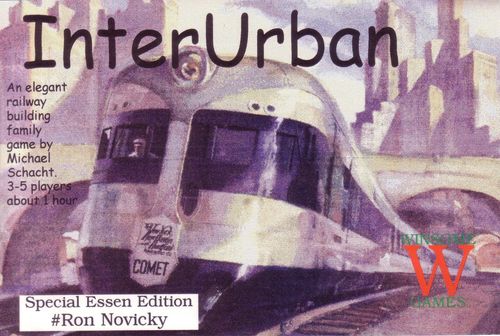
InterUrban
InterUrban Rulebook
Table of Contents
Table of Contents
Game Parts
- 50 Station tiles, 10 each of 5 different color sets (red, blue, purple, green and yellow).
- Supplied for each color are one 1 simple, two 1 crossing, one 2 simple, one 2 crossing, one 3 simple, one 3 crossing, two 4 simple and one 4 crossing Station tiles.
- 20 brown straight Track tiles.
- Supplied are three 2 value Track tiles, eleven 1 value Track tiles and six Track tiles with no value.
- 22 brown curved Track tiles.
- Supplied are eleven 1 value Track tiles and eleven Track tiles with no value.
- 4 blue Start tiles.
- 6 identical Locos.
- These rules.
Setting Up the Game
Give each player a color set of Station tiles. Each player turns their Station tiles face down in front of themselves, mixes them and turns three face up.
Place the 4 Start tiles face down, mix them up, choose two and put them together in the middle of the table. Turn them face up. This is the urban area for this game. The remaining Start tiles are not used this game. Place a Loco at every end-of-track.
Place all the Track tiles face down where all players may reach them and mix them up. Turn three Track tiles face up. Choose a starting player, start the game, continuing clockwise.
Ending/Winning the Game
The game ENDS at the completion of a player's turn if:
- All the end-of-track Locomotives have been removed (all six Routes have been completed),
- or
- All the Track tiles have been placed,
- or
- All that player's Station tiles have been placed,
- or
- That player could not place any tile.
At the end of the game, any uncompleted routes are considered to become completed and any extant Locos are removed. Compute each player's Victory points for each of the six Routes. The player with the most Victory points WINS the game. Ties are possible.
Experienced players may choose to play the Competition Game. The Competition Game is a series of games, where each player has been the starting player once. Victory points for each player for each game are totalled, and the player with the most total Victory points WINS the Competiton Game.
Sequence of Play
- Place 1-3 tiles
- Remove Locos from completed Routes
- Replenish tiles
During their turn, a player must place one, two or three tiles. They may use any face up tiles. A player may only place ONE Station tile during their turn. Any affected Locomotives are either moved to the new end-of-track or removed if its Route was completed.
(Diagram: a Loco sits at the end of a track; a Station tile, a straight Track tile and a curved Track tile are placed in a row and the Loco moves to the new end-of-track.)
At the end of their turn, the player turns over Track tiles until three (or as many as are remaining) are face up. If they had placed a Station tile, the player turns a Station tile of the same color face up, if any remain. Play continues with the player on the left until the end of the game.
Placing Tiles
The player may place one, two or three tiles at end-of-track locations, extending one or more Routes. At least one tile must be placed. If the player can not place any tile, the game is over.
Track tiles are placed at any end-of-track locations, extending the Routes of track. More than one Route may be extended in a turn.
One Station tile may be placed at an end-of-track location. The Station tile can be either the player's or another player's Station tile.
Note: A crossing Station tile may be placed with only one of the two straight tracks extending a Route. Please note that the two tracks of a crossing Station tile do not meet, they may each be part of a different Route.
Placement Restrictions
A) Only Track tiles may be placed next to the Start tiles.
(Diagram: a Station tile placed directly next to a Start tile is marked Not OK; a straight Track tile placed next to a Start tile is marked OK.)
B) A Track tile may not be placed if it completes a Route during the first round of play. Once every player has had a turn, this restriction is removed.
(Diagrams: two placements that complete a Route on the first round are marked Not OK; two placements that do not complete a Route are marked OK.)
C) Station tiles may not be placed next to each other, one or more Track tiles must intervene.
(Diagrams: two Station tiles placed with no Track between them are marked Not OK; the same Station tiles with Track between them are marked OK.)
D) A Route may not have two consecutive Station tiles belonging to the same player.
(Diagrams: a Route with two consecutive Station tiles of the same player is marked Not OK; the same Route with a Track tile between them is marked OK.)
E) Routes may not connect together.
(Diagrams: one placement where a Route connects to another Route is marked Not OK; one where the Routes do not connect is marked OK.)
F) A tile may not be placed if an untracked edge would touch a tracked edge.
(Diagrams: one placement where an untracked edge touches a tracked edge is marked Not OK; one where no untracked edge touches a tracked edge is marked OK.)
G) A Route may only have one 1 Station tile.
H) A Route may only have one 2 Station tile.
I) A Route may only have one 3 Station tile.
(Diagrams for G to I: a Route with two Station tiles of the same value is marked Not OK; a Route with one Station tile of each value is marked OK.)
J) A Route may have multiple 4 Station tiles, but only one per player.
(Diagram: a Route with several 4 Station tiles, each from a different player, is marked OK.)
Completing Routes
Recognizing the completion of a Route is a demanding part of the game. A Route of track is completed, and its end-of-track Loco removed, when:
- The Route has one of each type of Station tile, namely a 1 Station tile, a 2 Station tile, a 3 Station tile and at least one 4 Station tile,
(Diagram: a completed Route with a 1, a 2, a 3 and a 4 Station tile; the Loco at its end-of-track is removed.)
or
- Another Station tile can not be placed on the Route, given the Placement Restrictions presented earlier.
(Diagram: a Route on which no further Station tile can legally be placed is marked Completed Route, and its Loco is removed.)
When a Route is completed, the Locomotive at the end-of-track is removed. No further tiles may be placed on that Route.
The Value of a Route
The Value of a Route is the sum of all the numbers on the Track tiles (not the Station tiles) and the number shown on the Start tile.
(Diagram: a Route with Track tiles numbered 1, 2 and 1 and a Start tile numbered 5 is shown with Route Value = 9, calculated as 5+1+2+1.)
The Start tiles have special letters for some Routes.
- S - The Start number is the same as the number of straight Track tiles on the S Route. In the diagram above, the Start Number would be 3.
- C - The Start number is the same as the number of curved Track tiles on the C Route. In the diagram above, the Start Number would be 2.
- H - The Start number is the same as the highest value Start number used this game. An S or C value might be the highest!
- L - The Start number is the same as the lowest value Start number used this game. An S or C value might be the lowest!
Commerce Points of a Route
For each player, add the numbers on each of their Station tiles traversed on the Route. This sum is the player's Commerce points for this Route.
Note that two different Routes may traverse the same crossing Station tile. When this occurs, the Station tile provides Commerce points for both Routes.
(Diagram: a Route with Station tiles belonging to Purple, Red and Blue players. Purple points = 4, Red points = 4 (1+3), Blue points = 2.)
Victory Points of a Route
The player with the highest Commerce points for a route receives the full Value of the Route. If tied, the tying players each receive the full Value of the Route. Using the diagram above, Purple and Red have the highest Commerce points for this Route (4 each) and each receives 9 Victory points for this Route.
The player with the second highest Commerce points for a route receive half the Value of the Route. If tied, the tying players each receive half the Value of the Route. Round up. Using the diagram above, Blue has the second highest Commerce points for this Route (2) and receives 5 Victory points.
The player with the third highest Commerce points for a route receive a quarter of the Value of the Route. If tied, the tying players each receive a quarter of the Value of the Route. Round up.
The player with the fourth highest Commerce points for a route receive an eighth of the Value of the Route. If tied, the tying players each receive an eighth of the Value of the Route. Round up.
The player with the fifth highest Commerce points for this route receives nothing.
A Short Example Game
Ferdi, Lucy and Rey play InterUrban. The game is set up and Ferdi begins.
- A) Ferdi places a curved track at the '6' start, a curved track at the 'H' start and his green 2 crossing station. The station will provide Commerce Points for Ferdi for both routes!
- B) Lucy places two straight track and her blue 1 simple station tile.
- C) Rey places a curved track, his red 4 simple station and another curve.
- D) Ferdi places a green 4 station at the 'C' start end-of-track. He then places two curves, completing both the '6' route and the 'H' route, as no further stations may be placed on either route. Please see Placement restrictions c, e and f. Both end-of-track Locos are removed!
- E) Lucy places a curve, a straight and her 3 station.
- F) Rey places a straight and his 2 station.
- G) Ferdi places two straight and his 3 station.
- H) Lucy places a curve (no other track type would be allowed there), another curve and her 3 station. This completes the '5' route. (see restrictions c, d, f and i) The Loco is removed!
- J) Rey places two straight and his 3 station.
- K) Ferdi places a straight and his 4 station. This completes the 7 route, as one of each type of station (a 1, a 2, a 3 and a 4) are on the route. The Loco is removed!
The game is over as all the end-of-track Locomotives have been removed.
(Diagram: the final layout of the example game, with each Station tile marked by its route letter A through P.)
Scoring the Example Game
- The '6' route has the value 7 (the start 6 plus the 1 curve). Ferdi is the only player with a station on the route (worth 2 Commerce Points), so Ferdi receives 7 Victory Points (VPs).
- The '5' route has the value 7 (5 plus 2). Lucy has 3 CPs for her station, Rey has 2 CPs for his. So Lucy receives 7 VPs and Rey 4 VPs (3.5 rounded up).
- The '7' route has the value 10 (7+3). Ferdi has 4 CPs, Lucy also has 4 CPs and Rey has 2 CPs. Both Ferdi and Lucy receive 10 VPs and Rey gets 5 CPs.
- The 'C' route has the value 9 (4 curved + 5). Rey has 9 CPs, Ferdi 5, Lucy 4. Rey receives 9 VPs, Ferdi 5 VPs, Lucy 3 VPs.
- The '4' route has the value 6 (4+2). Ferdi has 4 CPs, Lucy also has 4 CPs, Rey has 2 CPs. Both Ferdi and Lucy receive 6 VPs and Rey gets 3 CPs.
- The 'H' route has the value 7 (7+0), as the highest start number is the 7. Note that if the 'C' route had 8 curves, the highest start number would have been 8! Ferdi has 2 CPs; Ferdi receives 7 VPs.
Ferdi wins with 35 (7+0+10+5+6+7) Victory Points! Lucy has 26 VPs, Rey has 21 VPs.