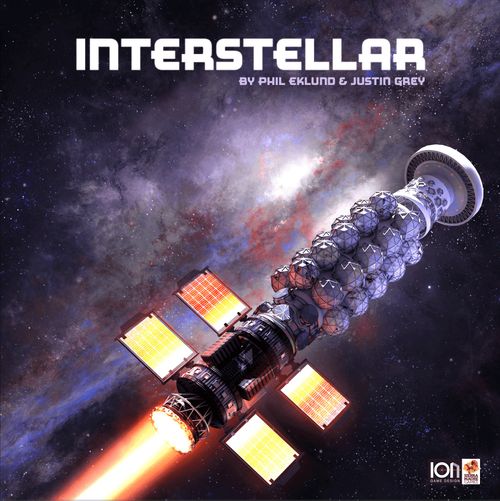
Interstellar
Interstellar Rulebook
Table of Contents
Table of Contents
- A. Interstellar Introduction
- B. Components & Anatomies
- B1. Component List
- B2. Workcell Cards (45), Earth Data Cards (6), & Agenda Cards (5)
- B3. Cyborg Placards (12)
- B4. Exodus Blueprint Placards (11)
- B5. Worker Dice (8 large & 6 small)
- B6. Playmats (6) & Slot Management
- B7. Jars Placard
- B8. Stellar Map (1)
- B9. Goo Chits (5)
- B10. Nugget Tokens (4)
- B11. Planets & Planet Chits (40)
- C. Setup
- C1. Assign Ideological Color
- C2. Crew Setup
- C3. Workcell Market
- C4. Nugget & Earth Data Setup
- C5. Fuel, Funding, Speed, & Alert Cylinders (Map Right Edge)
- C6. Starship Blueprint Setup (Lower Map)
- C7. Remaining Map Setup (Map Right & Left Edges)
- C8. Modified Setup for the Combined Game
- C9. Project Forward Variant
- D. Sequence of Play, Each Dozyear
- E. Blueprints, Erosion, & Foolhardy Experiments
- F. Political Hexagon
- G. Research & Librarian
- H. Workcell & Other Rolls
- I. Exploration, Arrival, & Terraform
- J. Endgame & Victory
- K. Example 3-Player Game
- K1. Dozyear 1 (Mission years 0 to 12). A Hazardous Course.
- K2. Dozyear 2 (Mission years 13 to 24). Astrological Fail.
- K3. Dozyear 3 (Mission years 25 to 36). The Crunch.
- K4. Dozyear 4 (Mission years 37 to 48). First Lab Accident.
- K5. Dozyear 5 (Mission years 49 to 60). Life-Support Failure.
- K6. Dozyear 6 (Mission years 61 to 72). On Immortality.
- K7. Dozyear 7 (Mission years 73 to 84). The Telescope.
- K8. Dozyear 8 (Mission years 85 to 96). The Champion.
- K9. Dozyear 9 (Mission years 97 to 108). Barnard's Approach.
- K10. Dozyear 10 (Mission years 109 to 120). Terraforming & Arrival.
- Glossary
A. Interstellar Introduction
Interstellar is a cooperative-competitive standalone game primarily for 1, 2, 3, or 6 players. It features worker-placement, tableau building, and push-your-luck risk taking. It can be played as a successor game to High Frontier in combination with Module 4:Exodus (C8). It can also be the 5th part of the designers' game series on the evolution of life (Bios:Genesis, Bios:Megafauna/Mesofauna, Bios:Origins, High Frontier 4 All and Interstellar). The 6th planned game in the series is Arrival.
A1. Overview
The Starship Exodus departs a troubled Solar System. Under extreme mass limits, her crew is limited to two heavily augmented teenagers plus frozen human embryos, eggs, and sperm. The ship is a generation ark on an interstellar voyage lasting over a century, with new humans conceived and born either to their mothers or from artificial wombs to be raised by robotic nannies. Searching for a new home planet, the human cyborgs and their robotic avatars develop technology to lighten the ship, fight cancer, terraform new worlds, and stay sane. As it flies through dusty interstellar space, the ship erodes and requires periodic reconfiguration; a job undertaken by living nanite machines that unfortunately sometimes reproduce out of control in a cancerous plague called gray goo. The ship's bow acts as a serendipitous high-energy particle collider, and the exotic "Nuggets" formed there give hints to the true nature of Reality which can change the game state from cooperative to competitive. Will these allow you to become a cult leader to adoring masses back home? Or will it destroy you as Humans transition to Posthumans or the ship's computer becomes subjectively conscious? Will you discover new life or new civilizations, or seed all the Goldilocks between Sol and Tau Ceti with human couples? Is your spouse, the Commander, thinking of leaving you for the attractive young pilot?
- a. Number of Players. 1 to 6. Asymmetric 4 and 5 player games are possible, see C2d. See C1b for details on the solitaire game.
- b. Ideology. Each color represents one of six social Ideologies (see glossary). A player can control multiple Ideologies.
- c. Cyborgs. To survive under extreme interstellar radiation, the crew are human-machine hybrids called Cyborgs.
- d. Commander. Some of the decisions are made by the ship's Commander, according to a command structure that is Ideologically-based. A Commander sets the ship's course, can enforce Regulations, can order colonization or seeding, and dictates the ship's legal marriages.
- e. Six Eves. The number of viable Embryos is limited on the Starship due to the accumulation of chromosomal and telomeric damage under starflight radiation. At least one female Cyborg or Posthuman (i.e. augmented immortal Human that can experimentally develop) must land on a Habitable planet, or else there is no victory for any player.
- f. Cooperative Victory if the players jointly achieve a minimum victory point (VP) total (J2), counting all the Tokens, chits, and Workcells on their Playmats and counting VP for their surviving Cyborgs. Each is worth 4 VP.
- g. Competitive Victory. One (and only one) player can metamorphose into the Posthuman, which changes the game from cooperative to competitive. A Cyborg becomes the Posthuman either by accumulating 4 Augmentations, or by performing certain Foolhardy Experiments, the kind that can only be performed in a relativistic starship, depending on if quantum Reality turns out to be X (subjective) or O (objective). The competitive winner is the Ideology with the highest victory point (VP) total (J3), and this Ideology forms the basis for the New World.
METARULES:
A word being defined is listed in bold, or italicized if defined elsewhere. A Capitalized word is a general game term defined in the glossary. However, a word in quotations, e.g. "Corpsicle," quotes the name printed on a card or chit.
Sequential Processes are presented in the order listed in the sequence of play, and are introduced by a simple overview followed by specific bullets.
The Golden Rule: If the text on a card, scenario, tutorial, or variant contradicts these rules, that text prevails.
2nd Person Pronouns: There are always 6 player colors in the game, each representing an Ideology, so a single player can control multiple Ideologies. If the rules state "you" or "your", as in "your Playmat" or "your Workcell", the reference is to your phasing Ideology.
A2. Game Scale
The cramped Starship Exodus is mass-limited to 400 tonnes, excluding Fuel. This dry mass has to be meticulously conserved for the voyage, because until she can enter into an Orbit somewhere, no more mass is forthcoming.
- a. Turns are 12 Earth years each. This is called a Dozyear, equal to one solar sunspot cycle in High Frontier.
- b. Map Spaces are one half of a light-year each (0.15 parsecs). Lightspeed moves 24 spaces each Dozyear.
- c. Engine Type is a magnetic-confinement Z-pinch fusion, with 3.9 terawatts (TW) of thermal power.
- d. Engine Thrust is 250 kN (9 in High Frontier scale). The mass flow (10 grams/sec) is similar to an electric rocket.
- e. Dry Mass is 80 tonnes (each fat Blueprint) and 40 tonnes (each skinny Blueprint). Starting dry mass is 400 tonnes. A quaddecatonne (40 tonnes) is a single mass point in the High Frontier scale.
- f. Wet Mass is 8000 tonnes maximum, when Exodus is carrying 190 tanks of Fuel. Each tank is 40 tonnes (one mass point in High Frontier) of isotopes of helium-3 and deuterium, or possibly other fusion fuels.
- g. Speed Track Steps are 4%c (four percent lightspeed, or 12,000 km/sec) each. This is 4800 Burns on the High Frontier scale. The top speed is 16%c. At top speed, one Dozyear is 12.16 years back on Sol due to time dilation.
- h. Acceleration. Each step moved on the speed track is about 3.2 milligees over one Dozyear. This is the initial fully-loaded acceleration of Exodus. Although barely perceptible to the crew, it will increase as it sheds Fuel over the years. The powered deceleration when carrying 800 tonnes of braking Fuel at the journey's end is much livelier at 21 milligees, but still compares poorly to the 830 milligee acceleration of a Shelby Mustang.
- i. Propellant Exit Velocity is 8%c (24,000 km/sec, or specific impulse of 2450 ksec). Burn up ratio is 83%.
A3. Constitution of Starship Exodus
The "inalienable rights" of Humans are not negotiable:
- a. Ideologies. Diversity and inclusion is deemed paramount to mission success, therefore the Starship must include and preserve the 6 fundamental Ideologies.
- b. Living Space Rights. Each Ideology must have only 1 Worker Awake at a time, either a Cyborg or Avatar.
- c. Mass Rights. Each Ideology has the inalienable right to their share of the ship's dry mass, which is 24 tonnes (2 Slots) at the start, but reduced as the ship erodes, or increased as systems are cannibalized. Every gram matters!
- d. Commander's Regulations. Many of the freedoms that we take for granted in the Western world are at risk on a starship under desperate circumstances. Freedoms depend upon the Ideology in command, with freedom being the most free and authoritarian the most regulated. See the Political Hexagon to see which Commander-specific Regulations (F1) and legal marital practices (F4b) are in force.
- e. Right To Protest. If an Ideology disagrees with the enforcement of a Regulation, an election (F3) is held to possibly install a different Cyborg to be the Commander.
- f. Reproductive Imperative requires that a female must make Arrival to ensure exohumanity can thrive without high-radiation genetic degeneration. A living female (or Posthuman) is necessary because her endometrial cells are required for the artificial wombs.
- g. Apprenticeship. When a child becomes a teenager, they must apprentice in an Ideology of their mother's choosing, but is not their mother's Ideology (H5c). This maternal right cannot be denied by the Ideology chosen.
- h. Extinct Ideologies. If an Ideology loses both of its Cyborgs, its placard and chits are preserved to count as VP during the endgame. The teachings of an extinct Ideology are constitutionally guaranteed to be preserved, and taught to the children in the New World.
A4. Mission Priorities (Strategy Tips)
During the voyage, your Cyborgs earn victory points while your Avatars are mainly used for grunt work useful for the overall mission. It is often best to Awaken your Cyborgs less than 7 Dozyears before Arrival. The following tips are to ensure a successful mission to land at least one female on a Habitable world:
- a. Flightplan. Check the Market for Workcells with the "Shield" subtitle (B2a), which provide protection from the LIC (Local Interstellar Cloud). Fly spinward (towards 61 Cygni, no LIC) if there are none, or counter-spinward (towards Sirius through 2 LIC) if only one. An ambitious destination (must survive 3 LIC and a flare star) is Epsilon Indi, launching Pods to Habitable worlds along the way (e.g. Alpha Centauri). Any flightpath that includes 2 yellow suns has a 40% chance of not needing any Domesticated Goo to be Habitable, or 43% of only needing 1 Goo.
- b. Wisps (E2c) are especially valuable to uncover Planet Chits, and choose flightpaths accordingly.
- c. Accelerate the ship (E2i) to reach the primary destination in about 6 Dozyears, or slower if more time is needed to prepare for any upcoming LIC with Shields or Dustbugs (see glossary).
- d. Gain Augmentations by assigning Cyborg/Avatar teams to Workcells (H1h).
- e. Slenderize (E1c) the Blueprints by assigning Awake Cyborgs to Workcells where Augmentations (3) of its shape can be earned, enabling the Maintenance Cell "Foamed Metal." Some Workcells also slenderize Blueprints. Skinny wardens = Dustbugs, skinny life-support = creating Goo for later domestication, skinny Jars = creating a seedship Pod, skinny batteries = Terraforming, skinny engine = aerogel refuel, Shields = EM shield.
- f. Obtain Earth Data by sending a radio signal (G1e). You can get the latest gaming VR or the cure for cancer.
- g. Demographics. If every female has a daughter at Age 18 (to eliminate the risk of age-infertility), the reproductive mission length will be 6 Dozyears (72 years). This has the advantage of maximizing Wisdom and minimizing Orphans, but may not be long enough to visit 2 yellow suns. Use Creche, Utility Fog, marriages, or midwife (Ideology Red Wisdom) to keep the population from dwindling.
- h. Stress Management. As Cyborgs age, the ship may become crowded, perhaps with Archenemies. Marriages, mimarobes (Wisdom), and the Stadium Cell will be necessary to contain Stress and Goo outbreaks (H1i).
Easily missed: The heart of the game's strategy is to decant your Cyborgs at the most promising moments, because gameplay with only an Avatar greatly limits your choices, especially for garnering victory points (VP).
Easily missed: The game is cooperative, but if there are exactly two Nuggets outside of the Cosmos and a Foolhardy Experiment is performed, there is a 50% chance that Posthumans will develop, which immediately converts the game into a competitive one (E6c).
B. Components & Anatomies
B1. Component List
- a. Cards (56). Workcells (45), Earth Data (6), Agenda (5). There are also 13 Cyborg placards.
- b. Punchouts (1 sheet for 24 placards and 73 chits). 11 Starship Blueprints, 5 Goo chits, 40 Planet Chits, 14 Medallion chits (17 including the 3 found in High Frontier Module 4:Exodus), 1 learning chit, 1 endgame chit, 6 Orphan/Pregnancy Cell chits, and 3 creative stress chits.
- c. Playmats (6). One of each Ideological color. There are 6 Ideological colors, for up to 6 players.
- d. Jars Placard (1). Each Ideology has a Jar where their frozen Embryos (Cyborg placards and dice) are stored.
- e. Starship Token. The Starship Exodus, a fusion-powered rocket. A plastic miniature is available as an upgrade.
- f. Large Cyborg Dice (8d6). One of each color for Cyborgs, plus 2 black dice (battery charge & Posthuman).
- g. Small Avatar Dice (6d6). One of each Ideological color for Avatars.
- h. Command Star Tokens (2). To show command, place 1 on the Cyborg and 1 on the Political Hexagon.
- i. Matrimonial Rings (6). One of each color, placed on the Political Hexagon to show who is married to whom.
- j. Red Disks (36) representing Stress and Busted disks. Use substitutes if you run out. All tokens and chits except the red Stress disks are limited to what is supplied.
- k. Radio Signal Domes (6). Representing radio signals (G1e) to/from Sol, 1 per Ideological color.
B2. Workcell Cards (45), Earth Data Cards (6), & Agenda Cards (5)
- a. Title & Subtitle. A Workcell's subtitle describes what the card does: selfish (8), Shield (7), parental (5), Earth Data (4), Exodus (4), Terraform (4), Stress relief (3), Pod (3), cold start (2), Plasma Risk (2), and research (2).
- b. Workcell Blueprint. Each Workcell indicates its Blueprint shape, to indicate where it is located in Exodus: wardens (hexagon), life-support (heart), Jars (jar), batteries (battery), or engine (triangle).
- c. "To Research" Augmentation/Nugget. This Augmentation or unflipped Nugget is needed to research this card (G1a,b).
- d. Risky Icon. A Cyborg rolling a 6 in a Workcell Roll is killed in an accident (H1g).
- e. Success Impact. Once a Workcell is in your Playmat, Workers can be assigned there and, during Phase D3, make a combined Workcell Roll. Every Worker dice present must be rolled. If at least one dice in a Workcell Roll succeeds, this impact occurs immediately (H1e).
- f. Neutron Sensitive Icon. These radiation-sensitive cards are Discarded during certain Plasma Risk Rolls (H6c).
- g. Earthware Icon. A Workcell with the earthware icon is valuable if sold to Earth (by sending a radio signal dome (G1e)).
- h. Victory Points. These are awarded in the endgame depending upon whether Reality = X or O (J3b).
- i. Earth Data Cards. The "Game Stadium" has a Cell, but the others contain general effects and no Cells.
- j. Agenda Cards. Treat these optional cards as Workcell cards after they are played from a Commander's hand (G1b).
B3. Cyborg Placards (12)
Every player starts with 2 Cyborg placards, which can be Awake in a Slot, Asleep in the Jars, or Discarded as dead.
- a. Male & Female Cyborgs. To survive interstellar radiation, passengers are human-machine hybrids. Only young females (or Hermaphrodites) have the Pregnancy Cell capable of reproducing in the Starship.
- b. Cyborg Color. Each color is an Ideology: individuality (gray), freedom (red), honor (white), unity (yellow), authority (purple), and equality (green).
- c. Cyborg Age. Each Cyborg card is double-sided, with a young side and an old side. The old side lists an Ability called Wisdom. The young side of a female contains a Pregnancy Cell. Each side can be oriented to one of 4 Ages, numbered from 1 to 8, as measured in Dozyears (12 years). See glossary.
- Fertility & Attrition Dice. These dice faces show what is needed for a successful Fertility Roll or Attrition Roll.
B4. Exodus Blueprint Placards (11)
The map contains a field to store the Starship's Blueprint placards. It starts with 5 of them fat (landscape Orientation). If slenderized (flipped and reoriented to its skinny, portrait Orientation), this indicates a lightweight version per E1c. Each Blueprint has 2 Maintenance Cells (see glossary).
- a. Shields (6). Unlike the other Blueprints, the 6 Shields are always slender and have no Workcells. They come in the 6 Ideological colors and are stored either in the shield Slot (Playmat) or in the bow.
- b. Wardens (hex shape). This houses autonomous rocket vehicles that operate outside the Starship for repair and the claiming of Nuggets in the bow. Loss of the wardens makes it harder to collect Nuggets.
- c. Life-Support (heart shape). This is the living quarters of the ship, plus the low temperature radiators. Loss of the life-support Busts all the middle Slots (those labeled "life-support") on each Playmat per E4d.
- d. Jars (jar shape). Loss of this Busts left-hand Slots (E4d) and Kills the Embryos (E4e).
- e. Batteries (battery shape). This capacitor bank supplies electricity to start the engine, to activate an electromagnetic (EM) shield during braking (frybys or icebraking), or to send Wisps, radio signals, and Dustbugs.
- Charge Dice. This black six-sided dice on the batteries indicates the remaining charge. It starts fully charged at "6" but can swing down or up as the batteries (capacitors) are charged or discharged. The charge dice can never go below a value of "1."
- f. Engine (triangle shape). This is the main Starship fusion drive engine, including its Z-pinch, compressors, nozzle, and Fuel. It is ignited if there is a Worker in the Ignition Cell (E2i). Engine Loss jettisons all the Fuel.
B5. Worker Dice (8 large & 6 small)
Worker dice come in Ideological colors and are of 2 sizes: Human Cyborgs are large and robotic Avatars are small. The 2 large black dice are used for the battery charge dice and the Posthuman twinned dice.
B6. Playmats (6) & Slot Management
Each Ideology has a Playmat with an area for Stress plus Shadows to store their accumulated tokens and chits. Playmats also have 3 Slots, which may hold either one Cyborg or 2 Workcells each.
- a. Slots. Because of severe mass limits, every Ideology starts with 2 Slots in their Playmat. Slenderizing (E1c) can increase this to 3 Slots (Jars, life-support, & Shield), and Busting (see glossary) can reduce this to 1 or 0 Slots. Each Slot can hold either 2 Workcell/Agenda cards or 1 Awake Cyborg.
- b. Trashing. At any time the player owning a Playmat may Discard one of its Workcells that has no Tokens on it. This is useful to make living space for a newborn Cyborg, either pulled from the Jars or by Motherhood.
- c. Moving Cyborgs. In this cramped Starship, a Cyborg placard never moves to a different Slot except by Commander Rescue (E4c) during Shield Erosion or jettisons. The rescue keeps the Cyborg in the Playmat of the Cyborg's color.
- d. Moving Workcells. A Workcell may be relocated to an empty space in a Slot in any Playmat by the Chief Engineer after a successful Workcell Roll (H1f). Other Abilities (e.g. Che's Wisdom) may also move a Workcell.
- e. Busted Slot. If a Workcell is Discarded or a Slot Busted (e.g. by Shield Erosion (E3) or other Blueprint Loss (E4)), any Workers on them are Killed unless (during Shield Erosion or jettison) saved by Commander Rescue (E4c).
Easily missed: Trashing is useful during research, to Discard a Workcell in order to make room for a better freshly-researched Workcell.
B7. Jars Placard
The Jars start with a male and a female frozen Embryo for each of the 6 Ideologies. These can be moved from the Jars into a Slot either by being decanted (E2e), or by being born and apprenticed (H5c) by a mother.
- a. Earth Data Storage. One of these 6 cards (B2i) starts facedown on top of each of the 6 Jars (C4b).
B8. Stellar Map (1)
The dots on the map, called spaces, are where Exodus, Wisps, and radio signals move. Twenty of them are Stars, including 10 yellow suns, 9 red dwarfs, 3 white dwarfs, and 5 brown dwarfs. Stars contain two types of potentially Habitable planets to explore: Goldilocks (solar-powered atmospheric biosphere) and Troglodyte (subterranean nuclear-powered biosphere). There are 28 Goldilocks (yellow pointers) and 28 Troglodytes (blue pointers).
- a. Spaces. Each space spans ½ lightyear. They come in five types:
- Interstellar Space.
- Oort Cloud (Comets/Sunlens). The space enables Oort icebraking (D5g) and allows a Wisp to snapshot the Star that is named (I1). The yellow arrow in the sunlens space points towards its target Star.
- Amat Jet. If Exodus enters a space, the Commander is allowed a Peep per D5j. (Amat = antimatter.)
- Local Interstellar Cloud (LIC). This is composed of erosive neutral particles, see glossary.
- Star, Binary Star, or Substar. This oversized space can be orbited and contains its system of planets/moons.
- b. Flare/Debris Hazards. Some Stars have hazardous flares or orbiting debris:
- Flare Star. If Exodus enters Orbit at a Star with this icon, immediately roll a Plasma Risk Roll (H6) row (2).
- Debris Disk. If Exodus enters Orbit at a Star with this icon, immediately roll a Plasma Risk Roll (H6) row (3).
- c. Stars have a name, icons for its Substars, and slots for the air and water chits of its planets. They come in 2 types, yellow suns and red dwarfs, as indicated by the star color and size on the back of its air chit.
- Goldilocks. A Habitable terrestrial atmospheric planet orbiting either type of star is called a Goldilocks. It is defined by a pairing of an air chit to the left with a water chit (B11a,b) to the right. It is depicted as a small green sphere. Its name uses a yellow pointer and may be followed by a default of hydration (I5a).
B9. Goo Chits (5)
Like the Humans, Goo are half machine (nanites) and half reproductive animals (tardigrades). There are 5 shapes of Goo, and until Domesticated each is strictly limited to cards and Blueprints of their shape. A Goo chit is placed (on its blue side) if a Goo outbreak (H1i) occurs, indicating a cancer-like unregulated replication, gobbling up vital equipment instead of trash. If not checked, it eats cards and Kills Cyborgs that are on the cards, and eventually destroys the entire Blueprint. However, if Domesticated, Goo is flipped to its yellow side and becomes a valuable tool.
- a. Warden Goo. Because the wardens in the game are powered by lasers from the mothership, hexagon Goo originating from wardens can both receive and transmit beamed power.
- b. Life-Support Goo. Heart Goo speciated from nanite algae in the photosynthesis vats. It thrives in visible light by using sunlight to sequester carbon dioxide.
- c. Jar Goo. This Goo obtains energy from temperature differences, like a heat engine. It plagues the radiators that keep the Jars cool. If unchecked, it will Kill all people in the Jars.
- d. Batteries Goo. The ship's capacitors store enormous energies under high voltages, which can spark like lightning if the intervening dielectric is degraded. Batteries Goo exploits these sparks, and if unchecked eats Fuel rather than the batteries.
- e. Engine Goo. Triangle Goo originates in the Ignition Cell, and uses either fusion products or iceflash for energy.
- f. Domesticated Goo. If you assign a Worker to a Goo Cell and succeed in a domestication Goo Roll (H3), flip the Goo chit to its "Domesticated" side and place it into the appropriate Shadow on your Playmat. This confers 5 advantages:
- Outbreak Immunity. Domesticated Goo permanently prevents further outbreaks of that shape.
- This Goo Chit Acts as an Augmentation of that Shape. This is useful as a "To Research" Augmentation (G1a) or to improve the chances of successful Workcell Rolls (H1e).
- Zeppelin Refueling. Domesticated Goo can refine He3-D Fuel from the atmosphere of a gas giant (I3a).
- Atmospheric Tailoring. Domesticated Goo is part of the right stuff to make a Goldilocks Habitable (I5b).
B10. Nugget Tokens (4)
The game starts with 3 Nugget chits, kept facedown so that no player knows their hidden values. These values answer the question about the nature of "what is": is it a feature of our consciousness (subjective), or is it a feature of the universe (objective)? You can examine these chits by using the collisional products of ultra-high energy relativistic exotic particles found in interstellar space. As a warden Maintenance Task (E2a), these products can be claimed as "Nuggets," plucked from the Erosion Shields of a starship like bugs from a windshield.
- a. Quantum Reality is randomly fixed during setup (C4a) as one of two states: objective or subjective.
- b. Nugget Creation is by entering LIC (D5e) or lightning (H6b). A maximum of 3 Nugget creations are possible.
Easily missed: The game is played with only 3 of these 4 Tokens.
B11. Planets & Planet Chits (40)
A planet is a potentially Habitable world, that is defined on the map by one water chit and sometimes one air chit. These chits are stored facedown on the map and flipped faceup per (I1). There are two kinds of planets:
- a. Goldilocks (I5) is a planet in the habitable zone of a Star. Just as in the fairy tale, a Goldilocks is "not too hot and not too cold" for liquid surface water. The air chit of a Goldilocks specifies the right stuff of Nuggets and Goo needed by a landing party to make its air breathable, and the lower part of its water chit specifies how many of hydration the planet has. A Goldilocks orbits either a yellow sun or a red dwarf (B8c).
- b. Troglodyte (I6) is a world that is Habitable underground. It is defined by one water chit plus a Substar icon (either a carbon planet at a brown dwarf, a phoenix at a white dwarf, or an icy moon at a gas giant). A single water chit can be shared by two planets orbiting the same Star (I6c), as indicated by the pointer(s) in the water chit spot.
B12. Medallions (17*)
These chits are awarded for specific accomplishments, and are worth 4 VP each in the endgame (J3c). There are 7 classes, each with their own shape, as listed below. (The number in parentheses is the number of chits). Each Ideology is allowed only one of each class of Medallion, placed upon their Playmat in the Shadow of the right shape. When earning a Medallion that states "latest," an Ideology may steal it from another Ideology who previously earned it.
- a. Hero (2) (escutcheon). "Founder" is awarded to the latest to have both their Cyborgs in the Soylent Green Pile. "Champion" is awarded to the latest Chief Engineer who Kills Goo (H4b).
- b. Explorer (3) (square). "Wisp" is awarded to the latest whose Wisp revealed a Planet Chit (I2a). "Galactic" is awarded to the latest whose Wisp took a snapshot (I2b) at a Sunlens. "Detective" is awarded to the latest whose Wisp revealed a chit with a magnifying glass icon (I2c) at a planet that exists. See I2.
- c. Savior (2) (cross). "Guardian" is awarded to the first to have their color Shield eroded. "Watchdog" is awarded to the latest to have their color Shield eroded.
- d. Broadcast (1) (bullhorn). "Pale Blue Dot" is awarded to the latest to send a radio signal (G1e) to Sol.
- e. Scientist (2) (flask). "Mad Scientist" is awarded to the latest Chief Engineer in a successful Workcell Roll in a Foolhardy Experiment. "Panspermia" is awarded to the first one to land a Dustbug onto an uninhabited Goldilocks per I4h.
- f. Seedship (4) (oval). These are awarded to surviving members of any landing party who have been dropped off in a Pod on an uninhabited world. They must survive a Plasma Risk Roll (row 1) (I4d). Once safely down, if the world is not Habitable, they can die of old age but still retain their Medallion. See I4g.
- *g. Combined Game (3) (pentagonal). The pentagonal Medallion chits are supplied in High Frontier Module 4:Exodus and, if achieved, are transferred to your Playmat into the pentagonal Shadow. This includes isobanker (4D2), propulsion (4D3c), and command (4D3b). Each scores 4 VP in the endgame. Unlike other Shadows, the pentagonal Shadow is not limited to a single chit.
B13. Augmentation Tokens (30)
These wooden tokens are in Ideological colors and have a shape corresponding to a Blueprint/Cell shape, and are placed upon Playmats as experience is gained in Workcell or Goo Rolls. Augmentations are worth 4 VP each.
B14. Game State Chits (11)
Game state chits do not count victory points (VP) and are only used to track game states:
- a. Learning Chit (1). This starts with human learning but can flip to machine learning per E6d.
- b. Endgame Chit (1). This starts cooperative but can flip to its Competitive Endgame (king) side as the result of a Foolhardy Experiment, either as stated on the card's result, or per E6c via a Posthuman.
- Deepfake. Both the learning and the endgame chits can also be flipped from their starting state (and back again) by a successful Workcell Roll on the "Deepfake" Workcell.
- c. Orphan/Pregnancy Cell Chits (6). Placed "orphan" side on decanted Embryos (E2e) and "Pregnancy Cell" side on a Hermaphrodite (Cyborg decanted by Hermaphroditism, see glossary).
- d. Creative Stress Chits (3). Place these by each Market row to indicate the Stress costs (G1c).
C. Setup
The number of players can be from 1 to 6. See C1b for solitaire, and C2d for the 4- and 5-player games.
C1. Assign Ideological Color
Each player starts with a number of Ideological Playmats as per the Setup Table.
- a. Starting Ideologies. Each player starts with the number of Ideological Playmats shown in the table. They may either choose the Ideologies they wish, or else roll dice, using the Pulse Order Number depicted on the Political Hexagon.
- b. The Solitaire Game. You start with all 6 Playmats. During the endgame victory points (J3), use only the one with the highest score, and count victory per J3. Also see cooperative victory point goals (J2). Otherwise play with all game rules.
- c. Seating Arrangement. Players may find it helpful to seat themselves around the table in clockwise fashion as shown by the Pulse Order Number, starting with individuality (gray) = 1, freedom (red) = 2, honor (white) = 3, unity (yellow) = 4, authority (purple) = 5, and equality (green) = 6.
- d. Jars Placard. This placard, containing the Hibernation Jars for each Ideology, is set in a common area. Each Ideology receives their 2 Cyborg placards plus the 1 large dice, 1 small dice, 1 radio signal dome, and 1 shield placard of their color. Stack all these components, except Shields (see next bullet), into the Jars of each Ideology.
- e. Busted Right Slot. Each Ideology places their Shield placard in the rightmost Slot of their Playmat with its Busted side faceup. This shows that the right Slot is Busted, leaving 2 available Slots.
Setup Table (Number of Players → Playmats per Player): 1 → 6; 2 → 3; 3 → 2; 4 → 1 (two players start with 2, asymmetrical, see C2d); 5 → 1 (one player starts with 2, asymmetrical, see C2d); 6 → 1. Number of Cyborgs: 12 (1 male & 1 female for each color); each starts in the Jars with a large dice and a placard, then the Cyborg of the Commander and of the first mate are moved from the Jars to the life-support Slot of their Ideology. Number of Avatars: 6 (1 for each color); each Ideology may have only 1 Worker active at a time.
C2. Crew Setup
Into each color in the Jars, place the 1 large dice and 2 Cyborg placards of that color. Place all 6 (small) Avatar dice into the Trapezoids (1 per color). For the starting shift, awaken one female and male teenager following these steps:
- a. Age & Orientation. All Cyborg placards, whether Awake or in Jars, start young and oriented to Age 1.
- b. Assign Awake Female/Commander's Star. A random Ideology starts with their female Awake. Place her placard into the Slot labeled "BUSTED: If Life-Support Blueprint Lost" on her color Playmat. Give her the two commander's star tokens (B1h) to show that she is the Commander. Place one on her Cyborg placard and the other on the Commander's star shadow on her color Trapezoid in the Political Hexagon. Swap her Avatar dice with her Cyborg dice, so that her Avatar retires to the Jars and her Cyborg dice sits in the Ideological Trapezoid.
- c. Choose First Mate. The Commander chooses one male from another Ideology. The player controlling this Ideology moves that male placard from the Jars to their Playmat's life-support Slot. Swap his Avatar dice with his Cyborg dice, so that the Avatar dice retires to the Jars and the Cyborg dice sits in his color of Trapezoid.
- d. 4- and 5-Player Games Are Asymmetrical! In a 4-player game, the Commander player and the first mate player start with 1 Playmat, and the other players start with 2 Playmats. In a 5-player game, one player (the first mate) starts with 2 Playmats, and the other three players start with 1 Playmat. An asymmetrical game is not recommended for inexperienced players, but makes for a unique Competitive Endgame experience!
- e. Rings. Place 1 matrimonial ring (B1i) in each of the 6 Trapezoids on the Political Hexagon.
- f. Commander's Agenda (optional). The Commander randomly takes 1 Agenda Card (glossary), hidden from the others.
- g. Control Pawns. Each player places a control pawn (B1q) of that color in front of them, which reminds other players which Ideologies they control.
C3. Workcell Market
- a. Workcell Market & Draw Decks. Separate the Workcell cards into their 5 Workcell Blueprints (B2b). Shuffle each deck, and setup a Market of 5 columns and 3 rows, just below their respective Blueprint off the map as shown. The top card only of each draw deck is faceup.
- b. Creative Stress Chits (B14d) are placed one to the left of each row as shown.
C4. Nugget & Earth Data Setup
The game comes with 4 Nugget chits, but only 3 are used in each game. Place 3 at random facedown in the diamond spots in the center of the map. This area is called the Cosmos. Return the 4th to the box, so that it will not be examined during the game. The facedown value of the Nuggets is secret from all players.
- a. Quantum Reality. The 3 facedown chits will be 2 of one state, and 1 of the other, but nobody knows which state is in the majority, and thus nobody yet knows the true nature of the quantum. This is important for the final victory tally, and the outcome of Foolhardy Experiments (E6).
- b. Earth Data (B2i). These 6 cards represent new technological ideas sent quid pro quo from the Solar System. Shuffle and set one (facedown) on top of each Jar, so that each Ideology starts with one that only they know.
C5. Fuel, Funding, Speed, & Alert Cylinders (Map Right Edge)
The funding tracks if the funding priority is Isotope or übermensch. The alert tracks whether the alert status is red ("shoot to kill") or yellow ("shoot to subdue"). The helm tracks the Starship speed and Fuel.
- a. Set Funding Cylinder. The Commander sets a cylinder (B1p) on her choice of one of two funding priorities: "Isotope" (2 steps more Fuel), or "übermensch" (start with smarter Cyborgs (H1c, D3a)).
- b. Set Alert Cylinder. Start this in yellow alert. Used in Goo fights per H3a,b.
- c. Set Fuel Cylinder. Start a cylinder in the fuel track at 190 if funding is "isotope" or 65 if funding is "übermensch."
- d. Set Speed Cylinder. Start a cylinder at Orbital Speed on the speed track. Thus Exodus starts at speed 0 (Orbital).
C6. Starship Blueprint Setup (Lower Map)
The Blueprints (B4) are arranged as follows:
- a. Blueprint Placards Setup. The engine, batteries, Jars, life-support, and wardens placards are set on the lower map edge, on their fat Orientation in the order shown. Exodus starts without any Shield placards.
- b. Batteries Charge Dice Setup. Set a black dice with a "6" faceup where indicated on the batteries Blueprint.
Optional: The Blueprints are normally set up in the order (from stern to bow) engine, batteries, Jars, life-support, and wardens. The Commander is allowed to start with other arrangements, as long as the engine is in the stern.
C7. Remaining Map Setup (Map Right & Left Edges)
Place the Starship Token in the space labeled "Sol." (It starts in solar Orbit).
- a. Planet Chits (B11). Stack the 9 yellow sun air chits in a facedown pile where indicated on the map. Do the same for the 8 red dwarf air chits and the 23 water chits. They will be placed and revealed during exploration (I1).
- b. Facing. Exodus starts pointing toward one of the 4 exits surrounding Sol, as decided by the Commander (A4a).
- c. Set Learning Chit in the "Learning" space, with the "blueeye" faceup to indicate it is Humans who learn.
- d. Set Endgame Chit in the "Endgame" space, with the "6-pawns" side faceup to indicate a cooperative game.
- e. Set Posthuman Card & optional Agenda Cards in the "Soylent Green Pile" square in the left edge of the map.
- f. Leapfrog Game. If in a previous game you have established a colony at a Star on the map, you may use these setup rules using this Star instead of Sol.
C8. Modified Setup for the Combined Game
If playing the High Frontier Module 4:Exodus Combined Game (see glossary), modify the setup as follows:
- a. Starting Ideologies. Because there are exactly 6 Ideologies and thus 6 Playmats in Interstellar, these must be distributed among the players. Each player starts with the Playmat of their player color in Module 4. Then distribute the remaining Playmats per C1a and the next 2 bullets.
- b. Isobanker Medallion. If you were the isobanker (4D2) in Module 4, then transfer the isobanker Medallion to your Playmat in the pentagonal Shadow, and choose the first mate.
- c. Command Medallion. If you obtained the command Medallion (4D3b) in Module 4, transfer it to your Playmat in the pentagonal Shadow, and you choose the starting Commander.
- d. Propulsion Medallion. If you obtained the propulsion Medallion (4D3c) in Module 4 by contributing the promoted TW thruster to the starshot, transfer this Medallion to your Playmat in the pentagonal Shadow.
- e. Augmentation Chits. Include the Augmentations on Colonists who you contributed to the starshot in Module 4 (wardens, life-support, Jars, batteries, or engine) on the Playmat of your player color (1 per type maximum). A Goo Augmentation starts as Domesticated Warden Goo on your Playmat.
- f. Skinny Wardens. If you contributed a promoted freighter to the starshot, the wardens Blueprint starts skinny instead of fat, and there is an extra Shield placard of your color in the bow. This allows you to begin with 3 unbusted Slots instead of 2.
- g. Skinny Life-Support. If you contributed a promoted Bernal to the starshot, the life-support Blueprint starts skinny instead of fat, and there is an extra Shield placard of your color in the bow. This allows you to begin with 3 unbusted Slots instead of 2.
- h. Starting Fuel Cylinder. If Exodus leaves in haste, she may not be fully Fueled. Each Fuel mass is equivalent to one fuel tank in the High Frontier scale. The number of starting tanks depends upon the isototal as determined by 4C4d (Module 4), and is equal to 190 tanks (max), 112 tanks (crisis), or 65 tanks (reckless).
C9. Project Forward Variant
In this alternative boost variant, Exodus Forward flies with neither Fuel nor a fusion engine. Instead, she rides on a stream of relativistic minisails, each imparting a bit of momentum over a span of decades. These minisails were accelerated by a solar-orbiting phased array of small sun-fired lasers, focused by a para-lens. Exodus Forward starts with the same 400 tonne dry mass as Exodus, but with 80 tonnes of Mag Sail and Shields instead of an engine. Since she carries no Fuel, her starting (wet) mass is 7600 tonnes lighter than Exodus.
- a. Blueprint. Remove the engine (triangle Blueprint). Instead place two Shields in the bow, in the colors of the Commander and first mate.
- b. 4-Column Market. Remove all the engine (triangle) Workcell cards from the game.
- c. Set Funding Cylinder. There is no fuel cylinder and the funding cylinder starts on "übermensch" (C5a).
- d. Starting Speed. Start at speed = 4. However, for the first Dozyear, move Exodus Forward only 2 spaces, as she takes 2 Dozyears to get to full speed. Without an engine, she will need to develop braking technology.
- e. First Dozyear. Skip all Phases of the first Dozyear (the crew is incapacitated by the laser flux). The only thing that happens is that the Starship moves 2 spaces and the Commander and first mate each Age 1 step.
D. Sequence of Play, Each Dozyear
Each Dozyear is divided into 7 Phases. Each Phase is completed by all Ideologies before going on to the next Phase. First comes Phase D1, which is performed starting with individuality (gray, Pulse Order Number 1) and going clockwise on the Political Hexagon to Equality (green, Pulse Order Number 6). In the subsequent Phases, the activities are executed in an order as directed by the Commander. Finally, go to the next Dozyear.
- a. Phase Cylinder (B1p). Place this on the sequence of play printed on the map to indicate the current Phase. It starts on "D1" (the assignment phase).
D1. Assignment Phase
This Phase is played beginning with Pulse Order Number = 1 (individuality) and continuing clockwise around the Political Hexagon until ending with Pulse Order Number = 6 (equality). In its pulse, an Ideology must assign its Worker either into the Market or into a Cell (Workcell, Goo Cell, Maintenance Cell, or Stadium Cell). Additionally, it may propose marriage. The following is a summary of assignments and their effects:
- a. Research (Cyborg Market Assignment). Placing a Cyborg onto a Market card immediately adds the card into an empty space in a Slot in any Playmat. The owner of the Playmat can trash a Workcell there to make room (B6b).
- "To Research." If the card lists an Augmentation "To Research," destination Playmat must provide the listed Augmentation per G1a. If the card has a Nugget "To Research" (E6), there must be at least one unflipped Nugget existing outside the Cosmos per G1b.
- Creative Stress. If the card is in the 2nd or 3rd row, you must pay the creative stress per G1c.
- Earthware. If the card has an Earthware icon, place an available radio signal dome upon this icon (G1e).
- b. Librarian (Avatar Market Assignment). Placing an Avatar onto a Market card immediately moves that card to the bottom of its draw deck, see G2. Return the Avatar to its Trapezoid.
- c. Workcell Assignment. You may assign a Worker to a Workcell in any Playmat, which can hold any number of Workers. All Workers in a Workcell will roll simultaneously in Phase D3.
- d. Blueprint Assignment (E2). Each Blueprint has 2 Maintenance Cells, and only one Worker can be assigned to each. If a Blueprint contains Goo, all assignments to that Blueprint must go to the Goo Cell (which can hold any number of Workers).
- e. Stadium Cell Assignment. If the "Game Stadium" Earth Data is in play, you may assign here to remove all but one Stress on your color Playmat during Phase D4.
- f. Pregnancy Cell Assignment. A young female can assign to the Pregnancy Cell in the center of her own placard, see H5. A Hermaphrodite can assign to their Pregnancy Cell chit. Resolve pregnancy during Phase D3.
Tip: There are two ways to create a newborn Cyborg: an Avatar can assign to the decant Maintenance Cell (E2e), or a young female Cyborg can attempt Pregnancy. The former (test tube baby) is certain, but drains battery energy and only one Orphan can be pulled from the Jars per Dozyear. The latter (Pregnancy) is uncertain and a Cyborg uses a valuable 12 years to raise the child. But this effort provides the child with its Wisdom Ability when they turn old.
Easily missed: When assigning dice, anywhere on a Workcell joins the Workcell Roll. When assigning dice, anywhere on a Goo chit is a Goo Cell (for a Goo Roll).
D2. Regulation & Mutiny Phase
During this Phase, the Commander may exercise his/her regulatory powers to reassign Workers or seize Nuggets. Alternatively, the Commander may skip this Phase (which also circumvents any possibility of a mutiny).
- a. Regulations. The list of what a Commander can reassign/seize depends upon the Regulation used, see F1.
- b. Mutiny. If the Commander uses a Regulation to make at least one reassignment or seizure, the Ideology who was reassigned or seized from can protest and call for a mutinous election. This mutinous Ideology must suffer 1 Stress (regardless of election win or loss), then hold an election per F3.
- c. Marital Restrictions. A Cyborg married to the Commander automatically divorces (F4c) if he/she protests, and may not protest at all if the marriage is monogamous or arranged (F4b).
D3. Cell Rolls Phase
In an order decided by the Commander, roll for each Workcell (H1), Goo Cell (H3), or Pregnancy Cell (H5) with assigned Worker(s). The rolls are 1d6. Also see "Workcell/Goo Cell Rolls" printed on the map to see if the roll succeeds or fails, and other consequences (e.g. adding Augmentations, Stress, Goo outbreak, or Goo Spread).
- a. Workcell Rolls. All the Worker dice in a Cell are rolled simultaneously. Each Worker dice that shows a "1" is a success, or a "1" or "2" if the Worker is Augmented for that Workcell. One or more successes enacts the success impact (B2e) listed on the Workcell card. See H1 for details.
- Übermensch Funding. If the funding cylinder is set to this level, the chances of success and Augmentation is doubled, see the Workcell Roll Table (H1b).
- Cyborgs in a Workcell Roll. The value of Cyborg dice rolled in a Workcell Roll have 2 possible additional effects: if the value is less than the Cyborg Stress, then there can be a Goo outbreak (H1i), and if the value is "6," the Cyborg suffers Stress, or death in the case of a Workcell with the Risky icon.
- b. Goo Rolls. Similar to a Workcell Roll, except that the chance and type of success depends upon the Alert Level (Augmentations do not help in a Goo Roll). Cyborg dice that roll a "6" are killed by the Goo. See H3 for details.
- c. Motherhood Rolls (young females only). Only one Cyborg dice is allowed, that of the mother. The chances of success depend upon the mother's Age. If the value is "6," the mother suffers Stress. See H5 for details.
Easily missed: Goo Rolls always occur before Maintenance Cells.
D4. Maintenance & Stadium Phase
In an order decided by the Commander, resolve the listed Tasks for Workers on Blueprints per E2 and in the Stadium Cell per D1e. These Tasks are automatically successful.
- a. Orbital Missions. If Exodus started the Dozyear at Orbital speed, the Commander may order an Orbital mission, either deploy refueling zeppelins, Terraforming (I3b), or Arrival (I). Arrival is mandatory.
- b. Engine-Acceleration/Deceleration Move. If the engine is Ignited, the batteries are discharged by 2 steps (or 1 step if the batteries are skinny) (H2a). The Commander moves the Fuel cylinder 1 step to the left, and adjusts the speed cylinder by 1 step (either faster or slower; if the Commander's decision is protested, hold an election (F3)). Because of neutron radiation, all Awake Ideologies suffer one Stress (not including newborns).
- Double Delta-V Acceleration/Deceleration. Exodus can change her speed by more than 1 step as she gets lighter from burning Fuel. If the number of Fuel tanks is 65 or less, then ignition can burn 2 steps of Fuel and adjust the speed cylinder by 2 steps.
- Empty Tanks. If the Fuel cylinder reaches "EMPTY," no further Fuel can be burned and the Ignition Cell Task (E2i) cannot be completed, unless the ship is refueled (I3a).
- Entering Orbit Deceleration. When decelerating to a speed of zero, Exodus enters Orbit if on a Star.
- The Vacuum Cleaner Rule. During a power-deceleration move, it is assumed that Exodus has been flipped so that her nozzle faces forward. If she enters a debris ring (B8b), the terawatts of power vaporize a passage, making the Plasma Risk Roll unnecessary. This doesn't work against a flare star, however.
- c. Endgame Check. The game ends at the end of this Phase if any of the endgame conditions (J1) are met.
D5. Move Radio, Wisp, & Starship Phase
Move all radio signal domes towards Sol by 12 spaces, and all Wisps to arrive at a destination within 10 spaces. Then the Commander must move the Starship a number of spaces equal to its speed. At any intersection, the Commander immediately decides which direction to go (but not back the way you came). Perform in this order:
- a. Earthbound Radio Signal. In Pulse Order, each dome placed on the map per G1e must move 12 spaces (half lightspeed) the shortest distance towards Sol. If your signal reaches Sol, you receive the broadcast Medallion (B12d). Remove your dome from the game and flip your facedown Earth Data (C4b) to faceup.
- b. Wisp. If this dice is on the map per E2c, move it up to 10 spaces (same rules as previous bullet) and then Discard. If it reaches a Star or Sunlens, you may make a single Exploration (I1) (sent back by radio).
- c. Helm Decisions (F2). These include course, jettison, braking, and alert decisions.
- d. Ballistic Move. The Starship must move a number of Spaces equal to its speed. If it entered any events during the flight (next 7 bullets), they are rolled/performed after the Starship has finished its move.
- e. LIC (Erosion) Entry. If Exodus entered an LIC (B8a), the forward Blueprint is Lost per E4 and an unflipped Nugget (E3a) is added to the bow. If a Dustbug was in the space, remove it and negate the LIC.
- f. Star Entry. If Exodus entered a Star in its flight, its Commander makes an Exploration (I1). If still at the Star, the Commander may also roll for a fryby (F2d). If at speed = 0, orbital missions (I3) can be performed, and the Starship may face any direction. See J1d if re-entering Sol.
- g. Sunlens Entry. If Exodus entered a Sunlens, it may roll for an icebrake (F2c).
- h. Forced Map Exit. If Exodus is at speed 1 or more and entered a space that has an exit arrow pointing to an off-map star (B8e), then she is forced to move off-map and during Phase D4 the game ends with scoring (J3).
- i. Flare/Debris Hazard Entry. If Exodus entered a space with either the flare or the debris icon, it makes a Plasma Risk Roll using row (2), see H6. This roll can be avoided for debris using the vacuum cleaner rule (D4b).
D6. Attrition & Aging Phase
For each Awake Cyborg, first make an Attrition Roll (only for Cyborgs of Age 5 or more), then advance the Age by 1 step. If newborn, instead move its dice to the Trapezoids. If the Commander dies, hold an immediate election (F3).
- a. Attrition Roll (Old Cyborgs Only). Roll 1d6, and the Cyborg survives if it matches one of the survival dice faces depicted for the old Cyborg's adjusted age. The adjusted age is the actual Age, plus 1 step for each Stress, to a maximum of 8. The cause of death is cancer for a female, and Alzheimer's for a male.
- b. Aging reorients the Cyborg card, and (if advancing to Age 5) flips it to its "old" side. A Cyborg at his/her maximum Age of 8 remains at this Age (there is no Age 9). Note that aging comes after attrition!
- c. Landing Party Aging. A Pod landing party will not grow older if the planet is Habitable, see I4f.
D7. Refresh Phase
During this Phase, Workers are returned, Stress is added for Archenemies, then subtracted for Ideologies that are married or Asleep. Finally, certain Wisdoms are resolved, and the Market is refreshed. Perform in this order:
- a. All Ideologies Reclaim Their Workers into their Trapezoids, except for newborns (D7j).
- b. Archenemies. If two Awake Cyborgs (not newborns) are Archenemies, both add one Stress to their Ideology.
- c. Bliss Stress Relief. Each marriage (including a polygamous one) must remove one Stress, but the marital partners must decide between them which one of them gains this benefit. If they disagree, they must either divorce (F4c) or each takes a Stress. During exogamy (freedom is in command (F4b)), both partners remove a Stress.
- d. Sleeping Stress Relief. If an Ideology is Asleep (all Cyborgs are in Jars, newborn, or dead), remove one of its Stress.
- e. Mimarobe & Scholastic Wisdoms are performed.
- f. Refresh Market (close gaps). If there are any gaps in any Market column, move cards down to fill each gap in its Market column, starting with the lowermost gap.
- g. Refresh Market (draw cards). Draw cards from the column's draw deck and fill the column from the lowermost empty gap. This restores the Market so that there are again 3 faceup cards in each column.
- h. If a draw deck runs out, slide the cards to the bottom of the column to leave gap(s).
- i. Ghost Ship. If no Ideology is Awake, each Ideology suffers a glitch (F5b).
- j. Newborns Become Teenagers. Move all newborn Dice from their Cyborg placard to their Trapezoid. This moves their Avatar Dice to their Jar (since an Ideology is constitutionally limited to one Worker per A3b).
Easily missed: If your second Cyborg is dead, so that both are in Soylent Green, you claim the "founder" hero Medallion.
E. Blueprints, Erosion, & Foolhardy Experiments
The Starship layout is represented by up to six rectangular placards called Blueprints, representing the Starship's engine, batteries, Jars, life-support, wardens, and Shields. These can be rearranged, jettisoned, Eroded, or eaten by Goo. Their Orientation is either fat or skinny. The Erosion of any Blueprint causes it to be Lost (E4), adding a Nugget.
E1. Blueprint Mass
The structure of Exodus is represented by placards called Blueprints, which can be Oriented either in fat (landscape) or skinny (portrait). The fat Orientation has a mass of 2 quaddecatonnes (80 tonnes), and the skinny Orientation has half that, or 1 quaddecatonne (40 tonnes). This is mass 2 or mass 1 in the High Frontier scale.
- a. Starting Blueprints. The 5 starting placards begin Oriented on their fat side so as to completely fill the blueprint track, which proudly depicts a picture of Exodus. From stern to bow, the placards are engine, batteries, Jars, life-support, wardens, and (if produced) one or more Shields.
- b. Starship Dry Mass is indicated by the number of tonnes visible above the rightmost Blueprint. The starting dry mass is 400 tonnes. If the "When first visible: ..." notice becomes visible for the first time (e.g. at dry mass = 200 tonnes), the Commander chooses to move either the speed cylinder or the Starship by one step (E4a).
- c. Slenderize Procedure. A Blueprint may be "made skinny" by the Chief Engineer, either in a Maintenance Task (E2m) or by a "slenderize" success impact on a Workcell. A slenderized Blueprint is flipped and rotated by 90°, into the portrait Orientation. If there are Workers still on the fat side who have not yet performed their Task, the Commander must reassign them to a new unoccupied Maintenance Task, including on the newly slenderized Blueprint. Then slide all of the Blueprint placards to the stern, so that all gaps between them are filled.
- d. Optional Shield. The Chief Engineer of a slenderize chooses whether to use the mass saved to build a Shield:
- Add Shield. Place a Shield (of any available color he/she chooses) in the bow (to the right).
- Don't Add Shield. This lightens the Starship per E4a.
Easily missed: Exodus starts with no Shields, but can have as many as 5 if all 5 Blueprints are slenderized.
E2. Maintenance Cells & Tasks
Each Blueprint has 2 Maintenance Cells on its skinny side and (except for Shields) 2 more on its fat side. Only one Worker can be assigned to each Maintenance Cell. During Phase D4, the Commander determines the order that Maintenance Cells are resolved. This may mean that some Tasks cannot be completed because of battery drainage. The Maintenance Tasks are:
- a. Prospecting (fat & skinny warden). Claim a Nugget in the bow, placed into your Playmat.
- Requirements. Discharge the batteries by 2 steps (fat side), or 0 steps (skinny side).
- b. Dustbug (skinny warden). Place one Dustbug (taken from anywhere) on an LIC (D5e), flare/debris (H6g), or an uninhabited Goldilocks planet per I4h within 4 spaces. For its effects, see "Dustbug" (glossary).
- Requirements. Discharge the batteries by 1 step.
- c. Wisp (fat & skinny life-support). Place this Worker as a Wisp at Exodus' location. It will move during Phase D5.
- Requirements. Discharge the batteries by 3 steps (fat side) or 1 step (skinny side).
- d. Outbreak (skinny life-support). A Goo outbreak (H1i) occurs in a Blueprint of your choice. The Goo shape must match that of the Blueprint. Starting next Dozyear, Goo fight assignments and Goo Rolls are made.
- e. Decant (fat & skinny Jars). Awaken an Age 1 Embryo of your color in the Jars, and place it into your Playmat, trashing (B6b) any Workcell(s) in the Slot to make room if necessary.
- Avatars Only. Since you are limited to one Awake Cyborg, decanting can only be performed by your Avatar.
- Orphan Chit. Place an Orphan Chit (B14c) on the Cyborg placard as a reminder that a child thawed as a frozen Embryo is raised without parental care, and thus will not have Wisdom in its old age.
Note: Although a Worker dice is used to represent the Wisp on its travel, it should be understood that the Wisp is under robonautic control of the Worker in the mothership, who is not actually riding on it!
Easily missed: The number of Cyborg placards in the Jars is strictly limited to 2 per Ideology. This low number reflects the high accumulation of mutations from the high radiation environment.
Easily missed: MHD Recharge is comparable to latrine duty — a Task vital to the mission that nobody wants to do. Remember that MHD (an abbreviation for magnetohydrodynamics, the science of turning rocket exhaust into electricity) can only be done with the engine running. The advantage of a Commander with the pawn regulation is that he/she can ensure that the dirty job gets done.
Easily missed: In order for the engine to be ignited, a Worker must be in Ignition, and one step of fuel plus 2 steps of battery charge must be expended at some point in Phase D4. If the batteries are skinny, only 1 instead of 2 steps of battery charge need to be expended. Ignition means that the Starship must change speed by one step. Engine ignition is required in order to perform the MHD recharge Task.
Tip: If you know the hidden status of a Nugget, you cannot show it to others, but you can tell others, with the possibility of lying. If you lie, this may help you gain a surprise victory as the Posthuman Ideology or competitive game-winner. But it might discredit you in future games!
E3. Erosion & Nuggets
The flight of Exodus through an LIC space erodes mass from its bow, causing Blueprint Loss replaced by stable grains of exotic matter called Nuggets. Erosion of the bow (or a random Blueprint, in the case of lightning) also happens in Plasma Risk Rolls (H6a), such as extreme aerobraking (icebraking or fryby braking).
- a. Nuggets. If Exodus enters an LIC, Discard the front Blueprint and replace it with one Nugget from the Cosmos (if any). See E4 for the effects of a Lost Blueprint. All Nuggets end up in the bow (ahead of the front surviving Blueprint), and remain unflipped (facedown). Once flipped, they stay faceup permanently.
- b. Collecting Nuggets. You move a Nugget to your Playmat (and Peep at it) by assigning to the prospect (E2a) Maintenance Cell, or by becoming Chief Engineer on the "Cthulhu-bot" Workcell (in batteries deck).
E4. Lost/Jettisoned Blueprint & Busting
A Blueprint is Lost during a Jars Pod (E2f), jettison (certain Maintenance & Workcells), Goo eating (H4a), or braking erosion (H6a). A Blueprint is also Lost (but replaced by a Nugget) if eroded by entering LIC (D5e) or lightning (H6b). A Lost Blueprint affects the following areas:
- a. Map Blueprints. Discard the Lost Blueprint, along with any chits, dice, or Tokens on them. Then remove gaps by sliding the Blueprints towards the stern.
- Lost/Jettisoned Shields. Use the Shield placard to Bust the right Slot of the Ideology whose color matches the Shield Lost. Discard any cards there per B6e unless they can use Commander Rescue (below). If the Shield was Eroded, the owner gains a savior Medallion per B12c.
- Nuggets. If the bow Blueprint is Lost, move any Nuggets to just ahead of the next Blueprint in line.
- Decreased Dry Mass. After adding any Shields, check if a "When first visible: either change speed cylinder 1 step or move Starship 1 space" is made visible. If so, right after Starship movement the Commander optionally chooses to either change the speed by 1, or move the Starship by 1 space (forwards or backwards, without changing facing) per D5c-k. This does not count as engine ignition.
- b. Lost Market. Discard the entire Market column and draw deck of that shape out of the game.
- c. Lost Workcells. Discard all Workcells and Agenda Cards with a Workcell Blueprint (B2b) of a Lost Blueprint. This Kills any Workers and Discards any Workcells.
- Commander Rescue. However, if the Blueprint is Lost by Shield Erosion or jettison, the Commander may choose to rescue Cyborgs in the affected Slots by moving them to another Slot in the same Playmat. The rescued Cyborgs can't refuse, and must trash Workcells if necessary (B6b).
- d. Playmat Slot Busting. If the Jars are Lost, this Busts the left Slot of every Playmat. If life-support is Lost, this Busts the middle Slot of every Playmat. Indicate Busting by placing a red disk in the Slot. If a Shield is Eroded, this Busts the right Slot of the Playmat of the same color, indicated by placing the Shield in the Slot.
Easily misunderstood: Each Ideology starts with their Shield Slot Busted by the presence of their Shield placard. What does this represent? This means that an Ideology starts with 2 Slots (at 12 tonnes mass allowance per Slot). They can increase their legal mass allowance to 3 Slots by moving their Shield to the bow after a slenderize. This simulates that they, by clever engineering, made the starship lighter, and are constitutionally entitled to make use of the mass savings to make more room.
Easily missed: If a Jars Pod is launched to a planet, any Cyborgs on Jars Workcells travel with it.
Easily missed: Anything that removes or slenderizes a Blueprint, without adding a Shield, "shortens" the Starship, representing a loss of dry mass. This can happen during LIC Erosion, braking erosion, Goo spread, or lightning. The Commander may then choose to change either speed or position. If this occurs while the Starship is moving, the change happens right after movement is finished. If the position is changed, interrupt the game to perform any effects of the new position, such as LIC, Risk Rolls, Exploration, etc.
E5. Blueprint Slenderizing & Unbusting
Several Workcells make a fat Blueprint skinny. This frees up half its mass, and the mass thus saved is, optionally, used to create a Shield. The Chief Engineer (H1f) who makes a Blueprint skinny chooses which color Shield to add, which moves it from that Playmat to the bow (in front of the other Blueprints). This unbusts that Shield Slot.
- a. Decreased Dry Mass. Slenderizing without adding a Shield can change speed or position per E4a.
E6. Successful Foolhardy Experiments
A Workcell Card with a Nugget "To Research" (B2c) is called a Foolhardy Experiment. In order to either research or attempt a Workcell Roll on a Foolhardy Experiment, there must be at least one unflipped Nugget existing outside the Cosmos. If the Workcell Roll succeeds, all the Nuggets outside the Cosmos (i.e. in any Playmat or in the Starship's bow) are permanently flipped to reveal either an X or an O. The results of Foolhardy Experiments cannot be negated by the Chief Engineer. Flipping one or more Nuggets yields three possible outcomes: more X than O, more O than X, or equal numbers of X and O:
- a. The Majority of Flipped Nuggets are X. The experiment indicates a subjective Reality and enacts the "X =" outcome on the Workcell. Possible X outcomes include: create a Posthuman, create a Bussard Ramjet, or change the Exodus' speed up to 3 steps. See glossary for details on capitalized terms.
- b. The Majority of Flipped Nuggets are O. This outcome is specified on the Workcell as "O =". Possible O outcomes include: Blueprint Restoration, exchange Blueprints for Fuel, flip faceup all Earth Data (C4b), Domesticate all Goo, Hermaphroditism, resurrect a dead Cyborg, or slenderize a fat Blueprint.
- c. Posthuman if Neither X nor O are in the Majority. If the only two faceup Nuggets are an X and an O, and no Posthuman yet exists, then the results listed on the card are ignored but the Chief Engineer becomes irreversibly Posthuman (see glossary). Furthermore, the endgame chit (B14b) is flipped to its "Competitive" (king) side, indicating that the endgame will be Competitive (J3).
- d. Flip Learning Chit. If the results of a Foolhardy Experiment indicate to flip the learning chit (B14a), then flip this chit to its "redeye" side (if not already), meaning machine learning (ML) of Avatars has surpassed Human inductive logic. Subsequent successful Workcell Rolls will yield an Augmentation reward (H1g) to all participating Avatars instead of Cyborgs. Avatar success or failure follows the initial funding, either isotope or übermensch (C5a).
Easily missed: In order to perform a Foolhardy Experiment such as "Cosm," there must be at least 1 unflipped Nugget outside the Cosmos. A successful Workcell Roll on a Foolhardy Experiment flips faceup every Nugget outside the Cosmos. Since flipping is permanent, at most there can be 3 successful Foolhardy Experiments in a game. If there are no unflipped Nuggets outside the Cosmos, Workers assigned to a Foolhardy Experiment cannot make a Workcell Roll.
Easily missed: After you succeed in a Foolhardy Experiment in one Dozyear, you may try for another Foolhardy Experiment in the same or subsequent Dozyears, as long as there are unflipped Nuggets outside the Cosmos.
Tip: Once the learning chit is flipped to its "redeye" side, thematically HAL monopolizes the evaluation of success and failure. Avatars become a primary means of earning victory points, with Humans only useful for research or avoiding ghost ship glitches.
F. Political Hexagon
This diagram is found on the map. It contains a sector for each Ideology, linked ring icons, Regulation icons, and star-shaped spaces where the star token is placed to indicate who is in command. The outer perimeter contains the 6 Trapezoids (see glossary).
F1. Commander's Regulations
As listed on the Political Hexagon, each Ideological Commander can enforce certain Regulations to reassign Workers or seize Nuggets during Phase D2. The list of Regulations plus their Ideologies are below:
- a. State Security (Equality, Authority, Unity): The Commander, without a Nugget, may confiscate one from another Playmat.
- b. Arranged Marriage (Authority Commander Only): The Commander may force a marriage (F4) or divorce.
- c. Carrot (Individuality, Equality, Authority): The Commander may reassign any number of Workers assigned to a Workcell subtitled as "selfish" to any other Cell. See B2a for details on subtitles.
- d. Pawn (Honor, Unity, Authority): The Commander may reassign a Worker assigned to any Cell to a Foolhardy Experiment, Maintenance Cell (if the Task is possible), or to a Goo Cell.
F2. Helm Decisions
During Phase D5, the Commander makes all decisions and makes Plasma Risk Rolls regarding the flightpath while moving Exodus (see D5d). Helm decisions are:
- a. Eradicate/Domesticate Decision. Set the alert cylinder (C5b) to either red alert (eradication) or yellow alert (domestication). This is important for any Goo fights (H3) next Dozyear.
- b. Flare/Debris Hazard Entry. If Exodus enters or ends a move on one of these icons during a move, make a Plasma Risk Roll, using row (2), see H6. Make the roll immediately after finishing the move.
- c. Oort Icebraking Decision (batteries discharged one). If Exodus enters or ends a move on a Sunlens (B8a), the Commander may decelerate by 1 step by discharging the batteries by 1 step and rolling a Plasma Risk, using row (3), see H6. Make the roll immediately after the move.
- d. Fryby Decision (batteries discharged one). If Exodus enters or ends a move on a Substar (i.e. gas giant, white dwarf, or brown dwarf), the Commander may discharge the batteries by 1 step and dive into it to decelerate by 1 step. Immediately after the move, roll a Plasma Risk using row (4), see H6.
- e. Post Icebraking/Fryby Movement. After a braking maneuver (previous 2 bullets), Exodus must continue to move a number of spaces equal to her original speed.
- f. Intersections. If entering an intersection, the Commander decides the path and final facing (D5k).
F3. Elections
If the Commander dies or there is a mutiny (D2b), interrupt the game to perform an election to determine a new one. A candidate can be any Awake Cyborg, and an election is unnecessary if there is but one Awake Cyborg. See F5 if there are no Awake Cyborgs. Every player (not Ideology) has a number of votes equal to the number of Medallions (B12) and the Commander's star (B1h) on all their Playmats. An election proceeds as follows:
- a. Initiation. An election occurs at the end of any Phase in which either the Commander dies or there is a mutiny (D2b).
- b. Eligible Candidate is any Ideology with an Awake Cyborg. Each player, whether Awake or Asleep, must give all its votes to a single candidate.
- c. Finger Pointing Procedure. The mutineer counts "one-two-three" out loud, whereupon all players (Asleep or Awake) simultaneously point with their finger to the player (including themselves) controlling the candidate they vote for. You may vote for any candidate (you are never forced to vote for yourself or a spouse).
- d. Tiebreaker. The player with the most votes choses the new Commander from among Awake Cyborgs they control. If the vote is tied, the tied candidate with the lowest Pulse Order Number becomes the Commander.
- e. Commander's Star Transfer. The new Commander (if any) starts immediately, including deciding on the action that caused the challenge. Move one star to the new Commander's Cyborg, and the other into the Trapezoid of the winning Ideology.
- f. Commander's Agenda. If playing with the optional Agenda Cards (see glossary), a new Commander receives the Agenda Card if it is still in the hand of the previous Commander.
- g. Democratic Mandate. As the final step of a successful mutinous election (D2b), the new Commander can cancel any Regulations enforced by the previous Commander and enforce any new Regulations (F1). Now illegal marriages are divorced immediately by F4c. These actions cannot be mutinied.
Easily missed: You are not allowed to swap or donate Workcells or Tokens between Playmats (e.g. as part of negotiations during an election).
F4. Marriages
You can propose marriage during the assignment phase (Phase D1). A marriage is only possible between two Awake Ideologies whose Ideologies are adjacent on the Political Hexagon. Unless polygamy is legal, an Ideology is allowed to be married to only one adjacent Cyborg partner. Some marriages are forbidden by legal marital practices.
- a. Popping The Question (not allowed during polycule). If there is an Awake Ideology adjacent to yours on the Political Hexagon, during Phase D1 you may propose marriage. Unless this Ideology immediately rejects you, bless this union by placing the matrimonial ring (B1i) of your color on the linked ring icon between the two Ideologies.
- b. Legal Marital Practices. The Commander sets the standards of new and existing marriages under his/her command. Marriage to more than one partner is only allowed during polygamy, and if polygamy is no longer legal then the Commander chooses which polygamous unions are broken.
- Polygamy (Individuality). An Ideology can marry both adjacent partners. Marriages to Posthumans are legal.
- Exogamy (Freedom). Bliss stress relief (D7c) is enjoyed by both partners, not just one.
- Monogamy (Honor). Divorce is not allowed (F4c). Those married to the Commander may not protest Regulations.
- Heterogamy (Unity). Same sex marriages are annulled/not allowed.
- Arranged Marriage (Authority). Matrimonial rings can be reassigned as a protestable Regulation by the Commander during Phase D2. Those married to the Commander may not protest Regulations.
- Polycule (Equality). All marriages annulled, but 1 reroll allowed for each Motherhood Roll (H5b).
- c. Divorce. Divorce is automatic for the following Cyborgs:
- If Affair. A Cyborg who is already married who wishes to marry a different Cyborg.
F5. Ghost Ship
If there are no Awake Workers, but there are still Embryos in the Jars, then Exodus runs on autopilot. Each Dozyear, the Avatars assign to Workcells, as well as librarian and Maintenance Cells, which are executed before moving or Orbiting the Starship. During the final Phase each Asleep Ideology loses a Stress, and the Starship suffers a glitch:
- a. Helm Decisions are made by the last Ideology who was in command. If any Plasma Risk Rolls are required, the risk roll must be made twice, accepting both results (reflects superiority of Human pilots).
- b. Glitch. During the end of Phase D7, each Ideology must Discard their choice of an Augmentation, Domesticated Goo, or Nugget. If they have none, there is no effect.
- c. Mission Failure. If no Humans remain, either Awake or in the Jars, the mission ends in failure without scoring.
G. Research & Librarian
You can assign Workers into the Market during Phase D1, placing them on the card. If the Worker is a Cyborg, this is a research assignment (G1), which instantly moves the card and Cyborg into a Playmat. If the Worker is an Avatar, this is a librarian assignment (G2), which instantly moves the card to the bottom of its draw deck.
G1. Research Assignment (Market Cell, Cyborgs only)
If you assign a Cyborg to a Market card, you must research it, instantly moving it as a Workcell to any Slot that is empty or contains only one Workcell. You may trash (B6b) Workcells in your own Playmat to make a Slot empty during research.
- a. "To Research" Augmentation. If the Market Card being researched has a "To Research" (B2c) shape requirement, it must be researched by an Ideology having the depicted Augmentation.
- b. "To Research or Workcell Roll" Nugget. This card is a Foolhardy Experiment (E6) which cannot be researched unless there exists at least 1 unflipped Nugget outside of the Cosmos (in any Playmat or in the Starship's bow).
- Agenda Cards. If the Commander still has their Agenda Card (see glossary) in their hand, they may play it into any Slot, together with their Cyborg dice, as a research assignment.
- c. Creative Stress. Researching a Market card adds a number of Stress to the Cyborg's Playmat, as shown by the numbers in the creative stress chits (C3b).
- d. Playmat Slot. Place a researched Workcell into any unbusted Slot that contains space (i.e. has no more than 1 Workcell). It can be in any Playmat. You may trash a Workcell in your own Playmat to make space (B6b).
- e. Earthbound Radio Signal. If you research a Workcell with an Earthware icon into a Slot, choose an available radio signal dome (B1k) to place on top of that icon. This dome is launched by the first successful Workcell Roll (H1k) and moved per D5a. This dome contains data about the card's novel technology, and so can be sent once, and no further domes can be placed on that Workcell.
Easily missed: The term "To Research" on a Workcell indicates an Augmentation requirement for research, needed to bring it into a Playmat Slot. Once in a Slot, this requirement is no longer relevant. The term "To Research or Workcell Roll" indicates a Nugget requirement to either research or, once it is in a Slot, to make a Workcell Roll for it.
G2. Librarian Assignment (Market Cell, Avatars only)
During assignment, an Avatar may be placed onto a Market card as a librarian. This immediately moves the Market card to the bottom of the draw deck of the appropriate column. This leaves a gap that will be filled in Phase D7 and helps keep the Market from stagnating. Return the Avatar to its Trapezoid.
Easily missed: Ordinarily each Worker can only perform a single assignment per Dozyear. The Wisdom for Eris the Hacker reads: "Assigning her to a Workcell may assign any number of Avatars to that Workcell." Thus it is possible for Eris to assign to a Workcell, and reuse Avatars who have already performed librarian duties earlier in the Phase.
H. Workcell & Other Rolls
There are several kinds of dice rolls:
- a. Workcell Rolls. These are rolled in the cell rolls phase (Phase D3) to determine the success or failure of Workers assigned to Workcells. Which Workcell is rolled for first, etc., is chosen by the Commander. The Worker dice themselves are used in the Workcell Roll. See H1.
- b. Goo Rolls. Fights against Goo are similar to Workcell Rolls.
- c. Motherhood Rolls. These are rolled in the cell rolls phase (Phase D3). See H5a for successful child rearing.
- d. Plasma Risk Rolls. Dangers include Pod Launches, flares, or diving into Substars. See H6.
Easily missed: In order to discharge 1 step, the batteries charge must be at least 2, since the lowest batteries charge is 1.
H1. Workcell Roll (Phase D3)
In an order decided by the Commander, roll for each Workcell with assigned Workers. A joint roll is made to determine success or failure. Each success impact can succeed only once (even if multiple Workers succeed).
- a. Participation Choice. All Workers must participate in the roll.
- b. Workcell Roll. For each Workcell, simultaneously roll the dice of all the Workers present.
- c. Funding Row. Use the row in the Workcell Roll Table according to the funding (isotope or übermensch, see C5a).
- d. Augmentation Bonus. If a Cyborg (or an Avatar, if "redeye") is Augmented in the same shape as the Workcell, the chances for success for that Worker is improved, see the Workcell Roll table (map).
- e. Overall Success. The Workcell Roll succeeds if at least one of the dice rolled is a success per the Workcell Roll Table. Perform the success impact (B2e) once, even if there are multiple successes. Success may depend on if the Worker's Playmat has an Augmentation of the same shape as the Workcell's Blueprint (B2b).
- f. Chief Engineer is the Ideology whose Worker dice rolls a success. In case of a tie, the Ideology owning the Playmat decides. The Chief Engineer decides how the listed success impact is applied, and who benefits from it.
- Hijack. The Chief Engineer can move the Workcell into any empty space in a Slot, and may trash his own Workcells to make room (B6b).
- g. Augmentation Reward. An overall success rewards an Augmentation of that shape to each Ideology with a qualified Worker that rolled. However, each Ideology can have no more than 1 Augmentation of each shape.
- "Blueeye" Learning. If the learning chit is "blueeye" (E6d), then only participating Cyborgs are rewarded.
Easily missed: The Chief Engineer can choose not to perform the success impact after a successful Workcell Roll.
Easily missed: If a Workcell Roll succeeds, do not forget to send off its radio signal dome if there is one on the card. This dome was previously chosen and placed by the player who researched the Workcell card.
H2. Maintenance Cells Requirements
Maintenance Cells typically list "Requirements" which must be met in order to perform the Maintenance Task.
- a. Batteries Discharge. Tasks requiring discharge indicate this by rotating the charge dice (B4e) to a lesser value. You cannot perform Tasks that would discharge the batteries under its minimum charge of 1.
- b. Engine Ignited. Some Tasks require that the engine is ignited, defined as when a Worker is in the Ignition Cell plus Fuel is in the tanks (E2i). The Starship must expend Fuel and change speed.
- c. Augmentations. Foamed metal Tasks require that Augmentations exist of that shape, counting all Playmats.
H3. Goo Roll (Goo Cell, Phase D3)
Every Goo chit on a Blueprint is also a Goo Cell that can be assigned to by a Worker starting the Dozyear after the outbreak. Resolve them in an order chosen by the Commander. If it contains no Workers, it spreads during this Phase per H4. If it contains Workers, all must roll simultaneously on the Goo Roll Table to see if the fight succeeds or fails. The results depend upon the alert status (F2a):
- a. Red Alert Status. If the alert status is red, use the upper row of the Goo Roll. If successful, the Goo is Killed, Discarding its chit. The Chief Engineer receives the "champion" hero Medallion (B12a).
- b. Yellow Alert Status. If the alert status is yellow, use the lower row of the Goo Roll. If successful, the Goo is Domesticated and its chit is stacked into the matching Domesticated Goo Shadow of a Playmat of the Worker rolling successfully. The Commander chooses among tied successes.
- c. Augmentation Bonus. If a Cyborg or Avatar is Augmented in the same shape as the Goo, the chances for success for that Worker is improved, see the table.
- d. Critical Cyborg Roll. If a Cyborg Roll (see glossary) in the Goo Roll is a "5" or "6" (red alert) or a "4," "5," or "6" (yellow alert), then that Cyborg is Killed.
- e. Augmentation Reward. If Goo is Killed or Domesticated, all Cyborgs present (or all Avatars present if "redeye") receive an Augmentation of that shape if they do not already have it. If Goo is Domesticated, its Chit goes to the one successful (chosen by Commander if there are multiple successes).
- f. Goo Spread. If the Goo Roll jointly fails, the Goo immediately spreads per H4.
H4. Goo Spread (Goo Cell, Phase D3)
If a Goo Roll fails to Kill or Domesticate Goo, or if nobody is assigned to the Goo, it will eat (Discard) all of the Workcells of its shape on Playmats. This Kills all Cyborgs on those Workcells, including the ones that are fighting it. If there are no Workcells to eat, the Goo will eat the Blueprint itself:
- a. Blueprint Is Consumed. If there are no Workcells to eat, then the Blueprint is Lost per E4, which Kills Workers on it. The Goo then goes extinct (starves to death).
- Batteries Fuel-Eating Goo. If the Goo has the battery shape and there is Fuel remaining, lose all steps of Fuel instead of losing the batteries Blueprint.
- b. Hero Medallion. Any Cyborg that Kills Goo is awarded the "champion" hero Medallion per B12a (taken from anywhere, limit 1 per Ideology).
Easily missed: Each Ideology always has exactly one active Worker, per the constitution (A3b).
H5. Motherhood Roll (Pregnancy Cell, Phase D3)
A young female is pregnant if her own Cyborg dice has been assigned to the Pregnancy Cell of her own Cyborg placard. Pregnancy consumes the entire Dozyear because it simulates 9 months plus the childcare period. A successful Motherhood Roll allows the Mother to choose a Cyborg of any Asleep Ideology of her choice. The newborn Cyborg can come from either the Jars or the Soylent Green Pile.
- a. Motherhood Roll (Females of Ages 1-4). Roll 1d6. This succeeds if it is among the fertility dice faces depicted for the young female's Age on her placard. If a 6 is rolled, the mother suffers 1 Stress.
- Hermaphrodite. The fertility dice for a Cyborg with the Pregnancy Cell chit are always "1," "2," "3."
- b. Marriages. If the female is married and the Motherhood Roll fails, a single reroll is allowed for success. If polycules (F4b) are legal, this reroll is made for all Motherhood Rolls.
- c. Childbirth & Apprenticeship. The mother (or the married couple if she is married) decides which Ideology the newborn will be apprenticed in when it becomes a teen. The Ideology chosen must not already have an Awake Cyborg, and must have a Cyborg available in their Jar or the Soylent Green Pile.
- Procedure. Place the Cyborg placard into the Slot with a large dice covering his/her Age, as a reminder that he/she does not advance in Age this Dozyear and cannot be assigned until next Dozyear when he/she reaches Age 1 (18 years old).
- Living Space. The Ideology chosen must trash (B6b) Workcells if necessary to make room in their Playmat.
- Constitution. Per A3g, the mother's right to choose her child's Cyborg cannot be denied.
- d. Sterility. Because the ship's artificial wombs require the endometrial cells from a woman, if all 6 females are dead, the mission needs to produce a reproductive Human (Hermaphrodite or Posthuman).
H6. Plasma Risk Roll
The Starship must roll one dice (1d6) for this risk right after she finishes a move (D5) that entered a flare/debris space (B8b), or performed either Oort icebraking (F2c) or a fryby (F2d). Two rolls are made if she is a ghost ship (F5a). Use the appropriate row (2, 3, 4, or 5) in the Plasma Risk Table to find the result. Interpret the icons as follows:
- a. Erosion. Beginning with the foremost Blueprint, braking erosion removes 1 or 2 Blueprints as indicated per E4. This forms one Nugget per Blueprint Lost per E3a.
- b. Lightning. The buildup of frictional charge causes a megabolt of lightning. After all other results are applied, a random Blueprint is Lost (E4), and a Nugget is placed in the bow Blueprint.
- c. Neutrons. Discard any Workcells with the "neutron sensitive" icon.
- d. Rock. A meteor Kills 1 random Cyborg from any Playmat (after all other deaths are applied). If this result is from a relativistic Pod Plasma Risk Roll, the Cyborg Killed must be in the landing party.
- e. Human Killed. All Cyborgs are Killed who are old, Awake, or in Jars as indicated. If this result is from a relativistic Pod Plasma Risk Roll, only the Cyborg(s) in the landing party are Killed.
- f. Relativistic Pod. If Cyborgs make Arrival (I) at Orbital speed, they do not need a Pod and there is no risk. But if the speed is 1 or more, the landing party needs either a Jars Pod (E2f) or a successful Pod Workcell and then must survive a Plasma Risk Roll (row 1). The results of this roll apply only to the landing party.
- g. Flare/Debris Mitigation. If a flare/debris space (B8b) contains a Dustbug, add 1 to the Starship's Plasma Risk Roll.
I. Exploration, Arrival, & Terraform
You can explore a distant planet (B11) orbiting a Star by entering Exodus, or a Wisp, into the Star's space, or by entering a Wisp into a Sunlens that names that Star. This Exploration fills its placement spots (B8c) with faceup Planet Chits drawn randomly. To attempt colonization, perform the following to achieve Arrival:
- a. Enter Orbit (D4b). The Starship must slow down to speed = 0. At this speed she can face in any direction.
- b. Perform Terraforming (I3b) to launch a dropstone in order to make a desert planet Habitable (I5a).
- c. Deploy Refueling Zeppelins (I3a) to refuel for moving to another Star or to launch a dropstone.
- d. Habitable Goldilocks. To make Arrival on a Goldilocks, it must have at least 2 of hydration (I5a) and Exodus must have the number of Domesticated Goo and/or Nuggets specified by its air chit (I5b).
- e. Habitable Troglodyte. Arrival on a Troglodyte needs a Posthuman/Hermaphrodite to be present.
- f. Seedship Launch. Alternatively, Exodus can maintain speed to continue to the next Star, but launch a Pod (I4).
I1. Planetary Exploration (by Starship or Wisp, Phase D5)
An Exploration reveals all of the air and water chits (B11) of a Star. Reveal a chit by taking, at random, one from the pile with the matching icon (yellow sun, red dwarf, or waterdrop). An air chit specifies the planet's right stuff (I5b) and a water chit specifies how much water is present (I5a). An Exploration occurs if Exodus enters, or a Wisp stops at, a Star with unexplored planets. If a Wisp stops at a Sunlens, it also performs an Exploration of the Star named by the Sunlens called a snapshot (because the Wisp's camera is but an instant at the exact focal point of the gravity lens).
- a. Goldilocks Exists? If the air chit says "No Goldilocks," then there is, unfortunately, no planet in the Goldilocks zone. If the system has a Substar, there could be a Habitable subsurface ocean world orbiting it (next bullet).
- b. Substar Troglodyte Exists? If a water chit with a Substar icon (B8d) is paired with that Substar on the map, then it is orbited by a Troglodyte (I6a). This non-atmospheric world is only Habitable by tapping the ocean deep underground, which requires a Posthuman or Hermaphrodite (see glossary). There are 3 types of Troglodytes:
- Icy Moon (11). This exists only if a water chit depicting a gas giant is paired with a gas giant map icon.
- Carbon Planet (3). This exists only if a water chit depicting a brown dwarf is paired with a brown dwarf map icon.
- Phoenix (3). This exists only if a water chit depicting a white dwarf is paired with a white dwarf map icon.
I2. Explorer Medallions
Sending your Wisp to an unexplored Planet awards your Ideology with an explorer Medallion (B12b), which is taken from wherever it is (either reserves or Playmat). Discard the Wisp after it makes its Exploration. Explorer Medallions are of three types, and each Ideology is limited to one (if a second is acquired, choose one to Discard):
- a. Wisp Explorer Medallion. Award this Medallion to the latest Ideology who uses a Wisp to take a "snapshot," thus revealing at least one new Planet Chit of a planet that exists (I5b, I6a).
- b. Galactic Explorer Medallion. Award this Medallion to the latest Ideology who uses a Wisp to take a "snapshot" at a Sunlens with the galaxy icon, which is a feature on the map. Once a snapshot is made at a Sunlens, it may not be repeated. The galaxy icon is found in the following 8 Sunlens':
- Galactic Center Sunlens. This Sunlens is located outside the 40 Eridani B/C trinary, where conditions are right to see the center of the Milky Way.
- Gould's Belt Sunlens. This Sunlens is outside of Kapteyn's Star.
- Off-Map Star Sunlens. There are 6 Sunlens for the 6 off-map Stars.
- c. Detective Explorer Medallion. Award this Medallion to the latest Ideology who uses a Wisp to take a "snapshot" of one of the 5 Planet Chits that has a magnifying glass icon. This can be a "living planet," "magnetic monopole," "diamond core" (phoenix planets only), "iron rain" (carbon planets only), or Siren Civilization (icy moons only). This last represents a Siren (alien) civilization living in the liquid diamond oceans of the gas giant.
- Peep. The magnifying glass icon also allows the Wisp owner to have one Peep (see glossary).
- Pair Rule Existence. If the magnifying glass icon is on a water chit, the planet must exist per the pair rule (I6a) to receive the Medallion or do any peeping.
I3. Orbital Missions
To refuel at a gas giant, Terraforming, or to make Arrival, Exodus must first brake to a stellar Orbit at a speed of zero. If Exodus starts the Dozyear at Orbital speed, during Phase D4 the Commander can order the following 2 missions:
- a. Deploy Refueling Zeppelins. If the Star has a gas giant, and any Ideology has at least 1 Domesticated Goo, then deploying a Dustbug (per E2b or a successful "MHD Dustbug" Workcell) adds one Shield and 1 step of Fuel (instead of regular effect). Performing aerogel refuel Maintenance Task (E2j) adds 1 step of Fuel. These simulate deploying a floating helium/deuterium refinery in the atmosphere of the gas giant. Arrival is not necessary for refueling.
- b. Terraforming. This assignment can be performed if orbiting a Goldilocks that has less than 2 of hydration (I5a) needed for habitability. Terraforming occurs by being in Orbit and either assigning to a "Dropstone" Maintenance Cell (E2h) or succeeding in a "Deep Hot Fusion" Workcell Roll. Terraforming can be accomplished up to two times, to add up to 2 drops.
Easily missed: If the Starship is in Orbit and ignites its engine, it accelerates to speed 1, thus leaving Orbit.
I4. Relativistic Pod Launch
Three of the game's Workcells and one Maintenance Cell are Pods. If there is a successful Pod Workcell Roll in Phase D3, then the Commander chooses 1 or 2 Cyborgs or Embryos from among volunteers for a landing party. The target Star system can be up to 4 spaces ahead of Exodus. A launch reveals all of the air chits and water chits of the Star, and an uninhabited planet is chosen to land on. Immediately make a Plasma Risk Roll (H6f) to see if they soft-land safely on this planet. Each Cyborg landing safely is awarded a seedship Medallion. If the planet is not Habitable (I5, I6), then the landing party cannot reproduce and will grow old until the Exodus crew takes action to make the planet Habitable. Exodus, having seeded this world with Humans, can proceed on her journey to the next Star system.
- a. Pocketed Right Stuff. The landing party do not remove any Nugget(s) or Domesticated Goo, since in their pockets they carry them as chips, regardless which Ideology owns them. If this is insufficient, see I4f below.
- b. Choosing Adam & Eve. The landing party must (if possible) consist of 2 Cyborgs, at least one a female or Posthuman. They can be either Asleep or Awake and of any Age. The Chief Engineer of the Pod Workcell chooses Adam and Eve from among willing volunteers.
- c. Pods. There are 4 types of Pods, depending upon the Workcell or Maintenance Cell used:
- Microwave Sail Pod. This Pod is found in the wardens deck and uses the ship's batteries-powered microwave beamers to accelerate the Pod away from the Starship. This requires the batteries to be discharged by a number of steps equal to 1 plus the Starship's speed.
- Pushrope or Eddy Brake Pods. These are found in the Jars and life-support decks respectively. They require engine ignition, since these Pods use the engine's contrail to magnetically decelerate.
- Jar Pod. The entire Jars Blueprint can be Jettisoned as a Pod in a Maintenance Task (E2f). In this case, all Embryos plus Cyborgs on Jars Slots and Workcells are the only ones to leave with the Pod, and the Chief Engineer chooses up to four to receive Medallions (I4g) from among the oldest of the appropriate gender.
- d. Relativistic Pod Risk. Adam and Eve make a joint Plasma Risk Roll (H6f). This may Kill every old Cyborg in the Pod, or everyone Asleep in the Pod. Place survivors into the "Adam & Eve" spot on the map. They make no further assignments or actions but if they have not died by the end of the game they count VP per J3a.
- e. Seedship Plasma Risk. The seedship makes another Plasma Risk Roll if entering a flare/debris space (B8b).
Easily missed: Most Pods (pushrope or eddy brake) require the engine to be ignited to be able to make the enormous deceleration required.
Easily missed: The landing party will no longer Age when they get the Goo and Nuggets needed (these can be transmitted by radio) and the Starship drops enough dropstones (I3b) to bring the hydration up to 2.
Easily missed: A Pod Launch to a Goldilocks with less than 2 of hydration is doomed unless the Exodus stops there to Terraform. A Pod Launch to a Troglodyte without a Posthuman/Hermaphrodite is also doomed.
I5. Habitable Goldilocks
A Goldilocks planet is defined by two chits: its air chit (black hex with red or yellow star) and its adjacent water chit (square). If a Goldilocks planet exists, it is Habitable if its water chit plus default has at least 2 hydration, and the landing party has the Goldilocks right stuff (a toolkit of Domesticated Goo and/or flipped Nuggets as listed on the air chit).
- a. Hydration. The lower part of a water chit indicates the number of drops of hydration (surface water cycle) on the Goldilocks. Use this data only for Goldilocks planets, not for Troglodytes.
- Earth/Super-Earth. If a Goldilocks has a drop icon following its name on the map, it has extra hydration, as indicated.
- Habitable. The total (from water chit plus the bullet above) must be at least 2 in order for the Goldilocks to be Habitable (0 or 1 = uninhabitable desert world, 2 = Habitable water cycle, or 3+ = Habitable Waterworld). If it is too dry, use Terraforming (I3b) to bring it up to 2 (or more).
- b. Goldilocks Right Stuff. The air chit specifies the right stuff, the number of flipped Nuggets and Domesticated Goo needed for Habitability. Thematically, it reinforces thin atmospheres (on Marslike planets) or sequesters excess atmospheres (on Venus-like planets).
- Nuggets. The Nuggets can be in the bow, but they must have been flipped by a Foolhardy Experiment.
- No Goldilocks. If the air chit says "No Goldilocks," no landings or Medallions are possible.
- c. Living Planet Exobiology. The air chit "Living Planet" indicates a Goldilocks green with plants, blue with oceans (at least 2 of water), and alive with exobiology. It needs no Terraforming or right stuff to become Habitable. The Arrival game will explore the interaction of an invasive earthling species with the native lifeforms.
I6. Habitable Troglodyte
A water chit paired with a Substar icon gives a chance of a Troglodyte, i.e. an airless world with a Habitable water-cycle beneath its surface. A Troglodyte exists if the upper part of its water chit has a Substar icon (I6a) that matches the icon it is paired with on the map. This Troglodyte is Habitable if the landing party includes a Posthuman/Hermaphrodite.
- a. The Pair Rule. Substars (B8d) come in 3 types: brown dwarfs, white dwarfs, or gas giants. Substar icons indicated by a water chit do not exist unless paired with the same icon on the map:
- Brown Dwarf. If the water chit has a brown dwarf icon and it is paired with the brown dwarf icon on the map, there is a Troglodyte carbon planet.
- White Dwarf. If the water chit has a white dwarf icon and it is paired with the white dwarf icon on the map, there is a Troglodyte phoenix.
- Gas Giant. If there is a gas giant water chit paired with a gas giant icon, there is a Troglodyte icy moon.
- Non-existence. If there are no icon pairings between the map and the water chit, then there is no Troglodyte.
- b. Troglodyte Right Stuff. A Posthuman or Hermaphrodite (see glossary) in a landing party have the right stuff to make a Troglodyte Habitable.
- c. Dual Habitable Worlds. It is possible for the upper part of a water chit to indicate a Troglodyte and the lower half to indicate Goldilocks hydration. The Commander decides which one the landing party lands on.
Easily missed: If a Troglodyte exists, by definition it has subterranean liquid water. Water drops on a water chit have meaning only for a Goldilocks, not for a Troglodyte.
J. Endgame & Victory
J1. Endgame Conditions
The game can end in the endgame check at the end of Phase D4. If any of the following are true, the game ends immediately, followed by scoring per J3.
- a. Arrival Endgame. All surviving Cyborgs (either Awake or in Jars) must make a risk-free Arrival in Phase D4, assuming the Starship is in one of these two Orbits:
- Goldilocks Orbit. Exodus is in Orbit (speed = 0) at a Star with a Goldilocks and the Goldilocks right stuff (I5b) specified on its air chit is available. Furthermore, the water cycle (I5a) of the Goldilocks is 2 or more (counting Terraforming).
- Troglodyte Orbit. Exodus is in Orbit (speed = 0) at a Star with a Troglodyte (i.e. the image on the water chit matches its adjacent Substar icon), and the Starship contains a living Posthuman/Hermaphrodite (see glossary).
- b. Mission Abort Endgame. If there is a consensus, the players can elect to end the game in failure.
- c. Exit Local Neighborhood Endgame. The game ends if you fly off the map (D5h), or are trapped in Orbit.
- d. Return to Sol Endgame. The game ends if you return to Sol Orbit. If the Commander wants to enter Sol Orbit, Earth will send tugboats to slow the Starship into Orbit if it is moving too fast. You can even use the setup rules to restart the mission with new Cyborgs, but transferring the Ideology's chits and tokens.
- Posthuman War. Exodus will be attacked using Plasma Risk Table row (5) if there are Posthumans aboard.
Tip: If Arrival is stopped for lack of the right stuff, but the Star has a gas giant and Exodus has at least 1 Domesticated Goo, then consider refueling (I3a).
J2. Cooperative/Solitaire Victory Point Goals
Assuming at least one female (or Posthuman, assuming a solitaire game) from any player survives Arrival, all 6 Ideologies combine their VPs (Victory Points, see J3) to see how well humanity has done collectively. Additionally, a minimum number of worlds must have living colonists plus a minimum number of flipped Nuggets (from successful Foolhardy Experiments, either on Playmats or in the bow) are needed to attain a particular victory level.
| Cooperative Victory Level | Cooperative/Solitaire Outcome | Combined Number of VPs | Worlds Colonized (Faceup) | Number of Flipped Nuggets |
|---|---|---|---|---|
| a. Minor loss | Immediate survival, but eventual exohuman extinction. | 60–100 VPs | 1 or more | 0 |
| b. Breakeven | ZPG (zero population growth), neither win nor lose. | 101–140 VPs | 1 or more | 0 |
| c. Victory | Linear population growth of at least 2 colonies. | 141–160 VPs | 2 or more | 1, 2, or 3 |
| d. Major victory | Exponential growth, unstoppable exohuman presence. | 161+ VPs | 2 or more | 2 or 3 |
J3. Competitive Endgame Victory Points
If the game ends with the endgame chit (B14b) flipped to its "king" side, and at least one female or Posthuman from any player survives on a planet, there is a Competitive Endgame. Each player receives victory points (VP) for their Cyborgs, Workcells, Medallions, Nuggets, Domesticated Goo, and Augmentations on their Playmat, plus Cyborgs in their Jar. If you control multiple Playmats, choose the one with the most VP.
- a. Cyborg VP. Each living Cyborg is worth 4 VP (including Embryos Asleep in the Jars, the Posthuman, and surviving members of landing parties).
- b. Workcell VP. First, all unflipped Nuggets are revealed, so that the quantum Reality is shown to be either XXO (Reality = X) or XOO (Reality = O). Each Workcell in your Playmat counts VP according to the X or O VP, as listed on the card. The first VP is counted if quantum Reality = X, and the second VP is counted if quantum Reality = O.
- c. Chit/Token VP. Each chit (Domesticated Goo chit (B9) or Medallion (B12)) or token (Augmentation, Nugget or Commander's star) on a Playmat is worth 4 VP to the Ideology of that Playmat. An Ideology can only hold one chit/token in each of its Playmat Shadows (except the Combined Game Medallions).
- d. The Winner has the highest VP. Tied players share victory, in the spirit of a (partially) cooperative game.
K. Example 3-Player Game
In a 3-player game, every player controls 2 Ideologies: Petr = freedom Commander (red) + honor (white); Samuel = individuality first mate (gray) + unity (yellow); Matthew = equality (green) + authority (purple).
K1. Dozyear 1 (Mission years 0 to 12). A Hazardous Course.
Commander: Meskhenet (freedom). First Mate: Hanno (individuality).
- a. Fuel & Funding Cylinders (C5a,c): Commander chooses fuel and funding = "isotope" (190 tanks).
- b. Starship Facing: After reviewing the Market, the Commander chooses galactic south, which has nearby stars but is bedeviled with LIC. To build Shields, she prioritizes engine research, noting that this will allow research of a shield card in the Market ("Nanofacturing").
- c. Secret Agenda: Commander's eyes only: Waterworld (Goldilocks with 3+ hydration are Habitable).
- d. First Assignments: Hanno researches "Reber Nozzle Telescope," an engine workcell card without requirements (1 creative stress). The Commander proposes an exogamy marriage to the first mate, quickly accepted, and assigns to the Wisp Maintenance Cell, hoping for an easy Medallion while the batteries are recharged. Two Avatars assign to Maintenance (engine ignition & MHD batteries recharge), and two to the newly researched Reber Nozzle.
- e. Regulations/Mutinies: With no Regulations to enforce, the freedom Commander runs a loose ship.
- f. Cell Rolls: Individuality also has one Workcell (the telescope), populated by a Cyborg and two Avatar dice, and these dice are rolled: "5," "5," "1." Therefore, unity is the Chief Engineer. The success impact does not send any radio signals (as there are none available) but it does give an engine (triangle) Augmentation to individuality (but not to unity since isotope funding only augments Cyborgs). The unity Avatar takes advantage of its status as Chief Engineer to hijack the Workcell into its own Playmat.
- g. Maintenance: Ignition lowers Fuel 1 step (to 112 tanks), and advances the speed to 4% c. The Playmats of the Commander and first mate suffer a Stress from ignition, and the charge dice drops from 6 to 4. Then it drops to 1 as the Wisp is fired, moving the yellow Avatar dice to the map. The Commander chooses the MHD recharge to go last, moving the charge up to 6. Note that the MHD recharge is only possible since the engine is ignited.
K2. Dozyear 2 (Mission years 13 to 24). Astrological Fail.
Commander Meskhenet (freedom) married to First Mate Hanno (individuality). Both are Age 2 (30 years).
- a. Starship: Speed = 4% c, Fuel = 112, location = Sunlens Achird of Sol, heading galactic south.
- b. Assignments: Hanno, enabled by his Augmentation, researches "Nanofacturing." Commander Meskhenet attempts pregnancy. Avatars assign to ignition and recharge, and the rest to the mission-critical Nanofacturing Workcell.
- c. Regulations/Mutinies. None possible under a freedom Commander.
- d. Cell Rolls: The 3 Workers on "Nanofacturing" fail, and Meskhenet's pregnancy fails (including her reroll for marriage).
- e. Maintenance: Ignition lowers Fuel 1 step (to 65 tanks), and the speed advances to 8% c. The Playmats of individuality and freedom suffer ignition Stress, and the charge dice drops before getting recharged to "6."
- f. Move: Exodus moves 2 spaces (1 lightyear), setting a course spinward toward Barnard's Star.
- g. Attrition/Aging: Meskhenet & Hanno move to Age 3 (42 years).
- h. Refresh: With exogamy marital bliss, the married couple each remove a Stress. The Market is refreshed.
K3. Dozyear 3 (Mission years 25 to 36). The Crunch.
Commander Meskhenet (freedom) married to First Mate Hanno (individuality). Both are Age 3 (42 years).
- a. Starship: Speed = 8% c, Fuel = 65, location = 4.5 lightyears (9 spaces) from Barnard's Star.
- b. Assignments: Meskhenet again attempts childrearing. The 5 remaining Workers assign to "Nanofacturing," because Shields are needed to protect Exodus when she strikes the LIC.
- c. Regulations/Mutinies. None.
- d. Cell Rolls: Meskhenet has a healthy daughter, Pachamama. When she comes of age, after some intense negotiation, mom decided her daughter will be trained as an ecologist in the equality ideology. In the labs, however, the secret of "Nanofacturing" eludes the crew, yet again.
- e. Maintenance: None.
- f. Move: Exodus moves 2 spaces (1 lightyear), slamming into the LIC. The bow of the Starship is pounded into slag, taking the wardens (and the warden Workcells) with it. But embedded in the slag is a shiny Nugget.
- g. Attrition/Aging: Meskhenet & Hanno move to Age 4 (54 years). Pachamama becomes age 1 (18 years).
- h. Refresh: The Market is refreshed. Hanno removes his last Stress.
K4. Dozyear 4 (Mission years 37 to 48). First Lab Accident.
Commander Meskhenet (freedom) married to First Mate Hanno (individuality) and a young daughter (equality).
- a. Starship: Speed = 8% c, Fuel = 65, location = 3.5 lightyears (7 spaces) from Barnard's Star.
- b. Assignments: Hanno and everyone else assigns to "Nanofacturing," except Pachamama who researches "Entanglement Meme" (taken for no creative Stress) and the authority Avatar, who joins Pachamama.
- c. Regulations/Mutinies. None.
- d. Cell Rolls: Pachamama/Hanno fail their Workcell Roll. Not only does the "Nanofacture" Workcell team fail, but Meskhenet rolls a "6" and (since "Nanofacturing" has the Risky icon) dies in a tragic laboratory accident. The Commander's body goes into the Soylent Green Pile. In the post-death election, Hanno is elected, with a campaign promise to make public the Agenda taken from the previous Commander.
- e. Maintenance: None.
- f. Move: Exodus moves 2 spaces (1 lightyear).
- g. Attrition/Aging: Pachamama turns Age 2 (30 years). Hanno turns Age 5 (66 years), and gains his Wisdom (pilot). Since Attrition Rolls are made before aging, Hanno does not risk death by old age until next Dozyear.
- h. Refresh: The Market is refreshed.
K5. Dozyear 5 (Mission years 49 to 60). Life-Support Failure.
Commander: Hanno (individuality) and his daughter, Pachamama (equality).
- a. Starship: Speed = 8% c, Fuel = 65, location = 2.5 lightyears (5 spaces) from Barnard's Star.
- b. Assignments: Nuptials: Hanno (Age 66) marries his daughter Pachamama (Age 30). Since polygamy is legal, expanding the marriage to include freedom or authority is possible, should more humans be born/decanted. All Workers assign to "Nanofacturing" since more LIC's loom dead ahead.
- c. Regulations/Mutinies. None.
- d. Cell Rolls: The "Nanofacture" Workcell team fails again, but this time Pachamama rolls a "6" and dies at age 30.
- e. Maintenance: None.
- f. Move: A repeat of K3f, except this time the life-support is lost. All cards with the heart shape are discarded, and all the middle slots in the Playmats are busted (including "Entanglement Meme" and "Nanofacturing"). Exodus continues its move, ending on an amat jet. This allows a Peep at one of the two bow Nuggets, and Hanno sees that it is X (subjective).
- g. Attrition/Aging: With 1 Stress, Hanno has an adjusted age of 6 and survives his Attrition Roll by rolling a "4." He then turns 78 (Age 6). He is twice widowed.
- h. Refresh: The Market is refreshed, revealing "Hyperspectral Telescope."
K6. Dozyear 6 (Mission years 61 to 72). On Immortality.
Commander: Hanno (age 78) is alone at the helm of a ship with only Jars, batteries, and the engine remaining.
- a. Starship: Speed = 8% c, Fuel = 65, location = the amat jet 1.5 lightyears from Barnard's Star, and 2.5 lightyears from Luhman's Rogue Planet, a brown dwarf.
- b. Assignments: Noting the 2 unflipped Nuggets in the bow, the Commander researches the Foolhardy Experiment "Hermaphroditism," gaining 1 creative stress. He moves it into the unity Playmat as his own Playmat has its only Slot occupied. Because it is an Earthware Workcell, Hanno places a radio dome on it, which he chooses to be his own color (gray). In a bid for Posthumanism, freedom, equality, and authority each add their Avatar to this experiment. The honor Avatar goes to Jars Maintenance (decant) and unity Avatar goes to engine Maintenance (ignite).
- c. Regulations/Mutinies. None.
- d. Cell Rolls: Rolls on "Hermaphroditism" are "1," "4," "4" and "4" – success. This gains Hanno the Jars Augmentation, and launches the card's radio dome. It also flips the two Nuggets at the bow – O and X. Thus the true nature of the universe is unresolved and the Workcell text is ignored. The Chief Engineer (freedom) becomes Posthuman – an immortal heavily-Augmented Human Cyborg, and the endgame chit on the map is flipped to its "King" side. Freedom receives the Posthuman placard and black dice. The experiment Kills the embryonic freedom Cyborg Brokkr, who retires into the Soylent Green Pile (thematically he is transformed into the Posthuman Prometheus). Freedom also receives the mad scientist Medallion (latest Foolhardy Experiment success).
- e. Maintenance: Engine ignition slows Exodus to speed = 1. Hanno gets an ignition Stress. The honor Avatar in the Jars decants Arduinna (honor). She has no childcare, and so, is born an Orphan. Both activities drain batteries to nearly empty (charge = 2).
- f. Move: The gray radio dome (with exciting new "Hermaphroditism" discoveries) travels 12 spaces towards Sol and reaches it in this Dozyear. So the Earth Data in the gray Jar is flipped faceup – permanent benefit "Hypertumor Silver Bullet." This is life-prolonging for females, but not males like Hanno. Individuality is awarded the broadcast Medallion. Exodus moves to the intersection and points towards Barnard's Star.
K7. Dozyear 7 (Mission years 73 to 84). The Telescope.
Commander: Hanno (age 90), also Awake are the Orphan Arduinna and a scary Posthuman.
- a. Starship: Speed = 4% c, Fuel = 35, location = 1 lightyear from Barnard's Star or 2 lightyears from Luhman's.
- b. Assignments/Regulations: Hanno researches "Hyperspectral Telescope" to the equality Playmat (with permission) for no creative stress. Everyone else joins there, which would be able to detect if there is a Goldilocks at Barnard's or a Troglodyte at Luhman's. To reach Luhman's, Exodus would have to be brought to a dead stop since the Starship is pointed in the wrong direction plus survive another LIC passage.
- c. Cell Rolls: Seven dice are rolled for the joint roll on "Hyperspectral Telescope," since the Posthuman rolls two dice and chooses one. The roll is successful, since Individuality rolled a "1."
- d. Telescope Success: The success means that the 3 Ideologies with Cyborgs there (individuality, freedom & honor) gain a battery Augmentation reward. Furthermore, the Planet Chits of two Stars are revealed. At Barnard's Star, the planet's right stuff is 2 flipped Nuggets and its hydration is zero. At Luhman's Rogue Planet, the pair rule indicates that an "iron rain" Troglodyte exists, which is made Habitable by the Posthuman on board.
- e. Medallions & Peeps: The discovery of "iron rain" at Luhman's awards the Chief Engineer (Individuality) a Peep, but unfortunately there are no unflipped Nuggets outside the Cosmos to peep at.
- f. Goo Outbreak: Since the successful Cyborg Roll ("1") is less than the Stress on that Cyborg (2), a battery Goo outbreak (H1i) is triggered. The battery goo token is placed upon the telescope Workcell.
- g. Maintenance: None. The nearly-dead batteries can't be recharged without engine ignition.
- h. Move: Exodus moves to the Oort of Barnard's. Commander sets Red Alert because of the Goo outbreak.
K8. Dozyear 8 (Mission years 85 to 96). The Champion.
Commander: Arduinna (honor), also Awake is the Posthuman Prometheus (freedom).
- a. Starship: Speed = 4% c, Fuel = 35, location = Sunlens 61 Cygni outside Barnard's Star.
- b. Assignments & Cell Rolls: The individuality Avatar assigns to foamed metal on the batteries, which is possible now that there are 3 batteries Augmentations. This slenderizes the batteries, and installs the gray Shield into the bow. Arduinna begets Nanshe (individuality female). Everyone else joins the Goo fight. With his twinned dice, the Freedom Posthuman successfully kills the Goo and gains the champion Medallion (B12a).
- c. Move & Plasma Risk Roll: Exodus moves to Barnard's Star. This is a flare star, so the Commander rolls a Plasma Risk Roll. The roll is a "5," so nothing bad happens.
- d. Attrition/Aging: Arduinna turns 42. Her newborn daughter Nanshe turns 18, moving her dice to the gray Trapezoid.
K9. Dozyear 9 (Mission years 97 to 108). Barnard's Approach.
Commander: Arduinna (honor). Also Awake is her daughter Nanshe (individuality) and the Posthuman (freedom).
- a. Starship: Speed = 4% c, Fuel = 35, location = Barnard's Star. The game may end in the next Dozyear.
- b. Assignments: MHD recharge, pregnancy (Nanshe), Workcell (Posthuman), engine ignition, library, and decant. It is not allowed to assign to "dropstone" Maintenance in this Dozyear, because the requirement for dropstones is that the Starship must be in Orbit, and it was not yet in Orbit at that point.
- c. Regulations/Mutinies. The Commander decides to use her "pawn" regulation to reassign Nanshe, hoping to deny her additional VP. This backfires, as she mutinies for the right for maternity leave, and the Posthuman wins the election. He uses his special power to reassign the Avatar in ignition into Shield jettison instead (this Maintenance Cell is on the Shield Blueprint E2k).
- d. Cell Rolls: Nanshe chooses to apprentice her child in equality (green) as Che the Communist. Because they have but one Slot already occupied by "Hyperspectral Telescope," Nanshe makes room for Che's arrival by moving this Workcell to an empty Slot in authority (B6b). The Posthuman fails his twinned Workcell Roll.
- e. Maintenance: The gray Shield is jettisoned (with gray's permission), which reveals a "DRY MASS: 200 tonnes" threshold and allows the Commander to bring Exodus to a halt, entering Orbit at Barnard's Star. Because the Commander reassigned the ignition Avatar, the batteries could not be recharged and authority's decant failed for lack of power.
- f. Endgame Check: Exodus orbits a Goldilocks, but at one drop of water the planet is too dry for Arrival.
- g. Move: None; Exodus is in Orbit.
- h. Attrition/Aging: Arduinna turns 54, and her daughter Nanshe, also a mother, turns 30.
- At the end of the Dozyear, Nanshe's son Che turns 18, moving his dice to the green Trapezoid. Beginning next Dozyear, this mother and child become Archenemies.
Easily missed: Nanshe (individuality) calculated that, by apprenticing her child in equality, a Workcell worth 4 VP would be transferred out of equality and into authority. This was a factor in Matthew coming in last place.
K10. Dozyear 10 (Mission years 109 to 120). Terraforming & Arrival.
Commander: Prometheus (Freedom), also Awake is Arduinna (honor), her daughter Nanshe, and her grandson Che.
- a. Starship: Speed = 0, Fuel = 35, location = orbiting Barnard b Super-Earth 2018, a desert Goldilocks.
- b. Assignments: Nanshe (individuality) assigns to dropstone (skinny batteries). To support this, an Avatar assigns to ignition and another to MHD recharge. The other Workers crowd onto the "Reber Nozzle Telescope," hunting for Augmentation VP. Nuptials: Che marries his mother Nanshe, to help reduce Stress.
- c. Regulations/Mutinies: None. A freedom Commander has no Regulations to impose.
- d. Cell Rolls: The "Reber Nozzle Telescope" succeeds and all 3 participating Cyborgs gain an engine Augmentation reward. Che, as Chief Engineer, hijacks this Workcell into an available space on the authority Playmat.
- e. Maintenance: Batteries are recharged and engines are ignited. The ignition allows the launch of a dropstone (E2a), dropping a planetoid of ice onto the Goldilocks and raising its hydration from 1 (because it is a super-earth) to 2. It is now Habitable! This maneuver reduces the Fuel by one step (from 35 to 17 tanks).
- f. Endgame Arrival: The 9 surviving Cyborgs, including the Posthuman and 5 Embryos, make Arrival to Barnard b Super-Earth 2018. This ends the game. Scoring is Competitive, since the endgame chit is "King."
- g. Nugget Reveal: The final unflipped Nugget in the Cosmos is revealed. It is X, and the universe is XXO.
- h. Determining the Winner: Final scores show that honor and individuality share victory at 24 VP each. The Posthuman (freedom) achieved 20 VP. Individuality lost 8 VP in the mutinous change of command and the loss of the telescope Workcell in Dozyear 9.
Final scoring: Each player counts only the higher of his two Ideologies, which turn out to be honor, individuality, and authority. The game is Competitive, and honor and individuality share victory.
- Petr (honor): 2 living Cyborgs (4 VP each), 2 Augmentations (4 VP each), 2 Medallions (4 VP each) = 24 VP.
- Samuel (individuality): 1 living Cyborg (4 VP), 3 Augmentations (4 VP each), 2 Medallions (4 VP each) = 24 VP.
- Matthew (authority): 2 living Cyborgs (4 VP each), 2 Workcells (7 VP on X side) = 15 VP.
Glossary
Capitalized terms are defined here.
Archenemy. Two Ideologies are Archenemies if their colors lie opposite to each other on the Political Hexagon (e.g. freedom and authority). During Phase D7, both Archenemies suffer 1 Stress per D7b. Newborns (Cyborgs just born earlier in the Dozyear) can never be an Archenemy.
Arrival (I). If Exodus is in Orbit at a Habitable planet, the crew lands without risk during Phase D4, ending the game.
Awake/Asleep. Each Ideology is constitutionally limited to 1 Awake Worker at a time. A Cyborg is Awake if its placard is in a Slot (excluding newborns), Asleep if in the Jars, and dead if in the Soylent Green Pile. An Avatar is Awake if its dice is not in the Jars. An Ideology is Awake if it has a Cyborg in any of its Slots (excluding newborns) and Asleep otherwise.
Blueprint. A rectangular placard that represents one of the 6 locations of the ship: Shields, wardens, life-support, Jars, batteries, or engine. They all have two Maintenance Cells. Except for the Shields, they may be slenderized (E1c), which makes that Blueprint one step lighter and optionally adds a Shield to bow. They can also be Lost (E4).
Busted. Adding a red disk (B1j) or a Shield Blueprint into a Slot indicates that it is Busted. This happens during Blueprint Loss (E4). Busting Kills the Slot's Workers (unless saved by Commander Rescue (E4c) during Shield Erosion or jettison) and Discards its Workcells per B6e. Store Shields in the right Playmat Slot on their "Busted" side.
Easily missed: Since Avatars are merely returned to their Trapezoid if Killed, they are effectively immortal.
Cell is a Workcell, placard, or chit where you can assign Workers during Phase D1 (assignment). This enables you to make a Workcell/Goo Roll during Phase D3 or perform its listed Task during Phase D4. There are 5 types of Cells:
- Workcell (in a Playmat). Must succeed in a Workcell Roll during Phase D4. If the "To Use" listed on the Workcell is not met (H2), you can assign there but will not be able to make a Workcell Roll. Each Workcell corresponds to a Blueprint (B2b) (e.g. Workcells with a triangle are located in the engine room).
- Goo Cell (on a Goo chit in a Blueprint). Workers assigned here fight per H3 during Phase D3.
- Pregnancy Cell (on a young female or Hermaphrodite per D1f). With a successful Motherhood Roll (H5a) during Phase D3, a child is born from the Jars or Soylent Green.
- Maintenance Cell (on a Blueprint). Performed during Phase D4 per E2. Each is limited to 1 Worker.
- Stadium Cell (C4b). Any Worker assigned here during D1e removes all but one Stress on their Playmat during Phase D4.
Chief Engineer. For a successful Workcell or Goo Roll, this is the color with the successful roll, with the Playmat owner breaking ties, see H1f. For a Maintenance Task, the single Worker color there is always the Chief Engineer. In case of 2 or more Workers tied for the most successful rolls, the Ideology owning the Playmat decides.
Combined Game. This game is continued from High Frontier, with Modules 0, 1, 2, & 4. For setup, see C8.
Commander is the last Cyborg to have won an election (F3). One Commander's star (B1h) is placed on the Cyborg and another is placed in the Trapezoid of their color in the Political Hexagon. The Commander makes the helm decisions (F2) and his/her Ideology sets the marriages and Regulations enforced on the Starship. Can rescue (E4c).
Competitive Endgame. If the endgame chit (B14b) is flipped to its "king" side, endgame victory points are scored per J3.
Cosmos. The area in the center of the map where the Nuggets are kept (C4), until accumulated by Erosion on the ship's bow. The Cosmos starts with 3 facedown Nuggets which cannot be Peeped.
Cyborg. Because pure humans would never survive the voyage's radiation levels, the ship's crew are hybrids of humans and machines, represented in the game by a Cyborg card and its Cyborg Dice. As Workers, Cyborgs differ from Avatars in that they Age, can research, and their Workcell Roll (during blueeye) can cause Augmentation reward, Stress, or death. Cyborgs can be male, female, or Posthuman. If in the Jars, it is called an Embryo.
Cyborg Roll is the value showing on a Cyborg dice (if any), after a Pregnancy, Workcell, or Goo Roll. It determines additional Stress or accidental deaths (H1g) and Goo outbreaks (H1i).
Discard. A Workcell or Agenda Card is voluntarily Discarded by moving it to the bottom of the draw deck of its shape (C3a). This can happen during a Plasma Risk Roll or during trashing (B6b). Voluntary Discard (during jettison) returns Workers on affected Workcells or Blueprints to their Trapezoid, while involuntary Discard (Erosion (D5e), Goo Spread (H4a), or lightning (H6b)), Kills Workers (with no permanent effect on Avatars). Discarded chits and Blueprints go into an "available" pile, except Discarded Shields go into the rightmost Slot of their Playmat. Discarded Nuggets go into the Starship bow.
Domesticate. Converts dangerously cancerous Goo into Domesticated Goo during a Goo Roll (H3b).
Domesticated Goo. An Ideology that Domesticates Goo per H3b or in a Foolhardy Experiment places that goo chit upon their Playmat in the appropriate Shadow. It is often needed for the right stuff (I5b) to make a Goldilocks Habitable, during Terraforming (I3b), or refueling (I3a). Furthermore, it is worth 4 VP.
Dozyear. Short for "dozen years"; the 12-year turn corresponding to the 12-year Sunspot Cycle in High Frontier.
Dustbug. This bug-shaped token (B1l) is a space vehicle deployed per E2b or the "MHD Dustbug" Workcell. Once deployed, it moves up to 4 spaces maximum then loiters in that space. It is used to convert an LIC into an ordinary space (D5e), flare/debris mitigation (H6g), or for the panspermia Medallion (I4h).
Earth Data. These 6 cards represent the latest biological/technological ideas from Earth. They are setup facedown into the Jars per C4b. You can announce (and lie about) your facedown Earth Data to other players (but cannot show the card). If your radio signal dome (G1e) reaches Sol per D5a, flip your Earth Data faceup on top of your Jar. Each revealed card becomes public knowledge with benefits that you cannot exclude from any player. Faceup Earth Data is preserved even if the Jars are Lost.
Earthware Icon (B2g). When a Workcell with the earthware icon is researched, place a radio signal dome on it (with a color as chosen by the Chief Engineer). This indicates that data with a trade value to Earth/Sol is ready for broadcast.
Embryo. A Cyborg placard and dice stored in the Jars. It is considered Asleep and is worth 4 VP.
Erosion. The Loss (and replacement by a facedown Nugget) of the bow Blueprint by sandblasted (H6a) or lightning (H6b), during entry of LIC (D5e), flare/debris space (B8b), Oort icebraking (F2c), or fryby (F2d).
Easily missed: If your Shield suffers Erosion, you receive one of the savior Medallions.
Exploration instantly flips all unrevealed air and water chits at a Star, see I1. Thematically, this is a telescopic exploration. It occurs if either Exodus or a Wisp enters a Star, or if a Wisp enters a Sunlens (D5b,g). Also some Workcells can Explore.
Foolhardy Experiment. A type of Workcell that requires an unflipped Nugget to exist outside the Cosmos, both to research (G1b) and to make a Workcell Roll (H1k). A successful Workcell Roll permanently flips all Nuggets outside the Cosmos faceup, and the effects of the experiment depend upon if X or O is the majority on all faceup Nuggets. See E6. These effects are listed on the card. If neither is in the majority (i.e. there are 2 faceup Nuggets, and one is X and the other O), a Posthuman is created per E6c.
Easily missed: The Chief Engineer of a successful Foolhardy Experiment gets the "mad scientist" Medallion.
Fuel. The number of tanks of He3-D Fuel remaining on the Starship is indicated by the Fuel strip (map).
Goldilocks. A rocky planet that is "not too hot" and "not too cold" for a water-cycle biosphere, which is solar-powered by either a yellow sun or red dwarf. A Goldilocks needs the specified right stuff and enough hydration to be Habitable. It has a yellow pointer and is defined by exactly two Planet Chits: one air and one water. Together these chits specify existence (I1a), water cycle (I5a), and the right stuff (I5b). The water cycle of a Goldilocks can be further bolstered by a drop icon after its name on the map (I5a).
Goo. Short for "gray goo." Exodus cannot function without her army of reproducing machines and neogens (life tailored from existing species), from nano- to macro- in size. These operate with various sources of energy, consuming worn machinery or the dead of their kind. But occasionally, under the stern ambient radiation, a cancerous mutation develops that overrides the reproductive protocols and thrives like a virus, reproducing for the sake of reproduction. A Goo outbreak occurs per H1i, spreads per H4, and is fought or Domesticated per H3b.
Goo Roll (H3). This is jointly made by Workers on a Goo chit and resolves a Goo fight, see Table H3.
Habitable. A planet upon which a Cyborg does not Age or make an Attrition Roll (presents a self-perpetuating colony). A planet is Habitable if the Cyborgs present have the right stuff (I5b, I6b). A Goldilocks must additionally have at least 2 of hydration (I5a) to be Habitable.
Hermaphroditism. A Foolhardy Experiment that, if successful, may decant an embryonic male from the Jars, and change him into a reproductive Orphan. Place a Pregnancy Cell chit (B14c) to indicate the change. This chit follows the rules for Motherhood (H5) and also indicates that this Cyborg acts as the Troglodyte right stuff (I6b). The fertility dice of a Hermaphrodite is "1," "2," and "3," for all Ages.
Ideology. A political premise on how exohumanity should be socially organized for prosperity and survival. Each has a color equivalent to the six BSU's (basal societal units) in High Frontier. Some BSU's are opposites:
- Individuality (Gray) BSU = diverse group, is the Archenemy of unity (Yellow) BSU = unified group.
- Freedom (Red) BSU = self, is the Archenemy of authority (Purple) BSU = benevolent dictator.
- Honor (White) BSU = personal distinction, is the Archenemy of equality (Green) BSU = society.
Ignition Cell (E2i). Assignment to this engine Maintenance means that the engine is ignited, assuming at least 1 step of Fuel. Furthermore, the battery must be discharged the number of steps indicated (2 steps if fat side, 1 step if skinny side). If the battery charge is too low, the engine may be ignited by assigning both to the Ignition Cell and the MHD recharge (E2g) Cell, which sequentially charges the batteries to 6, then must drain the steps specified for ignition.
Jars (B4d). These 6 containers hold the embryonic Cyborgs (placards & dice), inactive Avatar dice, and Earth Data cards. It also contains the radio transmitter, and its Loss Discards all radio signal domes and facedown Earth Data Cards.
Kill. If a Cyborg is Killed, its placard goes into the Soylent Green Pile. If Goo is Killed, return its chit to the reserves. If an Avatar is Killed, move its dice to its Trapezoid (indicating that it is quickly repaired and ready for assignment in the next Dozyear).
LIC (Local Interstellar Cloud). Spaces on the map containing neutral particles and grit that cause Erosion (D5e).
Loss, Lost (E4). Discarding a Blueprint, which destroys part of Exodus and its contents. Lost Jars Busts the left Slot of each Playmat, plus Kills everyone in the Jars. Lost life-support Busts the center Slot of each Playmat. Lost engine dumps all the Fuel. A Lost Shield is not Discarded, but instead added to that color Playmat, Busting the Shield Slot per B6e.
Maintenance Cell (E2). Each has a listed Task which is automatically successful if a Worker assigns there. See Cell.
Market. This matrix has 5 columns and 3 rows. Thus there are normally 15 ideas visible in the Market. During your pulse in the assignment phase (D1), you may assign your Cyborg to a Workcell in the Market to research it into a Playmat (G1), or assign your Avatar into the Market to move that Workcell to the bottom of its draw deck.
Medallion. Each of these chits is worth 4 VP and is awarded per B12. There are 6 classes (Hero, Explorer, Savior, Broadcast, Scientist, and Seedship), plus the Combined Game Medallions (B12g).
Motherhood Roll. If a young female assigns to her own Pregnancy Cell (D1f), during Phase D3 she rolls per H5a. This rolls 1d6 and consults the fertility dice printed on the female's placard to see if she successfully bears a child. If married, she may make one reroll of this roll (H5b). The newborn is chosen from either the Jars or the Soylent Green Pile.
Neutron Sensitive. The neutron sensitive icon appears on Workcells and Agenda Cards that are relatively sensitive to radiation, and thus are Discarded during "NEUTRONS" Plasma Risk Rolls (H6c).
Nugget (E3a). A token representing exotic matter that accumulates on the Starship's bow during Erosion. By using the wardens (E2a), it can be prospected and stored on a Playmat (worth 4 VP). A Nugget exists in two states: unflipped (facedown), or flipped (faceup). Once flipped faceup, it can't go back to facedown. Peeping does not change its state. If unflipped outside the Cosmos, it enables Foolhardy Experiments. Flipped or unflipped, it can serve as Goldilocks right stuff (I5b) or cooperative VP (J2).
Oort Cloud Comets. These icy bodies are always found in a Sunlens space, see Sunlens.
Orbit. If Exodus is at speed = 0 on a Star's space, she orbits that Star. At an orbital speed of about 30-42 km/sec, she can face in any direction.
Orientation. A Blueprint can be in two Orientations, either fat or skinny. Fat has a dry mass (80 tonnes) twice that of skinny (40 tonnes). A Cyborg can be in four Orientations, to designate his/her Age in Dozyears.
Orphan. Place this chit upon a Cyborg that is decanted rather than born. It indicates that it was raised by a robotic nanny rather than mom. When it becomes old, this chit is a reminder that its Wisdom is inactivated.
Peep. This allows a player to privately look under an unflipped Nugget, which must be either in the bow or on another Playmat. A Nugget always remains unflipped after a Peep. You may always look at a Nugget in one of your Playmats. Peeping is activated by certain Abilities, entering amat jet spaces on the map (the Commander does the peeping), or revealing a Planet Chit with the magnifying glass icon (I2c) and the planet exists per the pair rule (I6a). If a Wisp is used to reveal a Peep Planet Chit, the Wisp owner does the peeping.
Phase. The sequence of play (D) for each Dozyear is 7 Phases. After all players have completed a Phase, go to the next, indicated by moving the phase cylinder (Da) down one step.
Planet Chit. These chits are randomized until revealed by an Exploration. There are 2 types: air and water. See B11.
Playmat (B6). There are always six Playmats, one for each Ideological color. Each player can control up to 3 (C1a) in which to store Workcells, Stress, Nuggets, Commander's star, and chits. You may not swap Cyborgs, tokens, chits, or cards between your Playmats. In solitaire games, the player controls all playmats.
Pod is a lander that allows a landing party consisting of 1 or 2 volunteers (either Cyborgs or Embryos, with at least one female or Posthuman) to bail out via a Pod Launch (I4). This allows Exodus to continue its flight to other planets. If Exodus is not in Orbit, a Pod must make a Plasma Risk Roll (row 1) (H6f), reflecting the hazards of extreme deceleration.
Pod Launch (I4). A Pod containing a landing party can be launched either by Maintenance (E2f) or a successful Workcell Roll on a Pod Workcell. The destination must be an uninhabited Star system no more than 4 spaces ahead of Exodus. If the launch is greater than Orbital speed, make a Plasma Risk Roll (H6f) to see if the Cyborgs land safely, awarding seedship Medallions (B12f) to the survivors. A Pod Launch is not Arrival and the game continues if there are still living Cyborgs on Exodus.
Political Hexagon. This diagram on the map shows the game's six Ideologies. The geometry indicates which are adjacent and which are opposite. On the perimeter are the six Trapezoids with numbers to indicate the pulse order (D1). A star token here indicates who is in command, and Regulation icons indicate the Regulations. Rings on this diagram indicate which Ideologies are married to each other.
Plasma Risk Roll. A risk resolved by rolling one dice (1d6) on the Plasma Risk Table (H6). This can be modified (A4l). There are 3 occasions to make this roll: when making a Pod Launch (row 1), when entering flare or debris Star systems (rows 2 & 3), or when violently braking the Starship (rows 4 & 5).
Posthuman. An immortal heavily-augmented Cyborg. It can be created by being the Chief Engineer during a Foolhardy Experiment (E6c), if afterwards there are two faceup Nuggets: an X and an O. A Posthuman is alternatively created by accumulating 4 Augmentations (H1h). Use the Posthuman placard to replace the Cyborg(s) of the new Posthuman Ideology, and twin its Cyborg Dice. A Posthuman changes a Cooperative game to Competitive, indicated by flipping the endgame chit (B14b) to its Competitive "king" side, see J3. Further:
- Cyborg Assimilation. If you become the Posthuman, Kill both of your Cyborg placards (if they are alive, without gaining founder Medallion). Place the Posthuman placard in a Slot on your Playmat, trashing Workcells if necessary.
- Twinned Cyborg Dice. The Posthuman gains one extra (black) Cyborg dice. These two dice represent one Posthuman being and thus always stay together. During Workcell or Goo Rolls (H1,H3), both Dice are rolled simultaneously and the Posthuman chooses which one to use.
- Assignments, Aging, Marriage. The Posthuman can do anything a human male can (research, cause Goo outbreaks (H1i), enter Jars, vote, become Commander, marriage (during polygamy only), collect Stress and Augmentations, etc.). But it does not Age, and can marry only during polygamy (F4b).
- Death. A Posthuman does not age. It can be Killed by a Lost Blueprint (E4c,d), accidents (H1g), Goo spread (H4), and Plasma Risk Rolls (H6e). The game remains competitive, and the Posthuman has only its Avatar.
- Regulations & Mutinies. Posthumans are immune to Commander's Regulations. If the Posthuman is the Commander, in addition to its other Commander Regulations, it gains the pawn regulation (F1d) over all Avatars. As with all Regulations, the Posthuman's reassignments can be protested in a mutiny with an election (F3).
- Supremacy. Having a living Posthuman excludes any other Ideology from becoming Posthuman. If the Posthuman dies, its card is removed from the game.
- Troglodyte Right Stuff. A Posthuman in the landing party makes a Troglodyte world (I6b) Habitable.
Easily missed: The Posthuman placard has a male and a female side, and either side may be chosen when created. A Posthuman of either gender can reproduce only on a Habitable Planet, not on the Starship. The Posthuman, if the Commander, gains the "pawn" regulation.
Pregnancy Cell. Assigning a female Cyborg's dice to this square on her own placard is an attempt to get pregnant and raise a child to become a teenager. Hermaphroditism adds the Pregnancy Cell chit (B14c). See Cell.
Pulse Order Number. As shown in the Trapezoids on the Political Hexagon. Pulse Order Numbers are: gray (1), red (2), white (3), yellow (4), purple (5), and green (6). Assigning Workers (D1) proceeds from lowest to highest Pulse Order Number. A tie during an election (F3) is decided by the Awake Cyborg with the lowest Pulse Order Number.
Reality. That which exists outside of our minds. If Reality = X, then the philosopher Plato is correct: consciousness is primary and what lies outside our minds is but a shared mental construct. If Reality = O, then the philosopher Aristotle is correct: existence is primary in which our concepts and imaginations are part and must accommodate.
Regulation (F1). These rules allow the Commander to reassign Workers or seize Nuggets during Phase D2. The rules are specific to the Ideology of the Commander, as shown by icons on the Political Hexagon. Regulations include state security, arranged marriage, carrot, and pawn, see F1.
Restore. The Foolhardy Experiment "Weak Boson Physics" can restore a Lost Blueprint (on its skinny side) plus its Workcell deck (shuffled and setup per C3a). Due to conservation of mass, restoring a Blueprint must Discard a Shield.
Risky (D3a). If a Cyborg rolls a "6" in a Workcell Roll with the Risky icon (H1g), or in a Goo Roll (H3), it is Killed.
Shadow. These spaces are found on each Playmat to hold tokens (Commander's star, Nuggets) and chits (Medallions, Augmentations). Each Shadow can hold but one token/chit, worth 4 VP each.
Shield. Each Ideology has a Shield Blueprint of their color. Create it by making a Blueprint skinny (thematically it is made out of the mass saved). This moves the Shield into the bow and unbusts the Shield Slot on that Ideology's Playmat.
Slots. Each Playmat has 3 Slots. The first is Busted if the Jars Blueprint is Lost; the second is Busted if life-support is Lost, and the third is Busted if their color Shield is Lost. Each Slot can hold 12 tonnes: either one Cyborg or one pair of Workcells. A Slot is Busted per E4d and unbusted per E5. Add or subtract a card/placard from a Slot per B6.
Soylent Green Pile. A discard pile on the map for dead Cyborgs. They may be reborn by a successful Motherhood Roll.
Stadium Cell. A Cell located on the "Game Stadium" Earth Data card. See Cell.
Starship Exodus. A rocket represented on the map by a token with facing, and configured as indicated by the arrangement of Blueprint placards. See A2 for its specifications.
Star. Each large space (B8a) contains a Star/binary Star, plus its system of planets (B11). Star types are yellow suns and red dwarfs. Rogue planets are brown dwarf Substars, but are treated as Stars in this game.
Stress are red disks placed upon a Playmat. They represent radiation dosage, the burden of responsibility, and the mental baggage of sanity-sapping misfortunes accumulated by a dynasty. Stress is important in Goo outbreaks (H1i) and Attrition Rolls (D6a). Stress occurs during engine ignition (E2i), Archenemies (D7b), creative stress (G1c), and rolling a "6" in a Workcell Roll (H1g) or Motherhood Roll (H5a). If you run out of disks, use substitutes. Stress is removed by assigning to the Stadium Cell (D1e), by marital bliss (D7c), or by the mimarobe (D7e). An Ideology that is Asleep loses 1 Stress per D7b.
Substar. A white dwarf, brown dwarf, or gas giant, usually orbiting a Star or other Substar.
Sunlens. A space on the map containing a sunlens icon is at the focal point of a gravitational lens focused by a nearby Star. The arrow points towards that Star. Moving a Wisp into this space allows a snapshot (I1). A Sunlens space also contains Oort Cloud Comets, enabling Oort icebraking (F2c).
Task. A listed game effect in a Maintenance or Stadium Cell. It is automatically successful.
Terraform (I3a). If a Goldilocks has 1 or less of hydration (I5a), it is too dry to be Habitable. Terraforming delivers additional water to a Goldilocks to make it Habitable, either by the "Deep Hot Fusion" Workcell, or by launching dropstones (E2h).
Token Management. Tokens and chits are limited to what is supplied, on a first-come first-served basis. However Stress and Busted disks are unlimited; use substitute red disks if you run out.
Trapezoid (F). Each Ideology has a trapezoidal area in the outer perimeter of the Political Hexagon. The Trapezoid contains the Pulse Order Number. Store unassigned Worker dice and marriage rings here.
Easily missed: The binary Star Luhman 16 A/B has two potential Troglodytes.
Troglodyte. Meaning "cave dweller," it refers to a phoenix planet, carbon planet, or icy moon. It supports a subsurface water-cycle biosphere powered by natural and human nuclear energy. It has a blue pointer. Its existence and characteristics are defined by a single water chit adjacent to a Substar, and exists if this water chit is adjacent to the Substar specified on the chit (white dwarf, brown dwarf, or gas giant). The landing party must include a Posthuman (or Hermaphrodite) to make a Troglodyte Habitable (I6b).
Waterworld. A Goldilocks with 3 or more hydration (I5a). Possible at Super-Earths or by Terraforming.
Worker. A Cyborg (large dice) or Avatar (small dice).
Wisdom (B3c). An Ability found on the old side of Cyborgs. It is inactive if the Cyborg is an Orphan. You can negotiate the benefits of your Wisdom with other players.
Wisp. A featherweight reconnaissance probe pushed by directed energy beamed from the Starship. Launch it per E2c to make an Exploration (I2) of a Star space a maximum range of 10 spaces away.
Workcell. A card starting in the Market that can be researched into a Playmat Slot. In its corner, it has a shape showing the Blueprint it is located in. Workers on a Workcell make a Workcell Roll during Phase D3a. Those with a "To Research" icon (B2c) have a requirement in order to be researched into a Slot (G1a,b).
Workcell Roll. This is rolled by all Workers on a Workcell during Phase D3a, see H1b.