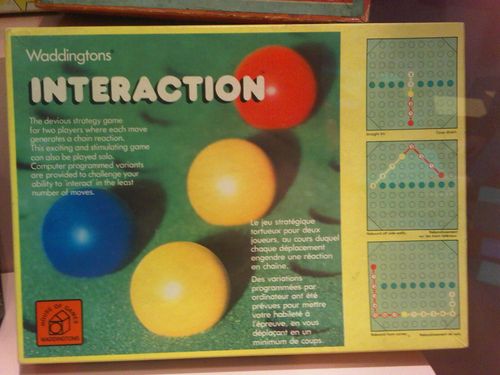
Interaction
Interaction Rulebook
Table of Contents
Table of Contents
Components
Playing area, 2 red balls, 2 blue balls, 10 neutral yellow balls, 2 score markers.
Object of the Game
Each player controls 2 balls. They use them to set the neutral balls in motion. The aim of the game is to be the first player to send five NEUTRAL YELLOW BALLS into the central line of pockets. Once a yellow ball has reached a central pocket, it is considered out and is removed from the game to be placed in the reserve of the active player.
Note on the source: the object section says the ball goes to the active player's reserve, while Rule 4 says it is placed on the player's score marker, counting for one point. Both are transcribed as printed.
Setup
Each player takes a score marker. At the start of each match the balls are placed on the green playing area as shown below.
[Setup diagram: the starting positions of the neutral yellow balls, the blue balls and the red balls are shown on the board, with the central line of pockets marked in dark green.]
The players decide who plays with the red balls and who plays with the blue balls.
Movement
The movement of the coloured balls and of the neutral balls is governed by two simple principles.
1. The principle of inertia
The blue ball moves two spaces before striking a line of four balls of any colour.
On impact, thanks to the momentum of the blue ball (2), an interaction is triggered through the other balls, so that the last ball is set in motion. In "Interaction", the distance (number of spaces) travelled by the coloured ball before impact is equal to the total distance travelled by the last ball after impact.
2. The principle of rebound
A moving ball that arrives straight at a wall rebounds straight back after impact.
A ball that strikes a wall at an angle rebounds off that wall at the same angle.
These principles apply whatever the colour of the ball concerned.
Note: a coloured ball may rebound off a wall or a corner before striking another ball. This can be an effective way to increase its inertia.
Using the principle of rebound, here are all the possible movements in Interaction when balls rebound off the walls or corners:
a) a straight shot against any side.
b) a diagonal rebound against a corner.
c) a diagonal rebound against any side.
d) a straight rebound against a corner.
e) a diagonal rebound against a corner.
f) a coloured ball starting its movement at X and moving in the direction shown rebounds against the left wall and continues its movement in the direction shown. If it were to continue on its way, it would rebound as shown in (d).
You will notice that, with the exception of (f), if the movements continue unobstructed, the balls would return to their starting position.
Note on the source: as printed, items (b) and (e) both read "a diagonal rebound against a corner". The figure labels are not legible in the text layer; the wording is transcribed as printed.
Rules
-
The players must decide in advance how many games they wish to play. They take turns to begin.
-
A legal move occurs when one player's ball is set in motion and strikes a neutral ball, a ball of the other player, or the other ball of the active player. The initial ball remains on the space it occupied at the moment of the impact.
-
A move that does not consist of launching a ball of one's own colour so that it eventually strikes another ball is illegal.
-
When moving his initial ball on the playing area, the player must count out loud the number of spaces travelled before striking another ball. This dynamic (the number of spaces) is then transferred in full to the balls in its path, and the player must again count out loud the spaces by which he moves the balls it touches. The only exception to this occurs when a neutral ball crosses the line of pockets before the total has been fully used. As soon as a neutral ball crosses this line, it is considered out: it is removed from the playing area and placed on the score marker, counting for one point for that player.
-
Coloured balls may cross the line of pockets without being affected at all.
NOTE: It is not possible to send a ball into a pocket during the first turn of the game.
Other Ways to Play
All symmetrical starting positions using one or two balls per player and about ten neutral balls or fewer will give a different game, whose complexity varies according to the starting layout.
Solo Interaction
To play Interaction Solo, the same rules apply as for the two-player game.
The player controls only a single coloured ball (indicated in the following diagrams) and the aim of the game is to send all the neutral yellow balls into the pockets in a minimum number of moves.
The following layouts vary in difficulty, starting with the easiest. We analysed each layout on a computer, and under each of them you will find the results we obtained.
To begin with, it is already good to send all the yellow balls into the pockets in a minimum number of moves, even if that number is higher than the one indicated. You should then concentrate on reducing that number of moves. Layout no. 1 is relatively simple; layout no. 6 is extremely difficult, the computer finding only 2 solutions.
Computer-tested variants
-
10 balls, 11 moves, 148 solutions.
-
10 balls, 11 moves, 660 solutions.
-
7 balls, 7 moves, 22 solutions.
-
9 balls, 10 moves, 20 solutions.
-
10 balls, 12 moves, 8 solutions.
-
9 balls, 10 moves, 2 solutions.
These results show the smallest number of moves needed to pocket all the neutral balls and the number of ways in which this result can be achieved; many hours of enjoyment can be spent designing new layouts and solving them.
You will find it useful to record your moves using the diagram at the left. The numbers signify the direction in which you first move your coloured ball. Align the playing area with the illustration and simply record your moves by writing the corresponding numbers.
For example, the first move of example diagram 3 would simply be noted as 6, because that is the direction in which the red coloured ball C moves at the start.
[Recording diagram: the board is numbered 1 to 8 around its edge (1 left, 2 right, 3 top, 4 bottom, 5 and 7 top corners, 6 and 8 bottom corners), giving the direction of the first move of the coloured ball.]
Example of the Start of a Game
At this stage, we suggest that you play the example game, noting the way in which the principles are applied, in "Interaction".
Set up the game as shown opposite and carry out the moves as described.
Diag. 1
Your balls are blue A and B; your opponent's balls are red C and D; the yellow balls are neutral. Count out loud as you move the blue ball one space forward until it stops in front of a neutral yellow ball. The inertia of (1) is transferred to the yellow ball, which moves one space.
Diag. 2
Your partner counts out loud as he moves his red ball C three spaces until it strikes the right-hand wall. On its momentum, an inertia of (3) is transferred by rebound to a yellow ball which can move only one space before passing the remaining inertia (2) on to another yellow ball. This ball moves a second space and transfers the remaining inertia to your blue ball B, which moves a third and final space to the central pocket. (Since it is a coloured ball, it is not removed from the playing area.)
Diag. 3
You now have the opportunity to pocket a neutral yellow ball. You count out loud as you move your blue ball B five spaces, rebounding off two sides before stopping next to a yellow ball. This inertia (5) is transferred to the yellow ball, which moves up to the central line of pockets and is therefore won by you: you place it on your marker, thus showing that you have scored a point.
Diag. 4
Your opponent now has the opportunity to pocket a yellow ball. He counts out loud as he moves his red ball C four spaces, transmitting its inertia (4) to a yellow ball which moves one space before striking the side and transferring its momentum to another yellow ball. This ball moves a second space, before rebounding off the side wall and passing the final momentum (2) to a yellow ball which moves into a central pocket and is removed, scoring a point for your opponent.
Diag. 5
You have no opportunity to score a point on your turn, but you see a chance to reach an advantageous position for your next move. You move your red ball B seven spaces, via a rebound off a corner, before being stopped by a yellow ball. This ball moves two spaces and transfers the remaining momentum to a yellow ball which moves the last five spaces.
On your next move, you will be able to pocket a yellow ball by transferring your ball B. Continue and finish the game.
Diag. 6
[Diagram only; the printed sheet gives no accompanying text for this figure.]
Printing the Board
Print twice, cut out without cutting your fingers, then assemble. For the balls, the ideal is to have Chinese marbles in three colours.