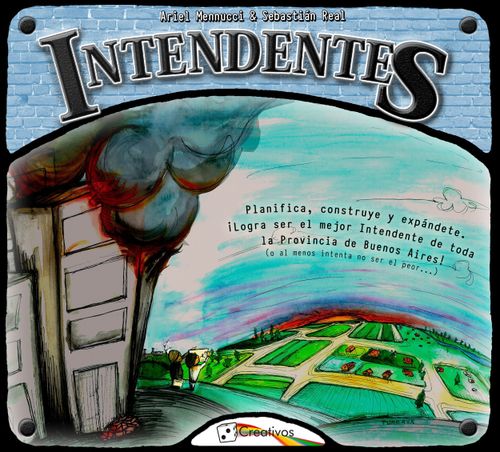
Intendentes
Intendentes Rulebook
Table of Contents
Table of Contents
Game Components
- 64 Block cards
- 32 Plan cards
- 28 Penalty cards
- 20 Event cards
- 4 Turn order cards
- 4 Identification / game reference cards
- 3 Indicator boards
- 70 Inhabitant tokens
- 6 blue tokens, 6 red tokens, 6 green tokens, 6 yellow tokens
- 1 black token
- 60 banknotes in values of $1, $2, $5, $10 and $20
Game Setup
Each mayor receives $20 from the bank, an Initial Town block and an Initial Field block. 2 inhabitants are placed on the initial town. All of this will form each mayor's "district".
The game boards are placed in the center of the table. Each mayor chooses a color and their identification card, then places their tokens on the score "10" in Splendor, "5" in Warehouses, and on "0" on the Discontent, Fire, Flood and Insecurity indices.
The event deck is shuffled, and 8 cards are separated and placed face down beside the boards forming the event deck; the rest of the event cards go back into the box without being seen by anyone.
The Plans and Blocks decks are shuffled and placed face down near the boards. From the Blocks deck the top 4 cards are taken and the first 3 of them are placed face up, forming a group of biddable blocks; the remaining card also stays face up: this will be the next biddable block.
The penalty cards are placed within everyone's reach. All leftover inhabitants form a common reserve for everyone.
Finally the black token is placed on the Food Market space ($7).
Taking the necessary number of turn order cards, they are shuffled and dealt at random, one to each mayor; that will be the turn order for the first round. This turn order will change as the game goes on in the following rounds; when that happens, the mayors must exchange the turn order cards accordingly. These cards must be in front of each mayor and in everyone's view.
Note that the game money is printed on one side only; if the mayors want to keep their money hidden, they can leave it on the table with its value face down.
Everything is ready to start!
Playing the Game
Each game is divided into "Rounds" and each round in turn has several "Game Phases". Completing all the phases means a round ends.
Except for the first round of play, where the turn order is drawn at random, at the start of each round a new turn order must be assigned. The mayors are ordered according to their splendor: the player with the most splendor will be first, the next second, and so on until all are placed. In case of a tie, whoever has fewer points in the sum of the 3 risk indices (fire, flood and insecurity) is considered first, and if the tie persists, whoever has more money. Each player takes the corresponding card and places it in front of them to mark the turn order.
Each Game Phase is carried out following the mayors' turn order, unless the phase says otherwise.
IMPORTANT: Each time a ROUND ends, the turn orders are assigned again.
Game Phases
1 – Bidding (Auctions)
The first mayor begins by choosing a block (from the biddable blocks) to acquire and install in their district, then states aloud the price they wish to pay for it, respecting the minimum price printed on the card. Using the round order of mayors to the left, the rest may take part in the auction until it ends.
Block card anatomy: block type; minimum acquisition cost; production (type and multiplier) of the block; initial inhabitants (orange, 3 in the example); maximum inhabitant capacity (5 in the example); index modifiers; splendor points; available personnel (red or blue); special effect.
Blocks with the capacity to hold population (towns, cities, industries and fields) usually provide income when there are inhabitants (tokens) on them. The number of inhabitants printed indicates the maximum number of inhabitants (tokens) allowed. The rest of the blocks (special, police and fire brigade) can never hold inhabitants. Special blocks usually have a text that modifies the rules of the game.
Example: there are four mayors in play, Juan, Carlos, María and Rubén. The mayor with the most splendor is Juan; he starts the auction and offers $6 for the city. Carlos and María decide not to bid on their turns, but Rubén does and raises the offer by offering $9. Juan can raise the offer or pass, and decides to raise it to $10. As Carlos and María already passed previously, they cannot take part in the rest of this block's auction. Rubén raises the offer to $13. Juan considers that too much and decides to pass, and it is Rubén who wins the block for $13. As soon as he acquires the block he adds it to his district, placing it in his "district" along with the rest of the blocks, and some actions must be carried out immediately:
First modify the indices (fire, flood and insecurity): Rubén is the one using the blue markers and increases fire by 1 point, flood by 2 and insecurity by 2. As the block has 3 orange inhabitants printed, Rubén adds 3 new inhabitants onto the acquired city, taking them from the common pool; finally he increases the 5 splendor points gained.
All these adjustments are made only once, upon obtaining a block. DON'T FORGET TO MAKE THEM.
As Juan did not buy and he is still the mayor with the best position in the turn order (he is first), he starts the auction again, in which Rubén does not take part.
IMPORTANT: Each time a purchase ends, fill the empty space of the biddable blocks (there must always be 3) by taking the next biddable block; then a card is drawn again from the Blocks deck, which will be the new next biddable block.
Each mayor may obtain only one block per round, so they stop taking part in the auctions once they have acquired a block.
The phase continues until all the mayors have acquired a block or not.
If a mayor does not wish to acquire a block, they must announce it when it is their turn to start an auction; on doing so they indicate a block they want auctioned among the rest of the mayors, and if nobody wants it, it is discarded and instantly replaced by a new one following the usual rules.
IMPORTANT: Remember that new inhabitants only enter the blocks that have orange inhabitants printed in the illustration (cities and towns); security blocks have police (blue) and fire brigade (red) personnel printed; these blocks cannot hold inhabitants, and the personnel are not ordinary inhabitants.
2 – Demography
Here the mayors may change the location of their inhabitants within their district. To do so they move their inhabitants from one block to another, always respecting the maximum inhabitant capacity printed on each block. Once all the mayors have placed their inhabitants, this phase ends.
Example: María has 5 inhabitants; she decides to move one from her town and another from her field to place them in her industry.
3 – Planning
Each mayor takes two cards from the Plans deck, keeps one in their hand and places the unwanted card on the discard pile.
The maximum number of cards in hand allowed for each mayor during the whole game is 4. If on playing this phase a mayor already holds 4 plan cards in their hand, they must discard one before drawing two new ones, or, if they prefer, they may keep the hand they already have without drawing cards. These cards are secret.
How to use plans? Plans are free actions; each round each mayor may carry out as many plans as they wish.
Each plan indicates its phase of use and its execution cost. To use it, the mayor must do so only in the indicated phase and pay the cost of the plan; once this is done and the plan is shown, its action is carried out. (Plan card anatomy: plan name; plan cost; action; phase in which the plan can be carried out.)
If the mayor uses the plan for their own district they do so on their turn, but if they carry it out on a neighbor's district they may do so at any moment during the corresponding phase.
When the plans deck runs out, shuffle the discard pile and form a new one.
Neighbors? Many plans can be carried out on neighbors. In games with 4 mayors, only the mayors to the left and right of whoever carries out the plan are considered neighbors. In all other games all the mayors are neighbors of each other.
Important: In the same round, two mayors are not allowed to carry out the same plan on a neighbor. If it happens, whoever has the better position in the turn order carries it out first.
4 – Event
The first mayor takes the top card of the event deck and reveals it, reading it aloud, then leaves it face up beside the board. The event card applies to all mayors equally, although it will affect each one differently.
Only one event card is revealed per round. The events describe their effects on the card itself.
Example of a "catastrophe" event: In the 4th round the event card "Fire 3" comes up (for each point on the fire index exceeding 3, the mayor must take a "fire" card). Juan (green) has a fire risk of 1, so he is not affected; María (red) has a risk of 3 and is not affected either, since her index does not exceed the event's. Rubén (blue) and Carlos (yellow) are in trouble since their indices are very high, and so they are affected by the event. Rubén gets 2 fire cards (3 to 5, a difference of 2) and Carlos 1 fire card x3 (it represents 3 cards in one) (3 to 7, a difference of 4, but the maximum is 3 cards). These cards must be placed face up within each mayor's district and are a mark of the affliction that district has.
Some events act differently, but don't worry: each of them has its full description on the card.
IMPORTANT: When penalties (fire, flood and insecurity) are obtained, the mayor can never take more than 3 in the same round, but they may accumulate them in following rounds.
For example, a player has their Insecurity index at 10 and an "Insecurity 1" event comes up; the difference is 9 points, but the mayor will nevertheless only take 3 insecurity cards.
These cards have 2 sides, a single side and a x3 multiplier side; when you accumulate many catastrophes and there are not enough cards to show it, flip the cards to use just one of them instead of 3 — what a bad job you're doing!
Each event is carried out only once; in the following rounds, the events already revealed remain in the past.
5 – Security Actions
The mayors may activate their security buildings (fire brigade or police) for two purposes: removing penalty cards of fire, floods, insecurity or demonstrations, or reducing the fire or insecurity indices of your district.
The mayor may also request national help; on doing so they are considered to temporarily acquire ONE SINGLE fire brigade or police officer. To do it they must pay $5 and lose 5 splendor points; this action only allows removing one flood, fire or insecurity card.
Police blocks are used to remove Flood, Insecurity and Demonstration cards. Each officer illustrated on the block allows removing one of those cards; each of the 2 officers can be used to remove a different card. If officers are not used to remove cards, the whole block can be used by paying $6 to lower the insecurity index by 1. (Card text: "Each officer removes one Insecurity, Flood or Demonstration card. Pay $6 and lower your insecurity index by 1.")
Fire Brigade blocks are used to remove Flood and Fire cards. Each officer illustrated on the block allows removing one of those cards; each of the 2 officers can be used to remove a different card. If officers are not used to remove cards, the whole block can be used by paying $6 to lower the fire index by 1. (Card text: "Each officer removes one Fire or Flood card. Pay $6 and lower your fire index by 1.")
Example of using the security forces: Juan and María have very calm districts with no catastrophe cards affecting them, but Carlos and Rubén are not so relieved.
Carlos has 4 fire cards and a fire brigade block. The fire brigade block has 2 officers (they can remove fires or floods), which he uses to get rid of 2 fire cards; the other 2 cards stay where they are. Carlos decides to use the national forces to eliminate another fire card: he pays $5 and reduces his splendor by 5. As the national forces can only be used once per round, Carlos ends his phase.
Rubén is really in serious trouble: he has in his district a demonstration card, an insecurity card, 2 fire cards and a flood card. He has a Fire Brigade block and a police block. The fire brigade block has 1 officer, which he uses to remove a fire. The police block has 2 officers; he uses one for the flood card and the other for the insecurity card. He could use the national forces to remove the demonstration, but if he did that he would increase his discontent by one point, lose $5 and 5 splendor points, and it seems too risky to him for now.
María is doing fine and has no card affecting her district; anyway she decides to take advantage of this phase and pays $6 to reduce her Insecurity level by 1 using her police block (it goes from 3 to 2). María also has a fire brigade block but doesn't have enough money to lower her flood level and decides not to use it.
Juan has a police block but prefers not to spend money reducing his insecurity index, which is not that high for now.
6 – Balance
This is the phase where each mayor collects their taxes, produces food and feeds their population. The phase is divided into 3 sub-phases.
6.1 – Buying Food (Market)
This is the only sub-phase of the whole round where the turn order is completely reversed: the last player will play first, making a reverse round.
Each mayor decides on their (reversed) turn whether or not to buy food from the market. To do so they pay the cost the marker indicates and automatically move it one space to its right (increasing the cost of the next purchase); each purchase grants the mayor 3 food, which must be added to their warehouse as soon as the purchase is made (moving their marker). When a mayor buys, they cannot buy food again until the next round. If a mayor decides not to buy, nothing happens; they simply "pass" this sub-phase and the market marker must not move.
IMPORTANT: When all the mayors have bought food or passed, the marker always moves back one space, reducing the purchase cost for the next round, and this sub-phase ends.
6.2 – Income
Following the usual turn order again (no longer reversed), each mayor calculates their district's income. To do so they multiply their inhabitants by the amount of income their blocks grant.
EXAMPLE: This district has 4 blocks with money adjustments (banknotes, upper right). The field, which besides producing food gives money, has 2 inhabitants there and receives $2 (one per inhabitant); the town has 2 inhabitants and grants $2 for each one living there: the mayor earns $4. The city also multiplies each inhabitant x2 and as there are 6 inhabitants, the mayor earns $12 more; finally the industry gives $5 per inhabitant: having 2 inhabitants, it earns $10. In total the mayor earned $28 (2+4+12+10); he takes it from the bank and keeps it.
6.3 – Producing Food and Feeding
Each mayor calculates how much food they produced. To do so they multiply the inhabitants by the food production of each block.
Then they add up the total inhabitants living in their whole district (remember that police and fire brigade officers are not counted) and subtract the number of inhabitants from the total food produced; that difference is used to modify the amount of food in the warehouses.
EXAMPLE: This district has 2 blocks that produce food. The field produces 2 food (one inhabitant x 2 food). Field B produces 6 food (2 inhabitants x 3 food). In total, the mayor collected 8 food but must feed a total of 10 inhabitants; as he is two food short of feeding all his inhabitants, the mayor must spend two food from his warehouse (moves his marker back two spaces).
A mayor who has surplus food when producing and feeding sends the surplus to their warehouses, moving their marker forward as many spaces as surplus food they have.
Famine: If in the feeding phase a mayor is unable to cover the total food needed to feed all their inhabitants, they must eliminate inhabitants from their district. For each missing food, one inhabitant must be removed from the block the mayor chooses. For every 2 inhabitants lost, the marker on the discontent indicator moves forward one space (this indicator is explained in detail later).
IMPORTANT: Mayors are not allowed to not feed inhabitants (eliminating them) if they are able to feed them.
7 – Happiness
In this phase we will find out how happy the inhabitants of each district are, as well as watching how the very promiscuous ones reproduce.
7.1 – Discontent
Each mayor checks how many discontent points their district increases: each fire, flood or insecurity card still in play on a district will make discontent increase. For each point increased, the marker on the discontent indicator moves up one space.
7.2 – Births
Births only occur in 2 types of blocks, towns (both initial and acquired) and cities; the rest of the blocks are not effective for reproduction.
In each town or city block where there are 2 or more inhabitants and there is still space to add inhabitants, a new inhabitant is born: the mayor takes an inhabitant token from the common pool and places it on the block where the birth occurs. Only one inhabitant is ever born per block if the conditions are met.
EXAMPLE: In this district there are 3 towns and 1 city (reproduction blocks); the rest of the blocks are not taken into account. Block A has 3 inhabitants, but its inhabitant limit is already filled: no births occur there. Block B has 2 inhabitants and has a maximum space of 4: a new inhabitant is born there. Block C has 5 inhabitants and a maximum capacity of 7 inhabitants: a new inhabitant is also born there. Finally, block D has one inhabitant and there are no births there since at least 2 inhabitants are needed.
IMPORTANT: Mayors cannot cancel births on a block by their own decision if the conditions for them to happen are met.
Increase population (fast): All mayors have the option of placing up to 3 new inhabitants in their district; these new inhabitants are installed automatically on any block that allows it regardless of the birth rules. This action can be used only once per round; doing so causes a loss of 10 splendor points, and it must be done after calculating births, not before.
8 – Decline
Each fire, flood and insecurity card remaining in a district will subtract one splendor point from the mayor, while each demonstration card will subtract 2 splendor points.
In this phase each mayor must calculate how many splendor points their district lost by adding up the total of the cards affecting it; that number of points must be subtracted on the splendor table on the game board.
IMPORTANT: This is the last phase of each round; each time this phase ends, a round ends and a new one begins. Don't forget to readjust the turn order as explained previously.
Discontent
Discontent indicates the mood and anger the inhabitants may have with the mayors' administrations. The markers on the discontent table can move during the course of the game for several reasons:
- Plans carried out.
- Increase of discontent in the happiness phase (7.1 Discontent).
- Using the police to remove demonstrations (repress).
- Famine.
This table has 4 spaces of vital importance (raised fists): each time a mayor's marker enters (moving forward) one of those spaces, they must take a number of demonstration cards equal to the number printed on the table (fist). The greater the discontent, the more demonstrations we may have in our district.
If, on the contrary, we manage to reduce discontent using plan cards, our marker may leave a demonstration space (moving back), and that causes a number of demonstration cards equal to the number the table indicates (fist) to be removed from the mayor's district.
IMPORTANT: When starting a new round of play, each mayor whose discontent marker is on the last space must take a new demonstration card. Evidently the people are more than angry.
Repress: If we have police, we can use an officer to get rid of a demonstration card in phase 5 "Security Actions" (5.2 – Use security forces); taking this measure causes the demonstration to be withdrawn (you remove the card), but at the same time it increases the population's discontent. It may even happen that on repressing, new and more demonstrations automatically appear.
Discontent examples: In the Discontent sub-phase (7.1) the mayors must calculate how much discontent increases. Juan (green) has no catastrophe card, so his discontent stays where it is. Carlos (yellow) has a Flood card and must move his discontent forward one space; as he enters the first demonstration space (fist) he must take a Demonstration card and add it to his district. María (red) must move forward 2 spaces for having 2 fires; on doing so she does not have to take demonstration cards — they are only taken when entering or passing a space with fists. Rubén (blue) must move forward 3 spaces, having 2 fire cards and one insecurity card; on doing so he passes the 3rd space with fists and must take 2 demonstration cards.
In a second example, María (red) uses the plan "Social Subsidies" in the Balance phase and moves her discontent marker back 3 spaces; on doing so she passes backwards through a fist space and thereby removes 2 demonstration cards from her district. Carlos (yellow) uses his plan "Open Concert", with which he moves back 2 spaces; on doing so he enters the fist space, but he did not manage to get past it, so it is not enough to remove demonstration cards — maybe next round he'll manage it.
End of the Game
In the round in which the last card of the event deck is revealed (round 8) the game ends; the round of play must be completed and all its phases must be played to the end.
Once the last phase (8) is finished, the final score is calculated and the winner is determined.
Final Scoring
Following the turn order, each mayor adds splendor points for achieving the following objectives:
District size (number of blocks*):
- 10 blocks: 10 pts.
- 9 blocks: 6 pts.
- 8 blocks: 2 pts.
- 7 blocks: 0 pts.
- 6 or fewer blocks: -4 pts.
* The initial blocks are also counted in this calculation.
Final census: For every 2 inhabitants, 1 pt.
Happiness (according to position on the discontent table):
- Peace (starting position): 8 pts.
- Up to and including the first fist: 4 pts.
- Up to and including the second fist: 0 pts.
- Up to and including the third fist: -4 pts.
- Beyond the third fist: -8 pts.
Overall risk: Each risk indicator (fire, flood, insecurity) grants 5 pts to the mayor with the lowest value; if more than one mayor shares the lowest value, each mayor receives 2 pts instead of 5.
Warehouses: For every 5 food stored, add 2 pts.
Economy: For every $5: 1 pt.
The player with the highest final splendor wins the game. In case of a tie there will be more than one winner: you can celebrate together or simply... settle it with a rematch!
Variants
For your first game, or when you want to introduce inexperienced mayors to the game, we recommend playing with a family variant.
In family mode the setup is the same as in the advanced game, with these differences:
- Family initial blocks: Use the family side of the initial blocks (field and town); these are identified by the "family" symbol illustrated on one of their faces.
- Family events: When building the event deck use only the ones marked as family; discard the rest. In the advanced game mode all the cards are used to build the event deck.