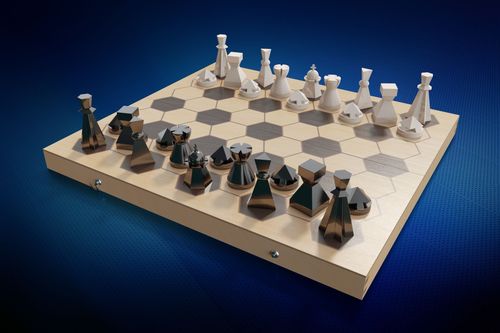
Intellector
Intellector Rulebook
Table of Contents
Table of Contents
Objective
The winner is the first player who, while following the rules, achieves one of the following:
- Captures the opponent's Intellector.
- Brings their own Intellector to the opponent's base line.
- Blocks all of the opponent's pieces that are on the board at that moment.
In a game played with a time limit, the player who exceeds the time allowed for a single move and/or their share of the time allowed for the whole game loses.
Setup
The board is a hexagonal grid of nine files (columns a to i) and seven ranks (rows 1 to 7). Each player's base line is the five dark hexagons on the edge of the board nearest that player, marked with the numbers 1 (White) or 7 (Black).
The pieces are placed as follows:
- White (rows 1 and 2):
- Row 1: Dominator (a1), Liberator (b1), Aggressor (c1), Defensor (d1), Intellector (e1), Defensor (f1), Aggressor (g1), Liberator (h1), Dominator (i1).
- Row 2: Progressor on each of a2, c2, e2, g2 and i2.
- Black (rows 6 and 7):
- Row 7: Dominator (a7), Aggressor (c7), Intellector (e7), Aggressor (g7), Dominator (i7).
- Row 6: Progressor (a6), Liberator (b6), Progressor (c6), Defensor (d6), Progressor (e6), Defensor (f6), Progressor (g6), Liberator (h6), Progressor (i6).
(Setup as shown in the diagram of the original rulebook, "Расстановка фигур".)
Terms
- "Move" (Ход) is the movement of a piece, according to the piece movement rules, from one hexagon to another: either to a free hexagon or to one occupied by an opposing piece. Note: In chess terminology such a move is called a "half-move".
- "Capture" (Взятие или захват). A move onto a hexagon occupied by an opposing piece (according to the piece movement rules) means capturing that piece, after which it must be removed from the board immediately.
- "Base line" (Базовая линия) is the set of five dark hexagons on the edge of the board belonging to the respective player (Рис. 1).
- "Blockade" (Блокировка). If one side, having the right to move, cannot make a move according to the rules of the game, its pieces are considered blocked. In that case, victory is awarded to the opponent.
- "Adjacent hexagon" (Соседний шестиугольник) is a hexagon that shares a side with the given hexagon.
Figure 1 (Рис. 1) shows the two base lines: the dark hexagons marked 7 at the top edge of the board and the dark hexagons marked 1 at the bottom edge.
Game Rules
Start of the Game
The game is always started by the player with the White pieces. After that, the players move in turn.
Passing the White Pieces
In each following game, the right to make the first move with the White pieces passes to the player who played Black in the previous game.
Note: This is done for fairness and to avoid unnecessary disputes.
Draw
Neither player is awarded a win in the following cases:
- by mutual agreement of both players;
- by threefold repetition of the same position;
- if, over the last 60 moves (30 for each player), no piece was captured and no Progressor made a move.
Promotion of the Progressor
When a Progressor reaches any of the five hexagons of the opponent's base line, it is immediately replaced (in the same move) by any other piece of its own color, except the Intellector.
Capturing Opposing Pieces
- A piece may not capture a piece of the same color as itself.
- Only one opposing piece may be captured in a single move.
Support from the Intellector
When a piece captures an opposing piece, every piece except the Progressor has the right to turn into a copy of the captured piece in its own color. This right exists only when the Intellector of the capturing side stands on an adjacent hexagon (Рис. 2). In that case the player may choose between two ways of capturing:
- I. The attacking piece turns into an identical copy of the captured piece in its own color and takes its place. Note: In fact, the attacking piece is removed from the board, and the captured piece is replaced by the same piece in the other color (Рис. 2).
- II. The opponent's piece is removed, and the attacking piece is placed on its square (Рис. 3).
Explanation: Without support, everything is standard. That is, if the Intellector of the capturing side does not stand on an adjacent hexagon, the attacking piece has only one way of capturing: remove the opponent's piece and place the attacking piece on its square. This is capturing as in chess (Рис. 3).
Example (Пример): A White Liberator, if its Intellector stands on an adjacent hexagon, may, after capturing a Black Dominator, either remove it and take its place, or remove it and become a White Dominator.
Piece Movement
The Latin name of each piece is given in brackets (the original rulebook explains the name of each piece in Latin).
Intellector ("understanding")
- The Intellector moves to any adjacent hexagon (Рис. 4).
- The Intellector never has the right to capture an opposing piece.
- The Intellector may swap places only with a Defensor of its own color, and only if the two pieces stand on adjacent hexagons (Рис. 5).
- A swap of the Intellector and a Defensor counts as one move, and may be carried out an unlimited number of times during the game.
Defensor ("defender")
- The Defensor moves to any adjacent hexagon (Рис. 6).
Liberator ("liberator")
On each move the Liberator may, at the player's discretion, move in one of two ways:
- I. The Liberator moves through one of the adjacent hexagons. When making such a move, the Liberator captures an opposing piece if that piece stands on the hexagon where the Liberator lands. The Liberator may jump over both White and Black pieces lying in the direction of its movement, and this does not count as a capture (Рис. 8). Explanation: In other words, with this kind of move the Liberator advances "by jumps", skipping one hexagon, and in doing so may capture opposing pieces.
- II. The Liberator may move to an adjacent hexagon if that hexagon is not occupied by any other piece, of either color. During such a move the Liberator may not capture (Рис. 9).
Progressor ("progressing forward")
- The Progressor moves only forward, to an adjacent hexagon: only to those hexagons that lie closer to the opponent's base line than the hexagon it currently occupies (Рис. 7).
- On reaching any of the five hexagons of the opponent's base line, the Progressor is immediately replaced (in the same move) by any other piece of its own color, except the Intellector (see "Promotion of the Progressor" above).
Aggressor ("attacking first")
- The Aggressor moves only to a dark hexagon that lies on a straight line connecting the corners (vertices) of dark hexagons (Рис. 10).
- The Aggressor may not jump over pieces standing on dark hexagons.
Dominator ("ruler")
- The Dominator moves in a direction forming a row of hexagons that touch one another along their sides (Рис. 11).
- The Dominator may not jump over other pieces of either color.