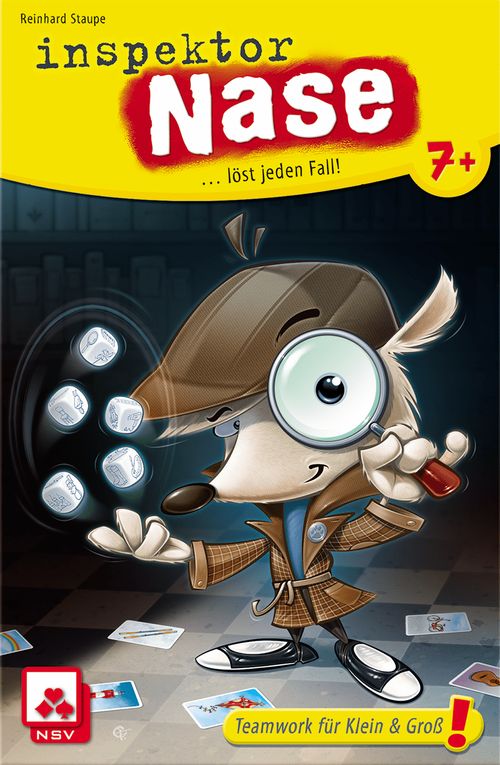
Inspektor Nase
Inspektor Nase Rulebook
Table of Contents
Table of Contents
Components
- 54 Image Cards
- 5 Number Cards (1-5)
- 1 Clue Card
- 8 Dice
Setup
Place the Clue Card (with a red arrow) face up in the middle of the table. It will stay there until the end of the game (5 rounds).
Shuffle the 54 Image Cards. Draw 25 Image Cards and return the remaining 29 cards to the box. Of those 25 cards, place 5 Image Cards in a row in the middle of the table, to the right of the Clue Card. You may choose whether you want to use the front or back side of the Image Cards. The Image Card closest to the Clue Card is number 1, the one next to that is number 2, and so on. Place the 20 remaining Image Cards off to the side: they will be used in later rounds.
Determine which player will take on the role of Inspector Nose during the 1st round. This player places the 8 dice in front of him. Inspector Nose shuffles the 5 Number Cards, secretly looks at the number on 1 of them (making sure no one else can see it!), and then places the chosen Number Card face down in front of him. The number on the card will tell Inspector Nose which item the other players must find!
Important: Inspector Nose must be careful when looking in the direction of the Image Cards, otherwise the other players might deduce from his gaze which card they are looking for.
Example: Tim takes on the role of Inspector Nose. He receives the 8 dice and the face-down Number Cards. He secretly looks at a card: it shows the number 2. This means the other players have to find the grapes (Number 2).
How to Play
Inspector Nose rolls 5 dice. Important: he cannot choose which dice to roll, but has to take 5 randomly. He then chooses 1 symbol he rolled which he thinks might give a good clue about the correct Image Card. He places the chosen die on the Clue Card with the red arrow.
Very important: Inspector Nose is not allowed to speak: not a word! He also cannot give any non-verbal clues such as rolling his eyes, pumping his fist, or anything else. The other players are also not allowed to give Inspector Nose any tips as to whether one of the dice might or might not fit a particular card. During this stage of the game, there has to be absolute radio silence between Inspector Nose and the other players!
Next, the other players will discuss what the chosen symbol could mean, and which Image Card it could be pointing to. They must agree on 1 card they think is incorrect. They eliminate that card from the row by placing it to the side. The remaining cards stay in place.
Example: Tim rolls 5 of his dice. He chooses the 'balloons' symbol and places the die on the Clue Card. The other players start to discuss and finally choose to eliminate the parking meter. Great, because the parking meter was not the card they are looking for!
If the players eliminated the right card (the Image Card they are looking for is still in the row), Inspector Nose gets to roll again. He takes the 4 dice he just used and randomly adds a 5th from the pool of remaining dice. After rolling, he chooses a new symbol which he thinks might give a good clue about the correct Image Card. Once again, he places the chosen die on the Clue Card with the red arrow.
The other players discuss what the chosen symbol could mean and which Image Card it could be pointing to. Again, they must agree on 1 card they think is incorrect. They eliminate that card from the row by placing it to the side. The remaining cards stay in place.
Example: Tim rolls 5 of his dice again. He chooses the 'windmill' symbol and places the die on the Clue Card. The other players start to discuss and finally choose the dresser. Great, because the dresser was not the card they are looking for!
The game continues in the same way. Inspector Nose always rolls 5 dice and places 1 of them on the Clue Card. The other players discuss and must eliminate 1 card they think is incorrect. Ideally, after 4 rounds the correct card should be the only one left on the table!
Congratulations: the team has solved the case and successfully eliminated 4 cards. Each eliminated card is worth 1 point, so the team scores 4 points.
Example: After 4 clues (Balloons, Windmill, Mushroom, Knife) only the card with the grapes is left. The team has solved the case! They score 4 points because they successfully eliminated 4 cards.
What happens when the players eliminate the card they were looking for?
If the team accidentally eliminates the card they were looking for, the round ends immediately. The team scores 1 point for each card they successfully eliminated.
All cards that were successfully eliminated are placed to the side, so you can easily count your final score at the end of the game.
One more tip: sometimes, none of the rolled symbols will be a proper match. Therefore, it is also important for the team to observe which symbols Inspector Nose did not place on the Clue Card. For example, if Inspector Nose rolls a piggy bank and the card you were looking for was an animal, then the piggy bank would be a very good clue. But if the piggy bank is not placed on the Clue Card, then the card you are looking for is probably not an animal.
The Next Round
Any cards that are still in the middle of the table are returned to the box. Place 5 new Image Cards in the middle of the table and start the 2nd round as described above. The next player in clockwise order becomes Inspector Nose. The game ends after the 5th round, after which all the successfully eliminated cards are counted and players check to see how well they performed:
- 0-11 Points: Clueless Snooper
- 12 Points: Cadet
- 13 Points: Constable
- 14 Points: Police Chief
- 15 Points: Investigator
- 16 Points: FBI Agent
- 17 Points: Code Breaker
- 18 Points: International Spy
- 19 Points: Investigative Genius
- 20 Points: Master Detective