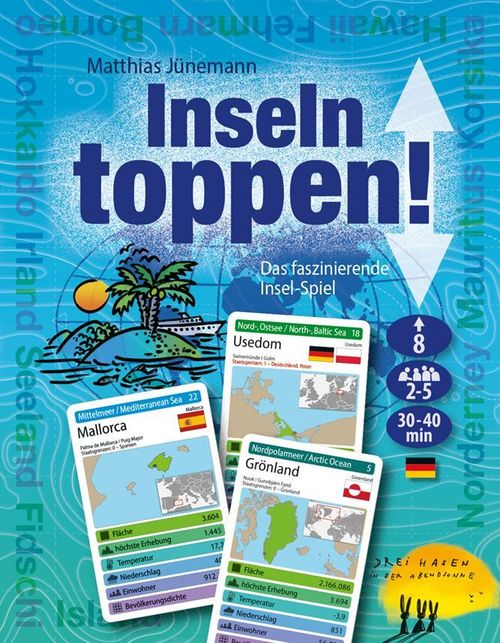
Inseln toppen!
Inseln toppen! Rulebook
Table of Contents
Table of Contents
Overview
Players: 2-5. Age: 8 years and older. Playing time: 30-40 min.
Game material: 128 island cards, 20 "blind cards", 5 folded paper strips with 6 categories, rules.
Note: Sort out the cover card and the following 5 advertising cards before playing!
Game Idea and Game Target
The game target is to take the most tricks by selecting the island cards skillfully. But taking tricks alone is not enough! If you want to win you have to split the cards of your tricks cleverly to get the most points in the end.
Island Cards
Right at the top of the island cards you will find the corresponding sea. In addition you will see the islands' location (in green) on the world map (section of the world map, island in green, principal town as a point).
Below, the six categories for each island or archipelago are indicated, as on the folded paper strips.
Categories
- Area (indicated in square kilometers)
- Highest peak (in meters above sea level)
- Average annual temperature (in °C, measured in the respective capital or the biggest city of the island)
- Precipitation amount (in millimeters)
- Number of inhabitants
- Population density (inhabitants per square kilometer)
Additional information
The meaning of the "national borders" is explained below. As additional information only, you will also find the principal town of the island and the name of the highest mountain below the country name, then the corresponding flag and the English name of the island. This has no influence on the course of the game.
Blind Cards
The blind cards are used to fill in all fields with cards in each round so no gaps remain. By that, the players shouldn't be able to take any advantages when placing the cards. The information on the blind cards will not be used in the course of the game.
Game Preparation
Each player gets a folded paper strip which he places in front of him. Everybody needs enough space for 12 card area fields: 6 cards above the strip and 6 cards below the strip.
All island cards are shuffled well to make a face down drawing pile. The blind cards are put next to it as a second pile.
The oldest player deals the cards. The number of players determines how many rounds will be played as well as how many hand cards everybody gets per round:
- 2 players: 10 island cards + 2 blind cards, 6 rounds
- 3 players: 10 island cards + 2 blind cards, 4 rounds
- 4 players: 8 island cards + 4 blind cards, 4 rounds
- 5 players: 8 island cards + 4 blind cards, 3 rounds
Course of the Game
Placing Cards
Afterwards all players place their hand cards (island and blind cards) face down to the categories on the paper strip:
- the highest value above the paper strip and
- the lowest value below the strip.
According to the number of players, a varying number of categories would remain free. The players put their blind cards (also face down and without letting the others know) in these places so no free spaces remain. In this way the other players cannot tell in which categories one hasn't got much to offer.
The challenge is to place your cards skillfully according to the related categories, to "sacrifice" unfavourable cards where needed and to place blind cards unnoticed.
(Note: placing the 12 cards happens before turning them over. No one knows where the blind cards are placed.)
Turning Over the Cards
As soon as all players have placed their cards they turn over the card of the first category simultaneously - from left to right, beginning with "Area" - and always first above, then below the folded paper strip.
Tricks
The player who got the highest or lowest value of one category gets all island cards that were placed for this category (above or below) as trick. Hence, a trick consists of a various number of cards depending on how the players placed their cards on the fields. The blind cards do not count, they are taken back by the players and added and shuffled with their island cards after each round.
Example with 4 players for the area above the paper strip (Area): Player A's card shows "Mallorca, 3.604 km2", player B's card "Madagaskar, 587.295 km2", player C's card "Kuba, 109.884 km2", player D's "Usedom, 445 km2". Player B's card is of the highest value. He takes the trick (= all four cards).
Example with 4 players for the area below the paper strip (Population): player A's card shows "Sylt, 17.713 inhabitants", player B's card "Island, 364.000 inhabitants", player C's card "Teneriffa, 928.604 inhabitants" and player D's card "Lampedusa, 4.500 inhabitants". Player D's card is of the lowest value and he takes the trick here.
Splitting the Tricks
If a trick consists of two or more island cards it needs to be split. To do this each player builds one face down pile and for each sea one face up pile (see Scoring).
Each player needs space for a maximum of 9 piles.
- At least one card of a trick will be placed on the face down pile.
- At least one card of a trick will be placed on a corresponding face up sea pile.
It is the player's choice how he splits the rest of the cards of one trick, if applicable, on his piles. Which piles he chooses depends on the course of the game and the tactics.
If a trick exceptionally exists of only one card (because all other players played blind cards), the player may choose where he puts this card.
Example: Player D (trick Island, Teneriffa, Lampedusa, Sylt) has several possibilities to split his trick: He could put the cards Island and Teneriffa on the Atlantic pile, Lampedusa on the Mediterranean pile and Sylt on the face down pile. He could also put Sylt on the North and East Sea pile and the remaining 3 cards on the face down pile - or Island and Teneriffa on the Atlantic pile and the other two cards on the face down pile.
In the rare case of several players having the highest or lowest value of one category, each of these players only gets his own island card. It is their choice where they put it. In this exceptional case nobody gets the remaining island cards. They are taken out of the game.
"National Borders"
Only a few islands of the world have national borders - for this reason national borders are indicated only on a few cards. If this special field is tagged red and shows a "1", the player who has taken the trick with such a card may take a face up card from a sea pile from another player of his choice and take it to one of his own piles.
There is even one island card with 2 national borders in the game. Who takes the trick with this card may even take 2 island cards from one or two player(s).
Rounds
As soon as the last trick (category lowest value "population density") has been split the first round ends. Now new cards from the face down drawing pile are dealt to the players and placed in the categories on the folded paper strip as before in the first round. Each player shuffles in his blind cards again (see Game Preparation).
All further rounds are played like this - the discard piles of the players are filled with more and more cards during the course of the game.
Scoring and Evaluation
Scoring is done as follows:
- Points for face up sea piles. Every player counts his island cards per sea pile in the following order and announces the number: North-, East Sea, Mediterranean Sea, Atlantic, Caribbean, Indian Ocean, Southeast-Asian Seas, Pacific, Arctic Ocean, Antarctic Ocean. Only the one who has taken the most cards per sea gets points - exactly one point for each island card of the corresponding sea pile.
- Points for the face down pile. You get one point for each card.
Then the figures for the face up ocean piles and for the face down pile are added up.
Examples: Player A has 7 face up Pacific cards, player B 6 and player C 2 face up Pacific cards. Player A gets 7 points, players B and C don't get any points.
If several players have the most cards for the same sea the points are split. If needed, whole points will be rounded up (7 : 3 = 2,33 -> 3 P.). Player A and B both have 7 Pacific cards. Each one gets 4 points (7 : 2 = 3,5 -> 4 P.). Players C, D and E each have collected 7 cards for the same sea. Each of them gets 3 points.
Winner
The winner is the one who has collected the most points after the given rounds! Whoever has split his tricks cleverly - by keeping an eye on the other players' ocean piles - may win, even though he may not have played the most cards in total. In case of equal points there will be several winners.
Variants for a Faster Game
Simple evaluation
The game may be played without splitting the tricks. In this case every player collects the cards he has won on a face down pile - and the one with the most cards in the end wins the game.
Game to go
It is also possible to take only the cards with you to play Island Competition on the road without any additional space requirements in the car, on the train or in the plane.
Card Notes
Island card "Alexander Island"
There is only a dash in the category "population density" on this exceptional card. There is no data given as this part of the world is not permanently inhabited. Therefore the card must not be placed at the folded strip in this category. The two Southern Ocean islands have no flag because they belong to the stateless Antarctic.
Island card "Liberty Island"
This island is extraordinarily small, that is why it is shown graphically. This card also has no data given for "population density" and must not be placed at the folded strip in this category.
Other notes
- The island card "Great Britain" includes only the main island.
- Island cards "Greenland", "Spitsbergen", "Ross Island" and "Ellesmere Island": here the world map differs a bit from the section - this is of no importance!
- Southeast Asian Seas: we created this term, adding an additional category to group together the many islands in the seas of Southeast Asia. Some of them are located in the Pacific and/or in the Indian Ocean.
- Archipelagos: on some island cards you find archipelagos like "The Seychelles", "Cape Verde Islands", "The Bahamas".
- It applies in principle: some islands, such as "Greenland", "Iceland", "Tasmania", "Great Britain" and "Tierra del Fuego" are not 100% assignable to a sea, which is why the author has chosen one of the two seas.
Further information
The figures for area and population were rounded up and down to a few decimal places which may cause slight fluctuations concerning the indication for population density. For very small islands more decimal places are indicated.