Insecta: The Ladies of Entomology
Insecta: The Ladies of Entomology Rulebook
Table of Contents
Table of Contents
Game content
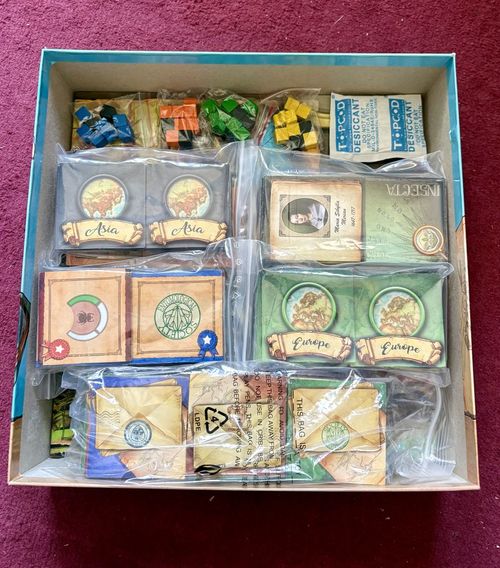
- 1 game board
- 75 Insect tiles
- 4 Season tiles (double-sided; the 2/3 players side and the 4 players side)
- 60 Mail tiles
- 17 Medal tiles
- 5 Researcher tiles
- 4 Researcher meeples, 1 of each colour (blue, orange, yellow, green)
- 20 markers, 5 of each colour (scoring, action, ability)
- 9 Black markers (activated abilities and season)
- 1 rulebook
Setup
- Place the game board in the middle of the table.
- Divide the Insect tiles by continent. Shuffle each group separately and place a pile with 8 tiles on the corresponding camp A and a pile with 7 on camp B.
- Shuffle the Mail tiles, create a face-down deck, and place it to the left of the game board. Then, draw the first 4 tiles and place them face up in a column.
- Randomly draw an Institution medal tile (blue medal) together with 2 other Medals (blue or red) and place them face down. Then, draw 3 Medal tiles and place them face up next to the face-down Medals, as depicted.
- Each player draws all the markers of their colour, 2 black markers, and 1 Researcher tile. They place them according to the picture:
- Place your Researcher meeple on camp A of her continent (indicated on her tile).
- Place one of your markers on each space of your Researcher tile.
- Place the extra marker on the "0" space of the Scoring track.
- Keep in mind you will need some space for your collection (6x4 grid).
- At random, place 2 Season tiles on the board - one on the Spring-Summer area and another on the Autumn-Winter area - according to the number of players. Also, place a black marker on the Autumn-Winter area and a marker of each colour in game on the first actions randomly.
How to play
The game is played in several rounds, following the order of the Action markers on the current Season tile.
A. Move the black marker from one Season tile to another.
B. In turn order (from top to bottom), each player moves their Action marker to an empty space on the tile with the black marker and activates the actions there.
C. Complete your collection. Optional action, at any moment during your turn (see Your collection).
Top space on the Season tile
Allows you to choose and activate one of the 4 available actions. The first player here places their Action marker on the lower position. If a second player chooses this space, they place their Action marker on the upper position.
Activate actions
Activate the actions from the chosen space in the order you prefer. Keep in mind it is not mandatory to activate all of them. For example, you may choose not to travel or even to activate no actions.
Actions have a number indicating how many times you may activate them. If there is a fraction, read the specific action to see how it works.
The four actions are: Travelling, Mail collection, Insect gathering and Medal claiming.
Travelling
Travel in search of new kind of insects to complete your collection.
- Move your Researcher from one camp to another in the same continent,
- Or move your Researcher from one continent to another, following the arrows that connect them.
Travelling actions are numbered 1 and 2.
Mail collection
Three scientific institutions (Société Entomologique, Entomological Society, and Deutsches Naturinstitut) send you commissions by mail indicating which characteristics your insect collection must have. You may use one Insect to complete different commissions, so it is essential a correct combination of the Insect and Mail tiles in your collection.
Mail tiles show a Mail origin, an Insect gathering symbol and Victory points.
- Mail actions numbered 1 and 2: Draw 1 of the 4 visible tiles. Immediately replenish the empty space with the next tile from the pile, which is now available, or draw the first tile from the Mail pile.
- Mail actions numbered 2/1 and 3/1: Draw 2 or 3 Mail tiles from the pile. Choose one of them and put the rest at the bottom of the pile.
Insect gathering
Insects are classified into 5 entomological orders. Each order has presence in each one of the 5 continents, but their characteristics are different: Coleoptera, Lepidoptera, Hemiptera, Orthoptera and Hymenoptera.
Each insect has a continent of origin, an entomological order it belongs to and a size (small, medium or large). Also, they have a wreath indicating each Researcher's favourite insect.
-
Insect gathering actions numbered 1 and 2: Draw the first or the last Insect tile from the camp where your Researcher is.
Example: Laura may draw up to 2 Insect tiles.
- A. First, she draws the tile visible in her camp.
- B. Then, she doesn't want the insect just revealed, so she draws the last tile from the pile of her camp. Since she is not interested in that one, she puts it at the bottom of its pile.
-
Insect gathering actions numbered 2/1 and 3/1: Draw 2 or 3 Insect tiles from the bottom of the pile from the camp where your Researcher is. Choose one of them and put the rest at the bottom of the pile.
Medal claiming
Collecting certain kind of Insects or completing Mails will give you the possibility to obtain Medals for your research work. The more conditions you accomplish, the more bonuses you will get, like actions, points or progress in your Researcher's journal.
Claim 1 of the 3 available Medals as a reward for your research work.
- Place one of the markers from your Researcher tile on a number of the chosen Medal according to the achievement accumulated. From bottom to top, claim the bonuses until you reach your Researcher marker's position,
- Or, if it is a Medal previously claimed, move your marker to the new number to update the achievement accumulated. Finally, from bottom to top, claim the bonuses from the previous position in the Medal (not included) to the current one.
Example: Laura has the colour blue and claims the Medal of insects from Africa. She places her Researcher marker on the third space of the track to let the other players know she has 3 Insects from the African continent in her collection. Then, one by one, she claims the 3 bonuses obtained: 1 Mail tile from the pile + 2 movements along the map + 1 fragment from the Researcher's journal.
Insect medal tiles
They require the presence of Insects of a specific order in your collection.
They require the presence of Insects of a specific continent in your collection.
They require the presence of Insects of a specific size (small, medium or large) in your collection.
Institution medal tiles
They require the presence of completed Mail tiles in your collection:
A specific Scientific Institution Medal.
Any Scientific Institution Medal.
Example: Laura has 3 completed Mail tiles in her collection. She claims the first 3 bonuses from the Scientific Institution Medal in game.
Example: George has 5 completed Mail tiles in his collection, but only 2 Mail tiles are related to the Scientific Institution Medal in game. So he claims the first 2 bonuses.
Your collection
During your turn, not only you are going to activate the actions just explained, but you are also going to make your insect collection by creating a grid of a maximum of 6 columns and 4 rows. This way, you will gain victory points if you complete the commissions from the institutions. To do so, there are 2 actions you may activate at any moment during your turn:
A. Place Insect and/or Mail tiles in your collection
Place the first tile anywhere in your play area and follow these rules for the next tiles:
- Any Insect tile must be orthogonally placed next to a Mail tile or diagonally next to an Insect tile.
- Any Mail tile must be orthogonally placed next to an Insect tile or diagonally next to a Mail tile.
- The size of the 6x4 grid must not be expanded as it is the collection's limit.
B. Score completed Mail commission
A Mail tile is completed when the necessary requirements are accomplished.
You may score completed Mail tiles at any moment during your turn:
- Move your Scoring marker on the Scoring track the number of spaces indicated on the tile.
- Then, flip the scored Mail tile over to show its back. Flipped tiles cannot be scored a second time.
At the end of each turn, any tile you didn't add to your collection must be returned to their corresponding pile.
Scoring types
For objectives in a row or column. Example: Laura places a medium Insect tile in her collection. By doing so, she completes the indicated Mail tile as she has 3 medium Insects in the column and the row. She moves her Scoring marker 3 spaces forward on the Scoring track according to that Mail tile, and immediately flips that tile over.
For adjacent objectives. Example: George places an African Insect tile in his collection. By doing so, he completes the Mail tile next to it, and immediately flips it over. Then, he moves his Scoring marker 3 spaces forward on the Scoring track.
For each adjacent objective. Example: Laura places an Insect tile of the Hymenoptera order in her collection and, although it doesn't completely surround the Mail tile next to it, she immediately flips it over and scores it. She moves her Scoring marker 3 spaces forward on the Scoring track, 1 space for each Insect of the required order next to that Mail tile.
End of the game
The end of the game triggers when a player places their 12th Insect or Mail tile in their collection. The game continues until the end of the round.
Once the round ends, each player adds any additional points:
- 2 points for each of your Researcher's favourite insect in your collection.
- 5 points if there are Insects from the five continents in your collection.
- -1 / 4 / 9 points for claiming 1 / 2 / 3 fragments from your Researcher's journal respectively during the game.
The player who has the most points wins the game. In case of a tie, the winner will be the tied player who has the largest diversity of Insects with different names. If the tie persists, the tied players share the victory.
Example: Laura triggers the end of the game by placing her 12th Mail tile in her collection and finishes her turn as usual. George, the second player, also finishes his turn. This way, the current round ends, and so the game.
Laura gained 24 points during the game and then:
- She adds 4 points, 2 for each of her Researcher's favourite insect.
- She doesn't have any Insect from Europe, so she gets 0 points for Insects from the five continents.
- Finally, she adds 4 points for completing 2 fragments from her Researcher's journal.
- Laura ends the game with a total of 32 points.
George gained 15 points during the game and then:
- He adds 2 points for his Researcher's favourite insect.
- Also, he adds 5 points because he has Insects from the 5 continents in his collection.
- And finally, he adds 9 points for completing 3 fragments from his Researcher's journal.
- George ends the game with a total of 31 points.
Laura is the winner of the game and George dares her to play a new game.
Researcher tiles
The Researcher tiles give you personal information about each one of them, as well as their career along history and their favourite insect. Also, each Researcher has different special abilities.
Every time you claim a new Medal, you will unlock one of your Researcher's abilities. You may activate this ability once during the game. When you do so, place a black marker on that ability to indicate it cannot longer be activated. Once you've used all three of your abilities, remove the markers and flip upside down your Researcher tile to indicate that you have no more abilities left.
Researcher tile key: 1 Name / 2 Dates / 3 Favourite insect / 4 Abilities.
Researchers
- Louise-Caroline d'Aumont, 1827-1853. A French Coleopteran collector who collaborated with her husband, Philibert Guéneau d'Aumont, in the collection of insects from the regions of Auvergne, Pyrenees and Provence. She died at the age of 22, probably due to malaria.
- Abilities: Draw an Insect from the game board located in Europe. / Swap the position of 2 Insect tiles or 2 Mail tiles (completed or not) in your collection. / Move 1 tile in your collection to an empty space.
- Favourite insect: Chrysomela ludovicae (Europe).
- Maria Sibylla Merian, 1647-1717. A German illustrator and a traveller. She travelled throughout Suriname (Dutch Guiana) sketching exotic insects and nourishing plants. Her work, published under the name of Metamorphosis Insectorum Surinamensium, is considered a masterpiece.
- Abilities: Draw an Insect from the game board located in America. / Change one of the actions from the chosen action space for any of the other three. / Perform an extra action during your turn. Choose among the ones available on the chosen action space.
- Favourite insect: Fulgora laternaria (America).
- Mary Kingsley, 1862-1900. An English explorer who travelled throughout Sierra Leone, Liberia, Costa de Oro, Benin, Cameroon, Angola, Congo, and especially Gabon. Kingsley was the first European who canoed up the Ogooué River. She collected insects and fish to sell them to the Natural History Museum in London. She also volunteered as a nurse to attend Boer prisoners who caught typhoid fever, a serious epidemic at that time. In fact, Kingsley died due to this illness near Cape Town, where she went to start a new expedition.
- Abilities: Draw an Insect from the game board located in Africa. / Complete one of your Mail tiles without accomplishing only one requirement. / In an Insect Gathering action, you may choose Insects from a continent next to your Researcher meeple's position.
- Favourite insect: Cosmoderus erinaceus (Africa).