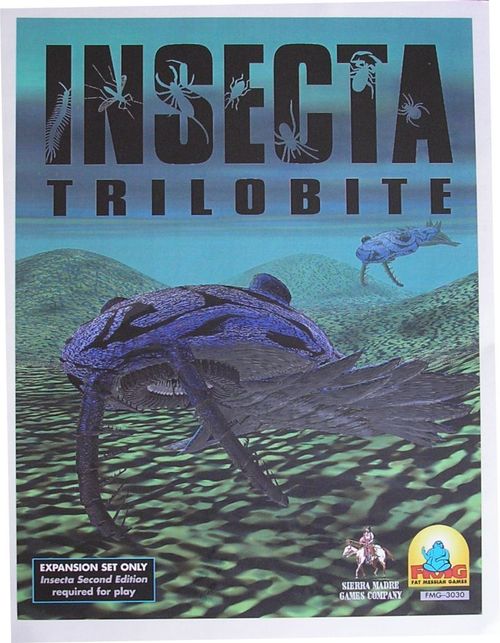
Insecta: Trilobite
Rulebook PDF: Sierra Madre Games / Fat Messiah Games · PDF
Insecta: Trilobite Rulebook
Table of Contents
Table of Contents
Introduction
Trilobite is a marine variant of Insecta. It uses the Insecta rules, optional rules, map, and components, while adding new marine design cards and Hive creatures. In addition, you may use the rules and components from the Rainforest expansion.
You must have Insecta to play Trilobite. The Rainforest is optional, for those players desiring an easier Hive.
In Trilobite, players design creatures that represent marine organisms at the dawn of macroscopic life on Earth, half a billion years ago. You may play Trilobite as an Arena game or as a Hive game. For the Hive game, Trilobite uses four eras in place of the five trophic levels of Insecta (see timeline, next page). In each era, new Hive animals replace the old. Roughly, the higher the era, the more advanced the marine creatures that the mutant players will face. Players surviving all four eras win the game.
Game scale. In Trilobite, instar 1 creatures are 5 inches long (12.5 cm), and each successive instar doubles that. This puts 2-meter humans at an equivalent of instar 5, and an 8-meter (26-foot) sea monster at instar 7. A movement speed of one hex per turn represents one meter per second.
Components. Trilobite contains this rules set, 16 catastrophe cards (on one sheet), 58 design cards and 18 counters (on two sheets), 48 sea monsters (on eight sheets), plus a half dozen rubber sea creatures plus a pixie.
Cards. Trilobite uses its own Hive deck, marked with a special symbol (the Trilobite icon).
The Hive cards are numbered by era, instead of by level, from Era I (the Cambrian) through Era IV (the Cenozoic). In place of the Ambuscade deck used in Insecta and the Rainforest, Trilobite uses a deck of catastrophe cards. (This deck is called the catastrophe deck.) Catastrophe cards are smaller than Hive cards and represent major geologic or ecological events affecting the course of evolution.
Map. Trilobite uses the Insecta map, but all chambers are assumed to be underwater. The Root Cellar now represents a sargasso, the Parlor is a reef, and the Dungeon is an abyss or underwater chasm. The roots and tunnels act just as they do in Insecta, but the roots now represent kelp, and the tunnels are coral.
Trilobite Arena Game
Setup and play of the arena game is the same as for Insecta, with the addition of the rules in this section and the new body parts detailed in the center pull-out section (pages A & B).
Optional arena game setup: Place two food markers in each chamber, and divide the mutants into two teams starting in different chambers. The object is to drag the most food or bodies into a player's home chamber. Ecdysis can occur in a chamber after the second movement in a row with no opposition present.
Underwater Movement
In Trilobite, creatures can either crawl or swim. Design cards that enable crawling are the leg pair and the foot. (The foot is a mantle foot, such as the kind snails have, and is distinct from the leg pair.) Design cards that enable swimming are the siphon, paddles, pectoral wings, and the caudal fin.
Crawling follows the standard Insecta rules. Swimming is like flying, and uses all of the same rules except for the following sections.
Swimming speed. Some card combinations reduce or increase swim speed (for example, see the rules on the calcareous shell and the swim bladder). When combining swim cards, the lowest maximum speed takes precedence; the creature must announce which cards are in use when announcing movement speed.
Example: A fish with a paddle (swim movement 3, maximum 6) and a caudal fin (swim movement 5, no maximum) could use a swim speed of 3 hexes (paddle alone), 5 hexes (fin alone) or 6 hexes (both cards), but could not swim 8 hexes.
Directional swim. Some swim cards (e.g., caudal fins) propel the swimmer forward. These are marked with an up arrow. Others (e.g., the siphon) propel the swimmer backward. These are marked with a down arrow. If a creature swims using a forward swim card, it may not enter any hex that falls outside the creature's forward field of fire, as that field is defined at the beginning of the creature's movement. Conversely, if it swims using a backward swim card, it may not enter any hex that falls outside the creature's rear field of fire (again, as defined at the beginning of the creature's movement). Refer to Insecta rule 5.31 for the definition of the fields of fire. For this purpose, ignore line of sight.
Example: The fish from the previous example can only move into its forward arc when using its fin (i.e. when it has announced a speed of 5 or 6).
Armored swimmers. Armored creatures have their swim speeds reduced by two, as do creatures with the calcareous shell. These effects are cumulative: An armored creature with the calcareous shell has its swimming speed reduced by four.
Hovering. A swimming creature may hover at the end of its move. In Trilobite, however, a hovering creature can be attacked by close combat weapons. The additional hex of range between hovering and benthic creatures still applies for all purposes (e.g. ranged attacks from tentacles, samurai mandibles, and so forth).
A benthic creature in a hex with a hovering creature must make an instinct roll to leave the hex (per Insecta rule 4.2), whether it leaves by swimming or crawling. All dead and incapacitated creatures sink to the ground immediately. If a creature swims into a hex occupied by a hovering creature, they both fall to benthic, unless one or the other of them has the pelagic ability (see below).
Hovering is prohibited in tunnels and roots, as it is in Insecta.
Pelagic. Shells, bladders, and wings all give a creature the pelagic ability (as long as the card in question remains functional). A creature with the pelagic ability can remain hovering when another creature swims into its hex; nor does it fall to benthic if it swims into a hex with a hovering creature. In both circumstances, if the other creature is not pelagic, it falls to benthic as usual. As a result of this rule, however, pelagic creatures can grapple other pelagic creatures while hovering.
Clinging
Creatures with the foot, tentacles, or radula may clamp symbiotically to allies to be carried around (like remoras), or parasitically to opponents to continue an attack (like leeches). Hermit crabs sometimes coax sea anemones onto their shells and keep them well fed in return for the protection derived from the anemones' stinging tentacles.
A creature with the cling ability (as shown by the limpet icon) can cling to another creature. The creature that does the clinging is called the clinger (more technically, the symbiont), while the creature it clings to is called the host. The clinger must be in the same hex as the host, and at the same level as the host (i.e., both benthic or both hovering). The host must be at least the same instar as the clinger, or larger. A creature cannot cling if incapacitated or buttoned-up.
Indicate that a creature is clinging by moving it from the map onto the host's Hive card or mutant display.
During combat rounds, clinging occurs at the end of the clinger's movement stage. During Hive movement, when the mutant team moves between chambers, mutant clingers may cling to other mutants and be carried by them.
Clinging and instinct. A creature attempting to cling must make an instinct roll if other eligible hosts are present in that hex and level. If it fails, it clings to a random host from among those eligible. Also, note that a clinger still counts for purposes of battle frenzy, which means the host must make an instinct roll to move, per Insecta rule 4.2.
Movement while clinging. The clinger moves with the host, following the same path and ending up in the same hex. (This may allow it to move twice in the first turn of clinging.) The clinger may not move on its own until it detaches. Each clinger of the same size as the host reduces the host's swim speed by 2; these reductions are cumulative. Clingers smaller than the host have no effect. Clingers never affect the host's crawl speed.
Combat while clinging. For purposes of combat, the host and clinger are independent creatures. They may attack each other, or attack other creatures, as instinct allows. Note that both creatures occupy the same hex, so they can grapple each other in close combat. The clinger always has the same facing as the host. If the host is radially symmetric (see the rules for the foot, page B), then at the start of each combat stage it must specify one facing that applies to all the creatures clinging to it (and any pixie riders, if you are using the Rainforest).
Detachment. A clinger may voluntarily detach at the end of the host's movement. A creature involuntarily detaches under any of the following circumstances:
- It is killed, incapacitated or buttons up.
- The host is killed or incapacitated.
- Either the host or clinger is grabbed by tongue or tentacles.
- The host enters an area that the clinger would be prohibited to enter, even if the clinger were using the movement mode of the host. An example of this would be a winged clinger whose host enters the roots or a tunnel. The detachment occurs at the hex immediately before the prohibited hex.
- If a host enters a tunnel, all clingers but one (selected randomly) detach, so that the tunnel stacking limit is preserved.
- If a mutant host exits the chamber, all Hive clingers immediately detach; if a Hive host exits the chamber, all mutant clingers immediately detach.
When a creature detaches, whether voluntarily or not, it may face any direction it chooses. It may hover, if pelagic (see page 1), or it may attempt to reattach to another creature in the same hex and level if one is available. If it does neither of these things, it must tumble to benthic and end its movement.
Ganged Attacks
Batteries and tentacles make ganged attacks, as indicated by the # sign for damage instead of the usual number. With a ganged attack, the attacker uses multiple weapons, all of the same type, all attacking at once, and all directed against the same target. The attacker first declares how many weapons of a single type (either batteries or tentacles) it is using.
Make a single attack roll to determine whether the ganged attack hits. The damage value is equal to the number of weapons used in the attack.
Ranged Attacks
Probosci and tentacles allow ranged attacks, as indicated by the arrow-bar icon. These are close combat attacks, not projector attacks, and occur during the close combat stage. They can hit targets at a range equal to the attacker's instar.
The attack must be into the creature's forward arc, like a forward-firing projector. There must be a clear line of sight to the target, per Insecta rule 5.32. Unlike a projector attack, the attacker may attack directly above or below itself, in the same hex.
Note that a creature with a foot (see page B) has a 360° forward arc, in which case the proboscis or tentacles may attack in any direction. Ranged attacks are rear attacks if the attacker is in the rear arc of the target, or if the target is directly above or below the attacker.
When attacking into or out of root hexes, the maximum range is one hex. The user may freely attack into or out of tunnels, as long as there is a clear line of sight.
Note: Clinging occurs during movement, not during the close combat stage, and thus there is no "ranged clinging" allowed.
Dual Abdomen
When an underwater mutant is allowed to take a second head card (as called for on its display), it may instead take a second abdomen card. The second abdomen must be of a different type than the existing abdomen. Place the new abdomen card below the existing one, and leave the second head slot empty. If the creature becomes entangled, it still receives a maximum of two entangle markers on the abdomen, one on each abdomen card. The top card is entangled before the bottom card, and the bottom card disentangles before the top card.
Background: The Four Eras
The four eras of life, each with its distinctive cast of fauna, are the Precambrian, the Paleozoic, the Mesozoic, and the Cenozoic. These eras were divided by three mass extinction events, and ended with the appearance of humans. It is not known if these divisions were cataclysmic or gradual. The eras and divisions are shown below, along with the duration of each era, where "my" stands for "million years." Trilobite begins during the Cambrian, a 65-million-year period that began 570 million years ago, between the Precambrian and Paleozoic eras.
- 570 my: Cambrian Period. The first-era "Cambrians" are the beasts of the Cambrian explosion, a turbulent period of evolution between the Precambrian and Paleozoic eras. After remaining simple, soft-bodied, and unspecialized for three billion years during the Precambrian, all the complex animal phyla (including arthropods, vertebrates, and mollusks) appeared over a geologically brief period. The term "explosion" is an evocative word for this vast diversification of life, which may have been driven by the first appearance of predators.
- 245 my: Permian Mass Extinctions. During the Permian die-off, half of all families went extinct, including 24 orders and superfamilies. The survivors included those genotypes developing backbones, swim bladders, cheliform claws, and shell-crushing beaks. These features caused a "Mesozoic Revolution," an evolutionary blitzkrieg that wiped out the dominant "Maginot Line" of armored crinoids and shellfish.
- 65 my: Cretaceous Event. The third great wave of mass extinctions was the Cretaceous event, the result of an asteroid impact in Yucatan. (Pieces of this impactor have been recovered.) Marine animals suffered equally with the dinosaurs in this period.
- Age of Man. Compared with the three previous great dieoffs, the upheavals due to the appearance of sentient humans are quite insignificant.
Trilobite Hive Game
In the Trilobite Hive game, there is only one level, simulating the low diversity in marine habitats compared with terrestrial ones (especially for plant biomes). Therefore, the transfer areas to different levels are dead ends, and creatures may not use them to exit a chamber. The tunnels and corridors between chambers act as they do in Insecta. However, the mutants may split up and leave chambers through different exits (ignore Insecta rule 10.1).
Setup. Set up the Hive game in Trilobite as you would in Insecta: First, separate the Hive cards by era. Then shuffle each stack and the catastrophe deck. Draw nine Era I cards and place three cards face-down in each chamber except the Foyer. The rest of the Era I cards form the initial draw pile. The mutants start in the Foyer.
Hive card stacks. When the Hivemaster deals Hive cards into a chamber, they must be kept in a stack. The order of the cards matters, because cards are added to the stack, or removed from it, as a result of catastrophes (see next section). This is different from Insecta, where the order does not matter. If the mutants escape a chamber, remove all damage from surviving Hive creatures, re-shuffle the stack and place it back in the same chamber.
Hive game end. During the fourth era, the game ends immediately if an era advancement catastrophe card is drawn (see below). In this case, the largest mutant wins. Mutants that have reproduced are considered larger than those that have not. The game also ends if all the mutants are killed. In this case, the Hivemaster wins.
Catastrophe Cards
In place of the Insecta ambuscade cards, Trilobite uses a deck of catastrophe cards, catastrophic events that mark the passage of time. Draw a catastrophe card at the start of the ecdysis phase if all mutants currently in the Foyer entered it during this turn from a different entrance than the one they most recently used to exit the Foyer. (Just occupying the Foyer won't trigger a card draw; the mutants must move out and through another chamber.) Follow the card instructions immediately. Do not draw a catastrophe card on the first turn.
Note that because Trilobite does not use ambuscade cards, the Foyer never contains Hive creatures.
Hive creature life cycle. Hive creatures go through three phases of existence:
- Before they appear in a chamber, when they still remain in the draw pile. In game terms, these creatures have not yet evolved.
- Once they appear in a chamber. In game terms, these creatures have evolved and represent a thriving genotype.
- After they die or leave a chamber, when they go into the "killed" pile. In game terms, these creatures are extinct.
Some catastrophe cards add new Hive creatures to the chambers. Others remove Hive creatures. As a result, relic animals from older eras can coexist with ones from later eras.
Biological Turnover. To add new Hive creatures to a chamber, draw them from the top of the draw pile and place them face-down on top of the chamber's stack. To remove Hive creatures from a chamber, discard them from the bottom of the stack into the pile of extinct Hive creatures. They will not enter the game again.
Era Advancement. When a catastrophe card features a globe icon, advance the era by immediately adding the Hive cards for the next era to the top of the draw pile (before carrying out any other instructions on the card).
However, two era advancements are not allowed in a row. In such a case, ignore the globe icon and carry out the other instructions.
Example: At the end of turn 1 a Supernova card is drawn, so the Hivemaster adds Era II to the draw deck (from the globe) and restores all chambers to three creatures (from the instructions on the card). The next catastrophe is Clouds on turn 4, restoring all chambers again but not advancing the era. On turn 6, an Asteroid appears, which kills all the largest creatures and advances the game to Era III.
Technology. When a catastrophe card with a wrench icon is drawn, mutant teams that include pixies receive three equipment cards.
Using Insecta Cards in Trilobite
In Trilobite, you may use all of the design cards from Insecta and the Rainforest with the following changes.
Flying and jumping. Creatures may not fly or jump underwater.
Projectors. Creatures may not use projectors underwater, except for the eversible labium and the pixie bow (both from the Rainforest).
Calcareous shell. The calcareous shell uses different rules under water than on land (as detailed in these rules). Regardless of where the creature came from, it follows the rules for its current environment, either land or water.
Spinneret. These cards do not function at all underwater.
Using Trilobite Cards in Insecta
You may use Trilobite design cards in Insecta in one of two ways.
- The hive is flooded. Use all Trilobite rules for movement within chambers and for combat, but follow all Insecta rules for Hive movement (moving between levels).
- The hive is terrestrial. Follow all Insecta rules, but add the Trilobite rules for clinging plus the rules for individual Trilobite design cards. Creatures cannot swim, there are no pelagic effects, and hovering creatures can only be attacked by projectors and ranged weapons. Echolocation allows flying in tunnels (each tunnel hex counts as two hexes; no more than one wing pair is allowed in tunnels), and in the roots at normal speed (each hex counts as one hex).
You may combine these by making some levels of the Hive flooded, and others terrestrial.
Camouflaged Insecta Creatures. The ambush bug, assassin bug, and chameleon (each of which can change color) and the walking stick all have the camouflage ability, as if they had a camouflage appendage.
Bibliography
Illustrated Encyclopedia of the Animal Kingdom, edited by Herbert Kondo, Art & Design by Jack Jaget. (The Danbury Press, 1968)
Audubon Society Field Guide to North American Fossils, by Ida Thompson (Alfred A. Knopf, Inc., New York, 1982)
Prehistoric Life, by Richard Moody, illustrated by V. Ambrus, M. Ansell, J. Baker, J. Barber, R. & C. Burrows. (Newnes Books, 1983)
Simon & Schuster's Guide to Fossils, by Paolo Arduini and Giorgio Teruzzi (Simon & Schuster, New York 1986)
Fossil Invertebrates, edited by Boardman, Cheetham, & Rowell. (Blackwell Scientific Publications, 1987)
Macmillan Illustrated Encyclopedia of Dinosaurs and Prehistoric Animals, Dougal Dixon, Barry Cox, R.J.G. Savage, Brian Gardiner (Macmillan, 1988)
Dynamics of Dinosaurs & Other Extinct Giants, by R. McNeill Alexander. (Columbia University Press, 1989)
Wonderful Life, by Steven Jay Gould, illustrated by Marianne Collins. (W. W. Norton & Co., 1989)
The Crucible of Creation, Simon Conway Morris, (Oxford University Press, 1998)
New Body Parts
Head Cards
Echolocation. Many cetaceans can recognize objects by beaming a train of sound pulses onto a target and then processing the return echoes. The echolocation organs are located in the soft tissue above the skull. When a creature with echolocation swims through a root (kelp) hex, it counts as one hex of movement, rather than the usual two hexes. Echolocation also enables the creature to swim in tunnels; each tunnel hex counts as two hexes of movement. However, creatures with one or more wing pairs may not enter tunnels.
Lure. Animals such as frogfish, batfish, and snapping turtles wiggle modified worm-like fin spines (esca) or tongues to attract prey. Allows the user to attack first (using any close combat weapon) during close combat, before creatures without the lure. If several creatures have lures, they attack in order of dexterity value, before all creatures without lures.
Radula. The radula is a file-like tongue studded with tooth structures, found in all mollusks except bivalves (clams). It can bore through armor. The target may not use its armor (if any) to defend against this weapon. The calcareous shell is ineffective as well. The radula can be used to cling to a host creature (see Clinging, page 1). While being used to cling, the radula may only attack the host creature, and is not subject to battle frenzy.
Appendage Cards
Battery. Each battery consists of modified muscle cells known as electroplaques which generate 100-volt electric fields. The original function of these organs was to aid in prey detection and navigation in murky waters. At the higher voltages used in this game, the electric charge is an offensive weapon. Batteries attack in gangs, and the attacker must fire at least as many batteries as the target's instar. If it lacks that many battery cards, it may not attack. It can use additional batteries beyond the minimum, if desired. Batteries hit automatically. The attacker's instar has no effect on the damage dice. The target rolls defense dice equal to its armor value (if any); do not add the target's instar. All battery cards used in the attack are immediately entangled.
Example: A ray attacks an instar 3 armored crab. The ray must use three batteries in the attack, and throws three dice of entangling damage, against which the crab gets one defense die. All three batteries are entangled, regardless of whether the crab is affected by the attack.
Camouflage. The octopus, cuttlefish, and flatfish are among the creatures who can change their color to match their surroundings. The cuttlefish, for example, can imitate a checkerboard pattern it is placed upon. A creature with camouflage does not count as a potential target for purposes of another creature's battle frenzy (see Insecta rule 5.2). That is, if an attacker has more than one target and fails its instinct check, camouflaged creatures are not potential targets. However, camouflage is not effective if the camouflaged defender is the closest target or the only target, or if the attacker succeeds its instinct roll.
Also, creatures do not require an instinct check to leave a hex containing only camouflaged creatures, an exception to rule 4.2, and do not have to stop when entering a hex with only camouflaged creatures, an exception to 4.3 and the collision part of 4.5.
Carapace. This appendage requires four damage points to tear off, rather than the usual two. Anything less is harmlessly absorbed. (It still only takes two points to entangle.) In all other respects it acts as a normal limb pair, but has no movement or attack value. Attacks hitting the carapace will still inject poison if the damage is equal to or higher than the defense roll. (Note that the carapace functions exactly like the Rainforest elytra.)
Paddle. Allows swimming movement of three hexes per paddle, to a maximum swim speed of six.
Pectoral Wing. By rippling their wing, creatures such as squid and rays can move forward or backward. Allows swimming movement of four hexes, with a maximum swim speed of six. The creature becomes pelagic, but may not enter roots or tunnels.
Pistol Claw. A noisy cheliform claw used to stun small prey by sonic vibrations alone. The target's armor does not defend against this weapon.
Preying Claw. A jackknife type claw used for capturing soft-bodied prey, can be of either the stabbing or crushing variety. Known by shrimp fishermen as the "thumb splitter." Same as the Insecta version.
Proboscis. The proboscis represents either a long sinuous neck or a flexible snout tipped with the head weapon. The proboscis enables ranged attacks with close-combat head weapons.
If the proboscis is torn off or entangled, the creature may not use its head weapons, even if they are undamaged, because they are attached to the end of the proboscis.
Position on mutant display. A mutant may take at most one proboscis card, which must be the mutant's first (top-most) limb card. Therefore it must be selected during the mutant's initial design, or during a mutation event resulting from a catastrophe.
Swim Bladder. A hydrostatic organ permitting buoyant hovering. The swim bladder gives pelagic ability, and increases the swim speed of any swimming card by one due to streamlining.
Tentacles. Tentacles can make ranged attacks, but may only attack targets of equal size or smaller who are not currently held by other tentacles or tongues. Tentacles attack in gangs (see page 2), so it is advantageous to carry as many as possible. Envenomed tentacles operate in the same manner as the nasutus projector (see Insecta rule 7.4). Like the nasutus, they are limited to a venom level of 1. Armored creatures are immune to this envenomation.
Grabbing and Carrying. If the attack entangles any card on the target, the target is immediately drawn into the attacker's hex. (If the target is prohibited from entering the hex it is being drawn into, it is drawn as far as possible and detaches unharmed.) While entangled, the target clings involuntarily to the attacker and cannot detach until it escapes or involuntarily detaches. Tentacles can carry dead, incapacitated, or buttoned-up creatures.
Escape. Creatures entangled by tentacles disentangle normally, but they cannot move until completely disentangled. The attacker may voluntarily drop the target at the end of any automatic effects stage, which immediately removes all entangles inflicted by the attack. The target is also dropped if the attacker becomes inactive or loses the use of all tentacles. Until the target completely disentangles or is dropped, the attacker cannot attack with any tentacles.
Clinging Targets. Clinging creatures are not immune from being grabbed, either by tentacles or by the eversible labium, a Rainforest weapon. If the attacker grabs a clinging creature, the clinger is immediately detached. The grab action has no effect on the host. If a host is grabbed, all clingers involuntarily detach.
Example: An instar 3 octopus attacks an armored crab (also instar 3). The octopus chooses to use all four tentacles. The octopus rolls seven damage dice for a 20; the crab rolls four defense dice for an 17. This entangles the crab's claws and pulls the crab into the octopus' hex. The crab remains stuck to the octopus until the automatic effects stage, when it removes the entangle marker and detaches. If the crab were instar 4, the octopus would not be big enough to use its tentacles.
Tentacles can be used to cling to a host creature of the same instar or larger. If so, all tentacles are used to cling, and none may used to attack.
Abdomen Cards
Calcareous Shell. The buoyancy of the calcareous shell is regulated by gas-filled chambers. The calcareous shell gives pelagic ability, but reduces the creature's swim speed by two.
In Trilobite, the calcareous shell does not bestow invulnerability as it does in Insecta. Rather, the user's abdomen has an armor value of three. The creature may also button-up (see Insecta rule 7.1 for details on buttoning and unbuttoning); while buttoned-up, the entire animal has an armor value of three. If the creature is armored, its body armor does not add to the protection given by the shell.
Example: An instar 1 armored mutant has a calcareous shell. For attacks to the head or appendages, it has armor value 1. For attacks to the abdomen, it has armor value 3. While buttoned-up, its entire body has armor value 3.
Caudal Fin. A tail that allows swimming movement of 5 hexes forwards.
Caudal Spine. Similar to the Insecta merostoma sting, but the creature must grapple or attack rear hexes. (Note that because creatures with the foot face in all directions, and therefore do not have rear hexes, such creatures may only use the Caudal Spine for grappling.)
Foot. The "suction" mantle foot that distinguishes most mollusks such as snails. A creature with a foot is radially symmetric: All hexes adjacent to it are considered front hexes. It can attack into any adjacent hex with a non-grapple close combat weapon. It has no rear hexes and therefore cannot be rear attacked. The foot allows crawling movement of one hex, but disables all other movement for the creature. The foot can cling to a host (see Clinging, page 1).
Siphon. The siphon expels water, allowing a "jet" swimming action. The siphon allows swimming movement of eight hexes rearwards, but using it prohibits the creature from hesitating. (During the movement stage, if the creature declares it is using the siphon, it may not hesitate.) This limitation is symbolized by an exclamation point as shown above. The maximum swim speed while using the siphon is eight.
Ink Sac. Releases a narcotizing fluid which numbs the sensory apparatus of predators. Ink may also serve a chaff function to defend against nocturnal echolocating predators such as dolphin. This weapon automatically hits every creature (except the user) in the user's hex and level. Victims are affected as if hit by the diapause pheromone (see Insecta rule 12.2A); this effect persists until the next ecdysis phase.
Ink Counters. Ink is persistent. Each time a creature attacks using the ink sac, place a spare counter in the hex to mark the presence of ink. All creatures are considered camouflaged while they are in the hex at any level, until the start of the next ecdysis phase. (See Camouflage, page A).
Pixie Cards (Rainforest Expansion)
As in the Rainforest, a mutant must take an undifferentiated abdomen in order to have a pixie sidekick. You may introduce a pixie into the midst of an ongoing Trilobite game by taking an undifferentiated abdomen as a second abdomen card during a metamorphosis or mutation.
Mermaid Tail. Used in place of pixie legs, this gives the pixie a swim speed of three and the ability to hover, but prohibits it from riding. Pixies underwater can have either legs or mermaid tails.
Nemo's Battery. Automatically hits. Damage is always two dice. The target rolls defense dice equal to its armor value (if any); do not add the target's instar. The pixie rolls for ammunition after each use (see Insecta rule 5.34).