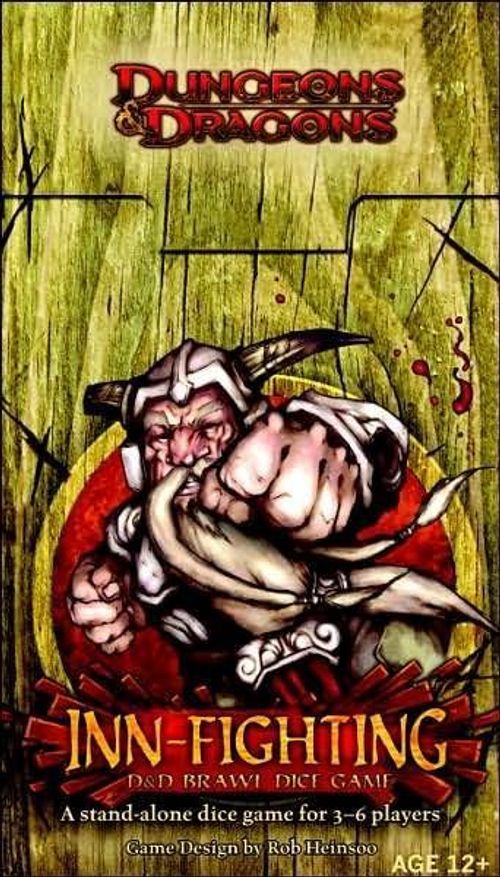
Inn-Fighting
Inn-Fighting Rulebook
Table of Contents
Table of Contents
What is Inn-Fighting?
Inn-Fighting: D&D Dice Game is a game for 3 to 6 players about what some adventurers do for relaxation. It's a light-hearted re-creation of the chaos and exhilaration of a fantastic tavern brawl that might occur in any town or city in any Dungeons & Dragons world.
Object of the Game
You compete to wreak the most havoc in the tavern. On your turn, when you damage an enemy Adventurer and end your turn with 20 or more victory points (VP), you win the game!
Components
- 6 custom Brawl Dice
- 5 gold dice
- 1 red die (Defense Die)
- 52 Inn-Fighting cards
- 15 Adventurer cards
- 20 Bystander cards
- 14 Action cards
- 2 Game Summary cards
- 1 blank Adventurer template card
- 1 20-sided die (d20)
- 1 rulebook
The Dice
The six Brawl Dice (five gold six-sided dice and one red six-sided die) determine what your band of brawlers can do during a round of Inn-Fighting. Each die shows five different symbols that represent attacks and actions in the game.
Punch is an attack that targets a character to your left.
Chair is an attack that targets a character to your right.
Power is an attack that targets a character with the most Victory Points.
Ale is an action that heals your Adventurer and allows you to roll again and make an attack.
Luck is an action that lets you draw an action card and allows you to roll again and make an attack.
The d20 is used to roll initiative to determine who goes first. It is also used to resolve attacks.
The Cards
The game uses a deck of 52 cards, including Adventurer, Bystander, and Action cards.
Adventurer Cards
Adventurer cards represent the heroes of D&D currently relaxing at the inn. You have one Adventurer active at a time, which is your main character in the tavern brawl. When your Adventurer gets Knocked Out, another Adventurer leaps into the fray—provided the brawl hasn't ended.
Each Adventurer card shows:
- Name describes the Adventurer the card represents, including the character's name, race, and class.
- Alignment is shown only if the Adventurer is Evil, since this has a special effect in the game. Unmarked Adventurers aren't Evil.
- HP describes how many Hit Points an Adventurer has, which is how much damage it takes to Knock Out the character.
- Skill is a rating used to determine the outcome of an Adventurer's actions and attacks.
- Knockout Bonus shows the Victory Points awarded for defeating this Adventurer.
- Punch and Chair show the direction of each attack, and the low and high damage these attacks deal to characters.
- Power details a special attack that targets an opponent with the most Victory Points.
- Defense Die shows what the Adventurer can do with the Defense Die when Luck or Power come up after a hit.
Example Adventurer card:
Silver Jack, Drow Barkeep (Evil) HP: 9 · Skill: 12+ · Knockout Bonus: 3 VP
- Punch (left): 1 or 2 damage
- Chair (right): 3 or 5 damage
- Power — Barkeep's Stealth: 2 or 4 damage; if two or more dice are showing Ale, the defender does not get a Defense roll.
- Defense Die — Hand Crossbow: Attack misses, and deal 2 damage to attacker.
Bystander Cards
Bystander cards represent the non-Adventurer characters currently at the inn. Some Bystanders are innocent—others are less so.
You might have no Bystanders in play, or you might have one or more in play at any given time. When a Bystander gets Knocked Out, discard the card.
Each Bystander card shows:
- Name describes the Bystander the card represents.
- Alignment is only shown if the Bystander is Evil, since this has a special effect in the game. Unmarked Bystanders aren't Evil.
- HP describes how many hit points a Bystander has, which is how much damage it takes to Knock Out the character.
- The card text describes an ability that the Bystander provides to your Adventurer during the brawl. Most of these abilities are active for as long as the Bystander is in play. A few can be used only in response to specific circumstances, as detailed on the card.
- Defense Die shows what the Bystander can do with the Defense Die when Luck comes up after a hit.
Example Bystander card:
Serving Wench (Bystander) HP: 2
- Full Round: Draw a card when you take the Ale action.
- Defense Die — Patrons Protect: Attack misses, and attacker takes damage equal to the number of players.
Action Cards
Action cards represent special actions your Adventurer can use during the tavern brawl. You keep action cards secret until you use them.
- Name describes the action this card makes available.
- Play tells you when you can use the card.
- Effect describes the card's effect, which usually breaks the rules of the game in some way for the round in which it is used.
Example Action card:
Bottoms Up (Action)
- Play: Play after an opponent has taken an Ale action, but before the opponent rerolls the Brawl Dice.
- Effect: You get to take the same Ale action (stealing the same number of VP, but possibly not from the same leader as the opponent who just acted) to heal your Adventurer. Your opponent then continues his or her turn.
Playing the Game
It's time for a tavern brawl!
Set Up
Separate the cards into two decks, as follows.
Shuffle all of the Adventurer cards (except for the blank card) into one deck. This is the Adventurer deck.
Shuffle all of the Bystander and Action cards into a second deck. This is the Action deck.
Place the Game Summary card to the side for all players to refer to during the game.
Place the Brawl Dice in the center of the play area where everyone can reach them.
Place a pile of tokens in easy reach of all players to create a bank. Use poker chips, pennies, or anything you want to represent Hit Points and Victory Points in the game.
Start
Each player draws one Adventurer card and places it face up.
Each player draws two Action cards.
If any of these cards are Bystanders, place them face up next to your Adventurer.
If any of these cards are Actions, keep them face down beside you until you use them.
Place a number of tokens equal to a character's Hit Points next to your Adventurer and any Bystanders you have in play.
Example: You have Silver Jack, Drow Barkeep in play. Place 9 tokens next to the card to represent Silver Jack's 9 Hit Points.
When you gain Victory Point tokens, place them in a pile behind your Adventurer and Bystander cards.
The Inns and Outs of a Brawl
Each player rolls initiative. High roll goes first.
First player rolls the Brawl Dice (5 gold and 1 red).
Using the result of the roll, select either an attack (Punch, Chair, or Power) or an action (Luck or Ale).
Make an Attack!
- Punch attacks target the opponent to your left.
- Chair attacks target the opponent to your right.
- Power attacks target an opponent with the most VP.
Once you've finished your attack, pass the dice to the player to your left. That player rolls any dice showing attacks (Punch, Chair, or Power); the player doesn't roll any dice showing actions (Luck or Ale).
Take an Action!
Taking an action requires at least 3 dice showing the appropriate symbol.
For Luck, draw an Action card. Then roll all the dice and make an attack if you can.
For Ale, heal your Adventurer with VP tokens taken from the player with the most VP. Then roll all the dice and make an attack if you can.
Once you've finished your action, pass the dice to the player to your left. That player rolls any dice showing attacks (Punch, Chair, or Power); the player doesn't roll any dice showing actions (Luck or Ale).
Victory!
If you reach 20 VP and damage an opposing Adventurer on your turn, you win the brawl!
Begin the Brawl
Now the tavern brawl begins...
Roll for Initiative
Each player rolls the 20-sided die (the d20) to determine who goes first in the brawl. High roll goes first. In the case of a tie, roll again.
The first player rolls all six Brawl Dice (five gold dice, one red die) and takes a turn (see below).
After the first player takes a turn, play continues to the left.
Turns
On your turn, roll the Brawl Dice. The first player rolls all six dice. Players in later turns may roll fewer than six dice, as described below.
After you roll the dice, select an attack (Punch, Chair, or Power) or an action (Luck or Ale) using the results shown on the dice. The more dice showing the symbol of the attack or action you selected, the better your chances of success.
Attacks
If you choose to make an attack on your turn, the attack form you select tells you which opponents you can target.
See the table below for attack options.
Resolve an attack by rolling the d20 and adding the number of dice showing for the attack form you selected.
If the total is less than your Adventurer's skill rating, you deal the low damage for the attack.
If the total is equal to or greater than your Adventurer's skill rating, you deal the high damage for the attack.
Sometimes dealing damage has a secondary effect. Unless otherwise specified, the effect happens on both high and low damage results.
Attack Options — If these symbols show on the dice, the result tells you who you can attack in the round.
| Symbol Showing | Result |
|---|---|
| Punch | Punch a Bystander controlled by the player on your left. If the player doesn't have a Bystander in play, attack the player's Adventurer. |
| Punch, or more | Punch any Adventurer or Bystander controlled by the player on your left. |
| Chair | Smash a Chair into a Bystander controlled by the player on your right. If the player doesn't have a Bystander in play, attack the player's Adventurer. |
| Chair, or more | Smash a Chair into any Adventurer or Bystander controlled by the player on your right. |
| Power | Use a Power on a Bystander controlled by the player with the most VP. If the player doesn't have a Bystander in play, attack the player's Adventurer. In the case of a tie, choose your target. |
| Power, or more | Use a Power on any Adventurer or Bystander controlled by the player with the most VP. In the case of a tie, choose your target. |
Fumbles and Critical Hits
When you make an attack, you have a chance of getting a fumble or a critical hit.
A roll of 1 on the d20 is always a miss, and you deal no damage for the attack. This is called a fumble.
A roll of 20 on the d20 is a critical hit. When you get a critical hit, you deal high damage +1, and the target gets no Defense roll (see below).
Defense Roll
The red Brawl Die is the Defense Die. Roll it along with the gold dice at the beginning of your turn. It has a special use when you are the target of an attack, however.
If an attack deals 3 or more damage to one of your characters, or if the damage dealt is enough to Knock Out one of your characters, you get to make a Defense roll. Roll the red Defense Die.
3 or Out — A handy reminder for when you get to make a Defense roll is "3 or Out." If an attack deals 3 or more damage or Knocks Out your character, make a Defense roll.
A Defense roll succeeds if it comes up as Luck for a Bystander or as Luck or Power for an Adventurer.
If the Defense roll succeeds, follow the instructions on the character's card.
Important! You never make a Defense roll for damage dealt by someone else's Defense roll. Defense rolls are only made in response to attacks.
Actions
If you choose to take an action on your turn, select a Luck or an Ale action.
You need to have at least three dice showing the action to use it—either three or more Luck symbols, or three or more Ale symbols.
Luck Action
If you take a Luck action, draw an Action card.
If the card you draw is a Bystander, put it into play face up next to your Adventurer. If it's an Action, keep it face down until you want to use it.
After you draw an Action card, roll all the Brawl Dice and make an attack. You can't use a second action (Luck or Ale) in the same round, so if the new roll generates just Luck and Ale, you're stuck.
Fighting with Ale — When taking a moment to guzzle Ale during the brawl, your Adventurer not only recovers some health, but also shows the opponent who is in the lead that nothing can stop your Adventurer from taking a swig in the middle of the fight. This in-your-face behavior demoralizes the enemy while rejuvenating your Adventurer.
Ale Action
If you take an Ale action, your Adventurer gets to heal damage taken in the brawl.
To heal your Adventurer with Ale, first determine which player has the highest VP. Take VP tokens from that player equal to the number of dice showing Ale you rolled. If multiple players are tied for the lead, take VP tokens from any one of them.
Replace any Hit Point tokens your Adventurer lost with the VP tokens. You can't gain more Hit Points than your Adventurer's starting total, so any remaining VP tokens are returned to the bank.
After healing your Adventurer, roll all the Brawl Dice and make an attack. You can't use a second action (Luck or Ale) in the same round, so if the new roll generates just Luck and Ale, you're stuck.
To Drink or Not to Drink — If you're in the lead when you take an Ale action, you replenish your Adventurer's health with your own Victory Points. It might look like a big waste, especially if your Adventurer isn't seriously hurt. But think of it this way—if you don't use the Ale, someone else might. So unless you can win the game by avoiding the Ale, you're often better off using it rather than passing it to the next brawler.
Passing the Dice
After you complete an attack or an action, pass the dice to the player on your left. That player leaves any dice showing action symbols in play (Luck or Ale), but rolls any dice showing attack symbols (Punch, Chair, or Power).
Using the symbols that are showing actions and the results of rolling the other dice, the player decides whether to make an attack or take an action on his or her turn.
Hit Points and Victory Points
The bank of tokens represents both Hit Points (to track damage) and Victory Points (to track who's winning the brawl).
Hit Points: When you add a new Adventurer or Bystander to your team of brawlers, place a number of tokens equal to the character's Hit Points on or next to the character's card.
Damage and VP: When you damage an opponent's Adventurer, remove that many Hit Point tokens from the character and place them in your Victory Point pile.
Bystander Knockout: When you Knock Out an opponent's Bystander, you get 2 bonus VP from the bank (in addition to the remaining Hit Points).
Adventurer Knockout: When you Knock Out an opponent's Adventurer, you get the Knockout Bonus listed on the character's card. These tokens come from the VP pile of the character's player, not from the bank.
Knockout!
If your Adventurer is Knocked Out, you aren't out of the brawl. Any Bystanders you have stay in play, but no one can target them with an attack until the start of your next turn. (They might still take damage from effects that don't require an attack, such as a Defense roll.)
You can't play Action cards if you don't have an Adventurer in play.
At the start of your next turn, draw a new Adventurer and one card from the Action deck.
Winning the Game
At the end of your turn, if you have 20 or more Victory Points and you damage an opponent's Adventurer, you win!
You can win the game even if an opponent has more VP than you, as long as you meet the victory conditions at the end of your turn.
You can't win the game on another player's turn, even if you have more than 20 VP.
You can't win the game unless you damage an opponent's Adventurer during your turn.