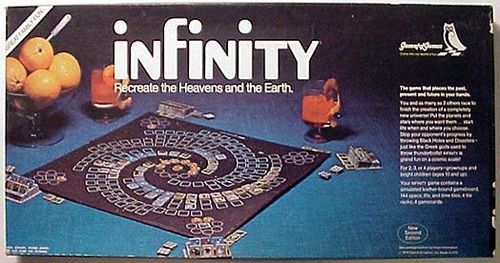
Infinity
Infinity Rulebook
Table of Contents
Table of Contents
Object
The OBJECT of INFINITY is to score the most Time pieces through the play of tiles onto the board. (A special objective is to be the first to play a destiny tile, gaining the game's Infinity piece. The possessor of the Infinity piece wins if he is in the tie for most Time pieces.)
The tiles provided represent Creation, Space, Life, Man and his accomplishments until Destiny. While attempting to play in sequence ("build") as many of these tiles as possible, a player can also use two other tiles - "Disaster" and "Black Hole" Tiles - to slow his opponent's progress.
After the correct sequence of building tiles is learned, the play of INFINITY will become second nature, with an average game taking from 30 to 45 minutes.
Equipment
Tiles
There are 144 tiles consisting of 12 circular Scoring pieces (11 Time Pieces and 1 Infinity Piece) and 132 player tiles. The Player Tiles consist of four identical sets of 33 tiles, each set identified by a number on the back of each tile. Each set is composed of 5 Special Event Tiles (gray backs with black numbers), 12 Space Tiles (gray backs with white numbers), and 16 life tiles (white backs with black numbers). The individual names of all Player tiles are found on the Building Sequence Chart.
Playing Board
The playing board, hereafter called The Universe, has four spiral arms, a time center in the middle and four player areas, one in each corner.
The spaces in the longest row of each spiral arm are called major spaces while the spaces in the two other shorter rows underneath are called minor spaces.
The Racks
Tile racks, hereafter called Stations, each hold six tiles.
Game Cards
These cards provide handy information for new players unfamiliar with the play of tiles.
Preliminaries
The "Universe" is placed "diamond-wise" with each player sitting near a corner and using the player area in that corner. Place the Infinity Piece in the Universe's center and the 11 Time Pieces on the surrounding circular spaces of the Time Center. Each player takes a station and places it in front of him. He takes the set of 33 player tiles matching the number of his player area. The 5 Special Event tiles are turned face up and lined up between his Station and the Universe. The other 28 are turned face down, mixed thoroughly, and placed to the left of his Station. These constitute his Draw Pile. (New players should keep a Game Card handy in front of them.)
Each player fills his station by randomly selecting 4 space and 2 life tiles from his draw pile. The player with the lowest numbered player area plays first and play proceeds to the right, counter-clockwise.
The Play
Building
A player on his turn may build as many tiles in sequence as he can (or wishes to) on any one Spiral Arm. He may play on a different Spiral Arm on his next turn.
When building, a player may use Tiles from his Station, from his own discards and from discards made by the player on his left. He may also use CREATION (C), BIRTH (B), and/or Event Tiles. (See Building Sequence Chart, and Universal.)
A player must build tiles according to the Building Sequence Chart. He always begins his building on the next Major space of the spiral arm. He may never build on a Minor Space in a column where a tile was placed prior to his turn.
If he builds more than one Tile, the additional tiles are placed on successive spaces, according to the Building Sequence Chart.
Scoring
While a player may play many tiles on his turn, only those he plays from his station count for scoring purposes. If a player plays 4 or 5 tiles from his station, he takes one Time Piece from the Time Center and places it in his player area. If a player plays all 6 tiles from his station, he takes 2 time pieces.
The first player to build a No. 16 - Destiny (or a Universal representing it) takes the Infinity Piece from the time center. Subsequent players building a No. 16 take one time piece instead.
When the Time Center is out of Time Pieces, a player takes scored Time Pieces from the player on his left, or the next player to the left when the nearest player has no Time Pieces, etc. The Infinity Piece may never be taken from an opponent.
Discarding and Replacing
When a player has completed his play, and scoring if any, he discards one tile from his station (unless all 6 were played) to the discard area to the right of his station. Discards are oriented so that the players on the right may also read their symbols.
The player refills his Station to 6 tiles from his Draw Pile (taking any combination of Space and Life tiles). When his draw pile is insufficient to refill his Station, or is completely exhausted, the player does not discard. He completes the refilling of his Station with his choice of Tiles from his own discards and those of the player on his left.
Special Events
A player in his turn can make any one or more of the following plays, either alone or in addition to building. All plays and/or building must be made onto only one Spiral Arm per turn.
Universal (U)
In building, a player can use a Universal Tile to represent any Space Tile or any Life Tile. (It can also be used to eliminate a Black Hole. See below.)
If a player in his turn has a Tile available - in his Station, in his discards or the discards of the player on his left - that is represented by a Universal Tile previously played onto the Universe, he can place his Tile in the proper space and take the Universal, adding it to his Special Event tiles. He may, if desired, use the exchanged Universal on the same turn.
Black Hole (H)
After a Spiral Arm has been built to No. 4 - Man or beyond, a Black Hole may be played on the next vacant Major space of that Spiral Arm, provided it is not currently Black Holed. A black hole stops building from occurring - no further building can be done on a Black Holed Spiral Arm, until the Black Hole is eliminated.
A player can eliminate a Black Hole by placing another Black Hole Tile, or a Universal Tile, face down on top of it. Both tiles remain on the space, out of play, and building may immediately resume on that Spiral Arm.
Disaster (X)
A player may play a disaster tile to the square space in the center of an opponent's Player area, provided the opponent has a total of at least 3 Time and Infinity Pieces in his player Area and doesn't already have a face up Disaster Tile in that space. The player playing the Disaster Tile may also play other tiles onto a Spiral Arm as part of his same turn.
The opponent loses his next turn and must also return a Time Piece to the Time Center. He then turns the Disaster Tile face down and it is out of play for the duration of the game.
Forced Play
A player on his turn must make at least one play, even if it is not to his advantage to do so. If no play is possible, he shows his Station Tiles to the opponents for confirmation. He then discards one Tile, unless his draw pile is exhausted, and refills.
Transcriber's note (from the source document): This rule led to a little ambiguity with my group. You could have a special tile that allows you to play, but you don't want to use it and don't have a legal play in your station. Since the rules didn't distinguish from being unable to play from your station in particular (although it was argued that showing your station implies it) we ruled that you must play any tile you are able to, even fairly cool ones like the Universal or from your discard pile if able.
Ending the Game
A game can end in one of three ways:
- If a player has 7 time and infinity pieces in his time center, he immediately wins the game.
- If at the end of a player's turn there are not enough tiles available to refill his Station, the game will end after each player - including the player with the incomplete station - has one more turn. That player, on his final turn, can score 1 time piece for reducing his station to 1 or 2 tiles or he can score 2 time pieces for reducing it to no tiles.
- If no further play is possible to any player, the game ends. (This occurs very infrequently.)
The player with the greatest total of Time and Infinity is the winner. If two or more players tie and one of those has the Infinity Tile, he is the winner. If none of the tied players has the Infinity tile, the player with the least tiles in his Station is the winner. If this is also tied, the victory is shared.
Rules for Two Players
All basic game rules are followed except for these changes and additions:
Preliminaries
One player sits by the No. 1 player area; the other by the No. 3 player Area. The disaster tile is removed from the No. 2 Tiles. The remaining 32 tiles are turned face down, mixed and placed - near the No. 2 player area - in separate groups of Space, Life and Special events. Four No. 2 life tiles are turned face up.
The Play
At the start of each player's turn, he has a choice of turning up either one Special Event Tile or a Space Tile and a Life Tile from the No. 2 set. All face up No. 2 tiles can be played by either player as part of his turn. A player can play from his own discards, but not from his opponent's discards.
When refilling after his Draw Pile is exhausted, a player can choose tiles from his own discards or from face up No. 2 Space and Life tiles.
Building Sequence Chart
Transcriber's note (from the source document): This came with a chart showing legal play of tiles. I will duplicate the chart using letters and numbers, the top row being the major spaces of a spiral arm and anything below it in line played into the minor spaces of that column.
Example:
C    G    S    P    P    P    P    P    B    1    4    6    9   11   13   15   16
                    m    m    m         m         2    5    7   10   12   14
                                             m         3              8
Player tiles are built onto each Spiral Arm in the following sequence:
- (C) Creation - On the first major space, closest to the time center.
- (G) Galaxy - on the next major space.
- (S) Sun - on the next major space.
- (P) Planets - on successive major spaces, beyond the sun. A spiral arm can have up to a maximum of six planets. (No further planet tiles can be played on a Spiral Arm after six have been built.)
- (m) Moons - on minor spaces, only beneath planets built by a player on the same turn.
- (B) Birth - on the Major Space adjacent to the last planet built. Cannot be played until at least two Planets have been built.
- (1-16) Life Tiles - on both major and minor spaces in numerical order.
A player may never build tiles in a column where tiles were built prior to this turn; that is, he must always begin his play by building on the next vacant Major Space. The first life tile a player builds on his turn is placed in the next vacant major space. Thereafter, additional life tiles built on the same turn are placed on the minor spaces of that column (if any) and then the major space of the next column, and then onto that column's minor spaces, etc.
The titles of the 16 life tiles are as follows:
- Plants
- Animals
- Primates
- Man
- Intelligence
- Communication
- Tools
- Art
- Math
- Science
- Humanities
- Industry
- Transit
- Atomic Energy
- Space Travel
- Destiny