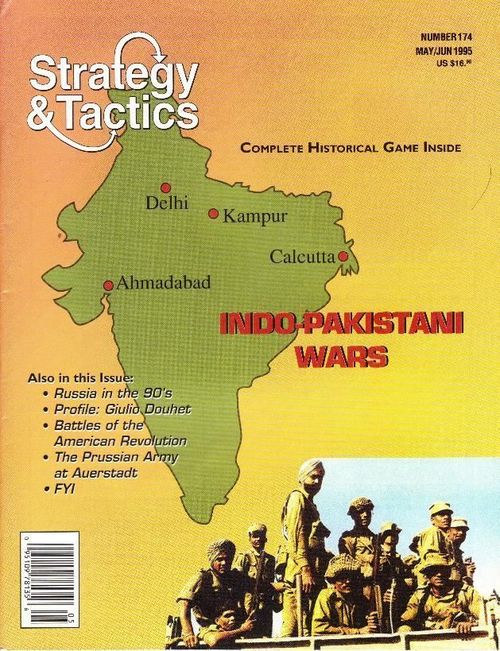
Indo-Pakistani Wars
Indo-Pakistani Wars Rulebook
Table of Contents
Table of Contents
1. Introduction
1.1 Scale
Each game turn covers two days. Each hex is approximately 30 km from side to side. Each regiment or brigade consists of 1,500-3,000 men; each division of 10,000-20,000 men. Each air group has three squadrons (24-48 aircraft).
1.2 Equipment
A complete set of IPW consists of the following parts:
A game map.
A rulebook.
A set of 240 counters.
The game tables (many printed on the map).
Two six-sided dice.
1.3 The Map
The game map shows the regions of Pakistan and East Pakistan (later Bangla Desh) where the campaigns indicated took place, plus the adjacent areas of India. A hexagonal grid has been overprinted on the map to regulate movement and placement of units and to delimit terrain types. For new players, units are placed in hexes and must remain within the boundaries of the hex at all times. There are two separate maps, the eastern and the western, where most of the game's actions will take place. Jammu and Kashmir are considered part of India for all purposes of the game. Additionally, there are holding boxes representing Central India, the Soviet Union (or Russia), the Indian Ocean (base of the American forces) and the U.S. 5th Fleet.
1.4 Counters
There are two types of game counters: units, which represent military forces, and markers, used to record various game functions and other information. The front of each unit is its effective side (full strength). The reverse side is its broken side and contains a stripe to indicate this. A combat strength in parentheses means the unit can only defend and never attack.
Values of land units:
The three numbers at the bottom are (from left to right) the combat strength, the survival rating and the movement capability.
An asterisk (*) indicates that the unit may employ weapons in reserve.
The number to the left of the unit symbol is the unit's identity (ID).
Mechanized and helicopter units generally have a lower survival rating than infantry. These weapons are more vulnerable to anti-tank weapons, air defense and other weapons. The major maintenance and supply problems created by these weapon systems must also be taken into account. Infantry, with a lower combat strength, has a greater ability to keep fighting despite losses. American units generally have a higher survival rating, owing to their impressive logistical capacity. Logistical units represent the entire chain of logistical units, extending from a country's industrial and training centers to the front lines. Consequently, they have a higher survival rating, since they are difficult to destroy completely.
Values of air units:
The numbers at the top are (from left to right) air superiority, strike, countermeasures and combat radius (range).
An asterisk (*) indicates that the unit may deploy weapons in reserve.
An "A" indicates that it is an "advanced fighter" type aircraft.
Nationality is indicated by the color of the unit:
India: black on brown.
Pakistan: white on green.
Mukti Bahini/Bangla Desh: red on white.
Azad Kashmir (Free Kashmir): green on white.
Soviet Union or Russia: black on red.
United States: white on light green.
Markers:
Some marker counters have two different sides printed on them. Players use whichever side the specific game function requires.
Base: all air units under the marker are considered to be on the ground at an air base.
Contamination: those hexes that have been contaminated by special weapons.
C-3-I: refers to the command, control, communications and intelligence factors that affect modern weapons.
Game turn: indicates which turn is being played.
Interdiction: lines of communication cannot be traced to the hex.
Operation Complete (Op. Complete): placed on units to indicate that they cannot move or attack until the marker is removed at the end of the friendly player's turn.
Phase: each part of the sequence of play being carried out.
Target destroyed: placed on a hex that has received severe damage from an air attack.
Victory Points: the number of victory points a side accumulates over the course of the game.
Zones of Control (ZOC): the area of hexes in which an effective land unit can exert its fire, patrol and survival capabilities. Depending on the unit type and the scenario instructions, a unit's ZOC may extend one or two hexes beyond the hex the unit occupies.
1.5 Tables
These are used to carry out certain game functions and to simplify some procedures. The following are included:
Terrain Effects Table: shows the effects of various terrain types on movement and combat.
Combat Results Table (CRT): used to resolve combat. Certain situations require one or more die roll modifiers. This is a number added to the result obtained on the die. For example, a modifier of two added to a result of six would give a final result of eight.
Doctrine Table: indicates the C-3-I rating of each country and nationality, which determines in how many "impulses" a unit belonging to the country or nationality may take part.
Game Turn Marker: indicates the turn being played.
Phase Marker: shows the current phase of the player whose turn is being played.
Victory Point Table: indicates the points gained from the various game actions.
Victory Point Marker: records each player's victory points.
1.6 Terms
Air superiority: the capacity of an air unit to engage in combat.
Combat strength: the basic military strength of a unit. It is based on the effectiveness of the unit's game strength and leadership.
Countermeasures: the capacity of an air unit to eliminate enemy air-to-air and surface-to-air defenses.
Broken: a unit that is not effective (it is flipped to the side with a crossing stripe). The unit's values are reduced.
Effective: a unit that is not broken.
Enemy: the units belonging to the side not in phase.
Friendly: the units belonging to the side in phase.
Identification (ID): the organization, number or historical name of the unit. Some units have arbitrary IDs assigned to distinguish one unit from another.
Movement capability: the basic number of hexes a unit can move in a friendly turn, assuming each hex costs one movement point. Sometimes terrain will change the movement point cost of each hex entered.
Not-in-phase: the side that is not on its turn.
In-phase: the side carrying out the current turn.
Radius: the number of hexes an air unit can fly from its air base.
Strike: the capacity of an air unit to engage in air-to-ground combat.
Survival: the capacity of a land unit to absorb damage when attacked.
Example of units: [Printed example graphic in the original rulebook; not reproduced in text.]
Land Game Rules
[Editor's note: the source text has no printed heading for rule 2.0; the sequence of play below is printed without a number, while the text cites "2.0" for the cease-fire provision.]
Sequence of Play
IPW is played in game turns. Each game turn is divided into two player turns, one Pakistani and one Indian. Each scenario specifies which side is considered the first player; the other side is automatically the second player. The side whose player turn is in progress is called the player in phase. Each player turn consists of several segments called phases. All actions take place in a prescribed order known as the sequence of play. The sequence takes into account the general command, control, communications and intelligence (C-3-I) capability of each nationality. Units belonging to the country with the highest C-3-I may take part in two or even three impulses in a single turn instead of only the first. The Phase Marker is advanced to remember which phase is being played at any moment.
At any time during the sequence of play, either side may propose a cease-fire. If both sides agree to a cease-fire, the game ends immediately and victory is determined normally. This is how the losing side can salvage something, reducing the winning side's level of victory, assuming the winner does not wish to pursue the total annihilation of the opponent.
First player's turn:
Reinforcement phase: The player in phase places the turn's reinforcements.
First impulse:
Movement: The player in phase moves all, some or none of his units.
Reaction: The player not in phase may move the units capable of reaction movement.
Air combat:
The player in phase carries out air superiority.
Both sides carry out air defense.
The player in phase carries out air strike missions (Strike).
Land combat: The player in phase carries out any combat with land units. Both sides may use close air support to increase their attack or defense strength.
Air base: All air units not located in a friendly air base must land or are eliminated.
Second impulse:
All steps of the first impulse are repeated, if the player in phase has sufficient C-3-I to allow it.
Third impulse:
All steps of the first impulse are repeated, if the player in phase has sufficient C-3-I to allow it.
Logistics phase:
All Operation Complete markers are removed from all units of the player in phase. Units of the not-in-phase side bearing the marker should be left alone.
Interdiction markers are removed from hexes to which the player in phase can trace a line of supply.
The player in phase checks the supply status of all friendly units. Unsupplied units are broken. If they were already broken they remain so without further penalty. Any supplied broken unit is checked to see whether it is flipped to its effective side.
Second player's turn:
As with the first player, except that the second player is now the player in phase.
Game turn advance:
The game turn marker is advanced one space on the Game Turn Track, signaling the start of a new game turn. The first player's turn begins again. If all the required turns of a scenario have been played, or if one side surrenders, the game ends and victory is evaluated.
3.0 Reinforcements
Reinforcements are additional units received during the course of the game. They are placed during the friendly reinforcement phase in accordance with the scenario instructions.
4.0 C-3-I Levels
Each nationality in the game has one or more C-3-I levels based on its historical levels of leadership, training and doctrine (those with more than one rating, such as the Indians in 1971, use one rating on one map and another on the other map). Depending on the C-3-I level (1, 2 or 3), units may take part in two or even three impulses per friendly player turn. C-3-I levels are indicated on the Doctrine Table. If a side controls units with different C-3-I levels, then only those friendly units qualified to carry out an impulse may do so.
Example: The Pakistani player in 1971 also controls the American units, which means that the Pakistani units (C-3-I = 1) may carry out only the first impulse, while the American units (C-3-I = 2) may carry out both the first and the second.
4.1 Levels and Impulses
C-3-I Level 1: Units may take part only in the first impulse.
C-3-I Level 2: Units may take part only in the first and second impulses.
C-3-I Level 3: Units may take part in all three impulses.
4.2 Red Army
Soviet/Russian units may take part in one of the three friendly impulses. No unit may act in more than one impulse each turn. Operation Complete markers are used to remember which units may not take part in another impulse during the same turn. The Russian army was and is trained to fight "in echelons," striking repeatedly at a single critical point.
5.0 Movement and Reaction
During the movement portion of an impulse, the player in phase may move all, some or none of his units. Each eligible unit may move from one hex to another, as many hexes as the player wishes as long as it does not exceed its movement capability. Once a unit has moved and the player has removed his hand from it, the unit may not move again. Unused movement points may not be accumulated or transferred from one unit to another. The same applies to units eligible for reaction movement (5.6) during the assigned portion of an impulse.
Important: Players may freely examine all friendly and enemy units on the map. Intelligence considerations are simulated by the C-3-I rule.
5.1 Movement Costs
Each hex entered costs a set number of movement points (MP). Crossing certain hexsides (such as rivers) during movement costs additional MP. All hex and hexside costs are indicated on the Terrain Effects Table. All units with a printed movement factor of at least one may always move one hex each impulse (even if they do not have the required movement factors), as long as they do not:
carry out prohibited movement (5.2), or
move directly from one enemy ZOC to another.
5.2 Prohibited Movement
A unit may never enter a hex containing enemy land units of any type, or terrain that it is prohibited from entering according to the Terrain Effects Table. Units may move from one hex to another that contains enemy ZOCs, as long as they pay the movement points needed to do so, in addition to those needed to enter and cross special terrain.
5.3 Special Terrain
Roads: A unit that crosses a hexside containing a road, railroad or bridge (even in enemy territory) pays one movement point (MP) for the next hex it enters, regardless of the hex's other terrain.
Tracks: A unit that crosses a hexside containing a track pays no more than two MP for the next hex it enters, regardless of the hex's other terrain.
Railroads: A unit that begins its movement during a friendly impulse in a friendly railroad hex may move up to 20 hexes, as long as each hex it enters and each hexside it crosses contains a friendly railroad symbol. A "friendly" railroad hex is one that extends within the borders of a friendly country at the start of the scenario and does not cross or extend into a hex occupied by an enemy unit, an enemy ZOC, an Interdiction marker or a Target Destroyed marker.
Interdiction markers: Road and railroad hexes and all bridges along their hexsides lose their special effects on movement until the marker is removed. The hex's other terrain and the hexside terrain are used to determine movement costs into and out of the hex.
Target Destroyed markers: Permanently eliminate the effects of roads, railroads, tracks, bridges, ports and airfields in the hex for the rest of the game. Once placed, these markers may not be removed from the game.
Contaminated markers: Prevent any land unit from entering the hex for the rest of the game.
5.4 Special Units
Some logistical units have a movement capability of 0. They may never move or retreat for any reason, including by railroad. Exception: air supply and amphibious supply units may move by airborne and amphibious movement, respectively (see 10.3 and 10.4). These infrastructure formations may not move within the time limit represented by the game.
Certain land units may use airborne, helicopter or amphibious movement. See the appropriate sections on special units (10.0).
Mechanized units pay only one movement point to enter a desert hex instead of the normal two.
5.5 Holding Boxes
Central India, the Far East and the USSR/Russia are all treated as holding boxes. Units in these boxes may enter other boxes and map hexes, within the restrictions indicated below. An unlimited number of units may be placed in a holding box.
Central India: Only Indian units and units friendly to India may enter the Central India area. This is done by starting their movement in a hex along a map edge and then leaving the hex using road, railroad or helicopter movement.
The exit hex must be on the east side of the western map or the west side of the eastern map. A unit in the Central India holding box may enter either the western or the eastern map. The unit is placed on the appropriate map side defined below and may not move further this turn.
Airborne units may enter the area from any hex on the map through airborne movement; see rule 10.3 for details.
USSR/Russia: Used as the staging area for Soviet/Russian units. These are the only units that may enter the area. Units may leave the USSR/Russia and enter the Central India area, or leave Central India and enter the USSR/Russia. See the optional intervention game for details.
United States holding areas:
The 5th Fleet contains all American units aboard the American naval Task Force. It is simply used to avoid stacking units under the Task Force counter and need not be used if its owner does not wish to. No other unit may enter the box.
The Far East contains the American reinforcements. They are placed in the box on their arrival turn as specified in the scenario instructions. Units in the box may enter any map or be placed alongside the naval Task Force in accordance with the rules presented in the Air Game and the Intervention Game.
Eliminated units box: The place for units eliminated in combat, which may later return to the game.
5.6 Reaction
Reaction represents the capacity of enemy forces to respond immediately to friendly movement. All air units plus the land units specifically designated on the Reaction Table or in the scenario being played may carry out reaction movement. The C-3-I rating also determines in how many enemy impulses a unit may carry out reaction movement. Reaction is carried out by the player not in phase during the player-in-phase's turn. Reaction movement is carried out exactly like normal movement, except as indicated below.
Air interception: When air units carry out reaction movement it is called "interception." Air units simply move to any hex within their combat radius that contains a friendly land unit which has enemy land units adjacent to it, or an enemy air unit, regardless of the adjacent units (this allows the defender not only to answer enemy air units but also provides additional Close Air Support to friendly units on defense).
Helicopter units eligible for reaction must begin movement in a hex that is not in an extended ZOC (EZOC). They may enter and leave another EZOC normally during movement.
C-3-I: A country with a C-3-I level of "1" may have each eligible unit carry out one reaction in any impulse at its owner's choice. Level "2" allows each unit to react in either of two phases and level "3" allows reaction in all three phases. If the enemy carries out no movement or combat in a phase, no reaction may occur. If there are no more active enemy phases, unused reaction capabilities are lost. Each unit that reacts receives an "Operation Complete" marker, meaning it may not move or attack until the marker is removed at the end of the unit's next friendly player turn. Examples: A unit with a C-3-I level of "1" could carry out a reaction in the first, second or third enemy impulse. A friendly unit with a C-3-I of "2" allows an enemy Soviet to choose to skip the first two impulses and carry out all activities in the third. The friendly unit could make a reaction movement in this impulse, but loses the ability to carry out a second simply because there is only one enemy impulse this turn.
6.0 Stacking
Stacking is having more than one friendly unit in the same hex. The stacking limit for land forces is four units per hex. Friendly and enemy land units may never be stacked in the same hex. Stacking is checked only at the end of each segment of an impulse. If a hex being checked contains too many units, all units in the hex are broken. Those already broken remain so, without further penalties.
6.1 Combat Effects
If there are more than four units in a hex, the excess units have no effect on attack or defense. They are considered to have a combat strength of 0. The owning side determines which units are treated as "excess."
6.2 Holding Areas
An unlimited number of units may be placed in the box corresponding to a particular holding area (5.5).
7.0 Zones of Control
All effective land units have zones of control (ZOC) that represent the area over which a unit can exert influence and observation, firing, patrolling and exercising its survival capabilities. ZOCs extend one or two hexes from the hex the unit occupies, depending on the unit type and the scenario instructions.
7.1 Standard ZOC
All units capable of attacking (not just defending) have a ZOC extending one hex in all directions.
7.2 Extended ZOC
The following unit types have an extended ZOC of two hexes in all directions from the hex they occupy. The second ring of hexes is called the extended ZOC.
American helicopter units, beginning with the 1963 scenarios or later.
American mechanized units, beginning with the 1982 scenarios or later.
Soviet/Russian helicopter units, beginning with the 1985 scenarios or later.
7.3 ZOC Effectiveness and Limits
Broken units never exert a ZOC; only effective units do.
ZOCs never affect air and naval units, only other land units.
ZOCs do not extend to or through hexes belonging to neutral countries.
ZOCs extend to or through terrain that the units exerting the ZOC cannot enter (including sea hexes).
The presence of an enemy unit in a hex never eliminates a friendly ZOC in that hex.
A unit's extended ZOC may pass through adjacent enemy units to reach the two-hex range.
7.4 Effects on Movement
Units may enter and leave hexes occupied by an EZOC (but not by enemy units), as long as they pay the appropriate movement costs, in addition to the other normal movement costs. These costs are indicated on the Terrain Effects Table. A unit unable to pay the costs to enter or leave a ZOC may not enter or leave the hex, even if it has not moved at all in this phase.
Entering: costs one extra MP to enter an EZOC.
Leaving: costs one extra MP to leave an EZOC.
Infiltrating: costs two extra MP to move directly from one EZOC to another.
7.5 Effects on Combat
Units are not obliged to attack simply because they are in an EZOC or exert a ZOC over a hex occupied by the enemy.
A unit may only attack units directly adjacent to it, even if it exerts a two-hex ZOC over a hex occupied by the enemy.
A unit may retreat to a hex containing an EZOC (but not enemy units). At the moment they enter such a hex, a survival check is made. If the die roll result is greater than the survival rating printed on the unit, the unit is broken (or eliminated if already broken). Otherwise, there is no effect.
Units that advance after combat do not pay the normal costs to enter, leave and infiltrate.
7.6 Effects on Supply
ZOCs affect the tracing of supply lines (9.4).
ZOCs in IPW reflect the nature of modern weapons. ZOCs do not block enemy units, since the range and precision of modern weapons give command a greater interdiction effectiveness over the area around the units. Extended ZOCs represent a unit's ability to influence the battlefield at considerable distance, through the use of reserve weapons, helicopters, etc. Extended ZOCs make it difficult to approach or engage enemy forces.
8.0 Land Combat
Combat occurs between adjacent opposing units if the player in phase decides to attack. The player not in phase is always the defender, regardless of the situation at that time.
8.1 Unit Selection
More than one unit may attack at once, as long as all attackers are adjacent to the defender's hex. The owner may choose which units in the hex will attack together, but all units in the defending hex must take part.
Important: A defending hex may only be attacked once during each combat segment of an impulse.
8.2 Procedure
Each battle is resolved before the next is calculated and resolved.
The attacker selects the Combat Results Table (CRT) to use in the battle, either combined arms or an air-ground battle. Only attacks in which at least half of the units involved are American units use the air-ground CRT, and then only in scenarios beginning in 1990 or later. In all other situations, the combined arms CRT is used.
The combat strengths of the attacking units involved (A) and of the defending side's units (D) are totaled separately. Be sure to multiply each side's total by the appropriate amount indicated for each terrain type of the defending hex. If the defender can use more than one terrain type, its combat strength is tripled (x3) (the defender may never be multiplied by more than 3). See terrain effects (8.3) for details.
If A is equal to or greater than D, divide A by D, disregarding fractions, and express the result (R) as R/1. If A is less than D, divide D by A, rounding fractions up, and express the result as 1/R. Note: the "1.5/1" column is used when the ratios are equal to or greater than 1.5/1 but less than 2/1. This is the only case in which fractions are not disregarded.
Find the column that corresponds to the ratio on the selected CRT, roll the dice, cross the result with the ratio column and apply the outcome. Explanations are provided on the CRT.
8.3 Terrain Effects
Units may not attack through or into terrain that they normally cannot enter, unless they attack across hexsides containing a road, railroad or track.
Helicopter-type units may attack across hexsides that are entirely sea-to-land; they may not attack entirely sea hexes (that is, they may not attack enemy naval units).
Mechanized and helicopter units gain no special benefit for defending in certain terrain types. This is due to their inability to maneuver effectively in cities, mountains, etc.
Light units double their attack factors when attacking certain terrain types. This is the only situation in which the attacker's strength is affected by the defender's terrain. See light units (10.1) for details. They are trained to operate in difficult terrain.
8.4 Retreat and Advance After Combat
Certain results allow or require a side to retreat from the hex it occupies. Retreat is governed by the instructions printed on the CRT.
Units with a printed movement capability of zero are eliminated if they must retreat.
A unit that retreats to a hex where it comes under a further attack in the same impulse defends normally, unless it violates stacking limits and is treated as an "excess" unit (6.0).
If all defenders leave their hex for any reason, the attacker may move some or all of the participating land units into the hex. This costs no movement points and EZOCs are ignored.
9.0 Logistics
Units require maintenance, administration and medical support. Logistics constitutes the backbone of any effective military organization. During the Logistics Phase of each player turn, three different functions must be carried out in the following order: administration, supply and recovery. Unlike many other wargames, players do not check supply during movement and combat.
9.1 Administration
All Operation Complete markers are automatically removed from all friendly units.
If desired, one Interdiction marker is removed from each unit that can trace a Line of Supply (LOS) to a friendly supply source. This is done voluntarily, hex by hex, and need not be applied to all units.
9.2 Supply
Many units in the game need to trace a Line of Supply (9.4) to a supply source. Any of the following logistical units may serve as a supply source: depots, air supply and amphibious supply. These units are never spent or "consumed" when used as a supply source. Broken logistical units may still serve as a supply source without any penalty.
Depot units represent weapons factories and military training centers. They may never move.
Air supply (AS) units represent the use of helicopters and parachute supply. During friendly movement in an impulse, the moving player may place each AS unit (whether inside or outside the map) in any hex occupied by a friendly land unit.
American amphibious supply (AM) units represent temporary port construction. During friendly movement in an impulse, the moving player may place each friendly AM unit (whether outside or inside the map) in any coastal Indian Ocean hex occupied by friendly units or in the Far East holding box.
Effects of being out of supply:
Each friendly unit on a map hex that is not able to trace a LOS to a friendly supply source in the friendly logistics phase is broken. If already broken, it remains so and suffers no further penalties. Unsupplied units are not eliminated, because the relatively short period of time does not allow the attrition of a unit to be completed.
Unsupplied units may not attempt to recover from being broken (9.3).
Automatic supply: the following units do not need to trace a LOS, are not broken for lack of supply and may always attempt to recover:
Logistical units.
Units in the same hex as a friendly supply source.
Guerrilla and special operations units operating within a friendly country.
Naval units.
All types of units aboard a naval unit.
All types of units in a holding box.
9.3 Recovery
A broken unit that can trace a LOS to a friendly supply source may make a recovery check during the recovery portion of a friendly logistics phase. A die is rolled and one is added if the unit is in a desert, salt marsh, mountain or glacier. If the final result is less than or equal to the unit's survival rating, the unit is flipped to its effective side. Otherwise, the unit remains broken (for example, the Indian player checks a broken armored unit with a survival of two to recover it. On a roll of 1 or 2, the unit recovers [is flipped to its effective side]; on a roll of 3-6 it remains broken).
9.4 Lines of Supply (LOS)
A LOS is a path of hexes traced from a unit to a supply source.
A LOS may not have more than three hexes and is traced from the unit checking supply to one of the following:
A supply source (which completes the LOS).
A transport line made up of any combination of road, railroad and track hexes that connect to a supply source (the path along road/railroad/track hexes may be of any length).
One or more General Support (GS) units forming a chain (of three hexes or fewer) that leads to a transport line (more than two) or a supply source (more than one).
Special situations:
A LOS may never enter a hex that contains:
Enemy land units.
A standard EZOC.
An air base occupied by enemy air units.
Entirely sea terrain.
A contaminated marker.
A LOS may be traced to or through a hex containing an Interdiction and Target Destroyed marker; however, it may not use any transport line of the hex.
A LOS may be traced through the following hexes/hexsides only if it is traced through a railroad/road/track/bridge:
Mountain.
Salt marsh.
Glacier.
Main river.
Entirely sea.
ZOCs and LOS. Standard ZOCs (that is, hexes adjacent to effective enemy units) block enemy LOS. Extended ZOCs do not block enemy LOS. Logistical units in an EZOC may only supply units that are in their own hex. They may not form part of a longer LOS.
Soviet and American units may trace LOS only to their own units and supply sources, never to those of their allies. Likewise, allies may not use Soviet or American units and supply sources.
Units may not trace LOS from the map to a holding box off the map.
Azad Kashmiri units always trace LOS to Pakistani supply sources. Mukti Bahini units always trace LOS to Indian supply sources.
10.0 Special Units
Several units in IPW have special capabilities and limitations. Unless otherwise indicated, these units are treated exactly like other "normal" units.
10.1 Light Units
Units designated as "light" in the unit types (1.4) have greater capabilities for operating in restricted territory.
Movement.
Light units may enter glacier hexes.
Guerrilla and special operations units pay no movement costs for entering/leaving/moving through EZOCs while the units enter or leave a hex of a "friendly country." The scenarios designate the friendly countries. They represent territories containing a friendly population that provides support to the insurgents.
Land combat.
Light units double their combat strength when attacking rough, forest, mountain and glacier hexes. They defend normally in these types of hexes.
Guerrilla and special operations units do not make survival checks when retreating to a hex containing an EZOC if the hex is in a friendly country.
Air attacks. If the only units defending in a hex are guerrilla units, special operations units, or a combination of the two, two is subtracted from any air attack or reserve weapons result, after all other die roll modifiers have been applied; this applies only if the units are in a "friendly country" hex.
Supply. Guerrilla and special operations units in a "friendly country" hex are always supplied. They need not trace a LOS. The "friendly countries" are indicated in the scenario instructions.
10.2 Helicopter-Type Units
All units designated as "Helicopter" in the unit types (1.4) are capable of moving by air. These units are always considered land units, not air units.
Movement. Helicopter-type units pay 1 MP per hex, except in mountains and glaciers. Helicopter units pay 2 MP to enter mountain and glacier hexes. Helicopter units ignore movement costs for crossing rivers and other hexsides. They may move through (but may not end movement in) entirely sea hexes, hexes occupied by the enemy and hexes with contamination markers. They pay no costs to enter, leave or infiltrate the ZOCs of enemy units, except those of air defense units. Helicopter-type units pay the normal costs to enter/leave ZOCs of air defense units.
Helicopter units are not affected by enemy air defense fire. They may not engage in or be the target of air superiority combat.
Restrictions. Helicopter units capable of reaction movement may not end that movement in hexes containing enemy air units carrying out missions. Helicopter units may not attack hexes containing enemy air units. These restrictions represent the helicopter units' inability to operate against enemy air power.
10.3 Airborne Units
All units designated as "airborne" in the unit types (1.4) are capable of being dropped by parachute into a combat zone.
Movement. An airborne unit or airborne supply unit that begins its movement in a holding box or in a functioning air base may move to any hex on the map. This is called Airborne Insertion. The unit may not land in a hex containing an enemy unit or terrain otherwise prohibited to the unit. A unit making an airborne insertion may ignore an EZOC in its drop or landing hexes. The unit may not move further in the impulse of the airborne insertion; it may attack normally this impulse. A "functioning air base" (12.2) is one that has no contaminated, interdiction or target markers; it may be in an EZOC and need not be able to trace a LOS.
Holding boxes.
Indian (and Soviet/Russian) units that begin in the Central India (or Soviet/Russian) box may use airborne insertion to move to the western or eastern map without the limits described above. Indian units that begin on the western or eastern maps may use insertion to move to the Central India box. They may not move directly from the western map to the eastern map (or vice versa) in the same impulse.
Pakistani units may not use airborne insertion to move between the western and eastern maps. The Indian air force and naval aviation make such movement impossible, regardless of the year or situation.
American airborne units may always make airborne insertions from any part of the map to another part (other than holding boxes prohibited to them).
A unit using airborne insertion may not land in a hex containing an enemy air unit.
10.4 Amphibious Units
Units designated as "amphibious" in the unit types (1.4) have the capacity to carry out amphibious assaults on any coastal hex.
Movement. Indian amphibious units must begin their movement in the Central India holding box. American amphibious units begin their movement in the Far East holding box. The amphibious unit then moves to any coastal hex not occupied by an enemy land unit, or to any entirely sea hex adjacent to a coastal hex occupied by the enemy. Once a unit lands, it may not move further this impulse.
Amphibious combat. Units that land may combat normally. Amphibious units assaulting from an entirely sea hex must attack an adjacent enemy-occupied coastal hex. If they clear the defending land units from the hex, they may advance into it. If they fail to clear the defender's hex, then all broken attackers are eliminated and surviving units in effective status are broken (and placed in the Far East holding box if American or the Central India holding box if Indian).
11.0 Winning
Victory is achieved by gaining control of strategic objectives and inflicting losses on enemy units. The Victory Point Table specifies the victory points (VP) gained for achieving certain objectives; it also specifies the loss of VP. VP are earned by controlling certain hexes and eliminating enemy units. A side controls a hex if it has a friendly land unit of any type physically occupying it. Merely being the last to have passed through the hex is not enough. In some cases, a side gains points for maintaining control of its own territory. This reflects that its side was in a defensive situation, trying to maintain its territorial integrity.
11.1 Victory Levels
Each side records its total VP over the course of the game, which may be a negative number, zero or a positive number, depending on the situation. When the game ends because of a cease-fire (2.0) or at the end of the last game turn of the scenario being played, the totals are used to determine which side wins. The lower total is subtracted from the higher to determine the level of victory obtained by the side with more VP. If the lower total is a negative number (less than 0), it is added to the higher total.
| Difference | Result |
|---|---|
| 0 - 19 | Tie |
| 20 - 39 | National |
| 40 - 59 | Continental |
| 60 + | International |
Tie: A propaganda victory is proclaimed.
National: Some support from the United Nations is obtained.
Continental: The enemy is decisively defeated and loses territory; the winner now controls the subcontinent.
International: The enemy must accept peace and a government imposed from outside; the winner has achieved the status of regional superpower.
The Air Game
Here we present the rules needed to add air units, reserve weapons and nuclear-chemical-biological warfare to the land game.
12.0 Flight
Air units move from a base hex to a target hex, where they carry out air missions. All air units of both sides over target hexes must return to a base hex in the base portion of an impulse. Units may also move from one base to another during the movement portion of an impulse. An air unit need not land at the same air base from which it took off.
12.1 Radius
Air units have radius values printed on their counters, representing the maximum number of hexes the units may fly from their air base to reach their targets during the movement portion of an impulse, or to return to a base during the base portion of the phase. Units unable to reach a friendly functioning base are eliminated. Units with unlimited range (U) do not need to count their radius points (RP).
Air units spend 1 RP to enter any hex, except:
Mountains and glaciers, which require 2 RP due to high flight altitude.
Any hex adjacent to or containing an enemy air defense unit, which costs 2 RP.
Air units may not enter hexes belonging to a neutral country.
Friendly air units may enter and leave hexes containing any type of enemy unit at no extra cost (except enemy air defense units, as indicated above).
Example: An air unit with a radius of 18 could move up to 18 hexes from one hex to its target; in the air base subphase it could then move another 18 hexes from the target back to base. If it entered a mountain hex and passed over a hex adjacent to an enemy air defense unit, it would only be able to enter 16 hexes (because the mountain hex and the air defense unit each require 2 RP).
12.2 Air Bases
Air bases include all airfields printed on the maps, the Central India and USSR/Russia holding boxes, and the American naval Task Force unit. An airfield or holding box may receive any type of air unit, but the naval Task Force may only receive naval air units. Air units must begin in functioning air bases in order to carry out air missions. "Based" markers are provided to help distinguish between air units flying over the hex and air units actually on the ground at the base.
A functioning air base is one that:
Is within a friendly country and is not occupied by any enemy land unit.
Is outside a friendly country and is occupied by at least one friendly land unit.
Does not contain an Interdiction marker, Target Destroyed marker or contaminated hex.
Air base capacity: each airfield printed on the map may hold two friendly air units at a time; if this limit is violated, all air units at the affected airfield are broken (those already broken remain so without further penalty). Holding boxes may contain any number of friendly air units. The American naval Task Force may hold any and all American naval air units present in the scenario.
Effects on land movement: Air units on the ground are eliminated the moment an enemy land unit enters their airfield hex for any reason.
Effects on land combat: Air units may not fly to or from an airfield while it contains an Interdiction marker. Airfields with a Target Destroyed or Contaminated marker may be overflown, although they may not receive air units, and all air units already in them when the marker is placed are eliminated. Air units on the ground in an airfield hex involved in land combat do not contribute to attack or defense.
Air attacks on air bases: Printed airfields are subject to air strikes and reserve weapons missions. Air units based there may suffer losses as land units do in this case. The Task Force and holding boxes may not be attacked.
12.3 Air Stacking
Both sides may have air units in a particular hex at the end of each segment (movement, reaction, combat) of an impulse. A hex may contain air units belonging to both sides (plus land units belonging to one side).
A side may have four air units in the air over a hex plus two more on the ground under a "base" marker. There could be up to ten units in a single hex: four of one side, four of the other and two on the ground at the base.
If a player exceeds his limit, all friendly air units in the air are broken (units previously broken remain so, without further penalty). Units designated as "excess" by the player must immediately return to a functioning friendly base (12.2), even if this causes overstacking, in which case the ground units are also broken. Units unable to reach a base are eliminated.
Suppression. If any friendly unit is flying over an airfield, then any air unit based there may carry out only interception (13.0) and only against air units in that hex (that is, if an air base has air units flying over it, the friendly air units based there may not escape to intercept in another hex).
12.4 Holding Boxes
Air units with unlimited range (U) may carry out missions normally outside the holding boxes they may enter. All other units must have enough radius points (RP) to reach a map hex in order to carry out a mission in that hex. A side may never move its air units or launch air missions into its opponent's holding boxes.
The Central India holding box is always treated as a functioning Indian air base. It may hold all Indian and Soviet/Russian air units. Air units that can pay 10 RP after reaching a hex on the east side of the western map or the west side of the eastern map may fly to the box. An air unit in Central India pays 10 RP to enter a hex on the east side of the western map or the west side of the eastern map. Air units with unlimited range (U) may fly directly from the eastern map to the western or vice versa.
The USSR/Russia holding box is always treated as a Soviet/Russian air base that may hold Soviet/Russian air units, though no others. A unit that begins its movement in the area may enter:
The Central India box and move no further in this impulse; or
a hex on the north side of the western map after paying 10 RP.
A unit wishing to enter USSR/Russia must begin movement in:
Central India and move no further than to USSR/Russia; or
begin in a hex on the western side, move to a hex on the north side and pay 10 RP.
The Far East holding box is for American reinforcements. An American air unit placed there may fly from the Far East to any functioning friendly air base on the map. A naval air unit may fly to the naval Task Force, if desired.
The 5th Fleet holding box is simply a convenient place to put American naval air units already aboard the American naval Task Force.
13.0 Interception
When friendly air units move during the reaction portion of an enemy impulse, this is called "interception."
13.1 Restrictions
An air unit may carry out interceptions in a number of enemy impulses equal to its country's C-3-I rating. The choice of phases is made by the player himself, although interception may not take place unless the opponent moves units during an impulse. If this does not occur, no interception is possible during that particular phase.
Example: India has a C-3-I level of 2. Each Indian air unit has the capacity to intercept in two different impulses. However, the Pakistani C-3-I level is 1, so it has only one impulse per player turn. Each Pakistani unit may intercept only once, and this would have to occur during the reaction portion of the Indian impulse.
Generally, an intercepting air unit may use only half of its radius points (RP), disregarding fractions. If the scenario instructions say that a side has AWACS capability, all friendly air units may use all of their printed RP to intercept.
Electronic warfare: if the United States takes part in a scenario, then all enemy countries lose their AWACS capability.
13.2 Effects
Once an enemy air unit completes its interception movement it may contribute to air superiority and close air support in the hex. It may not carry out air strikes or reserve weapons attacks as part of an interception.
An air unit that carries out an interception receives an "Operation Complete" marker to indicate that it may do nothing further until the marker is removed at the end of the next friendly player turn.
14.0 Air Missions
There are two types of air unit missions in the game: air superiority (air-to-air) and bombing (air-to-ground). Bombing is in turn divided into close air support, strike and (in the 1990s) reserve weapons missions. A single air unit may carry out an air superiority and a bombing mission during the same impulse. Both missions must be carried out against the same target hex. Air defense occurs between air superiority and bombing, and is carried out by land units against air units.
14.1 Air Superiority
If a hex contains air units belonging to opposing sides during the air superiority portion of an impulse, all the units must fight each other. Each side totals the air superiority values of the friendly air units present, rolls two dice, totals its results, and checks the result under the column corresponding to the total friendly air superiority strength. The results are applied simultaneously, after both sides have rolled the dice and obtained their results.
Results apply only against enemy air units with a countermeasures ratio equal to or less than the number designated by the result. For example, a result of E3 would affect enemy air units with a countermeasures ratio of 1, 2 or 3, but not of 14.
14.2 Air Defense
After all air superiority combat on the map has ended, each effective mechanized, conventional or helicopter unit on its side may carry out air defense fire against all enemy air units in its hex, regardless of which side is in its impulse. An effective air defense unit may carry out air defense fire against enemy air units flying over its hex or flying over an adjacent hex.
A side may use only one unit of its choice to carry out air defense in a particular hex, even if other units are capable of doing so. Each unit may fire in air defense only once per impulse; if there are targets in more than one hex, it must select only one target hex.
All air units in flight (not in an air base) that have not suffered air defense fire from a unit must roll two dice per hex and check the result under the "Others" column of the Air Defense Table. "Others" represents the effects of attrition (operational use, weather, etc.) on the aircraft.
Two dice are rolled and the result is crossed with the column corresponding to the combat strength of the air defense unit on the Air Defense Table. The result is applied to the enemy air unit(s) in the selected hex.
14.3 Bombing
Each air unit with a bombing strength may carry out one of the following bombing missions during a friendly impulse. Some may carry out one and the other in or against the same hex, at their owner's choice. Both sides use "Close Air Support" to increase the strength of friendly land units attacking or defending in combat, which occurs during the combat portion of an impulse. "Strikes" are used to attack enemy land units and certain terrain features during the Strike portion of an impulse. "Reserve weapons" are attacks that may be launched at a distance. Air units are never affected by the result of bombing missions; aircraft losses occur as a result of air defense fire (14.2).
Close Air Support: For an air unit to add its bombing strength to an attack or defense, it must be in the defender's hex. The printed bombing strength of each unit is added to the friendly side's total. Air forces are never altered by terrain or anything else. American strategic air units may provide Close Air Support to an attack, but not to a defense. All other strategic air units may not provide it to either side. The Americans perfected their close air support tactics with their B-52 strategic bombers during the Vietnam War.
Strike: The air unit in phase must be in the air and over a hex that contains any of the following: an enemy land unit, airfield, road, railroad, track, bridge, port, oil fields or military installations. Only one air strike mission may be made against a particular hex during a single impulse. Friendly bombing factors are totaled, a die is rolled on the Strike Table and the result is applied. This will generally be the breaking or elimination of enemy units or the placement of an Interdiction or Target Destroyed marker. A strike may not be launched against hexes containing friendly land units.
Reserve weapons: These are guided precision weapons, surface-to-surface missiles and other high-technology weapons launched at a distance. Units may fire reserve weapons only in the 1990s scenarios; they must have an asterisk (*) printed on their counters. Each unit may fire reserve weapons once per friendly impulse. A single hex may be the target of any number of reserve weapons attacks during a single impulse.
The firing unit must have the target unit within its range. The number of hexes from the unit launching the weapons to the target unit is counted (including the target hex but not the launcher's hex), ignoring terrain and units in between. Ranges are indicated on the Reserve Weapons Table. Air strikes with reserve weapons are treated as an air strike mission and are carried out in the Strike portion of a friendly impulse. A die is rolled on the column of the appropriate strength on the Reserve Weapons Table. The results are applied.
Special weapons represent various nuclear, chemical and biological weapons. All advanced tactical and strategic bombers and units capable of using reserve weapons may use special weapons.
The Americans and Soviets/Russians may use special weapons in any scenario. India and Pakistan may also do so in the 1990s scenarios. To carry out an air attack with special weapons, the "Special Weapons" column on the Reserve Weapons Table is simply used during the Strike portion of a friendly impulse. A contamination marker is placed if the combat result so indicates. Units that remain in a contaminated hex must immediately retreat to an adjacent hex or be eliminated. The scenario's Victory Point listing is checked to see the penalties incurred by using special weapons. Generally, the first player to use special weapons loses victory points. Once one player has used special weapons, the other may do so without losing victory points.
Do not confuse reserve weapons and special weapons. Each has different procedures.
15.0 Air Unit Logistics
Air units in holding boxes and aboard the naval Task Force are always supplied. Air units on the map are supplied if the base they are in can trace a normal LOS, like a land unit (9.4). If not, the units are broken, and those already broken remain so without further penalty.
Recovery of air units. Broken air units in a holding box, aboard the naval Task Force, or in a base able to trace a LOS during a friendly logistics phase may make a recovery check. A die is rolled and 1 is added if the unit is in a desert, mountain or glacier. If the result is equal to or less than the country's maintenance level indicated in the separate table, the air unit recovers. Otherwise, it remains broken.
Intervention Game
The intervention game rules are for players who wish to explore the possibilities of superpower intervention in South Asia.
16.0 American and Soviet Units
Players may introduce American and Soviet forces into the situation. It must be kept in mind that open military intervention was extremely improbable, at least in the 1960s and 1970s. This rule has been included mainly to show the comparative capabilities of the superpowers during this period. Remember that the Soviets become Russians in the 1990s.
16.1 Scenarios of 1965 and 1971
The Pakistani player may receive American reinforcements at the start of any friendly reinforcement phase in which India has 20 VP more than Pakistan.
The Indian player may receive Soviet reinforcements at the start of any friendly reinforcement phase in which Pakistan has 20 VP more than India.
The intervention orders of battle are indicated in each scenario.
Once one side receives intervention forces, the other may do so during any friendly reinforcement phase, regardless of the VP situation. They must still pay a VP cost to receive intervention units.
The game turn in which intervention forces first enter play is called "D-Day." The D-Day marker is placed in the appropriate box of the marker track. For purposes of placing additional reinforcements, the following turn is known as "D+1," the next turn is "D+2" and so on.
World War III: During the logistics phase of any player turn in which a Soviet unit attacks an American unit or vice versa, one die is rolled (only one die, regardless of the number of combats). If the result is 1-5 the game continues normally. With a result of 6, a global war begins (with a high probability of being nuclear). Both sides lose, since both are guilty of the ensuing conflagration.
16.2 1990s Scenarios
- Soviet/Russian reinforcements are always placed in the USSR/Russia holding box.
- The American naval Task Force and any unit aboard it is placed in any entirely sea hex of the Indian Ocean. The Task Force and all units based on it may move and fight in the same turn in which the Task Force is placed on the map. All other American units are placed in the Far East holding box.
- American units in the Far East area may move to any hex containing a friendly port, a friendly airfield or an amphibious supply unit. American airborne and amphibious units in the Far East area may carry out airborne/amphibious landings, respectively, on the map. American units moved in this way may not move further for the rest of this impulse, although they may fight normally.
- American units in a friendly port, airfield or amphibious supply unit may move to the Far East holding box (even if in an EZOC). This requires the use of all their movement during an impulse.
17.0 Naval Operations
The Americans have one naval unit: the naval Task Force (that is, the 5th Fleet). The Task Force may be placed only in entirely sea hexes of the Indian Ocean. The TF has unlimited movement capability (U); during friendly movement it is simply picked up and placed in any entirely sea hex of the Indian Ocean on any map. The Task Force has no ZOC. It operates as an air base, but may never be attacked. The Task Force may hold any number of naval air units (of no other type). No enemy unit may attack the TF, due to its impressive air defenses.
17.1 Naval Air Operations
American naval air units may move to/from the Far East holding box, any friendly airfield or the naval Task Force. The Task Force functions as an air base only for naval aviation units. Task Force units are placed in the Task Force holding box to reduce congestion; this does not count as movement.
17.2 Naval Bombardment
The Task Force may carry out a bombing mission against any adjacent coastal hex containing enemy land units. Combat is resolved exactly as a close air support or air strike mission, using the TF's combat strength as its bombing factor. The Task Force uses its combat strength as if it were an air attack factor (that is, it is added to the friendly land attack factors in offensive close air support, or it is treated as an air strike mission).
17.3 Reserve Weapons
In the 1990s scenarios the Task Force may launch one reserve weapons attack per friendly impulse during the attack portion. This is in addition to naval bombardment.
17.4 Amphibious Assault
American amphibious units in the Far East holding box may make amphibious assaults against any coastal hex on the map (see 10.4).
18.0 American Air Campaign Option
This historical rule assumes that the Americans carry out an extensive bombing campaign before beginning the land campaign, concentrating on enemy C-3-I capabilities, similar to what they did during the 1991 Gulf War. This option may be used only in the 1990s scenarios and only if the American forces begin the game deployed on one of the players' sides or in the third 1990s scenario. When this option is used, the following modifications are made to the game:
The side that controls the Americans loses 20 VP. This is due to various and varied political factors.
All air units belonging to the side that does not control the Americans are removed. The enemy air force is considered suppressed by other American air units not represented in the game.
The American air campaign reduces all enemy countries' C-3-I levels to 1, if they began with a level of two or three. If the enemy C-3-I level was 1, it becomes 0.
A C-3-I level of 0 has the following effects: Enemy units may move/attack only during their first impulse. They are limited to only moving or attacking, but may not do both during their impulse. The enemy may never carry out a reaction move or an interception action.
Unit Types
Note that some units are included in two categories, since they have special capabilities and limitations. See special units () for details.
[The unit-types table is a graphic in the source and is not reproduced here. The cross-reference "()" appears as printed in the source text.]