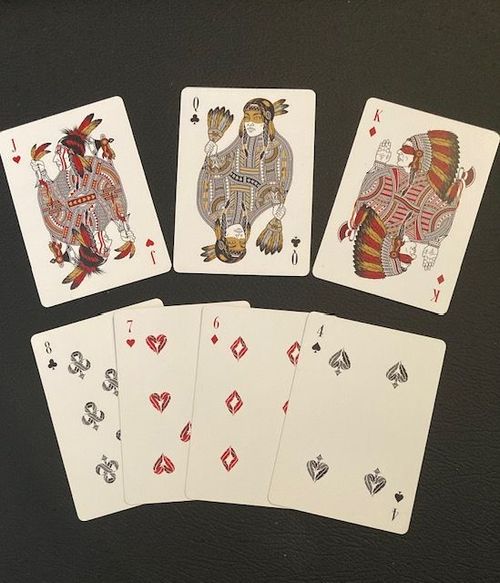
Indian Chief
Indian Chief Rulebook
Table of Contents
Table of Contents
Materials
For 4-8 players, use two standard decks of 52. With 2-3 players, use just one deck. Pencil and paper will be needed to keep score.
Objective
Be the person to score the highest after 7 rounds.
How to Play
Begin by dealing each player 8 cards, face down. The game lasts just 7 rounds.
Over the course of the game each player will make 7 different melds. Each meld requires a different number of cards and has different rules for scoring points.
The 7 melds take their names from the American version of the centuries-old counting rhyme:
- Rich Man (5 cards),
- Poor Man (3 cards),
- Beggar Man (2 cards),
- Thief (1 card),
- Doctor (6 cards),
- Lawyer (4 cards),
- Indian Chief (7 cards).
During the 7 rounds, a player makes each meld once and once only, but they can be made in any order. After each round the hands refill to 8 cards. The game is over at the end of the seventh round, (i.e., once everyone has made all 7 melds.)
All the players choose at the same time which meld they will make from their 8 cards and which cards they will use in that meld. When everyone is ready, the players all simultaneously reveal the melds they have decided to make on that round.
The scorekeeper will need to keep track not only of the points scored on each hand but also of which type of meld it was.
Refilling to 8 Cards and Shuffling
The players leave their melds face-up until the cards for the new round have been dealt from the remainder of the deck. Then all face-up/melded cards are taken up and shuffled with the remainder to form the supply for the next round (this insures important cards, like Aces, are in circulation).
Remember
The 7 melds can be played in any order. After the 7 rounds are played and scored, the winner is the player with the most points.
Card Values
Aces are worth one. Face cards are worth 10. All other cards are worth their values.
See the meld descriptions for rules and scoring.
The 7 Melds
Here are the 7 different melds in order of number of cards required:
1. Thief
Meld any single card and score the face value for that card. (For all "face values" in the game, aces count as 1 and face cards count as 10.)
The Thief's special power is that, after everyone's scores for the hand have been recorded, the player who played the Thief may elect, instead of being dealt a new card from the deck, to "steal" a card someone else has melded on that hand.
Once a Thief decides to steal a card, the player takes it into hand and replaces it in the other player's meld with the card melded as Thief. Thus it is available to be stolen by another Thief, if any. If more than one Thief is in play, the honor of the first steal goes to the lower or lowest number. If there is a tie and they cannot agree to take different cards, neither Thief gets to steal.
2. Beggar Man
Meld 2 cards and hope for sympathy. This symbolizes two outstretched supplicating hands. For each card someone else melds on the same round that matches the rank of EITHER of your two cards, score 2 points. (Pairs do not double matches, each match still only counts 2 points.)
3. Poor Man
Melding 3 cards, here is your chance to profit by the sweat of your brow. The spade is the symbol of your toil. Meld any 3 cards, but score the face values only of the spades you play.
4. Lawyer
The Law is exact. Meld 4 cards, and if their face values add up to exactly 25, score 25 points. Otherwise score nothing.
5. Rich Man
Even a Rich Man has to pay taxes! Meld any 5 cards, add their face values together and score the total as a negative number.
6. Doctor
The 6 cards melded as the Doctor must meet very stringent requirements, or they will score nothing. All 3 of these conditions must be met:
- No two cards can be of the same rank. (Because a Doctor needs wide and varied knowledge.)
- At least one of the 6 cards must be a heart. (Because a Doctor needs to have a heart!)
- One of the 6 cards must be an ace. (Because a Doctor should be an ace!)
If these three conditions are met, then the player picks one suit and scores 10 points for each card in that suit among his 6 cards. (Because a Doctor needs to be good at his specialty.)
7. Indian Chief
The Indian Chief is a compound meld, being comprised of two discrete parts: A five-card poker hand and a two-card chemin-de-fer hand.
-
To score the chemin-de-fer hand, add the face value of the two cards together and count just the last digit of the total. (For example, a 7 and an 8 added together make 15, so are worth 5.)
-
To score the remaining 5 cards in the meld, find the best poker hand that can be made and score as follows:
a. 50 for five of a kind (requires two decks are in play) (e.g., ♣8 ♦8 ♥8 ♠8 ♦8)
b. 45 for a straight flush (5 cards in sequence, same suit) (e.g., ♣4 ♣5 ♣6 ♣7 ♣8)
c. 40 for four of a kind (4 cards, same rank) (e.g., ♣J ♦J ♥J ♠J ♦8)
d. 35 for a full house (3 of a kind, with a pair) (e.g., ♣10 ♦10 ♥10 ♠9 ♦9)
e. 30 for a flush (5 cards of same suit, no sequence) (e.g., ♠4 ♠J ♠8 ♠2 ♠9)
f. 25 for a straight (5 cards in sequence) (e.g., ♣5 ♦6 ♠7 ♦8 ♥9)
g. 20 for three of a kind (e.g., ♣7 ♦7 ♠7 ♣K ♦3)
h. 15 for two pairs (e.g., ♣4 ♦4 ♣3 ♠3 ♣Q)
i. 10 for one pair (e.g., ♥A ♦A ♣8 ♠4 ♣7)
j. 5 for no pair (e.g., ♦3 ♣J ♠8 ♥4 ♣2)
Aces can be high or low in a straight (normal poker rules), but a straight cannot use the Ace to 'wraparound'. (e.g., ♦K ♣A ♥2 ♦3 ♠4 is not a straight.)
Sample Scoring
| (# of Cards) Meld | Player 1 | Player 2 | Player 3 | Player 4 |
|---|---|---|---|---|
| (1) Thief | 10 | 10 | 10 | 10 |
| (2) Beggar Man | 8 | 0 | 10 | 4 |
| (3) Poor Man | 28 | 17 | 27 | 18 |
| (4) Lawyer | 25 | 25 | 25 | 25 |
| (6) Doctor | 40 | 30 | 40 | 30 |
In this sample game, Player 3 won with a particularly strong 136 points (anything over 120 is considered a good score, with anything over 130 being an excellent score).
Variants
Indian Chief can be played solo, the rules are the same with the following changes:
- Do not reshuffle melds back into the deck. Leave the melds on the table. Fill hand from the cards remaining in the deck.
- When playing Beggar Man, score melds on the table with the same rank.
- When playing Thief, pick up a card from one of your melds on the table.
- Try to get the best score possible.