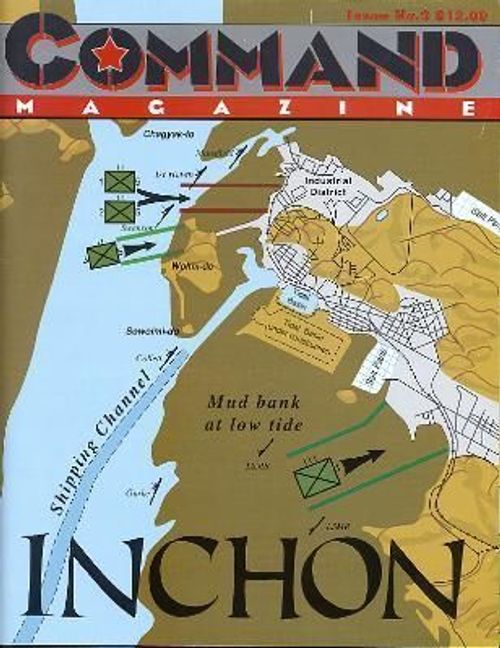
Inchon: MacArthur's Gambit
Inchon: MacArthur's Gambit Rulebook
Table of Contents
Table of Contents
- 1.0 Introduction
- 2.0 Game Components
- 3.0 Setup and Hex Control
- 4.0 The Turn Sequence
- 5.0 Zones of Control
- 6.0 Supply
- 7.0 New Units
- 8.0 Stacking
- 9.0 Movement
- 10.0 Combat
- 11.0 Artillery
- 12.0 Air Power
- 13.0 Improved Positions
- 14.0 The Invasion Turn
- 15.0 How to Win
- 16.0 Optional Rules
- 17.0 Variant Rules
- 18.0 Designer's Notes
1.0 Introduction
1.1 Background
Inchon: MacArthur's Gambit simulates the daring attack by the United Nations' 10th Corps against the port of Inchon and the subsequent advance on Seoul in September 1950. This operation resulted in the liberation of that capital city and the severing of the lines of communication to the North Korean units fighting around the Pusan Perimeter. As a result, virtually the entire North Korean People's Army (NKPA) in the south was destroyed, allowing UN forces to occupy all of North Korea but for a few mountainous enclaves. Unfortunately, one of the indirect results of this dramatic victory was Red Chinese intervention, once more throwing the UN into full retreat.
1.2 Game Scale
A. Each turn represents one day.
B. Each hex represents one mile from side to opposite side.
1.3 Beginner's Rules
The original version of these rules had several marked with a silcrow (section sign, §) to designate that beginners could ignore them. I just deleted them.
1.4 Abbreviations
| Abbr | Meaning | Abbr | Meaning |
|---|---|---|---|
| AA | Anti-Aircraft | IP | Improved Position |
| AF | Air Force | LOS | Line of Sight |
| AP | Air Point | MA | Movement Allowance |
| Arm | Armored | Mar | Marine |
| Arty | Artillery | MP | Movement Point |
| AT | Anti-Tank | OOS | Out of Supply |
| Batt |
2.0 Game Components
A. The components of a complete game of Inchon are the rules, the map, and the counters.
B. Players need to provide one standard six-sided die to resolve combat.
2.1 The Rules
Read the rules through once before beginning play. Familiarize yourself with the organization of the rules. They are organized by topic to assist players in locating ones about which they have questions.
2.2 The Map
A. The map represents the militarily significant terrain in the Inchon-Seoul area. The hexagonal grid printed over the map regulates the placement and movement of units. A unit is considered to be in only one hex at any one time.
B. Each hex contains terrain features which may affect the movement of units and combat between units. Terrain features on the map have been altered slightly from their real-world configurations to fit within the hex grid, but the relationships between the terrain types from hex to hex are accurate to the degree necessary for presenting players with the same space-time dilemmas faced by their historic counterparts in the actual campaign.
Clarification: Sogang (hex 3006) is not part of Seoul.
2.3 The Counters
A. There are 180 counters (or units) in this game, representing ground and naval combat units and informational markers.
B. Each ground combat unit contains several pieces of information: nationality, unit ID, size, type, proficiency rating (PR), combat factor (CF), and movement allowance (MA).
C. The unit above is the United States 1st Battalion/5th Marine Regiment. It has a CF of 7, a PR of 5, and a MA of 10.
D. Each naval combat unit contains the following information: nationality, unit I.D., type, CF, and range.
E. The unit above is the HMS Jamaica, a light cruiser. It has a CF of 8 and a range of 15 hexes.
Corrections: The US Army 92/5 Artillery unit is a battalion, not a battery. The US Army 13th Engineer Combat Battalion has been misidentified as the 18th Engineer Combat Battalion.
2.4 Nationality
The counters are printed in the following color schemes to identify their nationality and service.
| Nationality | Colors |
|---|---|
| US Marines | white on dark green |
| US Army | black on khaki |
| UN Ships | white on blue |
| Republic of Korea (ROK, South Korea) Marines and Army | red on gold |
| North Korea | gold on red |
2.5 Identification
A. Most units are identified by a number, indicating a unit's historical designation within its military. Some of the units carry letter abbreviations to further identify them.
B. These are:
| Abbr | Meaning | Abbr | Meaning |
|---|---|---|---|
| BB | Battleship | LSMR | Landing Ship, Medium (Rockets) |
| CA | Heavy Cruiser | NKPA | North Korean People's Army |
| C | The Capital Division | ROK | Republic of Korea |
| CL | Light Cruiser | SAG | Special Activities Group |
| DD | Destroyer | SC | 31st Seoul City Regiment |
2.6 Size
A unit's organizational size is denoted by the symbol along its top edge.
| Symbol | Size |
|---|---|
| III | Regiment |
| II | Battalion |
| I | Company |
2.7 Unit Type
All ground combat units belong to one of two categories: mechanized (Mech) or Non-Mechanized (Non-mech). Mechanized units are those whose primary means of locomotion is provided by motorized vehicles; nonmechanized units are those whose primary means of locomotion is provided by legs, human or animal.
2.7.1 Mechanized Units
- Armor
- Mechanized Infantry
- Self-Propelled Artillery
2.7.2 Non-Mechanized Units
- Infantry
- Airborne Infantry
- Marines
- Commandos
- Security
- Engineer
- Railroad
- Air Force
- Machine Gun
- Mortars
- Coastal Artillery
- Anti-Aircraft
- Artillery
- Anti-Tank (printed as "Ant-Tank")
2.8 Combat Factor
This measures a unit's ability to participate in combat.
2.9 Range
Artillery and naval units have a second number printed above and to the right of their CFs. This represents the number of hexes the unit can fire over to project its CF.
2.10 Proficiency Rating
This measures a unit's quality and ability to endure the rigors of combat.
2.11 Movement Allowance
This measures a unit's ability to move across the map. The movement allowance (MA) is made up of movement points (MPs).
2.12 Steps
A. Most units have two steps. They are back-printed, with the front side representing the unit at full strength, and the reverse side representing the unit after it has been weakened in combat.
B. If a unit with two steps takes a casualty, flip it over to its reverse (weaker) side.
C. There are several one-step North Korean units that have only a front side. If a one-step unit, or a two-step unit with its reverse side already showing, takes a casualty, it is eliminated and removed from the map.
D. The number of steps a unit contains measures its ability to absorb combat losses before it is eliminated. Elimination does not mean that every man in the unit is dead, only that the unit has taken sufficient casualties to cause it to cease functioning effectively.
2.12 Other Counters
There are counters in the game that do not represent combat units. Their functions are explained in later sections of the rules.
- Out of Supply marker (OOS, with a number)
- Shock marker
- Improved Position (under construction) marker
- Improved Position (completed) marker
3.0 Setup and Hex Control
3.1 Choosing Sides
A. Players should decide between themselves which side each will command.
B. The UN side controls the US Army, US Marines, ROK units, and all naval units.
C. The NKPA side controls all North Korean units.
3.2 NKPA Setup
A. The NKPA units with a dot in their upper left corners are set up first.
B. No units start the game in improved positions.
C. The following NKPA units begin the game on the map in the areas indicated.
| Location | Unit(s) |
|---|---|
| w/i 1 Inchon (1610) | 226 Mar Regt (3 x bns); 918 Coastal Arty Regt (3 x batts)* |
| w/i 1 Kimpo Airfield (2505) | 107 Sec Regt (3 x bns); 877 AF Bn |
| w/i any Seoul urban hex north of the Han River | 18 Rif Div/1st Inf Regt (3 x bns); 22nd Inf Regt (3 x bns); 18 AT Bn; 1, 2, 3, 4 Arty Bns; Seoul City Regt (3 x bns); 36/11 Sec Bn; 10 RR Regt; 19 AA Regt |
| w/i Suwon (3427) | 18/70 Inf Regt (3 x bns) |
| Anywhere at least four hexes from Inchon | 42 Mech Regt (9 x cos) |
*All six units set up at their one-step strength.
D. All other NKPA units are reinforcements and enter play after the game begins (7.0).
3.3 UN Setup
A. After the NKPA side deploys its starting units, place the following UN naval units on the map in any deep sea hexes.
| Type | Units |
|---|---|
| ODs | Mansfield, Dehaven, Swenson, Collett, Gurke, Henderson |
| CLs | Jamaica, Kenya |
| CAs | Rochester, Toledo |
B. Then place the following in any deep and/or shallow sea hexes.
| Type | Units |
|---|---|
| LSMR | 401, 403, 404 |
3.4 Hex Control
A. Each land hex on the map is controlled by only one side at a time. The control of a hex switches instantly from one side to the other as soon as a ground unit from the enemy side enters it.
B. At the start of the game, the NKPA side controls all hexes on the map.
C. Control is important for adjudicating victory (15.0).
4.0 The Turn Sequence
4.1 Turn Structure
A. The game is divided into 16 one-day turns. Except for the first turn (the Invasion Turn), each turn is divided into two player-turns, each of which is divided into several phases. When the word turn is used by itself, it means both player turns.
B. Each action must be taken in the appropriate phase.
C. Once a phase is finished, the player may not go back to perform some forgotten action or redo a poor one unless the opponent graciously permits it.
D. The first turn is a special Invasion Turn and has its own unique sequence of play (14.0).
4.2 Turn Sequence Outline
The complete Turn Sequence is given below in outline form. The rest of the rules are organized so as to explain things in the order they are encountered as you progress through the sequence.
I. UN Player-Turn A. Supply Phase B. New Units Phase C. Movement Phase D. Combat Phase E. Shock Removal
II. NKPA Player-Turn A. Supply Phase B. New Units Phase C. Movement Phase D. Combat Phase E. Shock Removal
5.0 Zones of Control
5.1 In General
A. All land units exert a Zone of Control (ZOC) into the six hexes adjacent to their position.
B. There is no qualitative difference between a hex containing a ZOC exerted by one unit and a hex containing ZOCs exerted by more than one unit.
C. The ZOCs of both sides may be simultaneously exerted into the same hex(es).
D. Naval units do not exert a ZOC and are never effected by the ZOCs of ground units.
E. Friendly ZOCs have no effect on other friendly ZOCs and units.
5.2 Terrain Effects
ZOCs extend across all hexsides and into all types of terrain with the following exceptions:
A. ZOCs do not extend across Han River, all-sea, or ferry hexsides.
B. ZOCs do not extend into urban hexes, but the ZOCs of units in urban hexes extend normally into adjacent nonurban hexes.
5.3 Enemy Zones of Control
A. A ground unit must cease its movement immediately upon entering an enemy ZOC (EZOC).
B. A unit that starts its move in an EZOC may move away without penalty, but it may not move directly from one EZOC to another EZOC, regardless of the presence of other friendly units.
5.4 Negating EZOCs
A. EZOCs are negated by the presence of friendly units for the purposes of tracing supply lines and conducting retreat after combat.
B. The presence of a friendly unit in an EZOC does not negate it for purposes of normal movement.
5.5 Effects on Supply
Supply lines may not be traced through hexes containing unnegated EZOCs, though they may be traced into such hexes.
5.6 Effects on Retreats
A. Retreat paths may not be traced into or through hexes containing unnegated EZOCs.
B. Units which cannot retreat because of EZOCs must take step losses to satisfy the combat result.
5.7 Effects on Advances
ZOCs have no effect on advance after combat (10.14).
5.8 Effects on Hex Control
The mere exertion of a ZOC into a hex is not in itself enough to cause the control of that hex to switch from one side to the other.
6.0 Supply
6.1 In General
A. All ground units require supply in order to be able to operate with their full capabilities. There are no counters in the game to represent supply; instead, units trace a supply line (a path of hexes) to a supply source.
B. Each side checks supply for its own units in the friendly Supply Phase. Units are then determined to be in supply or out of supply (OOS), and remain in that state until the next friendly Supply Phase. The supply state remains the same no matter what happens to the unit's supply line and/or supply sources in the meantime. Supply states are only changed during Supply Phases.
C. All units are automatically in supply the game turn they enter the map.
6.2 Supply Lines
A. For both sides, a supply line is a path of up to ten contiguous hexes (not MPs) in length from the tracing unit back to a friendly supply source.
B. The path must be free of enemy ground units and their unnegated ZOCs.
C. The path may not be traced into or through impassable terrain, and supply lines may only cross the Han River at operable ferries.
D. When tracing supply lines, do count the unit's hex, but not the supply source's hex.
Design Note: These are very liberal supply rules, but supply really was not a major limitation for either side, although getting supplies to the general area was a major UN challenge.
6.3 Supply Sources
6.3.1 UN Supply Sources
UN supply can be traced to UN-controlled Inchon or any UN-controlled airfield.
6.3.2 NKPA Supply Sources
A. NKPA supply sources are any NKPA-controlled hexes on the north, east and south map edges containing a road or railroad (RR).
B. Additionally, any NKPA-controlled urban hex to which an unbroken line of NKPA-controlled road or RR hexes running from a map edge may also serve as a supply source for that side.
C. Further, the Seoul RR station hex (3206) is always an NKPA supply source, even if it is isolated from all map edges, until such time as it first becomes UN-controlled.
6.4 Roads as Supply Sources
Any ground unit of either side may treat a road hex as a supply source if all of the following conditions are met:
- The unit traces a 10-hex (or shorter) supply line to the road hex;
- A path of road hexes can be traced from the road source hex to a supply source listed in 6.3;
- The path of road hexes is free of unnegated EZOCs and/or enemy ground units; and
- The road portion of the supply line does not leave the road's course at any point.
6.5 NKPA 105th Tank Division
In addition to the previous sources, any unit of this division is in supply if it can trace a supply path no longer than three hexes to any south map edge hex(es). The three-hex path must be free of enemy ground units and their unnegated ZOCs.
6.6 Supply States
A. Each unit is determined to be in supply or OOS during the Supply Phase. Check the units in descending order of OOS (that is, start with the OOS +3 units and proceed to unmarked units).
B. If a unit marked with any OOS marker is now in supply, remove the OOS marker. The unit may operate at full strength.
- OOS units suffer the effects listed in 6.7 below.
- If the unit is OOS, proceed with the following steps. a. OOS +3: If the unit is still out of supply, it must make a survival check due to its prolonged isolation. Roll one die for each unit: if the roll is greater than the unit's PR, the unit is eliminated. If the die roll is less than or equal to the unit's PR, the unit survives and remains in play with the OOS +3 marker. Exception: Units of the US 187th Airborne (3 x 4-4-10) never need make a supply survival die roll, no matter how long they are OOS. They do suffer all appropriate halving effects (6.7). b. OOS 3: If the unit is still OOS, make a survival check for it as above. If the unit survives, flip the marker to its OOS +3 side. c. OOS 2: If the unit is still OOS, replace the OOS 2 marker with an OOS 3 marker. d. OOS 1: If the unit is still OOS, replace the OOS 1 marker with an OOS 2 marker. e. Unmarked: If an unmarked unit is now OOS, place an OOS 1 marker on it.
6.7 OOS Effects
A. Supplied units move and fight with their printed combat and movement allowances.
B. OOS units suffer the various effects described below, depending on their OOS level:
- OOS 2, OOS 3, and OOS +3 units operate with their MA and CFs halved (for both attack and defense).
- OOS 1 units operate with their MA halved, and their CF halved on the attack only. On defense they operate with their full CF.
6.8 Halving
A. Remainders of MAs and CFs are dropped when halving, but no MA or CF is ever reduced to less than 1.
Example: Half of 5 is 2, but half of 1 is still 1.
B. When halving the CFs of stacked units, sum the factors of all the units to be halved, then halve the total.
7.0 New Units
7.1 In General
The forces on the board can be strengthened in two ways: reinforcements and replacements.
A. Reinforcements (7.2-7.11) are new units entering play for the first time.
B. Replacements (7.12-7.14) represent troops and equipment used to replenish depleted units already in play.
7.2 Reinforcements
A. Reinforcements become available to their owner per 7.10 and 7.11. Reinforcements may not be voluntarily delayed, though circumstances on the map can cause some to be involuntarily delayed.
B. Entry of reinforcements takes place before movement in each player-turn. Entry onto the map does not expend any MPs, regardless of how or where the unit is first placed.
C. All reinforcements move normally during their side's following Movement Phase, regardless of how they arrived on the map.
D. Except for the NKPA 87th and 85th Regiments, all reinforcements enter play at their full strength.
7.3 UN Reinforcements
A. Most UN land units enter at Inchon on a specified number of turns after the turn the city becomes UN-controlled. The notation +# on a unit's upper left corner indicates the number of turns after the city's capture that unit enters play.
Example: If Inchon is captured on Turn 1, all units with a +1 enter in Turn 2; those with a +2 enter in Turn 3, etc.
B. A unit scheduled to arrive at Inchon may be delayed if its placement on the map causes overstacking in that hex that cannot be resolved by the end of the ensuing UN Movement Phase. The arrival of such units is delayed until the next game turn's UN New Units Phase. In addition, all UN units scheduled to arrive at Inchon on later turns would then be delayed one more turn, in a kind of chain reaction of de lay.
C. If the NKPA side manages to recapture Inchon, all UN ground reinforcements are delayed the number of turns it takes the UN side to bring the city back under its control.
7.4 U.S. 187th Airborne Regiment
The three units of this formation do not have an entry turn printed on them. Instead, they enter play on any UN New Units Phase in which either the Kimpo or Suwon airfields are UN-controlled. They are all placed on one UN-controlled airfield, and have no airborne or airmobile movement capabilities after that; they treat them as regular army infantry.
7.5 USS Missouri
The USS Missouri is placed on any deep sea hex during the UN New Units Phase of Turn 5, regardless of the situation on land.
7.6 NKPA Reinforcements
A. During the NKPA New Units Phase, place NKPA reinforcements on the map edge hex corresponding to the number printed in their upper left.
B. If there is a contiguous line of RR hexes extending from that map edge hex to an urban/RR hex of the same RR, the units may instead be placed in the urban/RR hex. The line of RR hexes must be free of UN ground units and their ZOCs (both negated and unnegated). Such RR deployment, when available, is optional for the NKPA, and the NKPA may do so on a unit-by-unit basis, and need not deploy them all to the same urban/RR hex.
C. Within these limitations, the NKPA may apportion the placement of arriving reinforcements as desired.
Map Note: The RR bridge across the Han River is destroyed and the RR line does not cross the river.
7.7 Delay of NKPA Reinforcements
If the designated map edge entry hex for an NKPA reinforcement is occupied by UN units or is in their ZOCs (negated or unnegated), NKPA units scheduled to arrive there are delayed and enter instead two turns later at the map edge hex closest to the original that is not so blocked. If more than one such alternative arrival hex is available, the NKPA may choose the one to use. However, all units delayed together must enter via the alternative hex and may not use RR deployment.
7.8 NKPA 105th Tank Division
A. This formation's appearance is not automatic, and even if it does enter play, it is possible only some of its units will appear. The units subject to this rule all have a V (for Variable) printed in their upper left instead of a turn number.
B. Starting with Turn 7's NKPA New Units Phase, the NKPA rolls one die for each of the division's five regiments: 107th, 109th, 203rd, 206th and 308th. If the result is equal to or less than the Reinforcement Number printed on the Turn Record Track (TRT) for that turn, all three battalions of that particular regiment must enter at the Suwon urban hex (3427). If Suwon is occupied by UN units (not just their ZOCs), treat the units of the division as delayed NKPA reinforcements (7.7).
C. If the UN controls Suwon (occupies or was the last to occupy the hex with its units), apply a +1 die roll modifier (DRM) to the 105th's regimental reinforcement die rolls. This situation will make any 105th entry impossible on many turns.
D. Any 105th reinforcements delayed past Turn 16 are lost.
7.9 LSMR Withdrawal
The only units scheduled to be withdrawn during the course of a game of Inchon are the three LSMR naval units. On the Turn that any UN +1 reinforcements enter play, the LSMR units are simply picked up and permanently removed from the map.
7.10 UN Reinforcement Schedule
7.10.1 Regardless of Control of Inchon
| Turn | Units |
|---|---|
| 2 | The 187th Airborne becomes eligible to enter at Suwon or Kimpo airfield if UN-controlled. |
| 5 | Place BB USS Missouri on any deep sea hex. |
7.10.2 Inchon UN-Controlled
| Turn | Units |
|---|---|
| +1 | USMC 1st Mar Div arty bns: 1/11, 2/11, 4/11; ROK 1st Mar Regt bns: 1/1, 2/1, 3/1; withdraw LSMRs |
| +2 | USMC 1st Div/1st Arm Bn (3), 1st Eng Bn (1) |
| +3 | US Army 7th Inf Div/32nd Inf Regt (3), 73rd Arm Bn (3), 18th Eng Bn (1), 31st Arty Bn (1), 96/5th Arty Grp Bn (1) |
| +4 | US Army 7th Inf Div/31st Inf Regt (3), 48th Arty Bn (1) |
| +5 | US Army 73/19th Eng Combat Grp Bn (1) |
| +6 | USMC 1st Mar Div/7th Mar Regt (3), 3/11th Arty Bn (1) |
| +10 | ROK Capital Div/17th Inf Regt (3) |
| +11 | US Army 185/19th Eng Bn (1) |
| +14 | US Army 7th Inf Div/17th Inf Regt (3), 92/5 Arty Bn (1) |
Numbers in parentheses indicate number of units.
7.11 NKPA Reinforcement Schedule
| Turn | Location | Unit(s) |
|---|---|---|
| 4 | 3428 | 9th Rif Div/87th Inf Regt (3)* |
| 5 | 3600 | 25th Ind Bde (8) |
| 5 | NKPA replacements begin | |
| 6 | 3428 | 9th Rif Div/85th Inf Regt (3)* |
| 7 | Suwon | Earliest 105th Tank Div may enter (7.8). |
| 8 | 2400 | 78th Ind Inf Regt (3) |
- All enter at reduced strength.
Numbers in parentheses indicate number of units.
7.12 Replacements
A. Replacements represent troops and equipment used to replenish depleted units already in play. There are no counters representing replacements. Each side distributes replacements in the friendly New Units Phase. See 7.14 for availability of replacements.
B. One replacement point (RP) replenishes one depleted two-step unit to its full strength. Simply flip the unit from its reverse side to its full strength in its hex on the map. Neither side may use RPs to build up any unit beyond its two-step printed strength.
7.13 Eligible Units
A. Units receiving replacements must be in supply.
B. No unit which is totally destroyed and in the dead pile may receive replacements.
C. Only US Army infantry and Marine infantry units may receive UN replacements.
D. Only NKPA infantry and mechanized infantry units may receive NKPA replacements.
E. No other unit types are eligible.
7.14 Replacement Rates
A. The UN receives a total of 5 RPs for the entire game. Any number of available RPs may be used on any turn(s).
B. Starting on Turn 6, the NKPA receives 1 RP per turn, and it may not be accumulated. If it is not used immediately it is forfeit.
8.0 Stacking
8.1 Ground Units
A. Placing multiple units into a hex is called stacking. Both sides may stack up to three battalions in a hex. Company sized units count as one-third of a battalion each.
B. The NKPA's Air Force and Railroad Regiments each count as one battalion for stacking purposes.
8.2 UN Ships
No more than three ships may stack in any one hex (regardless of the class of ship).
8.3 Effects of Overstacking
A. Stacking is checked for the units of both sides at the end of each:
- Movement Phase;
- Combat Phase;
- Retreat after combat; and
- Advance after combat.
B. If a hex is overstacked at any of those times, the owner of the overstacked units must eliminate enough units (owner's choice) to bring the overstacked hex back into legal limits.
8.4 Overstacking in New Units Phase
Overstacking is allowed to occur in the New Units Phase, but stacking restrictions must be met again by the end of the immediately following Movement Phase.
9.0 Movement
9.1 In General
A. Every ground unit's MA is printed in its bottom right corner. This factor is the number of MPs available to the unit to carry out its movement across the map. Units move by expending MPs for each hex entered.
B. Units move from hex to adjacent hex, in any direction or combination of directions. Each side may move all, some or none of its units in each friendly Movement Phase throughout the game. Units which do move are not required to expend all their MPs.
C. MPs may not be accumulated from turn to turn, nor may they be loaned from one unit to another. The MP cost to enter a hex depends on the terrain in that hex. If a unit does not have enough MPs to enter a given hex, it may not enter it even if it has not yet spent any of its MPs. (That is, units are not guaranteed the ability to always move one hex per turn.)
D. The movement of each individual unit or stack of units must be completed before that of any other may be started. A player may not go back and readjust the movement of some previously moved unit/stack unless the opponent graciously allows it.
9.2 Friendly Units
Stacking restrictions apply only at the times in 8.3. Within those restrictions, units of the same side may enter and pass through each other's hexes freely. There is no limit to the number of units which may pass through a hex in a given Movement Phase.
9.3 Enemy Units
A. Moving units may not enter a hex containing enemy ground units.
B. NKPA ground units and UN ship units may stack together in the same coastal hex.
C. A ground unit must stop moving immediately upon entering an EZOC (5.0).
9.4 Terrain Effects on Movement
A. Terrain affects movement by determining a moving unit's MP cost to enter a given hex. These costs are summarized on the Terrain Effects Chart (TEC).
B. Each land hex is considered to contain only one kind of terrain (that which is visually the most prominent).
Example: 1806 is a Hill hex, while 1906 is Rural.
C. MP costs for some terrain types differ for mechanized and non-mechanized units.
9.5 Impassable Terrain
Ground units may not enter all-sea hexes or cross all-sea hexsides. Naval units may not enter all-land hexes or cross all-land hexsides. Both ground and naval may enter coastal hexes. No unit may voluntarily move off the map.
9.6 Roads
A. Ground units moving from a road hex to another road hex, through a hexside traversed by the road, pay only the cost for traveling along a road (1 MP for non-mech and ½ MP for mech), and not for the natural terrain in the hex.
B. Railroads have no effect on movement, only on NKPA supply and reinforcements (6.3, 7.6).
9.7 NKPA Ferries
A. The Han River may only be crossed at the three NKPA ferries: Haengju (2603/2702), Sinsa-re (3407/3408), and the destroyed bridges between Seoul and Yongdungpo (3106/3007).
B. These ferry hexsides are marked on the map and function as a terrain feature for NKPA units only. The instant a UN unit moves adjacent to a ferry hexside it ceases to be a ferry and is treated as a normal river hexside for the remainder of that game.
9.8 UN Ferries
A. The UN has two ferry markers that may be placed on any Han River hexsides anytime during a friendly Movement Phase. UN units use ferry markers to cross the Han River at the MP cost listed on the TEC.
B. Both ferries may be placed on the same hexside or each assigned to a separate hexside. Engineer units are not required to deploy ferries. Supply has no effects on their placement.
C. UN mechanized units may use a ferry marker to cross the Han only if a UN Engineer unit is present in either of the two hexes adjacent to the ferry marker at the moment the mechanized unit(s) crosses.
D. Only one US Marine or Army battalion may attack through a ferry marker hexside in a single Combat Phase, and then must do so with only half its printed CF. This halving is in addition to any OOS effects (6.7).
Play Note: Placing both UN ferry markers on the same hexside allows two battalions to attack through that hexside simultaneously.
E. If at any time during the turn, except during the UN Movement and Combat Phases, an NKPA unit is present in either of the two hexes adjacent to a UN ferry marker, that marker is removed from the map.
F. UN ferry markers are never eliminated. The UN may deploy and redeploy them any number of times throughout a game, but only once per UN Movement Phase.
Play Note: ZOCs never extend across ferry hexsides (5.2).
9.9 Naval Units
A. Naval Units have unlimited movement and, within certain limits, may move to any sea hex on the map.
B. Only LSMRs may enter all-shallow sea hexes. C. DDs, CLs, CAs and BBs may only enter deep sea hexes. Hexes containing both deep and shallow sea are considered deep sea.
10.0 Combat
10.1 In General
A. During the friendly Combat Phase, the phasing side's units may be used to attack adjacent enemy units. Air points (APs), artillery, and naval units not adjacent to enemy units may provide assistance in the form of combat support and bombardment.
B. The phasing side is always considered the attacker, and the other is the defender, regardless of the overall strategic situation.
10.2 Combat Is Voluntary
A. Attacking is always voluntary. The attacker may make as many or as few attacks as desired, and need not announce all attacks beforehand.
B. The attacker may resolve attacks in any desired order, but each must be completely resolved before the next begins.
10.3 Limits
A. No attacking unit may be involved in more than one attack per Combat Phase.
B. No enemy unit may be attacked more than once per Combat Phase. Exception: Bombardment (11.4).
C. A unit's CF is indivisible; it may not be divided among different battles, on attack or defense.
10.4 Multi-Unit/Multi-Hex Combat
A. A stack of units defending in a hex may only be attacked as if they were one single unit.
B. Attacking units stacked in one hex need not all attack, nor need they all attack into the same hex.
C. Attacking units in two or more hexes may attack together against a single hex.
D. Attacking units in one hex or in two or more hexes may attack together against two or more hexes, provided all the attacking units are adjacent to all the defending units in the single attack.
E. In a battle with defenders in more than one hex and with different kinds of terrain in those hexes, the terrain most beneficial to the defenders is used for combat calculations (10.19).
10.5 Battle Procedure
A. To resolve a battle, total the CFs of all the attacking units and then total the CFs of all the defending units. A unit's CF can be modified by terrain, supply, and shock.
B. Air, naval, and artillery combat support factors are also added to each side's combat totals (11.0, 12.0). The attacker commits its support factors first, then the defender commits.
C. Divide the defender's total strength into the attacker's total strength and round any remainder in the defender's favor. The result is the odds ratio. Example: 26 CFs attacking 7 CFs yields odds of 3:1 (26 ÷ 7 = 3.71, which rounds to 3, thus making 3:1 odds). (Printed as "26 +"; corrected to "÷" as the arithmetic requires.)
D. This odds ratio can then be shifted up or down by terrain, combined arms, and the Invasion Turn special rules (14.0).
E. Find the column heading on the Combat Results Table (CRT) corresponding to the final odds obtained in the previous step.
F. Roll a six-sided die and modify the result (if necessary) for terrain and PR difference (10.23).
G. Cross-index the modified roll with the appropriate odds column.
Example: For 3:1 final odds and a roll of 3, the combat result is 1/3.
H. Treat final odds greater than 7:1 as 7:1.
I. Treat final odds less than 1:4 as 1:4.
10.6 Combat Result
A. The number to the left of the slash applies to the attacker, and that to the right to the defender. Apply the results to the appropriate force as step losses, hexes retreated, or a combination of the two (10.7).
B. A 0 result means the units of that side are not affected in any way.
C. An E result means all involved units of that side in the battle are eliminated. That is, they are completely destroyed and removed from the map and from play.
10.7 Satisfying the Combat Result
A. Each step eliminated from the affected units satisfies one increment of the combat result. The step loss(es) may come from any participating unit(s). Each side has complete freedom to apportion losses among its participating units.
B. To absorb an increment of a combat result as a retreat, all participating units must retreat one hex (10.10).
C. Any step losses are always absorbed before retreating. Example: To absorb a 3 result, the owner could choose to lose one step from just one unit and then retreat all participating units (including the one that just took the step loss) two hexes, or lose a total of two steps (from one or two units) and retreat all participating units one hex; or lose three steps and keep all survivors in place.
10.8 Mandatory Step Losses
A. Combat results marked with an asterisk require the affected side lose at least one step from a participating unit as part of absorbing the total result.
Example: A combat result of *3 means that side must lose one step from one unit, in addition to any combination of two steps lost or hexes retreated to satisfy the last two increments of the 3.
B. The three NKPA Coastal Artillery units (with MAs of zero) may never absorb combat results by retreating; they must always take step losses.
10.9 Defender First
The defender fully applies its combat result before the attacker applies its result.
10.10 Retreat After Combat
A. Retreats are not considered part of regular movement; do not count the movement costs of the hexes entered during a retreat after combat. Instead, count the retreat in hexes.
B. During retreats, units may not enter a hex or cross a hexside prohibited to them in regular movement. They may not enter a hex containing an unnegated EZOC. If the only available line of retreat leads into such a hex, the unit(s) must stand and absorb step losses instead (even if that leads to total destruction).
10.11 Line of Retreat
A. Each side retreats its own units.
B. Units must retreat in as straight a line as possible toward the nearest friendly supply source.
C. No hex may be entered more than once during the retreat.
D. Units may veer from a straight course if it is blocked by enemy units, unnegated EZOC or impassable hexes.
E. Units may retreat into and through enemy controlled hexes which are empty of actual EZOCs or enemy units.
10.12 Stacks in Retreat
Stacked units must retreat together, splitting only if stacking restrictions would be violated in the last hex of their retreat. Keep the distance to the minimum necessary to allow legal stacking. Each unit of a split stack must still retreat the full required number of hexes.
10.13 Further Combat
If a unit retreats into a hex in which other units of its side are involved in a battle later in the same Combat Phase, the retreated units do not contribute in any way to that battle; however, they are subject to the new combat result rolled there.
10.14 Advance After Combat
A. After any attack in which any defending hex is emptied of defending units, whether by elimination or retreat, the victorious attacking units may advance after combat.
B. Advances are not considered part of regular movement and do not expend MPs.
C. Any or all victorious attackers may advance into the hex vacated by the defender, but stacking limits must be met at the end of the advance.
D. Advancing units may ignore EZOCs.
E. If the defenders retreated two or three hexes or were destroyed by an E or step loss result, the victors may advance one additional hex, again ignoring all EZOCs while doing so. In these extended advances there is no requirement to follow the defender's path of retreat; any hex the advancing attackers might enter as part of regular movement is eligible.
10.15 UN Required Advance
Any victorious UN units that attacked through a ferry marker or made an opposed landing must advance after combat, but never more than one hex.
10.16 Advance Restrictions
A. Advancing units may never enter prohibited terrain.
B. The first hex of the advance must be into the hex vacated by the defender.
C. In cases where the defender occupied more than one hex, the advancers need enter only one of the vacated hexes.
D. Self-propelled artillery is the only artillery which may advance after combat, and then only if the units they attacked were adjacent (11.0).
10.17 Defender Advance After Combat
A. After any attack in which the attacker has been eliminated or retreated from its attacking hex(es), and the defender's final combat result was 0, any or all of the defending units may occupy the vacated attacker's hex(es).
B. Advancing defenders may never advance more than one hex.
10.18 Terrain and Other Combat Modifiers
A. The following modifiers may affect a unit's CF, PR, the odds column used, and/or the combat die roll.
B. All modifiers are cumulative, but no unit's strength may be reduced below 1 for any reason.
10.19 Terrain Effects on Combat
Only terrain in the defender's hex or along the hexside separating the attacker from defender's hex affects combat. All effects are summarized on the TEC.
10.19.1 Rural
Rural terrain has no effect.
10.19.2 Urban
Reduce the odds column by two.
Example: A 5:1 attack would become a 3:1 attack if the defender were in an urban hex.
10.19.3 Hills
Reduce the odds column by one.
10.19.4 Improved Positions
Add 2 to the defender's final CF and add 1 to the defender's PR.
10.19.5 Minor River
If all attackers are attacking across minor river hexsides, apply a +1 DRM to the combat die roll.
10.19.6 Major River
Combat across rivers is prohibited except at ferries.
10.19.7 NKPA Ferry
No attacks are allowed, since the ferry is destroyed the instant a UN unit moves next to it.
10.19.8 UN Ferry
One US Marine or Army infantry battalion may attack at half its CF (drop remainders). NKPA attacks are prohibited.
10.19.9 Causeway
This is the hexside between 1610/1510. The attacker's final CF is halved (drop remainders).
10.20 Supply Effects on Combat
Any OOS attacking or defending unit may have its combat strength halved, depending on the length of time it has been OOS (6.0).
10.21 Combined Arms
A. If the attacking force consists of at least one unshocked armor unit stacked with at least one infantry (regular, marine, airborne or mechanized), then shift the odds one column in favor of the attacker.
B. If the defender has the same armor/infantry-class mix, then decrease the odds by one column.
C. If both sides satisfy the combined arms requirement, the odds shifts cancel out.
D. There can be only one combined odds shift for each side per battle, regardless of the number of stacks that may qualify.
10.22 Invasion Turn
For all battles on Turn 1 (both attacking and defending), the UN receives a one column shift in its favor.
10.23 Proficiency Rating
A. In every battle, compare the attacker's single highest PR to the defender's single highest PR. Apply the difference as a DRM to the combat die roll (adding if the defender's is higher and subtracting if the attacker's rating is higher). Example: If the highest attacker PR is 5 and the highest defender PR is 3, the difference is 2. A die roll of 3 would be modified to 1 (3 - 2 = 1), since the attacker had the higher rating.
B. A unit's PR can be modified by Shock (11.5-11.7) and by Improved Positions (13.0).
11.0 Artillery
11.1 In General
Artillery units use their CFs to bombard enemy-occupied hexes and to support attacking and defending friendly units. Artillery may use their CFs once per turn (one attack or one defense). On the map maintain a common orientation among all artillery units, and when they fire, rotate them 180 degrees as a reminder.
11.2 Combat Support
A. When supporting an attack by other friendly units, at least one of the defending enemy hexes must be within range of the artillery unit. If so, add the artillery CFs to those of the other attacking units.
B. When supporting a defense, the artillery unit must be within range of at least one of the friendly defending hexes. If so, add the artillery CFs to those of the other defending units.
C. Both attacker and defender may commit artillery support to the same battle; the attacker announces first.
D. When counting the range, do not count the hex the artillery is located in; do count the hex the target is in.
11.3 Artillery Characteristics
A. Combat results affect supporting artillery units only when they are adjacent to the enemy.
B. Artillery adjacent to enemy units can provide combat support only to the units with which it is stacked. Artillery in such situations may only lend support to other units if the hexside terrain separating the artillery from the enemy units is impassable.
C. When alone in a hex or stacked only with other artillery units, an artillery unit defends with a CF of 1.
D. Any number of in-range artillery units can support any given battle.
E. The UN side does not suffer any intra-organizational support restrictions. Example: US Army artillery may support Marines and ROK units.
F. Except for NKPA naval attacks (17.2), time and space scales in this game are such that artillery units never need worry about line of sight (LOS) or blocking terrain. If they are in range and otherwise eligible, they can fire at the enemy.
11.4 Bombardment
A. Anytime during a friendly Combat Phase, the attacker may make artillery bombardments.
B. Bombardment is resolved separately from regular combat procedures (including support).
C. To execute a bombardment, specify the bombarding artillery units and the target hex.
D. Bombarding artillery units are subject to all the range and frequency-of-use restrictions given for support missions. Example: The same artillery unit could not bombard and support during the same turn.
E. Bombardments do not use the CRT. Instead, follow the procedure in 11.5 to see if the targets suffer shock.
F. The defender may never execute bombardments.
G. A defending hex may be attacked once conventionally and any number of times by bombardment during the Combat Phase. This is the exception mentioned in 10.3.
H. Bombardment by land, sea or air can be applied against a defending hex any number of times in a given Combat Phase, limited only by the available number of bombarding factors.
I. Bombardment of a hex can occur any number of times before a conventional attack against it, and any number of times after the conventional attack (again, subject only to the availability of bombarding units).
J. A given artillery unit, ship, or AP may be used only once per turn to bombard or deliver combat support.
11.5 Shock
A. The attacker rolls one die for each enemy unit in the bombarding hex.
B. If the result is less than or equal to the defending unit's PR, there is no effect.
C. If the result is greater than the defending unit's PR, the unit is shocked. Place a shock marker atop it.
D. For every five fire support factors committed above 10, apply a +1 DRM to the bombardment die roll. (Ignore increments of less than 5.) Example: A bombardment of 23 factors provides a +2 DRM (23 - 10 = 13; 13 ÷ 5 = 2.6 = 2).
E. A unit receiving a bombardment while in a completed improved position (13.0) has its PR increased by one for its shock check.
11.6 Support and Shock
Whenever more than 10 artillery CFs are committed to a support mission, there is a chance shock may be generated. In such cases, shock is checked after the regular (supported) combat is resolved, even if the defenders retreated out of their original hex.
Clarification: A shock attack requires a minimum of 10 artillery/air/naval points, even if no regular ground units make a ground attack.
Example: During a regular battle, the NKPA attacks a stack of three US Marine battalions. As part of the attack, the NKPA allocates 12 fire support artillery factors. The CRT result is no effect for the US units, but they still must be checked for shock, since 12 (at least 10) fire support factors were used. The NKPA rolls a die for each Marine unit (each with a PR of 5). A 3 is rolled against the top unit, which results in no shock. A 5 is rolled for the second unit (again, no shock) and finally a 6 against the third unit, which causes it to be shocked.
11.7 Shock Effects
A. Shocked units have their PR reduced by one for all combat purposes, and their CF and MA halved. Drop all remainders, but the CF can never be less than 1. The halving is in addition to any OOS or terrain effects.
B. Shocked artillery may not be used for fire support or bombardments.
C. Shocked armor units may not be used for the combined arms odds modifier.
D. Additional shock results on an already shocked unit have no further effect.
E. Remove Shock markers from units at the end of the side's next player-turn.
11.8 Naval Artillery
A. Naval units use their CFs for support and bombardment in the same ways as field artillery units. Like field artillery, naval units may only fire once per game turn.
B. Artillery and naval units may participate in the same combat support or bombardments. In addition, if at least one naval unit is bombarding an enemy in the same or adjacent hex, apply a +1 DRM to the shock effect die rolls.
C. Naval units are not affected in any way by NKPA land units, even if stacked with them in the same coastal hex.
D. Flip naval units to their Fired side when used.
11.9 OOS Artillery
OOS Artillery (no matter what degree of OOS) may not conduct support or bombardment missions, and participate in regular defensive combat with a strength of 1.
12.0 Air Power
12.1 In General
A. The UN had complete air superiority over the campaign area. Historical UN strategic interdiction effects are factored into the NKPA reinforcement schedule. The UN APs discussed here represent aircraft assigned to tactical ground support missions.
B. There are no actual aircraft counters in the game; the UN keeps track of the number of available APs on the Air Point Track.
12.2 Air Points
A. Each AP is the equivalent of one ground CF.
B. APs are used for combat support and bombardment. They may be used alone or in conjunction with artillery and/or naval units.
C. The UN may add any number of APs to its attack and defense combat strengths, subject only to their availability on the Air Point Track.
D. APs may be used anywhere on the map; there are no range limitations.
12.3 Air Points Available
At the start of the game, the UN receives 20 APs per turn.
A. The turn after the UN gains control of Kimpo Airfield (2505), it begins receiving an additional 10 APs per turn.
B. The turn after the UN gains control of Suwon Airfield (3327), it begins receiving an additional 5 APs per turn.
C. If the UN loses control of one or both of those airfields, the number of APs the airfield contributes is lost until it is recaptured.
D. APs may not be accumulated from turn to turn, and if they are not all used by the end of the turn of their receipt they are forfeit, though the UN receives new APs at the start of every new turn.
E. As APs are used, the UN should move the AP Marker down the AP Track to keep indicating the current number still available for use during the remainder of the turn.
Example: The UN attacks with two Marine battalions with 14 CFs against three NKPA infantry battalions with 15 CFs. As the attacker, the UN must declare artillery fire support first. The UN uses two artillery battalions (each with 3 CFs), the two Royal Navy light cruisers (each with 8 CFs), and 5 APs. The UN's attack strength is therefore 41 (14 + 6 arty + 16 naval + 5 air). The NKPA defender allocates three artillery battalions (total of 6 CFs), which makes the defensive combat strength 21 (15 + 6 arty). The odds are 41 ÷ 21 = 1.95:1 or 1:1.
13.0 Improved Positions
13.1 In General
Any land unit except artillery and armor can build improved positions (IPs) in any land hex.
13.2 IP Characteristics
A. The defensive combat strength of a unit or stack of units in a hex with an IP is increased by two CFs after any modification for supply is made. B. Each unit in an IP has its PR increased by one when calculating regular attacks and bombardments.
C. All units in completed IPs, regardless of their type, benefit from those IPs.
D. Remove an IP marker from the map at the end of any phase in which it is unoccupied by friendly units.
13.3 Building IPs
A. To construct an IP:
- The land unit must remain stationary in the hex for two complete turns from the start of construction (this is figured from the start of the constructing side's Movement Phase); and
- No enemy unit may occupy or pass through an adjacent hex during those two turns. An enemy unit need not actually exert a ZOC into the building hex, it simply has to be adjacent to interfere. Exception: If the intervening hexside is a Han River, sea or ferry marker, then the enemy unit does not interfere with construction.
B. At the end of the first turn of construction, place an IP marker atop the building unit/stack with the pick and shovel side showing.
C. At the end of the second turn of construction (providing all the above conditions have been met) flip the marker to its completed side.
D. At anytime during the two-turn construction process, if the constructing unit moves away for any reason, or an enemy unit moves adjacent, the construction is aborted and the process must begin anew if an IP is to be placed there.
E. A unit's shock and supply states have no effect on its ability to build IPs. The bombarding of a unit building an IP also has no effect on the construction process. (In reality, bombardment would probably give added incentive to accelerate construction.)
13.4 IP Limits
A. There may never be more than one IP marker (no matter what side is showing) in a hex at the same time.
B. The number of IP markers each side is given in the counter mix is an absolute limit to their entrenching abilities.
C. The fact a given hex had an IP marker in it and then had that marker removed (for whatever reason) does not prohibit new construction (by either side) in that same hex later.
14.0 The Invasion Turn
14.1 In General
To simulate the two-stage nature of the invasion (due to the tides) and the effects of the massive preparatory bombardment on NKPA morale and cohesion, a special sequence of play is used on the first turn only.
14.2 The First UN Landing Phase
A. Place one battalion of the 1st Marine Division's 1st or 5th Regiments (UN's choice) on Wolmi-do Island/Green Beach (1510).
- If Wolmi-do is NKPA occupied, place the Marine unit on sea hex 1410. It must make an Opposed Landing (14.6).
- If the landing is unopposed, the Marine unit simply occupies Wolmi-do.
B. The UN may make bombardment attacks at any time throughout this phase.
14.3 NKPA Movement Phase
- The NKPA may attempt to move any or all of its non-tank units. To do so, roll one die for each unit and check the result against its PR, modified for shock if appropriate. If the result is less than or equal to the PR, the unit may move; if it is higher, the unit may not move.
- Make each movement attempt and move the unit (or not move) before checking the next unit.
- NKPA units may not begin the construction of IPs.
14.4 NKPA Combat Phase
Normal combat and bombardment procedures apply, but do not check or use any units' PRs in any way during this phase.
14.5 Second UN Landing Phase
A. This is the same as 14.2 except place two 1st Marine Division battalions on Inchon/Red Beach (1610). If that hex is enemy-occupied, place the units on sea hex 1509.
B. Place three battalions on Blue Beach (1710). If Blue Beach is enemy-occupied, place them on sea hex 1611.
C. Units forced to occupy sea hexes must make opposed landings against their designated landing hexes.
D. Units that made unopposed landings may attack adjacent enemy units and these attacks may be made in conjunction with units making opposed landings.
14.6 Opposed Landings
A. UN units whose landing hexes are enemy-occupied must make an opposed landing attack against those enemy units. Combat is resolved according to the standard procedure, and defender combat results are applied normally.
B. If the defender's hex is vacated, the landing units must advance into the landing hex and any attacker result greater than 0 must be taken as step losses.
C. After the defender's combat result has been applied, if the landing hex is still NKPA-occupied, the attackers are removed from the map. (They retreat back to their transports.) Attackers suffer losses only if the attacker combat result was an *# or E. If either of those results occur, the normal attacker combat results are not applied; instead, one step is lost from any one attacking unit.
D. UN units that have been repulsed on an opposed landing are placed on any UN-controlled coastal hex in the New Units Phase of any subsequent turn.
14.7 Combined Opposed/Unopposed Attacks
An opposed landing attack may be made in conjunction with units already ashore, provided those already landed units have not attacked previously that same phase. If the defenders are not dislodged from the landing hex by a combined land/sea assault, only the onshore attackers suffer the normal combat results. The landing units retreat, as in 14.6, but without step loss.
14.8 Restrictions
A. UN units that attack in either Landing Phase may not advance after combat unless their landing was opposed, in which case they may only advance from the all-sea hex onto their designated landing hex.
B. Once landed, UN units may not retreat out to sea.
C. Once ashore, UN units perform and absorb combat results as normal ground units.
Design Note: In the main (historical) scenario, opposed UN landings should always succeed. When using variants (17.0), getting ashore may be a greater challenge for the invaders.
14.9 Fire Support During Landings
A. NKPA artillery units and UN APs may be used for combat support and bombardment normally within the standard conditions and restrictions.
B. UN DDs, CLs and CAs may be used in both UN Landing Phases and in the NKPA Combat Phase.
C. LSMRs may be used in both UN Landing Phases, but not during the NKPA Combat Phase.
D. These exceptions to normal procedures apply only to UN naval units and to the Invasion Turn only.
E. Naval and air combat support may be used to assist an opposed landing or to make bombardments.
F. UN bombardments may be made even if all landings are unopposed.
G. Naval units may not move during the Invasion Turn.
14.10 Invasion Combat Shift
All UN units receive a one column shift in their favor in all combats during the Invasion Turn. This applies to both attack and defense.
14.11 Shock Duration
Shock markers placed on units during the Invasion Turn are not removed until the end of their respective player-turns on Turn 2. This means that NKPA units shocked on the Invasion Turn must wait until the end of Turn 2 to recover.
14.12 Automatic NKPA Victory
If the Invasion Turn ends with no UN ground units ashore, the game ends automatically in a North Korean strategic victory. (Don't laugh; it can happen.)
15.0 How to Win
15.1 In General
A. Basically, the UN side must capture Seoul to win, since that was the whole point of the campaign.
B. If the UN captures the city very late in the game, there is still a chance it can lose if it has not earned enough victory points (VPs) along the way.
C. If the UN fails to take Seoul, all that is left to be determined is the level of the NKPA victory.
15.2 Ending a Game
A. The game ends at the conclusion of Turn 16's NKPA player-turn or when the UN controls Seoul.
B. In addition, the game can automatically end at the conclusion of any game turn, if the NKPA controls Inchon and there are no UN ground units on the map.
15.3 Seoul Control
A. The game begins with Seoul controlled by the NKPA.
B. To gain control of Seoul, the UN must control the ROK Capital hex (3104) and at least three other Seoul urban hexes. (Hex control is defined in 3.4.)
C. The instant that the UN controls Seoul, the game ends and victory is determined.
15.4 UN VPs
A. When the game ends, the UN receives VPs for the control of various territorial objectives as follows:
| VPs | Location |
|---|---|
| 2 | Hex 1600 |
| 2 | Hex 2000 |
| 5 | Kimpo Airfield (2505) |
| 3 | Suwon (3427) |
| 2 | Suwon Airfield (3327) |
B. VPs for an objective do not accumulate from turn to turn. They are only awarded once at the end of the game, and only for those hexes actually under UN control at that time.
15.5 Seoul
This VP award depends on the turn Seoul becomes UN-controlled. Each box on the TRT has the number of VPs the UN receives for controlling Seoul on that turn.
15.6 Victory Levels
A. Not all victories are alike or of the same magnitude. The victory level depends on the UN VPs earned:
| VPs | Victory Level |
|---|---|
| 30+ | UN Strategic |
| 20-29 | UN Tactical |
| 10-19 | NKPA Tactical |
| ≤ 9 | NKPA Strategic |
B. Regardless of the UN VP total, if the game ends with Seoul still in NKPA control (per 15.3), the NKPA wins with at least a Tactical Victory.
16.0 Optional Rules
16.1 In General
The following rules may be used together or individually, as the players choose, before each match is begun. They contribute increased historical realism to the play of Inchon, but at the cost of some playability. The rules simulate events which could have happened during the campaign.
16.2 187th Airdrop
A. Instead of entering the game via the Kimpo or Suwon airfields, the 187th Airborne Regiment may be air dropped. Beginning with Turn 2, the UN may elect to airdrop these three units during any friendly Movement Phase. B. If a drop is made, all three units must be dropped in the same turn.
C. To perform an airdrop, the UN designates a separate drop hex for each battalion. Each drop hex must be within two hexes of at least one other drop hex. Drop hexes may not be enemy-occupied or all-sea; they may be in EZOCs. Roll one die for each battalion.
- On a 1-5, the unit is placed in its drop hex.
- On a 6, the unit drifts to an adjacent hex. Designate any of the hexes adjacent to the drop hex as hex 1 and, moving clockwise around the original drop hex, designate the next hex as hex 2, etc., out to hex 6. Roll one die and place the unit in the appropriate drift hex. a. If the new drop hex is all-sea, eliminate the unit. b. If it is enemy-occupied, the air-dropped battalion immediately attacks the NKPA unit(s) beneath it using normal combat procedures except no artillery or air support is allowed, nor may other adjacent UN units participate. If the NKPA defenders are not forced out of the drop hex, the UN unit must retreat at least one hex (in addition to any other combat results). For the purposes of this retreat the NKPA defender's ZOCs are considered negated.
D. The air drop of one battalion is resolved before the drop of the next begins.
E. Air-dropped units are in supply throughout the entire turn on which they are dropped. The drop is considered their movement for the turn, but they may conduct combat normally during the Combat Phase even if they made a drop-attack coming in.
F. Once dropped, they may not be dropped again or flown to an airfield.
16.3 Weather
A. After barely avoiding two typhoons, the UN forces had nearly perfect weather for the remainder of the campaign, in a country where weather is usually a big factor in any military operations. This option recreates the uncertainty faced by every commander when it comes to weather.
B. Weather primarily affects the availability of UN air support, along with both sides' reinforcement schedules.
C. At the beginning of every turn after the first, one player rolls a die. On a 6, the weather is bad for the entire turn.
D. If the immediately preceding turn's weather was bad, apply a +1 DRM to the roll, but the DRM is never greater than +1 no matter how many previous consecutive turns the weather was bad.
E. During bad weather:
- The number of available UN APs is reduced by 50 percent (drop remainders).
- The 187th Airborne Regiment may not enter play by any method.
- All UN reinforcements are delayed one additional turn, except for the BB Missouri, which arrives on Turn 5 regardless.
- All NKPA reinforcements are advanced one turn (that is, they arrive earlier), except for the 105th Tank Division, which still checks for arrival no earlier than Turn 7. However, the reinforcement number for still unentered 105th Division regiments is increased by 1 in bad weather turns only.
16.4 US Inter-Service Rivalry
A. Historically, Army/Marine rivalry and command friction were problems for the UN command that influenced all operational aspects of this campaign.
B. Accordingly, any time units of the 1st Marine Division and the 7th Infantry Division are involved in the same attack, apply a +2 DRM to the combat die roll and a -2 DRM if they are defending together.
C. The 1st Marine Division is composed of all US Marine units marked 1 on their left side and all three ROK marine battalions. The 7th Infantry Division is composed of all U.S. Army units with a 7 on their left side and the three ROK C battalions.
D. Fire support is not affected by this rule; artillery units of the different divisions may support any regardless of their organizational affiliations (within normal restriction of 11.0).
16.5 LST Supply
In any UN Supply Phase in which it has ground units on the map but does not control Inchon, the UN may designate as in supply all units in any one coastal hex.
16.6 Suwon Road Bombardment
A. This rule allows the UN to use APs in a tactical interdiction role, especially against the NKPA 105th Tank Division. This option should only be used in conjunction with the variable weather option (16.3), because it will tip the play balance in the UN's favor by making it impossible for the 105th Tank Division to arrive if the weather is always perfect.
B. The UN can allocate APs to bombard the road south of Suwon (just off map) to further impede the entrance of the 105th Tank Division units.
C. In the friendly Combat Phase, the UN announces how many APs will be used for this mission (that amount may be zero). For every 10 APs allocated, the 105th's reinforcement number is reduced by one. The reinforcement number can be pushed to zero and below.
16.7 NKPA Minefields
The NKPA's box mines were difficult to detect and remove. Their effect was more to slow the UN down than to cause high casualties.
A. Before the game begins the NKPA side secretly writes down the numbers of any four land hexes on the map. These hexes are mined. The instant the first UN unit or stack enters a mined hex, the NKPA must say there are mines present.
B. Each affected UN unit then immediately makes a shock check as if it had just been bombarded. If an NKPA unit is adjacent, apply a +1 DRM. If a UN engineer unit is present in the stack, apply a -1 DRM.
C. Each unit that passes the check may continue moving (if otherwise possible).
D. Those that fail end their movement for the turn in the mined hex and are marked for shock.
E. Retreating or advancing UN units that trigger mines may complete their retreat or advance but still must check for shock at the end of it.
F. Mined hexes may each attack just once per game. NKPA units are never affected by mines, nor can they trigger them.
16.8 Fog of War
A. Neither side may examine an enemy stack (that is, lift one or more units to see what is underneath) until that hex is attacked or bombarded. All units making the attack must be committed before the examination is made.
B. Attacks, once committed, may not be canceled after the attacker views the units in the defender's stack.
C. IP markers should be placed atop the units occupying them.
17.0 Variant Rules
17.1 In General
These game variant rules are mostly vehicles to explore what could have happened in the campaign if there had been a much greater degree of preparation and cohesion in the NKPA at the time. Various individuals and units in the NKPA had enough information about the impending landings to prepare to oppose them more resolutely, if not repel them altogether. The rules simulate events which could only have happened in the campaign if different courses of action had been taken some time in the past.
Design Note: 17.4-17.6 are highly speculative. They consider what the NKPA could have accomplished with some of its specialist units had their TO&Es, training and leadership actually been up to the levels they were supposed to have been.
17.2 NKPA Coastal Artillery
A. These units certainly had the firepower to do more damage if they had been better prepared and if their surprise at the UN invasion had not been complete.
B. The three 918 Coastal Artillery units may be used to bombard UN naval units once before the Invasion Turn, after the naval units are placed on the map, and in each NKPA Combat Phase. No other NKPA artillery units may attack naval units.
C. To bombard a naval unit, the artillery unit must be able to trace a clear LOS from the center of its hex to the center of the target hex. If this line passes through any hex containing land or naval units other than the target unit the LOS is not clear.
D. If it passes along a hexside and both adjacent hexes would block the LOS, the LOS is considered blocked.
E. The LOS can be traced into blocking hexes, just not through them.
F. Only one naval unit (NKPA's choice) may be the target of a bombardment, regardless of the number of ships actually in the targeted hex. The normal range and eligibility restriction for bombarding units apply; however, the shock procedure is never used, and the fire is resolved on the CRT.
G. Total the bombarding artillery factors and compare them to the naval unit's own bombardment value to determine the odds ratio as in regular ground combat. Shift those odds one column in the NKPA's favor if at least one of the firing artillery units is in the same coastal hex as the targeted ship. Roll the die, applying a -1 DRM if the targeted ship is adjacent to or in the same hex as at least one of the firing artillery units. Only one odds shift and one DRM is allowed. Find the result on the CRT.
H. Ignore all attacker results. If the defender result is an E, *2, or *3, the ship is damaged and removed permanently from play. All other defender results are treated as if they were 0.
I. Anti-ship fire is considered combat, and units that use it are not eligible to provide support fire for the remainder of the turn.
Design Note: Sinking a UN ship would have been pretty unlikely. The removal of one from the game represents its withdrawal due to damage.
17.3 US Commandos
A. If MacArthur had been so inclined, there was no reason he could not have searched around the US armed forces to find the personnel to flesh out a commando outfit.
B. When using this rule, include the Special Activities Group (SAG) counter (the 3-5-12 battalion with an asterisk in its upper left) in the UN at-start order of battle.
C. This unit functions as a regular non-mech infantry unit; however, it is always in supply when located in any coastal hex, and like the 187th, it cannot be destroyed due to lack of supply.
D. It may always ignore NKPA ZOCs.
E. It may never receive replacements.
F. It enters the game during any UN Movement Phase after the Invasion Turn by being placed on any non-enemy occupied coastal hex (at no cost in MPs). Once ashore, it may not be withdrawn.
17.4 NKPA 19th Anti-Air Regiment
The number of UN APs expended against a hex containing this unit is reduced by 3 when at full-strength, and by 2 when at reduced strength. Thus, to force a shock check on a stack containing this unit at full strength, at least 14 APs must be expended. This applies to both combat support and bombardments. The 19th has no anti-air effects while shocked.
17.5 NKPA 18th Anti-Tank Battalion
A. In any combat involving this unit, it negates the presence of one full-strength UN tank company or two reduced companies for Combined Arms odds shift purposes only. If reduced itself, the anti-tank unit negates only a reduced tank company.
B. The CFs of the negated tank units are still used for odds calculation.
C. The unit has no anti-tank effects if shocked.
17.6 NKPA 10th Railroad Regiment
A. When present on a railroad hex during an NKPA New Units Phase, this unit may be treated as if it were an urban/RR hex for the purposes of NKPA railroad reinforcement entry (7.6). All the normal reinforcement restrictions still apply.
B. To be used this way, the RR unit must be at full-strength, it may not be shocked or in an EZOC (negated or not), and it may not move in the subsequent NKPA Movement Phase.
17.7 Better Overall NKPA Preparations
A. This rule assumes the NKPA responded more rationally once the invasion became imminent.
B. The NKPA sets up as described in 3.0, but with the following changes:
- Deploy all 14 units of the 18th Rifle Division at least four hexes away from Inchon (like the 42nd Mechanized Regiment).
- Deploy up to five IPs in any NKPA-occupied hex.
C. The UN sets up as in 3.0, and the Invasion Turn is performed normally except that all NKPA tank units may attempt to move, and all unshocked 18th Rifle Division units are exempt from the movement check. Shocked 18th Division units must still make the movement check.
D. When using this rule, all UN VP values are doubled except for the Seoul VPs, which remain unchanged. All other victory conditions remain unaltered.
17.8 The Red Wall: MacArthur's Nightmare
Based on information provided by their spies in Japan, the NKPA is fully prepared for a UN invasion at Inchon. MacArthur's own agents warn him the invaders will meet a very hot reception. At the risk of staging another Tarawa, the Shogun goes ahead, but makes some radical alterations to his plans.
A. The NKPA sets up as described in 3.0, but with the following changes:
- The 18th Rifle Division sets up as in 17.7.
- The 226th Marine and 918 Coastal Artillery Regiments are deployed at full strength and in IPs.
B. If using 16.7, there are eight mined hexes.
C. Eight IP markers are deployed in any NKPA-occupied hexes.
D. The UN sets up as in 3.0, but the Invasion Turn is altered as follows:
- In the First UN Landing Phase, the UN may attempt landings at all three beaches with its entire landing force and up to three battalions per beach. The UN is not required to make any landings at all in this phase if desired. Bombardment is still performed as desired. (If the UN makes no landings this phase, make any desired bombardments, then skip to the Second UN Landing Phase.)
- In the NKPA Movement Phase, unshocked NKPA units do not have to make movement-attempt checks to move, and all NKPA tank units are eligible to move. Shocked units must still make the movement check.
- In the Second UN Landing Phase, just as in the First, the UN may attempt to land any invading force units that did not attempt to land earlier. Bombardment is performed normally.
- The UN Landing Force consists of the 1st and 5th Marine Regiments of the 1st Marine Division, and the 1st ROK Marine Regiment.
- The UN does not receive the Invasion Turn combat odds shift if this variant is played.
E. All UN VP hexes are tripled in VP value, except the Seoul conditions and point values are unchanged. In addition, the UN wins automatically if at the end of any turn there are no NKPA units south of the Han River.
18.0 Designer's Notes
A. MacArthur's Gambit is a relatively straightforward game, with a playing time of less than five hours, a small map, low counter density, and moderate complexity. Basically, one side has to come ashore and, as quickly as possible, take a difficult major objective and a number of lesser ones while the other side does its best to stop this.
B. It is not a systemically ambitious game either, as the sequence of play is the move-and-shoot kind that has been the standard since the dawn of wargaming.
C. However, the nature of this campaign dictated some different approaches be taken to show the relationship between firepower and unit quality. Thus the use of PRs, which are indicators of how well a unit can be expected to bear up under the more impersonal brands of enemy fire power, to comprehensively quantify the qualitative (and subjectively judged) characteristics of morale, training, cohesion and, of course, combat proficiency. Players will find a unit's PR is every bit as important as its CF, and good units rolling on the same column of the CRT as poor ones will generally be more effective.
D. The shock rule's use was also dictated by the structure and composition of the UN forces, which were frighteningly light on manpower, but heavy in artillery, air power and naval forces. In many games allocating fire support is a routine problem, but in MG, the UN also has to judge how it is used. Is it better to augment an attacker's organic firepower or to soften up targets? How much should be held back to deal with counterattacks? The UN must make these decisions at least once in nearly every turn of every well-played game.
E. As in the historical campaign, the victory conditions in MG are centered on Seoul – the critical objective due to its value as both a political and transportation center. Possession of airfields helps the UN air effort, obviously, and Suwon was the gateway to the south for the UN and to the Seoul area for the NKPA's 105th Tank Division.
F. The two hexes on the northern map edge are of less obvious importance. North of the map area, the NKPA possessed fords across the Han Estuary to the Kumpo Peninsula (formed by the Han on one side and the Yellow Sea on the other), giving them a route of advance toward Kimpo Airfield. The victory hexes give the UN a good, clear reason to cover the northern flank, as historic counterparts did, without recourse to complex rules.
G. The hexes were rather arbitrarily selected, but for solid historical reasons. This is not the first time a designer has done this; in the Campaign Game of TAHGCs 1776, Wyoming, Pennsylvania was made a strategic town not for its own intrinsic value (it had almost none), but as a symbolic gateway to the much more important western areas off the map.
H. MG simulates a campaign that beat the odds in the grand style, and which is unfortunately neither widely recognized today, nor overly simulated. With 1990-93as the 40th anniversary of the Korean War, this seems like a good time to redress both situations.