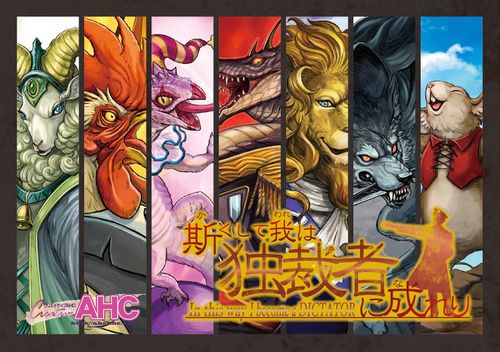
In this way I become a DICTATOR
In this way I become a DICTATOR Rulebook
Table of Contents
Table of Contents
Overview: Three Phases and Five Days
The game repeats three phases five times. The three phases are called Morning, Noon and Night, and the five repetitions are called the five days. Within the setting, the new ruler is decided by discussion and voting over five days.
- Morning: Discussion. Free discussion for 3 minutes. No restrictions. Meta-discussion is allowed.
- Noon: Voting. Players vote (投票) or discard a vote (棄票).
- Night: Role decision (discarding role cards). Each player discards role cards from their hand of seven.
The day's actions follow the same basic flow every day, but there are small differences between days. For example, the number of cards dropped changes each day, on day 1 only voting is possible, and on day 5 voting and discard-voting happen at the same time. For this reason the game includes a Time Card that shows what happens on each day, so that players can check it when unsure what to do.
Winning is decided mainly by the cumulative number of votes received over the five days. Each player keeps 7 role cards and drops them during the game, so that one role card remains in hand on the morning of day 5. If that remaining role's win condition is met, that player wins.
Phase 1: Morning – Discussion
- Players hold a free discussion for 3 minutes. There are no restrictions on what is said, and meta-discussion is allowed.
- Players should discuss which role card they intend to win with, and how they plan to control the votes to achieve it.
- Some role cards allow more than one player to win together, so forming alliances and negotiating is a good strategy.
Q&A (official): Should players make private deals with specific players during the morning discussion? The publisher's answer is that this is basically best forbidden. This is a contest to choose a new ruler, so players should openly state their own arguments. (House rules are free to adopt.)
Phase 2: Noon – Voting
There are two kinds of action at noon: voting (投票) and discard-voting (棄票).
- Vote (投票): give one vote to a player other than yourself.
- Discard-vote (棄票): remove one vote received by any player, including yourself.
Each day, players use the vote card (投票カード) or the discard-vote card (棄票カード). On each day exactly one of the two must be done. Discard-votes are processed first, and then votes are processed.
Discard-Vote Rules (summary play aid)
- A discard-vote costs one voting right (see Voting Rights below), and that player cannot vote on that day.
- Discard-votes are resolved before votes.
- To make a discard-vote, a player must reveal the role card they will drop that night (the card they are about to discard in the Night phase).
- Nobody has any votes on day 1, so discard-votes cannot be made on day 1.
- On day 5, votes and discard-votes are both made simultaneously.
Order of Votes (summary play aid)
- Votes (投票): there is no voting order except on day 5.
- Discard-votes (棄票): made simultaneously (一斉投票).
Voting Rights and Votes (summary play aid)
- Voting rights: at the start of the game each player is given 5 voting rights. Voting rights are separate from votes received.
- Votes received (得票数): the number of votes a player has received through voting.
Phase 3: Night – Role Card Drop
- Each player holds 7 role cards. In the Night phase players discard (drop) role cards from their hand.
- The number of cards dropped depends on the day: 2 cards on days 1 and 3, and 1 card on days 2 and 4. Remember it as "2 – 1 – 2 – 1". The official Q&A states that the rule's original wording was unclear and gives this schedule.
- Players drop cards closed (face down). All dropped cards are then shuffled together and revealed immediately, so nobody knows who discarded which card, but everybody knows which cards were discarded.
- Summary play aid: on day 4 the dropped cards are not revealed. On day 5 there is no drop. (The web overview describes the reveal as immediate every time, so the summary's day-4 rule is the printed exception and is kept here as printed.)
- After the drops, 1 role card remains in each player's hand by the morning of day 5. That final role card's win condition is checked at the end of the game.
Time Card
The Time Card summarises what happens on each day, including the day's drop count and whether voting and discard-voting are simultaneous. Players can consult it when unsure of the day's actions.
Roles and Win Conditions
There are seven roles. Each win condition is listed below as printed in the win-condition boxes of the official summary, with the web overview's wording where it adds detail.
Dictator (独裁者)
- Win condition: be the single top player by votes received across the whole group. The sole highest vote-getter wins.
- Easy to understand, so it is a good starting point for discussion. ("Who wants to stand as Dictator?" "I'll play the Jester.")
Jester (道化師)
- Win condition: win together with the Dictator when the Dictator wins.
- No other condition is listed for the Jester (summary: "なし" = none).
- The Dictator must be the top vote-getter, so the Jester has to work out what to do to win together with the Dictator.
Noble (貴族)
Nobles have two winning conditions; meeting either one is enough.
- Nobles in second place and with votes: at least one Noble is in second place (a), and at least one Noble has received votes (b). The summary chart marks both (a) and (b) as required, each with at least one Noble. A single top-ranked Noble does not count toward this condition and cannot win by it.
- Win together with the Assassin: a Noble wins together with the Assassin when the Assassin wins.
The two conditions are alternatives. The Noble may win with a group of Nobles, or by hiring the Assassin.
Revolutionary (革命家)
- Win condition: at least one Revolutionary is in last place (a), and at least one Revolutionary is in booby place (b), meaning one place above last. The summary chart marks both as required, each with at least one Revolutionary.
- A Revolutionary with 0 votes is not counted for this condition and cannot win by it.
- The Revolutionary has a high priority, so a strong card can be played if the Revolutionaries cooperate well. Even a revolution needs some minimum support, so votes are still needed.
Assassin (暗殺者)
- Win condition: the Dictator, the Revolutionary or the Priest meets its win condition, and the Assassin's own votes received are 0.
- Note: the web overview lists the three roles with a list separator ("独裁者・革命家・聖職者が勝利条件を満たし"). The summary is explicit that the condition is met if the Dictator or the Revolutionary or the Priest meets its win condition, so the summary's "or" is used here.
- The Assassin must have zero votes, because an assassin has to stay in the dark.
Commoner (民衆)
- Win condition: either (1) all players are Commoners, or (2) no player has met a win condition other than the Commoner's.
- If every player stays a Commoner to the end, everyone wins regardless of votes.
Priest (聖職者)
- Win condition: across all players, the difference between the highest number of votes and the lowest number of votes is 1 or less. Both the highest and the lowest may be 0 votes.
- The Priest is an independent role with a different feel from the others. It requires controlling the room, and it allows a sneaky win.
Ranking and Priority
Priority Chart
The summary's priority diagram ranks roles from highest to lowest:
- Assassin (暗殺者)
- Priest (聖職者)
- Revolutionary (革命家)
- Dictator (独裁者)
- Jester (道化師), at the same level as the Dictator
- Noble (貴族)
- Commoner (民衆), set apart from the others
The win-condition boxes state the priorities in words. Each role's box lists the roles that take priority over it:
- Dictator: taken over by Revolutionary, Assassin, Priest.
- Noble: taken over by Dictator, Revolutionary, Priest.
- Revolutionary: taken over by Assassin, Priest.
- Priest: taken over by Assassin.
- Assassin: none.
- Commoner: none.
- Jester: no entry.
Translation note: the printed box heading reads "【X】より優先" and lists roles beneath it. The list is read here as "roles that take priority over X", which is consistent with the priority chart and the arrows in the diagram (for example, the Assassin's success over the Priest). The diagram is an image and its arrow labels are not explained in the text, so the text above is the authoritative form of the priority ordering.
The diagram's arrow labels are: 暗殺成功 (assassination succeeds), 神の元に平等 (equal before God), 革命成功 (revolution succeeds), 支配 (rules over), and 支援(共に勝利) (supports, both win).
Counting Ranks (summary play aid)
- Ties: when several players are tied, the players below them are not moved down. Example: 1st place A (5 votes); 2nd place B and C (4 votes each); 3rd place D (3 votes). D is in 3rd place, not 4th.
- Zero votes are not ranked: a player with 0 votes is outside the ranking. A player with 0 votes is not in last place.
Official Rules Q&A
These are the official answers from the publisher's Q&A page. Question numbers follow the printed Q&A.
General
Q1. Can players make private deals with a specific player during the morning discussion?
A1. Basically no, it is better to forbid it. This is a discussion about choosing a new ruler, so players should openly state their own arguments.
Q2. The number of cards dropped at night is unclear.
A2. Apologies, the wording of the rule was poor. The schedule is: day 1 and day 3, 2 cards; day 2 and day 4, 1 card. Remember it as "2 – 1 – 2 – 1".
Q3. After a discard-vote results in negative votes, is that after the vote is processed?
A3. No. On no day do votes become negative at that moment. On days 2 to 4, votes do not go negative at the moment the discard-vote is processed. On day 5, votes and discard-votes are conceptually made at the same time, so a player may be negative during processing but never negative in concept.
(The printed answer to this question is labelled "Q2" in the source; it is the answer to Q3 and is numbered A3 here. This is a fix to the numbering only.)
Nobles
Q1. Can tied first-place Nobles win?
A1. Yes. For example, if there are two Nobles tied in first place and one Noble in second place, those three players win, because they meet the Noble condition.
Q2. If there are two or more players in second place, can the Nobles win?
A2. Yes. The condition is "one in second place and one with votes", and it is met.
Revolutionaries
Q1. If the Revolutionary win condition is met, do Revolutionaries who are neither last nor booby also win?
A1. Yes. For example, if the top, last and booby places are each a Revolutionary, all three of them win. A Revolutionary who does not fit the win condition is taken to have also helped the revolution.