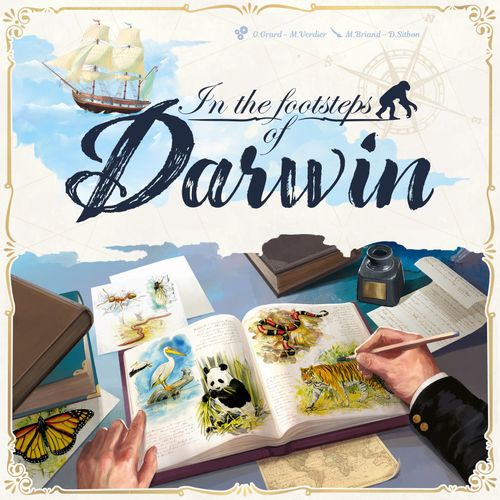
In the Footsteps of Darwin
In the Footsteps of Darwin Rulebook
Table of Contents
Table of Contents
Theme and Goal of the Game
Players are junior naturalists who just arrived aboard the Beagle to help Charles Darwin finish his book On the Origin of Species. During this journey, you will study animals, carry out cartographic surveys, publish your findings and develop theories. Your goal is to score more Victory Points (VP) than your opponents to determine who contributed the most to the Origin of Species!
Designers' note: Not as well-known as birds, mammals and reptiles, arthropods regroup insects, crustaceans, chelicerates (spiders and scorpions) and myriapods (centipedes). They represent half of all known species! To simplify and diversify, we added an annelid (Giant Gippsland earthworm) to the Arthropod category although it does not belong to it.
Components
Before your first game: shuffle the 64 Animal tiles and the 5 Character tiles together, then store them in the dedicated area of the box.
- 1 Journey board
- 64 Animal tiles
- 16 Publication tokens
- 1 Darwin token
- 15 Compass tokens
- 1 Beagle figure
- 5 Naturalist's notebooks ("journey" side and "appendix" side)
- 5 Character tiles
- 28 Theory tiles
- 1 score pad
- 10 Guide tokens
- 1 cloth bag
- 1 rulebook
- 1 appendix booklet
Setup
- Place the board, Journey side up, at the center of the table, then place the Beagle on its starting space.
- Give a Naturalist's notebook to each player, henceforth called a "naturalist" in the rulebook. The last naturalist who traveled by ship takes the Darwin token: they will start the game. If no naturalist has ever traveled by ship, choose your favorite way to determine who will play first.
- Place the Guide, Publication and Compass tokens on the dedicated spaces of the Journey board.
- A. Take 12 tiles from the box for each naturalist in play, then form several face down piles, that you place next to the Journey board. B. Take another 9 tiles from the box and place them face up on each of the 9 spaces of the Journey board (for example, take 24 + 9 = 33 tiles in a game with 2 naturalists).
- A. Deal a Theory tile to each naturalist. They must place it face up on their topmost Theory space, at the top right of their notebook. B. Then, form two face-down Theory draw piles and place them on the dedicated spaces of the Journey board. Then, draw 3 of them and place them face up on their dedicated spaces.
- Each naturalist takes a Guide token and places it on the dedicated space.
What's on an Animal Tile?
- Class of the animal: Arthropod, Mammal, Bird, or Reptile.
- Name (English and Latin), size and ecosystem of the animal: America, Africa, Asia, or Oceania.
- Bonus when you study the animal (either an immediate or an endgame bonus).
- Emblematic animal icon.
What's on a Character Tile?
- Character icon.
- Character's name, occupation, date of birth, date of death.
- Bonus when you take inspiration from the character.
How to Play
Starting with the naturalist controlling the Darwin token, naturalists take turns in clockwise order. On their turn, a naturalist performs these two steps in order:
- Study an Animal or Take inspiration from a Character.
- Voyage of the Beagle.
The game ends after each naturalist has placed exactly 12 tiles (Animal or Character) on their notebook.
1. Study an Animal or Take Inspiration from a Character
Choose one of the 3 tiles facing the Beagle and place it onto your Naturalist's notebook. It may be either an animal to study or a character from the Beagle's previous journey who will inspire you.
Example: the Beagle is facing a Coral Snake, an Armadillo girdled lizard and a Japanese crane. Anna decides to study the Japanese crane and places it on her notebook.
Study an Animal
Take the animal and place it on the space in your notebook matching their ecosystem and their class, then resolve their immediate bonus, if any:
-
Discover: these animals are an important discovery for the scientific community: they will be worth 1, 2 or 3 VP at the end of the game.
Example: Anna studies a Japanese crane, which will earn her 3 VP at the end of the game if it is still visible.
-
Chart: these animals are worth VP at the end of the game depending on the number of Compasses you have.
Example: Louison studies a Saltwater crocodile, which will earn her 1 VP for each compass she has at the end of the game if it is still visible.
-
Survey: immediately take a Compass token and place it in the Survey area at the bottom of your notebook. You may not have more than 5 of these tokens: should you be to take a 6th one, you may study the animal, but you do not take the compass.
Example: Anna studies a Keel-billed toucan, which comes with a Compass token. She immediately takes the token and places it at the bottom of her notebook.
-
Hire a guide: immediately take a Guide token and place it on an empty Guide space of your notebook. You may not have more than 2 of these tokens: should you be to hire a 3rd guide, you may study the animal, but you do not hire the guide.
Example: Louison studies a Black Mamba and therefore immediately hires a guide, which she places on her notebook. She may use them later in the game to perform a special action (Sail or Probe).
-
Emblematic: immediately take the Darwin token from whoever controls it and place it next to your notebook. If you were the one controlling it, nothing happens. At the end of the game, the naturalist controlling the Darwin token scores 2 VP.
Example: Louison studies a Moose, which has an Emblematic icon. Since Anna controls the Darwin token, Louison takes it from her and places it next to her own notebook. It will earn her 2 VP if she still controls it at the end of the game.
Take Inspiration from a Character
If the tile is a Character tile, place it on an available space on the left side of your notebook, then gain its bonus.
You may not be inspired by more than 3 characters. Characters' bonuses are detailed on page 12 of this rulebook (see the Characters section below).
Example: Anna takes inspiration from Conrad Martens. She places the tile on her notebook, then resolves its bonus: it counts as 1 Chart and allows her to hire a Guide.
2. Voyage of the Beagle
After placing a tile (Animal or Character) on your notebook, resolve these steps in order:
A. Move the Beagle as many spaces forward (following the arrows) as the distance between the Beagle and the tile you just selected (i.e. 1, 2 or 3 spaces).
B. Draw a new tile and place it face up on the empty space of the Journey board.
Special Actions
Use a Guide
At the beginning of your turn, before selecting an Animal or Character tile, you may use a single one of your Guides (by returning the token to the Journey board) to perform one of the following special actions:
-
Sail: move the Beagle one space back or forward. Then, play your turn as usual.
Example: at the beginning of her turn, Louison uses a Guide to Sail, because she wishes to study an Elephant, worth 3 VP at the end of the game. She moves the Beagle one space back and plays her turn: she studies the Elephant, and then moves the Beagle two spaces forward following the arrows.
-
Probe: discard the 3 tiles facing the Beagle and place them face down in any order at the bottom of any draw pile: replace them with 3 tiles from any draw pile. Then, play your turn as usual.
Example: at the beginning of her turn, Louison uses a Guide to Probe: she discards the 3 tiles facing the Beagle, returns them to the bottom of any draw pile and reveals 3 new tiles. Then, she plays her turn as usual: she studies an Emu, then moves the Beagle one space forward following the arrows.
Develop a Theory
When you study an animal from a class and an ecosystem you already studied, place the tile on top of the previous one, then resolve its immediate bonus, if any. The covered tile remains there but any VP value or icon on it will now be ignored. If you cover another icon (Discover, Chart, Survey), nothing happens: you do not have to return these elements.
Then, take a Theory tile among the 3 on display, or from the top of any draw pile. Place this Theory on the next available space of your notebook: its VP will be checked at the end of the game. You may own both copies of the same Theory if you wish to.
Then, if you took a Theory from the row, reveal a new one from any draw pile to complete the row.
Important: you may not have more than 6 Theories. If you take a 7th one, return one of your choice (possibly the one you just took) to the bottom of any draw pile. Should you need to draw a Theory and the row is empty, nothing happens.
Important: you may cover the same animal space of your notebook several times.
Example: Anna studies an Imperial eagle and must stack it on top of the Japanese crane she studied earlier, because both animals share the same class and the same ecosystem. Then, she takes a Theory tile, that she places on the right side of her notebook.
Write a Publication
Each time you cover all 4 spaces of a given ecosystem or class (i.e. by completing a column or a row on your notebook), you write a publication! Take any publication token on the Journey board and place it on the dedicated space at the top left of your notebook. Should you write more publications later in the game, simply stack the tokens.
IMPORTANT: if you cover the 4 spaces of an ecosystem or a class that you already completed before, you cannot write a Publication again that way.
Example: Louison studies a Giraffe, which causes her to have covered all the Mammals spaces of her notebook: she takes a Publication token and places it at the top left of her notebook.
End of the Game
When the last tile from the draw pile is placed onto the Journey board, the game ends. This happens once each naturalist has placed exactly 12 tiles (Animal and/or Character) on their notebook.
Score VP in the following categories:
- Discoveries: add up VP from your visible discovered animals (VP from covered animals are ignored). If you have been inspired by Robert McCormick, add his 4 VP to this category.
- Chart: multiply the number of Compasses you own by the number of visible Chart icons you own.
- Publications: score 5 VP for each Publication you wrote.
- Theories: check your Theories and score their VP (see the Theories section below).
- Token Darwin: if you control it, add 2 VP to this category.
Add up these 5 categories: the naturalist with the most VP wins the game. If there is a tie, the naturalist with the most VP in the Theory category wins the game. If there is still a tie, the tied naturalists share the victory.
Example: Anna scores: 4 VP for Discoveries (3 for the Great white pelican, 1 for the Ostrich); 12 VP for Chart (she has 4 visible Chart icons — Okapi, Armadillo girdled lizard, Tsetse fly and Conrad Martens — and 3 Compasses in the Survey area of her notebook); 10 VP for Publications (she wrote two); 12 VP for Theories (1 per animal from Africa for 6 VP, 1 per visible Emblematic animal for 4 VP because she developed this Theory twice, and 1 per Reptile for 2 VP); and 2 VP because she controls the Darwin token. Anna's score is 40 VP!
Achievements
When you win the game, check whether you completed one of the achievements below. If you did, write down your name in the empty box!
- Darwinism - Scored 50 VP or more.
- Observer - Scored 20 VP or more in the Discoveries category.
- Mentor - Took inspiration from 3 Characters.
- Natural selection - Studied 3 animals from the same class and ecosystem.
- Expert - Wrote 3 Publications.
- Cultural exchange - Ended the game with 2 Guides.
- Theorist - Developed 6 Theories.
- Emblematic - Had 4 visible Emblematic animals.
- Cartographer - Collected 5 Compasses.
- Diversification - Had a visible Discovery animal worth 1 VP, a visible Discovery animal worth 2 VP, a visible Discovery animal worth 3 VP, a visible Chart animal, a Compass, a visible Emblematic animal, and a Guide, all at once.
Theories
- Chapter 1 – Variation under domestication. Score 1 VP for each Bird you studied, including those you covered.
- Chapter 2 – Variation under nature. Score 1 VP for each Mammal you studied, including those you covered.
- Chapter 3 – Struggle for existence. Score 1 VP for each Reptile you studied, including those you covered.
- Chapter 4 – Natural selection. Score 1 VP for each Arthropod you studied, including those you covered.
- Chapter 5 – Laws of variation. Score 1 VP for each animal from America you studied, including those you covered.
- Chapter 6 – Difficulties on theory. Score 1 VP for each animal from Africa you studied, including those you covered.
- Chapter 7 – Miscellaneous objections to the theory of natural selection. Score 1 VP for each animal from Asia you studied, including those you covered.
- Chapter 8 – Instinct. Score 1 VP for each animal from Oceania you studied, including those you covered.
- Chapter 9 – Hybridism. Score 1 VP for each animal you studied in the top-left quarter of your Naturalist's notebook, including those you covered.
- Chapter 10 – On the imperfection of the geological record. Score 1 VP for each animal you studied in the top-right quarter of your Naturalist's notebook, including those you covered.
- Chapter 11 – On the geological successions of organic beings. Score 1 VP for each animal you studied in the bottom-left quarter of your Naturalist's notebook, including those you covered.
- Chapter 12 – Geographical distribution. Score 1 VP for each animal you studied in the bottom-right quarter of your Naturalist's notebook, including those you covered.
- Chapter 13 – Mutual affinities of organic beings. Score 1 VP for each of your Theories.
- Chapter 14 – Morphology and embryology. Score 2 VP for each visible Guide icon on your tiles.
- Chapter 15 – Recapitulation. Score 2 VP for each of your Publications.
- Chapter 16 – Conclusion. Score 1 VP for each visible Emblematic animal you studied.
Characters
Charles Darwin (1809-1882) — Naturalist. Boarding the Beagle at just 22, he travelled for 5 years around the world on the now famous ship, developing the theory of natural selection, which he published in 1858 under the name On the Origin of Species. Take 1 Theory tile among the 3 on display or from the top of any draw pile, then Hire a Guide.
Robert FitzRoy (1805-1865) — Ship captain. He was in charge of the H.M.S Beagle's expedition dedicated to the hydrographic exploration of Southern American coasts (1831-1836). He then became governor of New Zealand (1843-1845). Hire 2 Guides.
John Henslow (1795-1861) — Botanist. He was Charles Darwin's teacher at the University of Cambridge and referenced him for the H.M.S. Beagle's expedition. He published Darwin's letters, contributing to his fame. Survey and Hire a Guide.
Conrad Martens (1801-1878) — Painter. Robert FitzRoy, whom he met in 1833 in Montevideo, hired him to replace the artist voyaging on the H.M.S. Beagle, who had fallen ill. When the Beagle stopped over in Australia, Martens decided to stay and live there, which he did until the end of his life. Chart and Hire a Guide.
Robert Mc Cormick (1800-1890) — Doctor. A surgeon working for the English Navy, he officially travelled aboard the Beagle as a naturalist. During his career he took part in other expeditions, including one aiming to find the South pole. Score 4 VP at the end of the game. Hire a Guide.
IMPORTANT: you may never have more than 2 Guide tokens. Should you be to hire a 3rd guide, you may take inspiration from the character, but you do not hire the guide. This rule also applies for your 6th compass if you take inspiration from John Henslow or for your 7th Theory if you take inspiration from Charles Darwin.