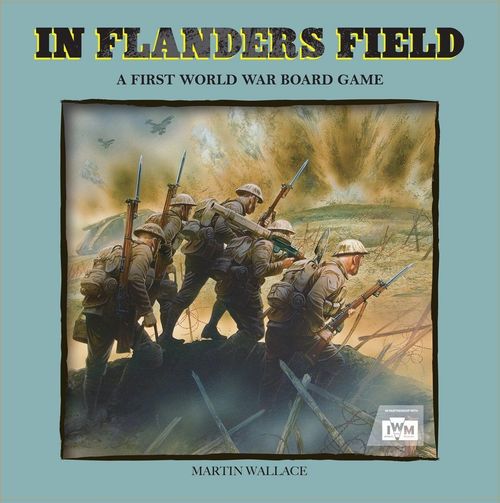
In Flanders Field
In Flanders Field Rulebook
Table of Contents
Table of Contents
Starting the Game
- Select your color (2 pawns).
- Place one pawn on the starting line of your color.
- Take 6 black pawns (8 for beginners) corresponding to the number of elements making up your section (troop pieces).
- Shuffle the cards and place one card in each location other than location no. 9 of the fixed card. The cards are of two types: British (green border) and German (blue border). If a row (not a column) of cards contains only German cards, then the three cards are discarded and a new set of three cards is drawn.
Playing the Game
Play clockwise. The game ends when a player has moved his colored pawn onto the Objective line (the opposite side of the map) OR when all players have lost all of their troop pieces. In a two-player game, it also ends when a player has no troop pieces left.
When it is your turn, you roll the three dice. Then select two dice and add the two values. You may then take the card from the location corresponding to the sum obtained. You must take a card if possible. This means you may be forced to take a German card with a blue border. Once vacated, the location is not refilled.
The space of card '9' holds a fixed card. Instead of taking this card, you place your second pawn on it.
You then have the choice either to roll the dice again and try to take another card (1) / (2), or to stop rolling the dice (3) and carry out the actions on the cards you have acquired so far.
(2) If you cannot take a card, you lose one troop piece for each grey symbol on the British cards you hold. You must also apply the penalties of all the German cards (black symbol) that you acquired during your turn. After that, you discard all the British cards you have (including those acquired in your previous turns, "May retain"). You must also remove your pawn from space '9' if it is there. You may then pass the dice to the next player.
(3) If you choose to stop rolling the dice, then you carry out the actions of the cards you have in hand, including the German cards.
Note: On his turn the player rolls the dice, takes the card and chooses whether or not to roll the dice again. When he stops rolling the dice, the effects (positive and negative) of the cards taken are applied.
Notes (1)
Some cards allow you to move your pawn on the battlefield, such as the "Infantery" card for example. You move your pawn the number of spaces indicated. You do not have to use the entire number of spaces allowed. Some cards allow you to move one additional space if you are prepared to sacrifice a troop piece.
If your pawn moves into a space containing a defensive line, then you cannot move any further this turn. The only exceptions to this rule are if you used a "Tank" card for this movement or if you can play a "Mines" card.
You also carry out the actions described on the German cards that you have acquired. Some German cards can inflict losses on you, which are indicated by black troop symbols. Each black symbol means that you must lose one troop piece.
Some cards can be kept until the next turn; these are identified by the text "May Retain".
If your pawn is on the space of card '9', use this "fixed" card as if you had an "Infantery" card. Remove your pawn after resolving the effect of this card.
When you have finished your turn, you discard all the cards you used this turn, including the German cards. The empty "card spaces" (3 to 11, except 9 of course) are refilled from the cards in the draw pile. If the draw pile is exhausted, shuffle the discard pile to form a new draw pile.
If a row (3 to 5 and 6 to 8; from 9 to 11 there is necessarily the fixed British card) contains only German cards, then all the cards in that row are discarded and the row is refilled from the draw pile.
Ending and Winning the Game
When a player has reached the Objective line, the game is near its end. The game continues until all players have had the same number of turns.
Once all players have finished their turn, if only one player has reached the Objective line, that player is declared the winner.
If two or more players have reached the Objective line, the one who has the most troop pieces is declared the winner.
If all players lose all of their troop pieces, the game ends immediately and the player who has the most "advanced" is the winner. In the case of a tie, the players are declared joint winners.