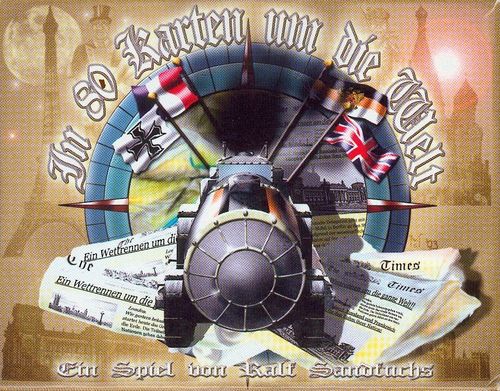
In 80 Karten um die Welt
In 80 Karten um die Welt Rulebook
Table of Contents
Table of Contents
Components
- 110 Cards
- 4 WaLaMob cards
- 4 Start cards
- 4 Boiler cards
- 4 Rules cards
- 11 Terrain cards
- 2 Pawn cards
- 1 Chip card
- 60 Travel cards
- 20 Base Camp cards
- This rules guide
Before the First Playing
Before your first playing cut up the chip cards to create two Weapon chips for use with the Explosive Balloons as well as eight markers for the Boiler cards. In addition cut out the two Pawn cards; by folding and, if need be, glueing, create four Pawns showing the symbols of the participating nations (alternatively each player can of course use a playing piece from elsewhere).
Goal of the Game
Three or four nations enter a race around the world with their steam-driven WaLaMobs (Water-Land-Mobiles). The vehicles drive over deserts and forests, cross ice fields, oceans and mountains, all for the fame and honor of king and country. The idea that it might not always end honorably, no one would ever admit, but that's exactly how it will turn out. Because in the end only thing matters: being first to cross the finish line.
Set-up
First choose the starting player: always the player best at sounding like a steam engine. If this is too silly for your taste, find another way to choose the start player (such as drawing from the face down Rules cards).
Each player receives a WaLaMob as well as the corresponding pawn and the matching Start card (recognizable by the national symbol). In addition each player receives a Boiler card with two markers and a Rules card. (The starting player receives the card with the finish flag on the back.) Next each player sets his WaLaMob out in front of him. The Boiler card is then placed to the left of the WaLaMob. The two arrow markers are each placed on the Boiler card so as to indicate value 5 on both the Kesseldruck [Steam Pressure] and Aktionspunkte [Action Points] tracks (alternatively a paper clip can be used if a marker should disappear).
Then the Terrain cards are shuffled and distributed to the players:
- 3 players: each receives 3 cards
- 4 players: each receives 2 cards
The remaining Terrain cards are placed nearby as they will be needed later. The Travel and Base Camp cards are shuffled into separate decks. Each player receives four Travel cards and one Base Camp card. The remaining decks are placed in the middle of play. The top card of each is revealed and placed next to the deck to form the start of the discard pile.
Creation of the World
Each player places his Start card before him. Each player's pawn is placed on the space with the arrow, which must point left, indicating the direction of travel (clockwise).
Now the starting player begins creating the world by placing one of his Terrain cards to the left or right of any Start card.
Then players continue in turn, placing one of their cards to the left or right of any other card; it is not important who has placed which card. This continues until all of the Terrain cards have been placed. After this adjust the placement to form a continuous circle of twelve Start and Terrain cards; this is the "racing course".
Important Note! Upon conclusion there must be the same number of Terrain cards between each pair of consecutive Start cards; this number corresponds to the number of Terrain cards each player received.
Finally the starting player begins the game with his first turn.
A Player's Turn
Each turn consists of the following phases:
- Determine Action Points
- Perform Actions
- Draw Travel and/or Base Camp cards
Let's consider these phases in more detail:
Determine Action Points
The Boiler card has two tracks, one showing 2-9, the other 0-9.
THE LEFT TRACK (valued 2-9) shows the STEAM PRESSURE of the WaLaMob. This is reduced by various actions and cards, but can also be increased by cards.
THE RIGHT TRACK (valued 0-9) indicates how many ACTION POINTS the player has left in the turn.
At the start of the turn the Action Points marker is placed to match the Steam Pressure (for example, if the Steam Pressure were 6 then the player would have 6 Action Points for the turn).
Afterwards the Steam Pressure is reduced by 1 point. (In the long run it will be necessary to do something to keep up the pressure in the Boiler.)
Important Note! Certain cards state that they must be played at the start of the turn; as an exception, these cards may be played in this phase.
Perform Actions
The player's Action Points are noted in order to fix how many and which actions he can perform. For each Action performed the Action Points marker is moved down a corresponding number of points. As soon as the "0" is reached the player cannot perform any more Actions. Thus it is not allowed to use more Action Points than one has available!
The following actions are possible:
- Move the WaLaMob
- Shovel Coal
- Play a Travel card
- Fire a Missile
- Make Improvements (only in Base Camps)
The number of Action Points each uses either depends on the Action or can be read on the card played.
The Individual Actions
Move the WaLaMob
As this is a race, movement is one of the most important Actions. WaLaMobs always race in the clockwise direction; moving backwards is not allowed.
The individual Terrain cards are all divided into four spaces. Normally it costs two Action Points to move one space forward. This cost can be adjusted if one has made certain alterations to his WaLaMob (see Make Improvements below). These reduce the movement cost, usually for particular Terrain types. However the Improvement has no effect in Terrain types other than those specified.
Certain Improvements require special rules:
- A Gas Balloon is activated as soon as it has been installed. Upon arrival at the next Base Camp, the player either turns over the Gas Balloon or discards it, his choice.
- Springs and Extra Rockets are activated by turning them 90 degrees. When they are "used up" the player similarly has the choice of either turning them over or discarding them.
An Improvement can be discarded at any time in one's own turn.
There are other cards which reduce movement cost. However, regardless of how many factors affect movement cost, every movement costs at least one Action Point.
For Space moved: the rules apply to the target space.
Example: Moving with Kufen [Skids] from a Sea space to a Desert space costs only 1 Action Point; however, moving from a Desert to a Forest space with Raupenketten [Treads] on board costs the usual 2 Action Points.
With cards which affect the current space or the current terrain card, it is the next space which is always considered.
Example: A player on the last space of a Sea card before a Forest card who takes up an "Ortskundigen" [local guide] receives a guide for Forest terrain.
Shovel Coal
The player can shovel coal into his Boiler. To do so he discards a Coal card from his hand and increases his Steam Pressure according to the large number on the card.
Shoveling Coal costs 1 Action Point regardless of the number of Coal cards.
THIS ACTION ONLY INCREASES THE STEAM PRESSURE, NOT THE CURRENTLY AVAILABLE ACTION POINTS.
Play a Travel card
The player may play Travel cards as long as he has sufficient Action Points remaining. The cost to play these can be found in the corners of the cards. The effects are also written on the cards. [English readers see the cards Summary below.] These cards are discarded after use.
There are four types of Travel cards:
- Aktion [Action] Cards: These cards represent actions affecting the player or his WaLaMob. They can be played at any time during one's own turn.
- Besatzung [Crew] Cards: These cards show team members who can help the player. To activate the special effects of these cards they must be placed along the upper edge of the WaLaMob. Each card states how many Action Points it requires. A WaLaMob may have at most one Crew card at any one time. Further use of the card's special abilities is free thereafter. A Crew card can be discarded at any time during one's own turn.
- Reaktion [Reaction] Cards: These cards can only be played in reaction to other cards. They cost no Action Points and only operate when a certain card or type of card has been played on the owner. The effects of each Reaction card are explained on the card.
- Störung [Interference] Cards: These cards affect other players. They can be played at any point in one's own turn or during another player's turn (see Playing Interference Cards below). Certain cards take effect only at the start of the target player's next turn. These are placed on his WaLaMob until the end of his turn.
Fire a Weapon
The target of a Weapon (see Add a Weapon below) can be any WaLaMob in Range. The Range is counted in spaces from the position of the firing WaLaMob. A Weapon can be fired in either direction.
A fired Weapon always hits (marksmen were better back then). Damage equal to the number of explosion icons on the Weapon card is subtracted from the affected Boiler's Steam Pressure (down to a minimum of 2). Alternatively, the attacker can decide to destroy an Improvement or a Weapon (the corresponding card is discarded) instead of causing damage.
The only defense against a Weapon are certain Reaction cards which either obstruct the firer or reduce the resulting damage.
A Weapon can be discarded at any time during one's own turn.
Firing a Weapon does not cost an Action Point. The Weapon card is discarded afterwards.
There are 3 types of Weapons:
- Erdtorpedo [Earth Torpedo] (4 in the deck): An Earth Torpedo bores its way through the earth's crust (at least 5 spaces away to a maximum of 16), emerges and explodes.
- Rakete [Rocket] (4 in the deck): A Rocket does not have the range of an Earth Torpedo, but makes up for it with greater explosive power. It explodes on impact. (This is the only weapon which permits attack on a WaLaMob in the same space.)
- Sprengballon [Exploding Balloon] (2 in the deck): The Exploding Balloon emerges from a WaLaMob on the Exploding Balloon chip with the corresponding number and is placed on a neighboring space. The Weapon card is turned 90 degrees to show that it has been "fired". Thereafter the owning player moves the chip one space in any direction at the start of each turn (including opponents' turns!). If the Exploding Balloon reaches a WaLaMob, it explodes and does its damage and the Weapon and chip are discarded. If the Weapon card is discarded before it explodes, the chip can no longer be moved.
Make Improvements (only in Base Camps)
On each Terrain card there is a space showing a tent, crane, tools and oil barrels -- the Base Camp. There the player can make the following Improvements to his WaLaMob:
- Add a Weapon: The player can place a Weapon card to the right of his WaLaMob. The card states how many Action Points must be paid. The Weapon can be fired immediately. A WaLaMob can have at most 1 Weapon on board.
- Make Improvements: The player can play an Improvement. The card states how many Action Points must be paid. The Improvement is effective immediately. A WaLaMob can have at most 1 Improvement on board.
IMPROVEMENTS PLAYED AT BASE CAMPS MUST COME FROM THE OWNER'S HAND.
Draw Travel and/or Base Camp cards
To end the turn a player may discard one of his Travel or Base Camp cards. Then he can draw Travel or Base Camp cards until he again has 5 cards in hand. He can only draw a Base Camp card when in a Base Camp space. The cards can be individually drawn and considered before deciding from which deck to draw the next card.
Then it becomes the turn of the next player.
Actions Outside One's Turn
Outside of one's own turn there are two ways to intervene in play:
- Playing Reaction Cards: Anytime a player is "attacked" by an opponent's card, it's legal to defend with the corresponding Reaction card.
- Playing Interference Cards: A player may play Interference cards on any other player even when it is not his turn. He simply indicates the Interference, at which time normal flow of play is interrupted until the Interference is resolved. As it is not his turn the player does not have any Action Points so the payment comes from his Steam Pressure. Thus playing out of turn reduces his Action Points for the next turn. An Action is only permitted if at least the corresponding number of Steam Points are available. If it would cause the Steam Pressure to fall below 2, playing the Interference card is not permitted.
If playing a card outside one's own turn it is not allowed to replenish the hand. This may first be done at the end of one's next turn.
End of the Game
When a player's pawn reaches or passes his own starting space the end of the game is not far away. After this each player takes one turn until it would be the turn of the starting player. Others may also reach their starting spaces. Instead of taking his turn, the starting player announces the end of the game. If the starting player was the next player after the one who crossed the finish line, the game ends immediately.
Determine who won:
- If only one player crossed the finish line, he wins.
- If multiple players crossed the finish line, the one who went furthest past the line wins.
If this does not determine a winner, I advise the opponents to settle the matter in civilized fashion arranging to meet the next morning for a duel (the player who crossed the finish line first chooses the weapons).