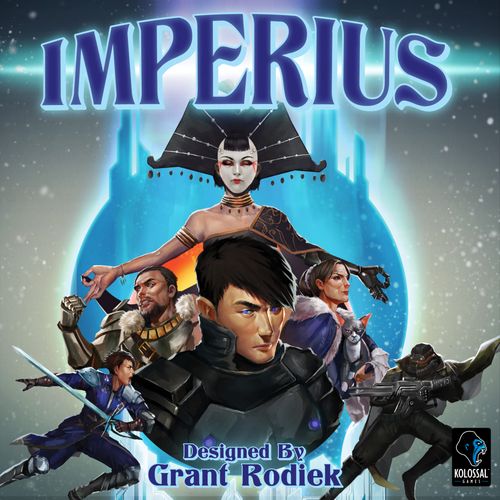
Imperius
Imperius Rulebook
Table of Contents
Table of Contents
Components
- 28 Faction cards: 1 Ambassador, 1 Assassin, 1 Commander, 1 Noble, 1 Royal Guard, and 2 Elders per faction.
- 12 Event cards
- 4 Basic Planet cards
- 8 Advanced Planet cards
- 24 Control tokens: 8 per faction
- 1 Score track
- 4 Score markers: 1 per player
- 4 Casualty markers: 1 per player
- 4 Faction boards
- 1 First player token
- 1 Rule book
- 1 Emperor's Legion card used in two-player games
Setup
-
Each player selects a Faction board and then claims all of the corresponding Faction cards: Ambassador, Assassin, Commander, Royal Guard, and each of that faction's Elder cards. Secretly, each player selects one of their faction's Elder cards to use in this game. Alternatively, players may shuffle their elders and choose one randomly. For your first game, use the basic Elders with no ability text. Return any unused Elder boards and cards to the box.
-
Each player takes the Control tokens of their faction and places them on the indicated spaces of their Faction board.
-
Each player takes a Casualty marker and places it on the skull space on their Faction board.
-
Randomly select four Event cards to use in this game. Return all other event cards to the box. For your first game, use the following Event cards: Diplomatic Envoy, Orbital Bombardment, Whispered Secrets, and Coalition Forces.
-
Randomly select one Advanced Planet card and place it in the play area starting the planet line. Then, return the remaining Advanced Planet cards to the box. Randomly select Basic Planet cards placing them in the planet line until there is one planet per player. Return any remaining Basic Planet cards to the box. For your first game use only Basic Planet cards: Akkara, Jedhallu Sanctum, Vyrid, and Wujen.
Two-Player Exception: In a two-player game, set up the planets as if it were a three-player game with one random Advanced Planet card and two random Basic Planet cards. Place the Emperor's Legion card to the side of the Planet cards.
-
Place the Score track near the play area and place the Score markers for each player on the 0 space of the track. Return any unused markers to the box.
-
Take all Faction cards and the four Event cards and shuffle them together. Place them in a facedown deck near the Score track.
-
Choose a player randomly to go first and give them the First Player token.
You're ready to fight for the Dawn Throne!
Goal of the Game
Imperius is a game of information, manipulation, and deception. Outwit and outmaneuver your enemies to score victory points. Play continues until one or more players earn 20 victory points, which signals the final round of the game. The player with the most victory points at the end of the game wins.
How to Play
Imperius is played in a series of rounds until the end of the game. Each round follows the same phases in order, each of which is explained in full detail below.
- Deal Phase: Players are dealt cards from the deck.
- Draft Phase: Players draft cards, including Faction cards belonging to their faction or those of their enemies, as well as Event cards.
- Dispatch Phase: Players take turns deploying their drafted cards one at a time to the planets.
- Resolution Phase: Cards deployed to the planets are revealed and resolved.
- Reset Phase: Cards are discarded, the First Player token is passed, and players check to see if the game ends. If the game does not end, shuffle the discarded cards and place them on the bottom of the deck.
1. Deal Phase
Deal each player five cards from the top of the deck.
Two-Player Exception: Deal each player six cards instead of five.
2. Draft Phase
During this phase, players draft cards belonging to any faction, theirs or their enemies, as well as Event cards. Each player will simultaneously choose one card to place in front of them facedown. All remaining cards are then passed to the player on their left. Each player then chooses another card to place in front of them. This continues until each player has drafted four cards.
After drafting their fourth card, each player passes their fifth card facedown to the First Player, who shuffles them and randomly deploys one to each planet faceup.
Two-Player Exception: At the start of the Draft Phase, both players draft two cards instead of one. Then players continue drafting one card at a time until each player has drafted five cards. The First Player takes the Emperor's Legion card that was set aside during setup and shuffles it with the two cards undrafted by the players. The First Player then randomly deploys one of these three cards to each planet faceup. Both players now draw a card from the top of the deck bringing their total cards in hand to six.
3. Dispatch Phase
Beginning with the First Player and proceeding clockwise, each player deploys one card from their hand to a single planet until each player has deployed all of their cards. Cards can be deployed to any planet, faceup or facedown, but the following rules must be followed:
- There can never be more than two facedown cards on any Planet card unless otherwise noted.
- If there are two facedown cards on a planet, subsequent cards must be deployed during the Draft Phase.
- There can never be more than five cards on a planet, including the initial card deployed during the Draft Phase, unless otherwise noted. If there are five cards on a planet, subsequent cards must be deployed to another planet.
Once each player has deployed all of their cards, this phase ends.
Special card rules: Some cards have special rules which are key to understand. If the rules on a card conflict with the rules in this book, the card takes precedence!
INFILTRATE: Cards with the INFILTRATE keyword do not count against a planet's five card limit. Regardless of the number of cards already on a planet, cards with INFILTRATE can always be deployed. There is no limit to the number of cards with INFILTRATE that can be deployed to a single planet.
REVEALED: Cards with the REVEALED symbol must be deployed faceup.
IMMEDIATE: Cards with the (!) symbol must be deployed faceup, and are resolved immediately when deployed to a planet as indicated by the card text.
The Event card Whispered Secrets contains all three special rules: Whispered Secrets is deployed to a planet revealed because of its REVEALED symbol, the card text is resolved immediately because of the IMMEDIATE symbol (!), and the card does not count toward the planet limit because of the INFILTRATE keyword.
Example: Akkara has five cards, two of which are facedown. No more cards may be deployed here unless they have INFILTRATE. Jedhallu Sanctum has four cards, one of which is facedown. One more card may be deployed here, and it may be deployed facedown. Vyrid has five cards, two of which are facedown. The sideways event card has INFILTRATE which does not take up one of the five spots on the planet. One more card may be deployed here faceup. Wujen has four cards, none of which are facedown. One card may be deployed here and may be deployed facedown.
4. Resolution Phase
All of the cards on each planet will be revealed and resolved to score victory points, inflict casualties, and place Control tokens on planets.
Beginning with the leftmost planet, the First Player reveals all facedown cards on the planet and arranges all cards in initiative order from lowest to highest. The cards are resolved in initiative order, one by one, until all cards are resolved. This process is repeated on the next planet to the right until all cards on all planets have been resolved.
-
There are two Nobles and one Assassin on Akkara. The Drakkai Assassin cannot target the Drakkai Noble so it targets the Quell Noble. However, the Quell player chooses to discard their Royal Guard to PROTECT the Quell Noble.
-
Because there are two Nobles on Akkara, Quell and Drakkai, the players need to determine which is favored. Quell has two Favor in total, one from their Commander and one from their Noble. Drakkai has one Favor in total from their Noble. The Quell Noble will score the planet giving two victory points.
-
The Quell Commander checks to see which faction is strongest on the planet. Both Drakkai and Quell have a Strength of two. Because they are tied, Quell does not place a Control token on the planet nor do they score one victory point.
Strength and Favor
When a card indicates the Strength or Favor icon, add up the value for all cards belonging to each faction on the planet being resolved to determine who has the most of the corresponding statistic.
Unfriendly Ties: No player receives a card's benefit if there is a tie between Strength or Favor.
Basic Planet: Basic Planet cards can be identified by their double-sided artwork.
Advanced Planet: Advanced Planet cards can be identified by their blue card backs.
A Basic Planet card shows a Title, a Victory Point Value, and an Effect. An Advanced Planet card likewise shows a Title, a Victory Point Value, and an Effect.
A Unit card shows an Initiative value, a Strength icon, a Favor icon, a Title, and an Effect.
Unit Cards
Each faction is comprised of the same six unit cards. There are slight differences in the Favor, Strength, and even victory points on some of these cards, but functionally each unit is the same. Only Advanced Elder cards differ in functionality.
Ambassador: If the Ambassador's faction is Favored on the planet, gain victory points as indicated.
Commander: If the Commander's faction is Strongest on the planet, gain victory points as indicated. In addition, place one of your Control tokens on the planet. If you have no more Control tokens, you can still place one, but you still score the indicated victory points.
Elder: Elders contribute Favor and Strength and have no additional functionality. Advanced Elders provide new abilities. Each Advanced Elder provides a unique effect that is described on the card's text. As always, cards take precedence over the rules in this book.
Noble: The Noble scores the victory point value of the planet to which it has been deployed. However, only one Noble can score each planet! If multiple nobles are deployed to a planet, the most Favored faction on that planet with a Noble breaks the tie. If any factions with a Noble on the planet are tied for Favor, no Nobles score the victory point value of the planet.
Assassin: The Assassin can target an enemy Noble on the planet with ASSASSINATE, and gain victory points as indicated on the Assassin. The discarded enemy unit's owning faction moves their Casualty marker one space to the right. If more than one Assassin is present on a planet, only the Strongest can ASSASSINATE. If any factions with an Assassin on the planet are tied for Strongest, no ASSASSINATE can be performed.
The Casualty track on each Faction board is numbered -1VP, -2VP, -3VP, -4VP, -5VP, -6VP, -7VP, -8VP. Each time a faction takes a Casualty, move that faction's Casualty marker one space further along the track. The space the marker occupies shows, at a glance, the total victory point penalty that faction has accumulated from Casualties (see Final Scoring).
Royal Guard: The Royal Guard contributes Favor and Strength. If another card belonging to your faction on the same planet as your Royal Guard is to be assassinated, you may instead discard your Royal Guard to prevent this. This decision is made when your card is targeted for assassination. You do not take a Casualty for the PROTECT key term.
Event Cards
Event cards are not owned by any faction. An Event card either triggers an immediate effect controlled by the player deploying it or changes how the planet to which it was deployed is resolved.
Atmospheric Storm will affect all players present on the planet where this event was deployed regardless of which player deployed Atmospheric Storm.
Expose is resolved immediately by the player who deployed the event to the planet. This effect is not resolved during the normal planet resolution step.
5. Reset Phase
First, check to see if any player has earned 20 or more victory points. If so, the game is over! Proceed to Final Scoring. Otherwise, play continues. Pass the First Player token to the left. Gather all cards that were deployed to planets or were discarded, shuffle them, and place those cards on the bottom of the deck. Begin a new round, starting with the Deal Phase.
Final Scoring
At the end of the game, players determine their final score by combining their position on the score track, scoring their Control tokens, and deducting points for casualties.
For each planet, the player who has the most Control tokens on the planet scores the planet's victory point value. If multiple players are tied for the most Control tokens, no player scores the planet's victory point value. Next, each player scores one victory point for each Control token they have on planets. For example, if the Drakkai player had a total of five Control tokens on planets, they would score five victory points.
Finally, players deduct one victory point per Casualty they have earned during the game.
The player with the most victory points wins. In the case of a tie, the player with the fewest casualties wins. If still tied, the player with the most Control tokens on planets wins. If still tied, the players share the victory and reign over the Known Universe together.
Advanced Rules
Once you are familiar with the core concepts of Imperius, you should play with the following rules to enhance the experience.
Advanced Elders: During setup, in secret, each player selects one of their faction's Elder cards to use. Alternatively, players may shuffle their elders and choose one at random.
Advanced Planets: During setup, replace one basic planet with a randomly selected advanced planet. Advanced planets will introduce new rules that apply only to the advanced planet. Some of these planets have an ongoing penalty or reward, while others have abilities that occur when cards are deployed there.
Events: During setup, randomly select four Event cards to use.
Turn Reference
- Deal Phase: Players are dealt cards from the deck.
- Draft Phase: Players draft cards, including Faction cards belonging to their faction or those of their enemies, as well as Event cards.
- Dispatch Phase: Players take turns deploying their drafted cards one at a time to the planets.
- Resolution Phase: Reveal and resolve cards deployed to the planets.
- Reset Phase: Players check to see if the game ends. If the game continues, the First Player token is passed and cards are discarded to be shuffled and placed on the bottom of the deck.
Key Terms
ASSASSINATE: Discard one enemy card on the same planet as the card with the key term. The owning faction of the discarded card gains one Casualty. If a specific card type is noted on the card with the key term, the use of ASSASSINATE is limited to a target of that type.
Deploy: This means to play a card to a planet.
Enemy: An opposing faction when referring to a player. A card of an opposing faction when referring to a card.
Favored: The faction with the most Favor on a planet. Multiple factions cannot be Favored.
INFILTRATE: Cards with the INFILTRATE keyword do not count against a planet's five card limit. Regardless of the number of cards already on a planet, cards with INFILTRATE can always be deployed. There is no limit to the number of cards with INFILTRATE that can be deployed to a single planet.
IMMEDIATE: Cards with the (!) symbol must be played faceup, and are resolved immediately when deployed to a planet as indicated by the card text.
PROTECT: This means to discard a card with this ability to prevent a single ASSASSINATE attempt against another unit of your faction on the same planet. The use of Protect is declared when a unit belonging to your faction is targeted by ASSASSINATE.
REVEALED: Cards with the REVEALED symbol must be deployed faceup.
Strongest: The faction with the most Strength on a planet. Multiple factions cannot be Strongest.
Contributions
Designer: Grant Rodiek Illustrator: Gong Studios Graphic Designer: Chris Byer Lead Developer: Travis R. Chance Developers: AJ Lambeth & Chris Hamm Production: Zongxiu Yao-Charpentier Project Manager: Kira Anne Peavley
Thank You to: Antonio Romeo, David Miotke, and Kevin Gibson, Beth and Peaches, Jason Funk, Chris Haemmerle, Van Willis, Kevin Haemmerle, Mark Burke Board Games with Panda, The Drinking Meeples, and Family Time Games.