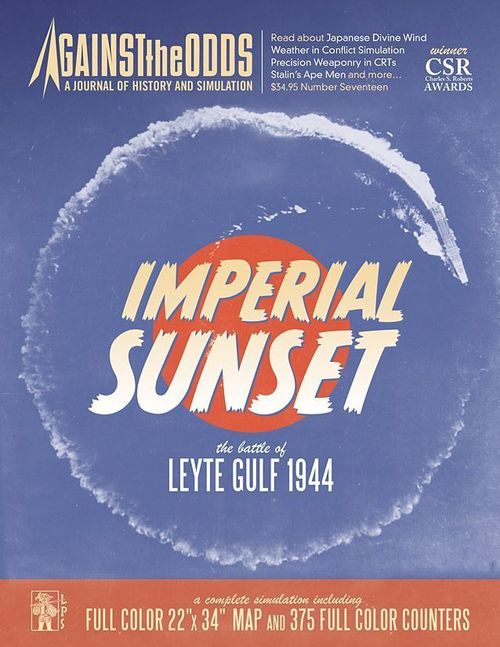
Imperial Sunset: The Battle of Leyte Gulf 1944
Imperial Sunset: The Battle of Leyte Gulf 1944 Rulebook
Table of Contents
Table of Contents
- Read This First
- 1.0 Introduction
- 2.0 Game Components
- 3.0 Sequence of Play
- 4.0 Activation Phase
- 5.0 Task Forces (TF)
- 6.0 Movement
- 7.0 Detection
- 8.0 Combat
- 9.0 Ship Damage
- 10.0 Submarines
- 11.0 Special Rules
- 12.0 Victory Conditions
- 13.0 Scenarios
- 14.0 Optional Rules
- Errata and Addenda: Components and Charts (Aug. 15, 2025)
Read This First
We've organized the overall structure of the rules of this LPS simulation game to follow this game's sequence of play in introducing concepts. The rules themselves are written in a format known as the Case System. This approach divides the rules into Modules (each of which deals with a major important aspect of play). Modules are numbered sequentially as well as possessing a title. Each Module is divided into Sections (that deal with a major sub-topic inside the Module) which are also numbered sequentially. Modules and Sections are introduced by some text that briefly describes the subject covered by that particular Module or Section. Finally, the majority of each Section consists of Cases. These are the specific, detailed rules that govern play. Each Case is also numbered sequentially. The numbering follows a logical progression based upon the number of the Module of which the Cases are a part. A Case with the number 7.51, for example, is the first Case of the fifth Section of the seventh Module of the rules. Each Module can have as many as ninety-nine Sections and each Section can have as many as ninety-nine Cases. The numbering system is designed as an organizational aid. Use it to determine where a Case is located in the rules.
The example above is the number of the fourth Case of the first Section of the third Module of the rules. (Case 3.1.4.)
Learning to Play the Game
Begin by familiarizing yourself with all of the components listed for this game. Then skim through the charts and rules, reading all the titles of the Modules and Sections. Set up a game scenario or portion of a scenario (after reading the applicable Module) and play a trial game against yourself. During this trial game, try referring to the rules only when you have a question and remember the numbering system we employ makes it easy to look up rules when you do. While a trial game may take you an hour or two, it is the quickest and most pleasant way to learn (short of having an experienced friend teach you). We also don't recommend attempting to learn the rules word-for-word. Memorizing all the details is an effort that few can do. We've written these rules to be as comprehensive as possible - but they are not designed to be memorized. Taking in the rules in this way (as you play along) is the best approach to mastering this game. We're always open to suggestions on how to improve the comprehension of our rules. Write to us (see addresses in 3.0) if you have an idea on how we can communicate better with you.
1.0 Introduction
Imperial Sunset is a moderately complex simulation of the largest naval battle in history, the Battle of Leyte Gulf. The battle was fought from October 23-26, 1944, as the US returned to the Philippines, landing on the island of Leyte. The US Navy and the Imperial Japanese Navy fought a series of actions that are collectively known as the Battle of Leyte Gulf. The historical outcome was a decisive defeat of the Imperial Japanese Navy, virtually eliminating it as a viable force for the remainder of the war. For the US Navy, it was a victory that was almost squandered due to command problems.
1.1 Game Scale
Each game turn is six hours; there are three day turns and one night turn for each calendar day. Each sea hex is approximately 25 nautical miles across. Each naval unit represents 1 (battleships and carriers) to 4 (DDs, DEs and other smaller craft) ships.
1.2 Rounding Convention
When making any calculation for game purposes, round up all fractions of 0.5 and over to the next highest number unless otherwise indicated. Round down fractions less than 0.5.
Errata (Aug. 15, 2025), new Case 2.3.4 Rounding Convention: When directed to half a quantity in the game, drop any fraction, but never less than 1.
2.0 Game Components
The following components make up a complete copy of the game:
2.1 Game Map
The map is used for all Task Force (TF) movement and movement by air units. Two tactical displays are used, one for naval surface engagements and another for air attacks.
2.2 Charts and Tables
The following tables are used to regulate play. Many are found on the Player's Aid Charts.
- Search Table
- Task Force Composition Cards, one for each player. Note: They should be kept from the opposing player's view at all times.
- Damage Table
- Critical Hit Table
- Damage Logs, one set for each player. Note: Players should make copies before play.
- Air-to-air Combat Table
- Antiaircraft (AA) Table
- Submarine Attack Table
- Anti-submarine Warfare Table
Not provided, but needed for play, is a 10 sided die. A die roll of 0 is treated as ten (not zero). Players will also need an opaque container (cup, bowl, envelope, etc.) from which to randomly select marker units during the course of the game.
If any of these parts are missing or damaged, write to the publisher (see the contact details in the printed rulebook).
2.3 Playing Pieces
The playing pieces are of two types: combat and marker units. Combat units are either Naval or Air. Marker units are used to record various game functions and/or events.
2.3.1 Sample Naval Unit
See diagram on facing page.
Note: USN units are distinguished by a differing color band as to whether they are 3rd or 7th Fleet units.
Diagram labels (Sample Naval Unit):
- Front, Normal Mode: AA Fire Combat Factor; Surface Gunnery Combat Factor; Surface Gunnery Range; Torpedo Capable (if displayed); Unit ID.
- Back, Fired Mode: Protection Factor; Movement Factor(s); Ship Type; Fired Indicator.
2.3.2 Sample Air Unit
See diagram on facing page.
Carrier-based aircraft have identical values, but are distinguished with the name of their parent ship. USN carrier-based units also have their squadron identification shown. The aircraft assigned to USN escort carriers function differently than aircraft assigned to fleet carriers. Note: See Case 6.5.2 for more details regarding FB air units based on escort carriers.
Note that all IJN air units (except kamikaze) have two steps. When a full-strength IJN air unit loses a step, it is turned over to its weaker side. When an IJN air unit already on its weaker side loses a step, it is destroyed. USN air units never lose steps, but full-strength units are flipped over to their fatigued side following operations or as a result of engagement.
Diagram labels (Sample Air Unit): Air Combat Factor (ACF); Flight Range; Aircraft Type; Unit ID; Back (Japan) Reduced; Back (US) Fatigued.
2.3.3 Game Markers
See key to the right (printed marker key on page 3).
- Detected / -1 MP or -2 MP markers.
- Task Force (TF) markers. Each TF has two markers; one is an Activation (AM) / Moved marker, the other is used on the game map to indicate where the TF, and the ships that make it up, is located.
- Smoke Markers.
- Submarine Contact. The reverse side indicates the presence of a US or Japanese submarine or a false contact.
2.4 Abbreviations
- AF - Air Fleet (Japanese)
- APD - Transport
- AVGR - TBF Avenger (Carrier Torpedo Bomber)
- B - Bombers
- BET - G4M "Betty" Bomber
- CAP - Carrier Air Patrol
- CSR - F4U Corsair (Carrier Fighter)
- CV - Carrier
- CVL - Light Carrier
- DD - Destroyer
- DE - Destroyer Escort
- DES D - Destroyer Division
- DES RN - Destroyer Squadron
- DTLS - Dauntless (Carrier Fighter-bomber)
- ES Carrier - Escort Carrier
- ES Destroyer - Destroyer Escort
- F - Fighters
- FB - Fighter Bombers
- HB - Heavy bombers (represent B-17 and B-24 types)
- HD - Helldiver (Carrier Dive-bomber)
- HLCT - F6F Hellcat (Carrier Fighter)
- IJN - Imperial Japanese Navy
- LT - Carrier Light Carrier
- LT - Cruiser Light Cruiser
- LT AA CRSR - Anti-Aircraft Light Cruiser
- OS - K-43 "Oscar" Fighter
- PT - Patrol torpedo boat
3.0 Sequence of Play
The following phases make up a complete game turn:
3.1 Initial Phase
During this phase, all new units are entered into play and both players may adjust the composition of their Task Forces (TF). On turns indicated on the Turn Record, the IJN rolls for air reinforcements. During all day turns, both players allocate Combat Air Patrol (CAP) missions to be performed over the aircraft carrier's own TF. Also only on day turns, the IJN player rolls for all flown air units to determine their availability this turn. Determine the availability of submarines. The USN player places his PT Boat marker. Lastly, both players place all active TF and other Activation Markers into the Activation Pool.
3.2 Activation Phase
All units, including naval TF and land-based air formations, move and fight during the Activation Phase. During each Activation Phase, there are a varying number of activation sub-phases as each TF or land-based air formation is activated on a semi-random basis as TF markers are withdrawn from the Activation Pool. After all units from both players have been activated, the Activation Phase is concluded.
3.3 Terminal Phase
During this phase, both players move damaged units that are not assigned to a TF. The IJN player moves his damaged ships first followed by the USN player. During any day Terminal Phase, USN air units in the Flown Box are turned over to their exhausted side and placed in the Ready Box on their TF Composition Card. If this is a night Terminal Phase, all exhausted USN air units are rolled for (by carrier) to determine if the units are placed on their regular side, and how they are deployed in the Ready Box in their TF Composition Card. Remove all detected markers from TF units or flip the TF marker to its Undetected side during every night Terminal Phase (see optional rule 14.7). Remove all Sonar/submarine contact markers during every Terminal Phase.
Errata (Aug. 15, 2025), Night Recoveries (discrepancy between Sections 3.3 and 6.5.3): The procedure for night recoveries is stated differently between these two rules. Players desiring a simpler game should use Rule 6.5.3 as is and ignore the die rolls mentioned in Section 3.3. Players looking for a bit more realism should use the rule as stated in Section 3.3, but then reference Section 16.4 in the Optional Rules for the actual die roll numbers and process. (Section 16.4 is not in the source file; see the source note.)
4.0 Activation Phase
Combat units, both air and naval, may be moved about the map and conduct combat operations when the fleet or formation of which they are a member is activated. The timing of activation is determined when players randomly select formation/fleet activation markers from the opaque container.
4.1 Task Forces (TF)
Every TF (dummy and real) has two markers. One is used to track movement on the map and the other is placed in the Activation Pool at the start of every turn. Land-based air formations have only a single marker that is placed in the Activation Pool at the start of every turn. On certain turns, Kamikaze units are placed directly into the Activation Pool (see 11.1). It is recommended that the players place all the TF and air unit markers in an opaque container for the Activation Phase.
4.2 Activation
At the start of each activation sub-phase, one of the players randomly draws a single marker from the container. This is the TF (or air formation) that is activated for that sub-phase. The owning player moves and fights with the TF or air formation that has been drawn. This process continues until all markers have been withdrawn from the container and all TF and air formations have been activated. Players can track which TF have already been activated by placing the drawn TF marker on the TF Composition Card on its "Moved" side after activation. In order to track which TF have moved on the game map, turn the TF over to its moved side when its activation is complete.
4.3 Command Chits
At the start of each Activation Phase, there is one USN and one IJN Command Chit placed in the Activation Pool. When the USN Command Chit is drawn, the USN can activate any one TF or the USAAF if it has not already been activated. After doing so, he returns the command chit to the Activation Pool. Thus, the USN command chit can potentially be used to activate several TF during a single turn. The IJN player may also activate any one TF or air formation of his choice (exception: the IJN player cannot activate Kamikaze units through the use of his Command Chit) that has not already been activated when he draws the IJN command chit. However, after he has done so, he does not return the IJN Command Chit to the Activation Pool. Thus, the IJN Command Chit activates a single TF or land-based AF during a turn. For both players, when the marker of the TF or air formation activated by the players' Command Chit is drawn from the Activation Pool in a later sub-phase, simply ignore it and select another marker. Command Chits do not allow a TF or air unit to move twice in an Activation Phase, but they do permit the players an enhanced degree of control over their forces.
4.4 Task Force Activation
When a TF is activated it can do the following:
- Move
- Search its own hex
- Conduct air searches
- Conduct air attacks
- Conduct surface attacks
These actions are done in any order desired by the owning player. For example, a TF can move while attempting to detect enemy TF in any hex it enters or by using its aircraft, launch an air strike against a detected enemy TF. It can also engage in surface combat against an enemy TF in the same hex. When all movement or combat is finished, the TF activation is over.
Example of play (1): Japanese "Force A" (TF1) has been activated. The lowest speed of any ship in the TF is a "4", so the speed of the entire TF is 4. The TF has a -1 MP marker placed on it from an air attack last turn, so its speed this turn is actually 3. The TF begins in hex 3223 and moves two hexes to hex 3423 where it enters the same hex as a USN TF. It conducts a search in the hex for the USN TF (this costs no MPs). After a successful search, IJN TF1 initiates surface combat with the USN TF. The initiation of surface combat ends TF1's movement, despite the fact that it had expended only two of its three MPs.
Example of play (2): USN TG 38.3 (TF3) has 5 MPs as all its ships are speed rated 4/5 and this is an even-numbered game turn. It begins in hex 2120 and conducts an air search. It finds an IJN TF in hex 3215 (beyond its normal strike range), so it spends 3 MPs to move toward its intended target, and then spends its last 2 MPs to launch an air strike against it.
4.5 Land-based Air
These formations can only conduct search and air attacks. Both can be done in the same sub phase.
4.6 Kamikazes
These units, when activated, can only conduct an air strike. For more, see Section 11.1.
5.0 Task Forces (TF)
All naval units are assigned to a TF. Under certain conditions, naval units can change their assigned task forces. As a result of damage, naval units may proceed independently without a TF assignment.
5.1 TF Creation and Disbandment
TF may be created or disbanded during the Initial Phase. Any ships present in the same hex can be used to form/merge into new/existing TF during the Initial Phase of the turn. If a new TF is created or abandoned, be sure to add or remove its marker from the Activation Pool. Thus, at the start of each Activation Phase, only active TF (real and dummy) have a marker in the Activation Pool.
If a new TF is formed from an existing TF, it has the same detection status as the TF it came from. Any damaged ship that is detached from a TF also has the same Detection status (Section 6.4). Note: This also applies to any TF formed as a result of Reorganization, Case 6.2.1.
When forming a new TF, the owning player should inform the opponent of the number of ships in the new TF as if it were a Detection DR Result of 5 (both sides).
5.2 IJN TF Limits
The initial IJN TF assignments reflect the historical order-of-battle. Within restrictions, the IJN player can alter the number of active TF and their composition once play begins. Active IJN TF at the start of play include the Force A, Force B, Force C, Shima Force, Ozawa Force, Reinforcement Escort Force, Destroyer Division 21, and the Transport group. The IJN player can have a maximum of ten naval TF active. As there are eight TF active at game start, as many as two additional real or dummy TF can be created initially. In addition, the IJN player has two land-based air formations.
5.3 USN TF Limits
The USN player can have a maximum of 16 naval TF active. His initial assignments reflect the historical structure of the forces present at the battle. Nine TF are active at game start including four from the Third Fleet (TG 38.1, TG 38.2, TG 38.3, TG 38.4) and five from the Seventh Fleet (TF 78, TF 79, Taffy 1, Taffy 2, Taffy 3). As there are nine TF active at game start, as many as seven additional real or dummy TF can be created.
Errata (Aug. 15, 2025), 5.3 USN TF Limits (correction): There are eight (not nine) Active USN TF at the start of the game. Ignore the reference to TG 38.1 (this is a reinforcement and does not start the game in play). (The errata also lists an "unofficial" USN and IJN Activation marker variant; it is not part of the official rules and is not transcribed.)
5.3.1 USN Fleets
Units of the Third Fleet can never be assigned to a TF with Seventh Fleet units and vice versa.
5.3.2 US Land-Based Air
The USN player controls a single land-based air force formation (USAAF bombers flying out of the island of Morotai). When activated, it controls both US land-based air units. This unit also represents land-based and tender-based long-range search aircraft.
5.4 Dummy TF
Both players can create dummy TF. A dummy TF has no ships assigned. Dummy TF have a maximum speed of four hexes per turn. Since they have no ships, they cannot engage in searches or combat. If the opposing player gains any type of detection on a dummy TF, it is immediately removed from the map without a contact report being made. If a marker of a removed Dummy TF is subsequently drawn from the Activation Pool, it is simply ignored.
Dummies are introduced during the Initial Phase. They can be placed anywhere, but it is recommended that they be placed in the same hex as an existing TF so that the controlling player can "split" his force from a single hex, thus confusing the enemy. Dummies can be voluntarily removed by the owning player during any initial phase. They can be reused during the same initial phase.
5.5 Stacking
Up to two friendly TF may be in the same hex. Opposing TF may occupy the same hex and do not affect friendly stacking limits. This restriction applies during all phases of each turn. See Section 6.4 and Case 8.3.9 for the only exceptions. Additionally, for the USN player, only Third Fleet TF can stack with other Third Fleet TF, and only Seventh Fleet TF can stack with Seventh Fleet TF.
Up to 16 ship units can be assigned to a single TF. For purposes of determining this limit, a destroyer unit counts as a single unit, regardless of how many actual destroyers are assigned to it.
5.5.1 Carrier TF
To reflect the doctrine of the day, the USN player is restricted on the TF assignment of Third Fleet units. Only four TF can be formed with carriers (fleet or light carriers) and each can include a maximum of five carriers. Likewise, the USN player has restrictions on his arrangement of Seventh Fleet units. Only four TF can be formed that include escort carriers and no more than six escort carriers may be assigned to a single TF.
6.0 Movement
Units are moved about the map by the owning player when an Activation Chit is drawn.
6.1 Naval Units
During movement, TF markers move from hex to hex expending MP to do so. Hexes cannot be skipped in movement. Only light blue sea hexes may be entered. Dark blue partial sea hexes are not passable.
Errata (Aug. 15, 2025), The Map, Shoals (clarification): Shoals along a hex side will block movement. For example, movement from 3722 to 3723 is not allowed.
6.2 TF Movement
The number of movement points available to a TF is equal to the speed of the slowest ship in the force. Thus, the entire TF moves at the maximum movement rate of the slowest ship in the force. Of course, a TF can choose to move at a slower speed or even not at all.
Some naval units have a mixed speed (e.g. 3/4). These units move at their lower speed during all odd-numbered game turns and during odd-numbered rounds during surface combat; they use their higher speed during even-numbered game turns and surface combat rounds.
6.2.1 Reorganization
During the Initial Phase, any TF that was newly formed, or an existing TF that combined or divided in any way, loses one MP.
6.2.2 Carrier Operations
Any TF with a carrier (fleet, light, or escort) that conducts a strike mission (not CAP) expends two MPs. This cost is in addition to any hexes entered during movement. A TF cannot conduct a strike unless it has adequate MPs to do so. Note: This represents the cost in time to turn and move the TF into the wind in order to launch and retrieve aircraft.
6.2.3 Air Attack
Any TF that undergoes an attack by at least four enemy air units during a single activation sub-phase loses one MP. A maximum of two MP can be lost in this manner per turn. This penalty takes effect during the TF's next activation (which could come the following game turn).
Errata (Aug. 15, 2025), 6.2.3 (Additional Optional Rule): Do not count Fighter units that participate in an attack on a TF as part of the 4 air units that impose the -1 Movement penalty if the fighters were engaged by friendly CAP.
6.2.4 Damage Markers
Movement restrictions due to ship damage are indicated by the use of -1/-2 MP markers. To maintain ambiguity regarding whether or not a TF on the board is a dummy, these markers are placed on the appropriate TF space on the TF Composition Card. A TF is not guaranteed a minimum number of MPs; all of its available MP could be absorbed by penalties. However, movement penalties do not carry over an activation sub-phase; all penalties are removed following the TF movement. If a ship in a TF with a movement penalty detaches from the TF, it carries its movement penalty to its new TF.
6.2.5 Surface Combat
Whenever the active TF engages in surface combat, its movement is concluded, even if the TF had MPs remaining before the combat.
6.3 Movement Restrictions
IJN TF can exit the map off the western and northern edges. Once they have exited, they cannot return to play. USN damaged units and their escorts can exit the eastern edge of the map, but cannot return. Additionally, USN units can enter the San Bernardino Strait (hex 3119) but cannot advance any farther west. USN units can also enter Surigao Strait (hex 3722); however, only USN cruiser (any type) and destroyer units can advance beyond Surigao Strait and these units can only go a single hex to the west.
6.4 Movement of Damaged Ships
When a ship is damaged, the owning player can decide to have the ship detach from its TF at the end of the activation sub-phase that it was damaged. If the choice is made at this time, there is no MP cost for detaching damaged units. When detached, the damaged ship(s) is removed from the TF Composition Chart and is placed directly on the game map in the hex where it was damaged. Place a Detected marker on the ship(s).
Detachment of damaged units permits the parent TF to move at a greater speed with its remaining undamaged ships. In the next initial phase, the owning player may create a new TF for the detached damaged unit and its escorts (escorts discussed below). To do so, the owning player may either create a new TF from any currently unused TF markers or immediately remove a dummy TF marker and place it in the hex with the damaged ship(s). The new TF moves when activated in the usual manner.
If no unused TF markers remain and the owning player chooses not to remove a dummy TF, the damaged ship(s) remains on the game map in full view and is always considered to be detected. It cannot be activated and moves only in the Terminal Phase. Once a damaged ship detaches, the damaged ship cannot rejoin any TF (but it can create its own TF). It must proceed to the nearest base as fast as possible (i.e., expending its maximum number of MP in the shortest distance/number of hexes possible).
6.4.1 IJN Detached Destroyers
Damaged IJN heavy cruisers, battleships, and carriers can be escorted by one or two destroyers. To detach a destroyer from its parent destroyer squadron, mark off the appropriate number of hits on any destroyer squadron present in the hex and place a detached destroyer marker(s) with the damaged ship. This escort is now part of the new TF (or is placed on the map) and cannot rejoin the original squadron, and if exited from the map is permanently out of play (i.e., once exited with the damaged ship(s) the escort vessel(s) is also out of the game).
6.4.2 Damaged USN Ships
These units proceed to the east edge where they exit (they are assumed to be going to the fleet anchorage at Ulithi). When detached, USN ships can be escorted by any number of undamaged ships. This escort is now part of the new TF (or are placed on the map) and cannot rejoin their original TF (i.e., once exited with the damaged ship(s) the escort vessel(s) is also out of the game).
6.5 Aircraft Movement
Land-based aircraft are moved and perform combat when a player's land-based air AM is selected. Carrier-based aircraft are moved when the carrier's TF is activated.
6.5.1 Carrier-based Aircraft
Each carrier has a number of assigned aircraft units. At the beginning of the game, these units start on their respective carrier as indicated by the scenario. Each TF display has a number of boxes for the aircraft assigned to the carriers within the TF. These boxes are Ready, CAP, and Flown. At the start of each day turn, all units start in the Ready Box. During the Initial Phase, units designated to fly CAP over their own TF are placed in the CAP Box. When the TF is activated, its air units can conduct CAP missions over a different TF or conduct strike missions. Fighter units flying CAP over a different TF are simply placed in that TF CAP Box. Units flying strike missions are placed on the target hex of the map whenever a strike mission is flown. When determining the range of a strike mission, the hex of the carrier is not included, but the hex of the target is. After combat is resolved in the target hex, carrier based air are placed in their TF Flown Box and flipped to their exhausted side.
6.5.2 USN Escort Carriers
An air unit based on an escort carrier functions differently than its fleet carrier-based counterpart. An escort carrier-based air unit can function as either a fighter or bomber in a turn. Which type, F or B, the air unit will be for the turn must be declared when the Fleet's AM is drawn. Though its combat factor can be used for either air-to-air combat or surface attack, the squadron can perform only a single mission in a turn. It can either be assigned a CAP mission in which case its combat factor is obviously used for air-to-air combat, or it can perform a surface strike mission in which case the squadron acts in all respects as a strike aircraft (its combat factor is used for surface attack). Within these guidelines, an escort carrier squadron can change its role from turn to turn.
6.5.3 USN Aircraft Exhaustion
Air units on a fleet or light carrier (not escort carrier) can fly more than one mission in a day. In the Terminal Phase, air units in the Flown Box are flipped to their Exhausted side and placed in the TF Ready Box. When these air units conduct another mission in the same day they are placed in the Flown Box and cannot conduct any other missions for the remainder of the day. Thus a non-CAP carrier-based aircraft unit can conduct two missions daily. During the Terminal Phase of a night turn, exhausted aircraft units are placed in their TF Ready Box after being turned over to their regular side.
Errata (Aug. 15, 2025), 6.5.3 (correction): Delete the first sentence of this rule (struck through above; the printed first sentence reads "Air units on a fleet or light carrier (not escort carrier) can fly more than one mission in a day."). The night-recovery discrepancy with Section 3.3 is noted under Case 3.3.
Reminder: Air units based on an escort carrier can only perform one mission per turn.
Note: See optional rule, Section 14.6.
6.5.4 Combat Air Patrol (CAP)
Fighter units (only) can conduct CAP. Units assigned to CAP missions over their own TF stay in their TF's CAP Box throughout the day (thus they can stay aloft up to three turns) but must be placed in the Exhausted Box at the conclusion of the last day turn of each day. During any Initial Phase, a unit on CAP can be removed from that assignment and placed in their TF's Ready Box. Fighter units can also fly CAP over a TF other than their own, but cannot stay aloft indefinitely. During the Terminal Phase of any day turn, these units are returned to their TF's Ready Box and flipped to their Exhausted side. They are still available to fly one more mission that day in the manner discussed above.
Errata (Aug. 15, 2025), 6.5.4 (clarification): Air units on CAP are flipped to their Exhausted side (not placed in an Exhausted space/box as mentioned in the rule).
6.5.5 Carrier Damage
If a carrier is destroyed or damage to the carrier renders it unable to operate aircraft, its air units are removed from the game (they are considered combat ineffective for the period of the game and eliminated if the carrier is later sunk).
6.5.6 USN Aircraft Extended Range
USN non-escort carrier aircraft units, not already on their Exhausted side, can fly extended range missions. When doing so, they can fly up to 12 hexes but do so with their exhausted strengths. After returning to their carrier, they are immediately placed in the Flown Box in their TF Box.
6.5.7 IJN Carrier Air Units
IJN carrier air units that fly strike missions cannot return to their carriers. They can land at any Japanese airfield within range from their target hex. The units cannot fly again in the turn should a ground-based AM be subsequently drawn. Once based ashore, they cannot return to their carriers and are considered to be land-based units for the remainder of the game. The airfield they landed at determines which Air Fleet they are now subordinate to. IJN carrier-based units that fly CAP can return to their carrier. If they fly CAP over a TF other than their own, they are placed in the Flown Box during the Terminal Phase and cannot fly any other mission that turn.
6.5.8 US Land-Based Air Units
When the USAAF marker is drawn, the USN player can conduct searches against TFs located within the land-based search area indicated on the game map. The USN player can also enter one or both of the USAAF units in the same area to conduct a strike mission. However, USAAF heavy bomber units can only fly once per day. When its marker is drawn, the USN player decides whether or not to use his strike aircraft this turn or to save them for a future turn during the same day. Once they conduct their daily mission, heavy bombers are placed in the Flown portion of the USAAF box on the USN TF Composition Card. Searches can still be flown even if a strike mission is not.
6.5.9 IJN Land-Based Air Units
There are two Japanese land based air formations in the game, each with its own marker. Each IJN air unit is marked as to its subordination. The 2nd Air Fleet operates from any airfield on Luzon north of hex-row 2500 while the 1st Air Fleet operates from any other airfield on the map. When destroyed, place IJN air units in the box provided on the game map. On certain turns indicated on the Turn Record, the IJN player rolls during the Initial Phase on the Japanese Air Reinforcement Table to see if any additional units appear. If any do, they are selected at random from the units in the Destroyed Box and placed in the Ready Box of the appropriate Air Fleet on the IJN Task Force Composition Card. If no aircraft are in the Destroyed Box, then none are received that turn. Also during the Initial Phase of every day turn, the IJN player determines how many units are moved from the Flown Box to the Ready Box of each Air Fleet. For both air fleets, a 1-3 must be rolled to ready an aircraft unit. Unlike USN aircraft units, IJN units are not automatically made ready at the start of a new day.
Errata (Aug. 15, 2025), 6.5.9 (correction): The rule should read "north" (not "west") of the 2500 hex row; the text above has been corrected accordingly. The legend and Japanese Air Fleet indicators are correct as depicted on the map.
Searches and CAP can still be flown if strike missions are not. For determining the strike range of IJN 2nd Air Fleet aircraft, all missions are traced from Clark Field (hex 2412).
6.5.10 Scramble
When either side has a carrier in a TF involved in a surface attack, he can "scramble" all aircraft on all carriers in the TF that are not currently in the Flown Box. These aircraft are eligible for action in the surface engagement. There is no movement penalty for a TF that scrambles aircraft.
6.5.11 Night Flying Prohibition
No aircraft can fly during night turns. Accordingly, do not place any of the land-based air formation markers in the Activation Pool during a night turn.
7.0 Detection
A TF must be detected before it can be attacked by either air or surface forces. Note: Submarines can detect a TF in order to attack it, but this does not put the TF into a detected status. When activated, each (non-dummy) TF and land-based air formation may attempt to detect enemy TFs within its search range. For TFs without carriers, this means any enemy TF in its hex. For TFs with carriers, this means any enemy TF within search range of its aircraft. If detected, a detected marker is placed on the affected TF. This marker remains on the TF until the Terminal Phase when it is removed.
7.1 Surface Search
When activated a TF can always search the hex it is in; this includes any hex it moves through during its turn. Only one detection attempt can be made per hex during each phase a TF is activated.
7.1.1 Mutual Surface Search
If opposing TFs are in the same hex, both TFs must conduct searches against the other when one TF becomes activated. This is the only occasion when the player not moving an activated TF can conduct any search action.
7.2 Air Search
When activated during a day turn (air searches are not possible during a night turn) a TF with any type of carrier (or in the case of the IJN an aircraft cruiser - CAV) can use its aircraft to search a number of hexes beyond the TF marker. Any search result other than No Detection results in the TF/ship being flipped/marked as Detected (use the Detected markers for individual, damaged ships, flip TF markers to their Detected side). For a TF with a USN CV or CVL, this range is 12 hexes; for a TF with an escort carrier, it is 4 hexes. For an IJN CV/CVL and all land-based air, the range is 14 hexes. For the IJN cruiser Mogami, the range is 6 (this ship had extra search floatplanes aboard and had a flight deck constructed on its stern. See optional rule, Hermaphrodite Warships, Section 14.5). This search is made at any time during the TF activation.
Searches must be attempted against any/all enemy TF markers within range during the TF activation. The Search Table is used to resolve all search attempts by both players using the modifiers indicated. For USN searches, the report provided by the IJN player is based on the instructions from the Search Table. When ambiguity is called for in the report, e.g. number of ships by type + or -1, the IJN player can "fuzzy" the number of any ship type present, but cannot add non-existent types into the report. Note: Ship types are those listed in Section 2.4. Also, if present, a ship type must be reported as present in some number; in other words, the ambiguity allowed cannot bring a ship type total to zero. IJN searches are also rolled on the Search Table to determine whether or not they are successful. If any kind of detection has been gained, the USN player secretly rolls on the IJN Search Results Table to determine what kind of report he provides to the IJN player. Any result of "No Detection" against an already Detected TF will result in the TF becoming Undetected (so be careful in deciding if you want another look).
Errata (Aug. 15, 2025), 7.2 IJN Detection (clarification): Treat a DR result of 1-4 on the IJN Detection Results table as No Detection vs. an already Detected TF. With such a result the already detected TF becomes undetected.
Example of Play: A USN TF with three carriers (two fleet carriers and one light carrier) is searching for an IJN TF with three battleships, six light and heavy cruisers, and two destroyers within its 12-hex range. The USN TF is seven hexes away. The roll of the Search Table is a "7" which is modified by +1 because of the two carriers present and a -1 because of the range. The final result is a "7" which is a report "Number of ships by type + or - 2". The IJN player informs the USN player "I have a TF present in the hex with one battleship, four cruisers, and one destroyer" (destroyers are reported as ship units, not actual ships present within the unit). The USN player knows this report can be off by as much as two ships by type, so guesses it is a report of low accuracy. Meanwhile, IJN land-based aircraft are searching for a USN TF with four carriers, four cruisers (heavy, light and anti-aircraft) and four destroyers within its 14-hex search range. The initial roll on the Search Table is "6", modified to a "5" because of the adjustment for IJN land-based air searches. This roll results in a detection, so the USN player secretly rolls on the IJN Search Results Table before giving a report. The roll is "10" which results in the following report by the USN player "I have a TF in the hex with three carriers, three cruisers, and three destroyers. The IJN remains unsure about the accuracy of the report, but obviously knows a USN carrier TF is present."
8.0 Combat
There are different types of combat. The type of units involved (air, surface, submarine) determine what combat resolution procedure is followed.
Errata (Aug. 15, 2025), Sample Naval Unit and 8.0 (clarification): The Protection Factor (PF) of a ship or group of ships indicates how many hits it/they can absorb before being sunk. The number of hits inflicted is tracked on the Damage Logs of both sides. The PF has nothing to do with the adjudication of any type of combat.
8.1 Air to Surface Combat
Once detected, a TF can be attacked by aircraft. The following steps are conducted to resolve air attacks on surface ships:
- The active player announces he is attacking an enemy TF and designates all participating air units from the TF Ready Box on his TF Composition Chart. The parent TF must be within air range of enemy TF to launch an air attack.
- CAP combat is resolved. Any units assigned to CAP in the CAP box of the TF being attacked can intercept.
- If any attacking aircraft survive CAP combat, the player being attacked places all ships in his TF on the Air Battle Tactical Display. A maximum of one ship is placed in each area.
- The attacking player places his aircraft units on the same areas as the ships he wishes to attack. There is no limit to the number of attacking aircraft that can be placed in a single area.
- Resolve AA fire. The order of attacks is determined by the attacking player.
For the IJN player, each ship being attacked can only fire at the aircraft unit(s) attacking it. As each air unit attacks sequentially, a ship can fire at each air unit that attacks it in a single turn. Use the Antiaircraft Table to determine results. IJN units in hexes adjacent to the ship being attacked which themselves are not being attacked can fire at a single attacking air unit with half their AA strength. All ships fire separately and all results gained from the AA Table are cumulative. Against USN heavy bomber units, only the ship under attack can fire, and only at half strength.
For USN ship units under attack, use the AA Table but note the difference that USN AA fire can result in the destruction of IJN aircraft. USN units in a hex adjacent to the ship being attacked which themselves are not being attacked can fire at a single attacking air unit with half their AA strength. All ships fire separately and all results are cumulative. If an IJN air unit is destroyed by AA, roll the die. If 1-5 is rolled, the aircraft is destroyed before it could deliver its ordnance; if 6-10, it conducts an attack before it is destroyed. In this case, the aircraft delivering the attack keeps all die roll modifiers gained against it before it was destroyed.
- Resolve bombing attacks. This is done by totaling the attack factor of the air unit and finding the appropriate column on the Damage Table. After applying all die roll modifiers gained from AA fire, roll a single die and find the result. Each aircraft attacking a ship resolves its attack separately.
- Record ship damage/critical hits. If a ship suffers damage, mark off the number of hits on the ships roster. Any damage can also result in a critical hit. Roll on the critical hit table and record the results immediately.
- If a target ship is sunk before all designated air units conduct their attack, the excess attacking air units cannot select a new target. These units are considered to have wasted their opportunity while attacking the sinking ship (target fixation is a real phenomena).
8.1.1 AA Suppression
Fighter units escorting strike aircraft that have not been engaged by CAP aircraft in air-to-air combat can be used for suppression of a target ship's antiaircraft fire. Each available fighter unit is paired with a strike aircraft. The fighter aircraft performing suppression can reduce a single die roll modifier (DRM) by 1 from the AA fire of the target (not escort) unit. Fighter units performing AA suppression are not affected by AA fire.
USN Escort Carrier squadrons performing surface attack always receive an AA Suppression capability equal to that of a single fighter unit.
8.2 Air to Air Combat
Only fighter aircraft (F units) can initiate air-to-air combat. Air-to-air combat can only take place if CAP intercept aircraft conducting a strike mission.
8.2.1 Combat Air Patrol (CAP)
Each player can use fighter (F) units to perform CAP over their own TF or any TF within range. Units performing CAP over their own TF are placed in the TF CAP Box during the Initial Phase of each day turn. F units can also provide CAP for any other TF within range when activated by simply being placed in the other TF's CAP Box. However, after the turn, the air unit conducting CAP over a different hex than its own is placed in the Flown Box. Also, if at any point during the turn the TF providing CAP and the TF receiving CAP are no longer within range, the CAP unit is placed in its Flown Box. IJN land-based F units providing CAP use any appropriate airfield for determining range.
8.2.2 CAP vs. Strike Without Escort
If a CAP mission is present over a TF that is the target of a strike mission that is unescorted by friendly F units, the following procedure is used to adjudicate combat. Total the number of factors on CAP, and find the appropriate column on the Air-to-Air Combat Table. If USN CAP aircraft are firing, the result is the number of IJN aircraft steps destroyed. The IJN player selects which units suffer any step losses, but every unit present must have been reduced to its single step side before any one unit is destroyed. If IJN CAP aircraft are firing, the result is the number of USN aircraft that are flipped to their exhausted side. The USN player selects which units are affected. Once each USN strike air unit has been flipped to its exhausted side, any remaining excess results are converted to a negative DRM for the damage roll against the IJN ship. The DRM is placed by the IJN player on any participating USN aircraft (or split between more than one if a result greater than 1 was obtained). Exhausted USN CAP aircraft can be maintained on CAP throughout the day in an identical manner to non-exhausted CAP units. Strike aircraft never fire back at fighter aircraft. Surviving strike aircraft then conduct strikes against ship targets.
8.2.3 CAP vs. Strike with Fighter Escort
Fighter units can accompany strike aircraft as escort during a strike mission to a target hex. If enemy CAP is present, air-to-air combat between the escort and the CAP units occurs first. The player with the escort units must commit at least one unit to air-to-air combat for each CAP unit present; the remainder can be used for AA Suppression. If there are more CAP fighters than Escorts, the player with the CAP can assign the additional units as he sees fit. Both sides total the number of air combat factors present and find the appropriate column on the Air-to-Air Combat Table. Combat is considered to be simultaneous, so no results are applied until after both sides have fired. If USN fighter aircraft are firing, the result is the number of IJN aircraft steps destroyed. The IJN player selects which units suffer any step losses, but every unit present must have been reduced to its single step side before any one unit is destroyed. If IJN fighter aircraft are firing, the result is the number of USN aircraft that are flipped to their exhausted side. The USN player selects which units are flipped; any excess results are ignored. Surviving CAP aircraft then conduct air-to-air combat against strike aircraft in the manner outlined in 8.2.2. Any surviving strike aircraft conduct attacks against ship units.
Example of Play: The USN player has launched a strike of one 6-8 and one 5-8 escorted by two 4-8 fighter units against IJN TF1 with a single 3-12 fighter unit on CAP. As both CAP and strike escort aircraft are present, the first step is to resolve air-to-air combat between the two. The USN player has to commit one of his fighter escort units to engage the IJN CAP, but decides to withhold the second fighter escort to perform in an AA Suppression role. Air-to-air combat between the remaining escort unit and the CAP unit is simultaneous with the IJN player rolling a "5" on the "2" column of the Air-to-Air Combat table and the USN player rolling a "6" (modified to a "7") on the "4" column. The USN player suffers no losses, but the IJN player suffers a step loss and flips his 3-12 fighter unit. Then the surviving CAP unit (now a 1-12) attacks the strike aircraft. On the "1" column, the IJN player rolls a "9" requiring the USN to flip one of his units (he picks the 5-8). The surviving strike aircraft (the 6-8) and the now flipped 3-8 now conduct their attack on IJN TF1.
IJN TF1 includes three battleships and a number of escort cruisers and destroyers. These are placed one ship unit to an area on the air attack tactical display. The USN player decides to attack the battleship Musashi in an effort to damage it and possibly force it to detach from its TF. Both aircraft units are placed on the Musashi's area. The first unit to attack is the 3-8. Musashi fires its AA first, using the "6" column of the Antiaircraft Table. A roll of "4" results in a -1 die roll modifier. Next, the IJN player selects one of Musashi's escorts in an adjacent area to fire. The cruiser Myoko is selected; it fires on the "2" column of the AA Table (its full AA strength of 4 is halved). A roll of "6" results in another -1 DRM. The aircraft now conducts its attack, rolling on the "3" column of the Damage Table; a roll of "7" is reduced to 5 by the -2 DRMs from the ships' AA fire with the final result being a miss. The next unit to attack is the 6-8, paired with the excess fighter performing AA suppression. Musashi fires its AA again, using the "6" column of the AA Table. A roll of "6" results in a -2 die roll modifier; this is reduced to a -1 DRM by the unit on AA suppression. Next, the IJN player selects another one of Musashi's escorts in an adjacent area to fire. The battleship Yamato is selected; it fires on the "4" column of the AA Table (its full AA strength of 7 is halved, rounded up). A roll of "3" results in no additional DRMs. The aircraft now conducts its attack, rolling on the "6" column of the Damage Table; a roll of "8" is reduced to 7 by the -1 DRM from the ship's AA fire with the final result being 2 damage points. The damage is marked on the IJN Ship Damage Log.
8.3 Surface Combat
If a TF of the active player has moved into the same hex as a detected enemy TF, or is activated in the same hex as a detected TF, surface combat is initiated. The active player can also move into a hex with an undetected enemy TF, detect the enemy TF and then initiate surface combat. Also, the non-active enemy TF in the hex can initiate surface combat by successfully detecting any enemy TF that moves into its hex. Surface combat is optional if the Activated TF is undetected (or remains so if it just moved into the hex), but still requires the enemy TF be detected. The determination of whether surface combat occurs is made by the player whose TF is activated. This type of combat is conducted in rounds. Each round is composed of the following sequence:
- Movement Segment
- Gunnery Segment
- Torpedo Attack Segment
- Air Attack Segment
- Disengagement Segment
- Ship Placement Adjustment Segment
Use the Battle Round Marker to record the number of Surface Battle rounds that have been played. All ships from the active TF and all ships of one detected enemy TF (active player's choice) in the same hex are removed and placed on the tactical surface action display. There are an indeterminate number of rounds for a surface battle. Surface Combat Rounds are repeated until either one side disengages or all opposing ships are sunk (see Case 8.3.8) or the maximum of eight rounds is reached.
Errata (Aug. 15, 2025), 8.3 second paragraph, second sentence (correction), and Player's Aid Charts, Surface Combat (change): The beginning of the sentence is changed to read "All ships from the active TF and all ships of one detected enemy TF (active player's choice) in the same hex are..." The printed wording was "All ships from the active TF and all detected enemy TF in the same hex are...".
8.3.1 Deployment for Surface Action
If detection occurs, the ships of the opposing TF are placed on the Surface Combat Battle Board. Each player divides the ships of his TF into groups of four and rolls individually for the placement of each. The groups are then placed in the area of the tactical display corresponding to the die roll. Note that there are different placement areas for day and night combat. IJN ships are placed face-up and USN units are placed face down with just their generic ship type shown.
Errata (Aug. 15, 2025), 8.3.1 (clarification): US units are turned face-up (unfired) after the Japanese ships are deployed and before the first battle round is played.
8.3.2 Movement Segment
Ships move on the tactical display during the Movement Segment of a surface combat round. Each player rolls the die; the player with the higher roll moves first. Using their movement factor, ships move as many areas as desired up to their movement allowance. Ships can move into or through areas occupied by friendly or enemy ships without hindrance. Remember, movement allowances are reduced if the ship is marked with -1 MP marker from firing or from being under air attack. After the Movement Segment, all movement penalty markers are removed and if the ship(s) moved more than a single area it is marked with a Moved marker (rotate an individual damaged ship to indicate it has moved).
Errata (Aug. 15, 2025), 8.3.2 (correction): Rotate units 90 or 180 degrees to keep track of what ships have moved. Despite what the rule says, there are no "Moved" markers (a holdover from playtesting that made it past editing).
8.3.3 Gunnery Segment
During the gunnery segment, both players execute combat. Gunnery is simultaneous with all results being applied only after both sides have fired. Each player fires any or all of his ship's gunnery factors selecting any target within range. The USN player is not required to designate targets before he conducts combat. However, the IJN player is required to pre-designate each of his ship's targets. Once this designation has been made, it can't be changed.
To resolve combat, take the ship's gunnery factor, find the appropriate column on the damage table, and roll a single die, applying all modifiers. Results are applied after all ships have fired. Each ship fires separately at a target. More than a single ship can fire at the same target, but all ships after the first firing at the same target have their gunnery factor halved. After the Gunnery Segment, all ships that fired have a -1 MP marker placed on them.
Errata (Aug. 15, 2025), 8.3.3 (correction): Flip ship units to their Fired Mode side to indicate the unit has fired. Despite what the rule says, there are no "Fired" markers (a playtesting hold-over).
8.3.4 Sighting
During a day turn, the sighting range on the tactical board is unlimited. At night, the maximum sighting range for USN units is 18 areas; for IJN units it is 6 areas. However, any unit which fires at night is considered detected and can be fired upon by any unit within range. Place a Detected marker on these units. These markers are removed at the end of the round.
8.3.5 Smoke
All DD/DE ships can lay smoke during movement. Each DD/DE can place smoke in a single area during its movement segment. All ships firing into or through an area with a Smoke marker (with gunnery or torpedoes) have their die roll (DR) modified. Units firing out of a smoke area have the same DRM. Smoke is removed at end of each round after any attempts at Disengagement are resolved (Case 8.3.8). Note: Smoke has no effect on night turns.
8.3.6 Torpedo Combat Segment
All units marked with a "T" have the capability to fire torpedoes. A ship unit using its torpedo attack capability is considered to have fired all its torpedoes and has the "T" crossed off on its Ship's Log.
USN units: When employing a torpedo attack, select as many targets as there are damage points left on the firing unit and use the "6" column of the Damage Table. If desired, all torpedoes can be fired at a single unit. Normal range is three hexes. Subtract 1 from the die for each area beyond three up to a maximum of seven areas.
IJN units: Cruiser and light cruiser units fire at a single target. Destroyer and destroyer escort units fire at as many targets as there are damage points left on the firing unit. If desired, all torpedoes can be fired at a single unit. All IJN units use the "6" column of the Damage Table. Normal range is up to six areas. Subtract 1 from the die for each area beyond six.
Errata (Aug. 15, 2025), 8.3.6 (correction): The last line of the "IJN units" segment reads "Subtract 1 from the die for each area beyond six" (not seven). The printed wording was "beyond seven".
8.3.7 Air Attack Segment
During any day turn, there is a possibility that an Air Attack Segment will occur during the surface combat round. This only occurs if a TF that includes a carrier/light carrier/escort carrier comes under surface attack and the carrier unit has aircraft units in the Ready Box. If he desires, the owning player can remove these units from the Ready Box and immediately re-assign them to conduct a strike mission against units of the enemy TF in the same hex. This attack occurs during any Air Attack Segment of a surface combat round. The usual rules for air attack are used with the exception that only the target ship fires AA; no escort ships can allocate any AA fire in its defense. Results against the target are implemented immediately; additionally a -1 MP marker is placed on the target ship.
8.3.8 Disengagement Segment
After each round, the players decide if they wish surface combat to continue. If both desire combat to cease, the combat is ended and the end of surface combat procedure is used. If neither player wants surface combat to end, it continues (up to a maximum of eight rounds). If only one player wants surface combat to continue, the active player rolls the die to see if combat is concluded. Add 1 to the DR if one side has made smoke in the round. Add 2 if both sides have made smoke. Any modified DR of 10 or more immediately ends combat and the end of surface combat procedure is implemented. After the first round, one is added to the roll for each round of combat already conducted.
8.3.9 End of Surface Combat
Once surface combat has been broken off, the players determine in which hexes to place their TFs. If one player chose to disengage, then his TF cannot remain in the combat hex. If the disengaging player moved into the hex to initiate combat, his TF returns to the hex it used to enter the combat hex. Otherwise, the player places his TF in the following order:
- A vacant adjacent hex other than the one used by the initiating player to enter the combat hex.
- A hex with a friendly TF present within stacking limits.
- The hex used by the initiating player to enter the combat hex.
- A hex with a friendly TF or TF beyond stacking limits. This over-stacking causes all TF present in the hex to receive a -2 MP marker and the over-stacked condition must be corrected at the earliest opportunity. Overstacked ships that are not moved to another TF during the next Initial Phase must be placed on the map (owning player's choice). These are "independent" and can only be activated when damaged ships are during the Terminal Phase (i.e., they cannot initiate attacks) until they rejoin a TF that does not violate the stacking limits.
The TF of the player that did not choose to disengage remains in the combat hex.
If neither player chose to disengage and the surface combat was ended due to the conclusion of the eighth round, the player with the highest victory point total of undamaged ships still present remains in the combat hex and the other player places his TF as outlined above (in the unlikely event there is a tie in ship values, flip a coin to determine who stays and who retreats). If both players chose to disengage, neither TF remains in the combat hex, and both players place their TF as outlined above. For both players, all non-damaged ships have to be placed in the same hex - a force cannot be divided.
Ships that are damaged below 50% (rounded down) of their damage capacity stay with their assigned TF. Ships damaged beyond 50% remain in the combat hex. At the conclusion of surface combat, they are placed directly on the map and marked with a detected marker (see 6.4).
8.3.10 Combat in Strait
If one player has a TF in a strait hex, and the opposing player moves a TF into the strait hex and combat is initiated, all ships in the TF moving into the strait have their gunnery factors halved for the first round of combat. Torpedo factors are not affected.
8.3.11 Ship Placement Adjustment Segment
If ships are approaching the edge of the surface action tactical display, move these ships to the center of the display maintaining the proper existing distance between ships. Players should use common sense in deciding which ships move how far and in what direction. Remove all Moved markers at this time.
Example of Play: The USN player has a TF with battleships Mississippi and West Virginia and destroyers X-Ray 1 and 2 in the Surigao Strait hex. The IJN player activates a TF with battleship Fuso, cruiser Mogami, and Desdiv 4 and moves into the strait hex during a day turn. Neither TF is detected, so a search must take place to initiate surface combat. The IJN TF rolls a "4" on the Search Table which is modified by +3 because of the strait and the IJN TF searching its own hex. The final result is a "7" which results in a detection thus initiating surface combat.
Next, the ships are moved to the tactical display and their placement is determined. The IJN player must place all his ships in a single group; a roll of "5" places the group (all face-up) in the 6 area of the tactical display. The USN player also has a single group of 4 ships and his roll of "8" places his group (face-down) into the 20 area of the tactical display.
The first round of combat now begins with the Movement Segment. The USN player rolls higher and moves first. He moves his destroyers up to the 18 area (both receive a Moved marker) but moves his battleships only a single area to the 19 area (does not receive a Moved marker). The IJN player decides to close the range and moves Fuso up 3 areas to the 9 area and the destroyer and the Mogami units up 4 areas to area 10. All receive Moved markers. For the first Gunnery Segment, the IJN player must pre-designate all fires. He assigns Fuso to one of the USN battleships and decides that Mogami and the destroyer will not fire to avoid receiving a -1 MP marker. Fuso's fire is at a range of 11 areas (-4 DRM) and the ship has a Moved marker so the final modification is a -5. Firing on the 6 column of the Damage Table (don't forget, Fuso's gunnery factor is halved during the first Gunnery Segment since she is entering a strait hex), a roll of "7", reduced to "2" results in a miss. The USN player does not have to pre-designate his fire, but decides to fire both his battleships at Fuso. The DRM for the range is the same, -4, but there is no modification for having moved and all USN die rolls receive a +1. The final modification is -3. Firing on the 11 column, Mississippi rolls a "9", modified to a "6" giving 3 hits. Now the West Virginia fires (her gunnery factor is halved because she is the second ship firing at the same target) on the 6 column with the same -3 DRM. A roll of "6", modified to "3", results in another hit. Since combat is simultaneous, all damage is marked off after the segment. Because of the range, there is no torpedo combat, nor is there any Air Attack Segment. However, because of the first round's results, the IJN player attempts to disengage; the USN player does not, so a die is rolled. A roll of "10" is needed to disengage which is not rolled, so combat continues. At the end of the round, all Moved markers are removed.
For the second round, the IJN player rolls higher and moves first. He moves Fuso a single area to area 8 (Fuso's speed due to damage is now 2 and she had a -1 MP marker from firing last turn). Mogami also moves to area 8 and receives a Moved marker. To screen the crippled Fuso, Desdiv 4 moves its full speed of 5 up to area 15. The USN player, seeing the torpedo threat to his battleships, moves them back two areas to area 22 (the speed of both battleships is 3 and both had a -1 MP marker from last turn). The 2 destroyers stay in area 18.
For the Gunnery segment, the IJN player designates Desdiv 4 to fire at USN destroyer X-Ray 1. The range is 3 so there is no modification, but Desdiv 4 moved and the target is a destroyer, so the final modification is -4 [the sign is faint in the scan; -4 is consistent with the stated result, a roll of "5" modified to 1]; a roll of "5" (modified to 1) on the 4 column gives a no effect. The USN player starts by firing X-Ray 1 at Desdiv 4. There is no range modification, but the target is a destroyer (-3) and a USN unit is firing (+1) so the final modification is 2. A roll of "10" on the 5 column gives a "8" which is two hits. As destroyer units take only a single damage point per damage roll, the result is a single hit on Desdiv 4. All other USN gunnery at Desdiv 4 misses.
The Torpedo Segment is next, and this is also simultaneous. Desdiv 4 decides to fire at Mississippi with all 3 of its remaining damage points. The range is 7 areas, so there is a -1 DRM. On the 6 column, the IJN player rolls three times with modified rolls of "9", "5" and "3", totaling four hits, including a critical hit. A roll of "6", modified to "5" because the target is a battleship, gives a no result. One USN destroyer unit fires torpedoes at Desdiv 4. There is no range modification as the range is three, but the destroyer target gives a -3 DRM, adjusted by a +1 USN modification; the final DRM is -2. The USN destroyer unit has four damage points remaining, so four rolls are made on the 6 column of the Damage Table. Modified rolls of "8", "3", "2" and "1" result in a total of 2 hits since every damage point beyond one on a single roll is ignored.
For the Disengagement Segment, the IJN player again tries to break off combat. A "9" is rolled, modified to a 10 since this is the second round of combat, which results in a disengagement. The USN TF remains in Surigao Strait since it did not choose to disengage, and the IJN TF returns to the hex that it moved into the strait hex from. The surface engagement is over.
9.0 Ship Damage
Each ship possesses the capability to take hits equal to its damage capacity. After the ship has suffered damage equal to its damage capacity, it is sunk. Before being sunk, a ship will incur damage that impacts its speed and fighting abilities. All damage is recorded on each player's ships log. As each box on the ships damage track is marked off, the ship's new speed and combat capability is indicated. Note: A ship's Protection Factor doesn't change regardless of the number of hits it receives. This factor is not listed on the individual spaces to record damage.
9.1 Damage to Carriers
Certain damage levels on the Ship's Damage Logs indicate that a carrier loses its aircraft capability. If this occurs, all aircraft assigned to the carrier are out of play (but not considered eliminated unless the carrier later sinks).
9.2 Critical Hits
Some results on the damage table are also considered to be critical hits. Only ships larger than DD are affected (battleships, any type/size of cruiser, any type/size of carrier). Roll a single die on the Critical Hits table. Apply any result immediately.
9.3 DD/DE/APD
These units are not subject to damage in the manner of larger ships. Each one of these units represents between two and four ships. When a unit of these types is "damaged", it actually represents the loss of one of its ships. DD/DE/APD units cannot detach from their parent TF as a result of damage. Whenever a DD/DE/APD is attacked, it suffers a maximum of one hit per gunnery or torpedo attack; any additional results that may be called for per the Damage Table are ignored.
9.4 Damaged IJN Ships
These units may not immediately detach from their TF as a result of damage until they have suffered at least 50% damage. Round up when calculating this degree of damage; e.g. a ship with the capacity for five damage points can detach from its TF after suffering three damage points. Damaged IJN ships must go the north edge (to Japan) or the west edge (to Singapore). CA/CL ships can also go to Manila (hex 2512). Ships in Manila are not subject to air attack during the span of the game.
10.0 Submarines
Both players may receive submarine units during the game.
10.1 Submarine Determination
The number of submarines in play, in the form of Sonar Detection markers, for each turn is determined by a DR performed at the beginning of the Initial Phase.
- 1-3 = 5 Sonar Detection units
- 4-6 = 4 Sonar Detection units
- 7-8 = 3 Sonar Detection units
- 9+ = 2 Sonar Detection units
Modify the submarine determination DR by +1 for each submarine on either side eliminated earlier in the game.
10.2 Submarine Deployment
Place all of the Submarine Detection markers inverted on a flat surface, shuffle them around and then randomly draw the number equal to the DR result determined in Section 10.1. Players alternate placing the available markers. Make a DR for each marker drawn to determine its placement restrictions per the results described below. These markers are placed unknown (do not look at the reverse side) as per 10.2. Obviously, if the Japanese player draws a US submarine marker (or vice-versa) then that player will place it on the map per the 10.2 CR check in a position most advantageous to the player that drew it. This simulates the lack of perfect control the real life commanders faced.
- Odd DR = Sonar Detection unit can be placed on or within 1 hex of any enemy TF.
- Even DR = Sonar Detection unit is placed 2 or more hexes from an enemy TF.
Errata (Aug. 15, 2025), 10.2 Submarine Deployment (1st paragraph change): The first paragraph above replaces the printed first paragraph, which read: "All of the Sonar Detection markers available, IJN, USN and Dummy, are placed into a cup and a number equal to the DR result determined in Section 10.1 are drawn at random. Players alternate placing the available Sonar Detection markers (determined in Section 10.1) and then roll a die to determine how drawn Sonar Detection marker can be placed."
10.3 Submarine Movement
Sonar Detection units cannot be moved once placed. No more than one Sonar Detection unit can be in a single hex.
10.4 Submarine Contact
When the enemy player traces the movement of a TF from, into or through a hex containing a Sonar Detection unit, or activates a TF in a hex but does not move out of it that has a Sonar Detection unit, the Sonar Detection unit is flipped over to reveal its identity. If the unit is a dummy or a friendly submarine the Sonar Detection unit is removed from the map. If the unit is proven to be an enemy submarine the owning player performs a detection report (see below), rolls a single die, and refers to the Submarine Attack Table. Note that the IJN player always subtracts one when rolling on this table.
Errata (Aug. 15, 2025), 10.4 Japanese Submarine Attack (correction): The Japanese player's DR modifier is -1 (not -2). The printed text read "the IJN player always subtracts two"; the text above has been corrected.
10.5 Submarine Detection
Before the submarine attack continues to the target selection phase, the submarine player is given a detection report of how many ship units are present, and if any are capital units (battleships or carriers (any type)). Following this detection report, the submarine player selects his target(s) or picks them randomly, per the Submarine Attack Table.
10.6 Submarine Combat
The submarine fires on the "6" column of the Damage Table and applies the result immediately.
10.7 ASW Combat
If a sub has conducted an attack, it is exposed to a counterattack. The player with the attacked TF rolls a single die if he has a destroyer unit in the TF. If the roll is a "10", the submarine is sunk (removed from the map and play). Add one to the die roll for every destroyer unit (not ship) present after the first. The USN player adds one if he has a carrier/light carrier/escort carrier present in the hex.
Example of Play: A sonar detection marker is in hex 1004 when the IJN Ozawa Force moves through the hex. It is turned over to reveal a US submarine. The USN player decides to attempt an attack. The USN player rolls a "6" on the Submarine Attack Table meaning the sub can conduct an attack. Before the attack is resolved, the IJN player gives his contact report that 11 units are present in the TF including capital units. Now the IJN player places all non-destroyer/destroyer escort units from the Ozawa Force into a container allowing the USN player to select one. The cruiser Tama is selected. The USN player rolls the attack on the "6" column of the Damage Table. A roll of "8" results in 2 damage points which is sufficient to sink the ship. The final step is to see if ASW combat was successful. Two IJN destroyer/destroyer escort units are in the TF resulting in 1 being added to the die roll. A roll of 8 (adjusted to 9) gives a no result against the sub.
10.8 Submarine Redeployment
During the Terminal Phase all submarine and sonar contact markers are removed from the map.
11.0 Special Rules
Both sides possess units with special capabilities.
11.1 Kamikazes
During any 25 October day turn, the IJN player places two Kamikaze markers in the Activation Pool. Once drawn, they are immediately moved to the map to execute a strike against a detected TF. If no TF is yet detected, they are not used until the next turn. Once used, they are expended. On 26 October, the IJN player receives another Kamikaze marker. This is used in the same way.
Kamikazes are not subject to interception by CAP or to antiaircraft fire. The IJN player simply picks a non-DD/DE target and rolls the attack using the "9" column on the Damage Table. Any damage point result is also considered to be a critical hit and is rolled immediately before the next Kamikaze is used.
11.2 PT Boats
A single marker is used to represent the 39 PT boats available to the USN's 7th Fleet. The PT Boat unit is available every Initial Phase and can only be placed within three hexes of hex 3521.
Errata (Aug. 15, 2025), 11.2 PT Boats (correction): The hex reference for the set-up of the PT Boat unit should be 3521 (not 3308). The printed text read "within three hexes of hex 3308"; the text above has been corrected.
11.2.1 PT Boat Effects
If an enemy TF enters the same hex as the PT Boat unit, the TF undergoes an attack. This occurs before any other combat. No detection is required. Instead of using the Damage Table, the special PT Boat Attack table is used. If the attack occurs during a night turn, add two to the die roll.
- 1-7: No Effect
- 8: -1 MP marker placed on the TF
- 9: -1 MP marker placed on the TF
- 10: -1 MP and one hit. The hit is placed at random against any ship in the TF.
12.0 Victory Conditions
At the conclusion of the last 26 October turn, both players add the number of victory points received during the game. The total VP gained by the IJN player is subtracted from the USN player's total and the net is compared to the victory table.
12.1 Japanese VP Awards
The IJN player is awarded VPs for sinking or damaging the following USN units (per unit), or for US failure to meet requirements of optional rules 14.1 or 14.4.
- CV sunk = 10
- CV damaged = 2
- CVL sunk = 5
- CVL damaged = 1
- ES Carrier sunk = 3
- BB sunk = 8
- BB damaged = 2
- CA sunk = 4
- CL sunk = 3
- DD or DE each point damage = 1
- Air Support Mission not performed = 1 (optional rule 14.1)
- Lack of Naval Bombardment support = ? (optional rule 14.4; the value is printed as "?" in the source)
If the IJN player successfully moves his APD unit to hex 3520 (the port of Ormoc), spending an additional 1 MP in the hex to unload, he is awarded a VP for each damage point remaining on the APD (this represents the movement of ground reinforcements from Mindanao to Leyte).
Errata (Aug. 15, 2025), 12.1 Japanese VP Awards (clarification): A damaged ship for a VP award is defined as one with at least 50% of its hits marked off the damage roster.
12.2 USN VP Awards
The US player is awarded VPs for sinking or damaging the following IJN units (per unit), or for Japanese use of rule 14.3.
- CV sunk = 10
- CVL sunk = 5
- BB Yamato or Musashi sunk = 10
- Other BB sunk = 8
- CA sunk = 5
- CL sunk = 2
- DD or DE each point damage = 1
- Each additional Kamikaze unit = 2 (optional rule 14.3)
Using the same values, total the value of all IJN units that escaped destruction by the last turn of the game. Subtract 75% of this total for all non-CV/CVL units from the USN victory point total; CV/CVL are deducted at their full VP value. Note: See Case 13.1.5.2 regarding Japanese withdrawal of ships from the map edge. The Japanese APD naval unit may never be withdrawn.
For each turn that each Seventh Fleet TF with an assigned escort carrier is not within three hexes of hex 3521, the USN player loses 1 VP. Note: This VP award is still in effect even if Optional Rule 14.1 is in play.
12.3 Levels of Victory
- Decisive USN Victory (historical result) = USN net over 30 points
- Significant USN Victory = USN net between 21 and 30 points
- Draw = USN net between 10 and 20 points
- IJN (Pyrrhic) Victory = USN net less than 10 points
IJN Decisive Victory = If the IJN player gets a TF with at least 25 victory points worth of ships into the US beachhead hex (3521), even if there are also USN TF present, then the game ends immediately in an IJN Decisive Victory.
Example of Play: The USN destroys a total of 114 points worth of IJN units; 80 points of IJN units escaped destruction, so 60 points (75% of 80) is subtracted from the 114 for a total of 54 USN VPs. The IJN destroyed 28 points of USN units and successfully landed reinforcements on Leyte worth 4 points. These 32 IJN VPs are subtracted from the 54 USN VPs for a final tally of 22 USN VPs resulting in a Significant USN Victory.
13.0 Scenarios
There are three scenarios to Imperial Sunset: the Historical October 24th start, Variable Deployment, and Full Campaign.
13.1 Historical Scenario
There are twelve turns in the game covering the period from 24-26 October. Listed are the historical task forces of each side with their assigned ships. Players may assign any TF number to these they desire. No dummy TFs are deployed at game start.
All IJN Task Forces start the game undetected. All USN Task Forces start the game detected.
13.1.1 IJN Forces
Errata (Aug. 15, 2025), 13.1.1 Japanese Set Up (corrections): The Japanese TF set-up hexes are as follows. (The hex numbers are from the playtest, and not the final, version of the map; the final edits did not make it to the printers.) Force A in 3009, Force B in 3009, Force C in 4010, Shima Force in 3410, Reinforcement Force in 2612, Transport Group in 4120, Destroyer Div 21 in 2612. The hex numbers printed in the original rule were: Force A 2821, Force B 2821, Force C 3820, Shima Force 3119, Reinforcement Force 2418, Transport Group 3909.
Force A, hex 3009 with following assigned units:
- Battleships: Yamato, Musashi, Nagato
- Cruisers: Chokai, Myoko, Haguro, Noshiro
- Destroyers: Div 31 (with two damage points), Div 2/32
Force B, hex 3009 with following assigned units:
- Battleships: Kongo, Haruna
- Cruisers: Kumano, Suzuya, Tone, Chikuma, Yahagi
- Destroyers: Div 17, DES RN 10
Force C, hex 4010 with following assigned units:
- Battleships: Fuso, Yamashiro
- Cruiser: Mogami
- Destroyer: Div 4
Shima Force, hex 3410 with following assigned units:
- Cruisers: Nachi, Ashigara, Abukuma
- Destroyer: Div 7/18
Reinforcement Force, hex 2612 with following assigned units:
- Cruiser: Kinu
- Destroyer: Uranami
Transport Group, hex 4120 with following assigned unit:
- Maru APD
Destroyer Division 21, hex 2612 (printed as 2418; corrected per the errata above) with the following unit:
- Destroyer: Div 21
1st Air Fleet
- Ready Box: one 3-F-12, one 3-12
- Flown Box: one 3-F-12, one 3-12
2nd Air Fleet
- Ready Box: four 3-F-12, one 3-12, three 4-12
- Flown Box: two 3-F-12, two 3-12, two 4-12
13.1.2 Japanese Reinforcements
Turn 1 Ozawa Force enters undetected between hexes 1015 and 1028 (inclusive) with the following assigned units (units in parenthesis after carriers indicate air units):
- Carriers: Zuikaku (3-12, 4-F-12), Zuiho (3-12), Chitose (3-12), Chiyoda (3-12)
- Battleships: Ise, Hyuga
- Cruisers: Isuzu, Tama, Oyodo
- Destroyers: Div 43, Div 61
Turns 6 and 10: Roll for possible IJN air reinforcements.
Errata (Aug. 15, 2025), 13.1.2 Japanese Reinforcements (correction): The Ozawa TF enters between hexes 1015 and 1028 (inclusive), not 1023-1030. The text above has been corrected accordingly.
13.1.3 USN Forces
13.1.3.1 Seventh Fleet
Within two hexes of 3623:
Taffy 1 with the following assigned units:
- Carriers: Sangamon (with Air Group 37), Suwanee (with Air Group 60), Santee (with Air Group 26), Petrof Bay (with Composite Squadron (CS) 76)
- Destroyer: Taffy 1/1
- Destroyer Escort: Taffy 1/2
Taffy 2 with the following assigned units:
- Carriers: Natoma Bay (with CS 81), Manila Bay (with CS 80), Marcus Island (with CS 21), Kadashan Bay (with CS 20), Savo Island (with CS 27), Ommaney Bay (with CS 75)
- Destroyer: Taffy 2/1
- Destroyer Escort: Taffy 2/2
Taffy 3 with the following assigned units:
- Carriers: Fanshaw Bay (with CS 68), St. Lo (with CS 65), White Plains (with CS 4), Kalinin Bay (with CS 3), Kitkun Bay (with CS 5), Gambier Bay (with CS 10)
- Destroyer: Taffy 3/1
- Destroyer Escort: Taffy 3/2
Task Force 78 and/or 79 within two hexes of 3521 (east of Leyte Island) with the following assigned units:
- Battleships: Mississippi, Maryland, West Virginia, Tennessee, California, Pennsylvania
- Cruisers: Louisville, Portland, Minneapolis, Shropshire, Denver, Columbia, Phoenix, Boise
- Destroyers: DES RN 54, 56, DES DIV 108, 112/1, 112/2, X-Ray/1, X-Ray/2
USAAF: two HB units.
13.1.3.2 Third Fleet
Task Group 38.2 in hex 2824 with the following assigned units:
- Carriers: Intrepid (with VF-18 (2), VB-18, VT-18), Cabot (with VF-29, VT-29), Independence (with VFN-41, VTN-41)
- Battleships: Iowa, New Jersey
- Cruisers: Biloxi, Vincennes, Miami
- Destroyers: DES RN 50/1, 52, DES DIV 104, 106
Task Group 38.3 in hex 2621 with the following assigned units:
- Carriers: Essex (with VF-15 (2), VB-15, VT-15), Lexington (with VF-19 (2), VB-19, VT-19), Langley (with VF-44, VT-44), Princeton (VF-27, VT-27)
- Battleships: Massachusetts, South Dakota
- Cruisers: Santa Fe, Mobile, Reno
- Destroyers: DES RN 50/2, DES RN 55, DES DIV 110
Task Group 38.4 in hex 3328 with the following assigned units:
- Carriers: Enterprise (with VF-20 (2), VB-20, VT-20), Franklin (with VF-13 (2), VB-13, VT-13), San Jacinto (with VF-51, VT-51), Belleau Wood (with VF-21, VT-21)
- Battleships: Washington, Alabama
- Cruisers: New Orleans, Wichita
- Destroyers: DES RN 6, DES DIV 12 (both units), 24
PT Boats: Within 3 hexes of 3521 (see Section 11.2).
13.1.4 USN Reinforcements
Turn 10 arriving in hexes 2328, 2428 or 2528:
TG 38.1 with the following assigned units:
- Carriers: Wasp (with VF-14 (2), VB-14, VT-14), Hornet (with VF-11 (2), VB-11, VT-11), Hancock (with VF-7 (2), VB-7, VT-7), Monterey (with VF-28, VT-28), Cowpens (with VF-22, VT-22)
- Cruisers: Boston, Chester, Pensacola, Salt Lake City
- Destroyers: DES RN 4 (both units), 46, DES DIV 92, DES DIV 100
13.1.5 Scenario Special Rules
The following rules must be used in this scenario, but are recommended for all others as well.
13.1.5.1 Wild Bull Rule
The decisions of the commander of the US Third Fleet (Admiral "Bull" Halsey) were the most controversial and critical of the entire battle. Players wishing to replicate this important aspect of the battle should use the Wild Bull rule. For those players that believe that this rule unfairly ties the hands of the USN player, ignore it. However, be advised that to ignore this rule greatly affects play balance.
When any IJN TF has been detected that contains a CV or CVL, the USN player rolls the die and consults the Wild Bull Table. This roll is done secretly. At the time of the die roll, any USN TF adjacent to any IJN TF is exempt from any Wild Bull requirements.
13.1.5.2 IJN Fanaticism
The Leyte operation was a do or die effort for the IJN. To replicate this, the IJN player must move all units from Forces A, B, C and the Shima Force through either the Surigao or San Bernardino Straits no later than one of the 25 October turns. These forces must continue to advance on the US beachhead hex (3521) until they have been engaged in a significant battle. This is defined as having engaged a USN TF that contains at least one BB, CV, CVL, or escort carrier in a surface action that the IJN force does not elect to disengage from. Once an IJN TF meets this requirement, it has no restrictions on its future operations. It can even elect to attempt to exit off a friendly map edge. The Ozawa Force has no restrictions on its operations other than that it cannot exit the map until 26 October.
13.2 What-if Scenario
This scenario gives both players maximum freedom of action. The same set-up is used as in scenario Section 13.1. However, in this scenario, the Wild Bull rule is not used. In order to maintain some measure of play balance and to reflect the USN's uncertainty about the state of the IJN's carrier and land-based air forces, a variable IJN air order of battle is introduced. The IJN player secretly rolls a die before the game and modifies his initial set-up as indicated below:
| Die Roll | Result |
|---|---|
| 1 | Historical OB |
| 2 | Historical OB |
| 3 | Carrier Junyo gains one 4-12; Carrier Zuikaku gains one 3-12 |
| 4 | Carrier Junyo gains one 4-12; Carrier Zuikaku gains one 3-12 |
| 5 | Carrier Junyo gains one 3-F-12, one 4-12; Carrier Zuikaku gains one 3-12 |
| 6 | Carrier Junyo gains one 3-F-12, one 4-12; Carrier Zuikaku gains one 3-12 |
| 7 | Carrier Junyo gains one 3-F-12, one 4-12; Carrier Ryuho gains one 3-12; Carrier Zuikaku gains one 3-12 |
| 8 | Carrier Junyo games [printed "games"; read as "gains"] one 4-12; Carrier Unryu gains one 3-F-12, one 4-12; Carrier Zuikaku gains one 3-12 |
| 9 | Carrier Junyo gains one 4-12; Carrier Unryu gains one 3-F-12, one 4-12; Carrier Amagi gains one 3-F-12, one 4-12; Carrier Zuikaku gains one 3-12 |
| 10 | Add all enhancements |
To reflect a higher level of training, suspend the rule that IJN carrier-based strike aircraft can't return to their carriers. However, IJN carrier-based aircraft can only fly one mission per day. They can still fly CAP over their own TF throughout the day.
Just before the battle, IJN land-based air force strength was drastically reduced by a series of USN strikes on Formosa (Taiwan) and other bases. The USN was not fully aware of the dire straits of the IJN land based air force. To reflect this uncertainty, all IJN air units are considered "Ready" at game start.
For good measure, assume the following ships were not ambushed by USN submarines on 23 October:
- Add cruisers Atago, Takao, and Maya to Force A and remove the two points of damage to DES DIV 31.
- Add cruiser Aoba to the Reinforcement Escort Force.
Victory Conditions are the same as in Scenario 13.1.
13.3 Full Campaign Game
This scenario starts one day earlier on 23 October. Accordingly, the game actually starts with the night turn of 23 October, followed by three day turns before picking up on 24 October as per scenario 13.1.
All IJN at-start Task Forces begin the game undetected. All at-start USN Task Forces are detected.
13.3.1 IJN Forces
Same as scenario 13.1 with the following modifications:
- Force A, hex 4301; add cruisers Atago, Takao, and Maya and remove the two points of damage to DES DIV 31.
- Force B, hex 4412.
- Force C, hex 4412.
- Shima Force, hex 3410.
- Reinforcement Escort Force, hex 2510 with the addition of cruiser Aoba.
- Transport Force, hex 4120.
- DES DIV 21, hex 2512.
- 1st Air Fleet
- Ready Box: one 3-F-12, one 3-12
- Flown Box: one 3-F-12, one 3-12
- 2nd Air Fleet
- Ready Box: three 3-F-12, one 3-12, three 4-12
- Flown Box: three 3-F-12, two 3-12, two 4-12
Errata (Aug. 15, 2025), 13.3.1 Japanese Set Up (correction): There are six (not seven) Japanese F units in the Second Air Fleet. Three (not four) begin in the Ready Box of the Second Air Fleet. The 2nd Air Fleet Ready Box above reads "three 3-F-12" (printed: "four 3-F-12"); the Flown Box is unchanged.
13.3.2 IJN Reinforcements
Turn 5 Ozawa Force enters undetected between hexes 1015 and 1028 with the following assigned units (units in parenthesis after carriers indicate air units):
- Carriers: Zuikaku (3-12, 4-F-12), Zuiho (3-12), Chitose (3-12), Chiyoda (3-12)
- Battleships: Ise, Hyuga
- Cruisers: Isuzu, Tama, Oyodo
- Destroyers: DES DIV 43, DES DIV 61
Turns 10 and 14: roll for possible IJN air reinforcements.
Note: The Ozawa entry is covered by the Aug. 15, 2025 errata to Case 13.1.2 (entry between hexes 1015 and 1028, inclusive, not 1023-1030). The printed wording of 13.3.2 already reads 1015 and 1028.
13.3.3 USN Forces
Taffy 1, Taffy 2, Taffy 3: within two hexes of 3623.
Task Force 78/79: within two hexes of 3521.
USAAF: two HB units.
13.3.4 USN Reinforcements
Turn 2 arrive undetected, hex 2828: TG 38.2.
Turn 2 arrive undetected, hex 2328: TG 38.3.
Turn 3 arrive undetected, hex 3328: TG 38.4.
Turn 14 arrive undetected, hexes 2428, 2528, or 2628: TG 38.1.
Errata (Aug. 15, 2025), 13.3.4 US Reinforcement (correction): US TG 38.1 enters on turn 14 (not turn 10). The printed text read "Turn 10 arrive undetected, hexes 2428, 2528, or 2628: TG 38.1."
13.3.5 Scenario Special Rules
The Wild Bull and IJN Fanaticism rules are retained. Additionally, the IJN 1st and 2nd Air Fleets cannot conduct operations or roll for aircraft readiness during 23 October.
14.0 Optional Rules
The following rules are meant to be used as play-balance variants, as well as giving players more options to explore.
14.1 Escort Carrier Ground Support
Air units from the escort carriers were committed to air strikes supporting the ground invasion on Leyte. The fighting on Leyte was more intense than first estimated as General Yamashita sent significant reinforcements to the island's garrison. To simulate this a number of escort carrier-based air units equal to a DR, done during the Initial Phase of each day turn, must be set aside in the Flown Box of the USN TF chart to provide air support. The US player may elect to use these air units regardless of the DR and keep the air unit as available, but the Japanese player is awarded 1 VP for each air unit not committed to Ground Support as mandated by the DR.
For each air unit used for Ground Support a DR is made in the Terminal Phase. If the DR is 9 or 10 the air unit is flipped to its Exhausted side (the effects of Japanese AA fire).
This rule is not in effect during night turns.
14.2 Airfield Suppression
Until a Japanese TF with a carrier is detected a number of USN air units based on carriers and/or light carriers must be committed to Airfield Suppression missions. The number of air units used for this purpose is determined by a DR +2 (+4 if a Kamikaze was put in play previously), done during the Initial Phase of each day turn. These air units are considered Flown and placed in the Flown Box of the USN TF Chart. The US player may not choose to ignore the Airfield Suppression DR result (as in Section 14.1).
For each USN air unit committed to Airfield Suppression, roll a die for a Japanese land-based air unit (Japanese player's choice). If the DR is 1-3 the air unit is moved to the Flown Box of the Japanese Airbase Chart. If the DR is 4+ the air unit is unaffected. Note: Excess USN air units above the number determined by the Airfield Suppression DR may not be assigned.
Errata and Addenda: Components and Charts (Aug. 15, 2025)
These corrections come from the official errata sheet "Imperial Sunset Addenda as of Aug. 15th 2025" and are applied here as printed corrections to the components and charts. They are listed for reference; the case-level corrections are marked in the text above.
- Counters, spelling: "St. Lo" (not "St. Louis"); "Gambier Bay" (not "Gambler Bay"); "Intrepid" (not "Entrepid"). Clarification: the battleship counter labelled "Dakota" is the South Dakota.
- Counters, factors: CVL Ryuho MF is 3/4 (not 4/5). BB Haruna, fired side, MF should be 3/4 (not 4/6). USN CVE units Taffy 1/2, 2/2 and 3/2, fired side, MF should be 2/3 (not 3/4).
- Damage Logs: both the IJN and USN damage logs have errors. Corrected copies are available from the publisher (ConSimWorld or the Imperial Sunset page of the Against the Odds website, atomagazine.com, Details.cfm?ProdID=49). The printed logs in the scan should not be relied on without the corrections.
- Player's Aid Charts, Surface Combat: see the Aug. 15, 2025 errata under Case 8.3.