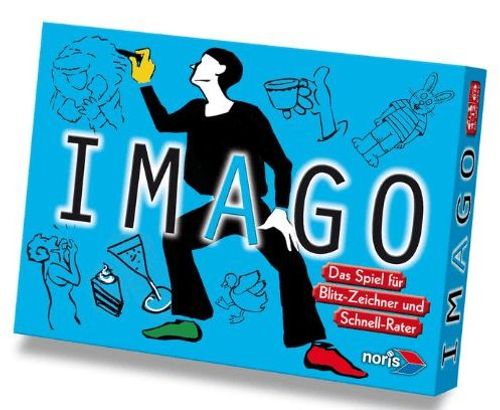
Imago
Imago Rulebook
Table of Contents
Table of Contents
Overview
Imago is a game for two teams. You need at least four players (two against two), but the more players take part in this action game, the more fun it gets.
Players: 4–12. Age: 12 and up / adults. Playing time: 45–90 minutes.
Components
Game board – 110 cards with a total of 2,640 terms – 1 timer (30 seconds) – 2 game pieces – 1 die – blank pad – rulebook.
Game Setup
First, shuffle the 110 cards and place them at the edge of the game board. Then form two teams of roughly equal strength. It is best if the two teams sit around a table with enough room beside the components to draw. Each player receives several sheets of the blank pad and gets a pencil, as no pencils are included with this game. Each team receives one game piece and places it on the start field of the game board. Set out the timer, which runs for half a minute. One player from each team rolls the die. The team with the higher number begins.
Goal of the Game
The most important goal of Imago is the fun of drawing and guessing. Especially when several people are together and a party threatens to become boring, this game is electrifying – with Imago, boredom disappears!
Of course, winning matters too. The goal is to guess the terms or proverbs drawn by players of your own team within the time limit. For every term guessed correctly, your game piece may advance one or two spaces toward the goal. The team that first reaches the goal field wins.
Playing the Game
Basic Rules
Each team takes turns. Within a team, a different player draws a term each time. When all players of a team have had their turn, the first player draws again, and so on.
Apart from the drawer, all members of the team guess.
Which Term Must Be Drawn?
The player whose turn it is to draw takes the bottom card of the card stack, chooses one side, and on that side chooses a column (left or right).
Each column contains six terms (or proverbs or idioms), arranged into six areas. At the edge, each term is assigned a die result (1–6). The player rolls the die, and this determines exactly one term.
Before drawing, the player may name for his team the area the term belongs to, e.g. "From Person to Person" or "Nature & Environment", etc. This tells the guessing team the general direction in which to think.
Before the drawer begins, he must also do the following:
- He must show the term, which his own team may not see, to the opposing team for checking. The card is then turned over and placed face up on top of the card stack. Then a player from the opposing team presses the timer, and drawing and guessing can begin.
What a player may NOT do while drawing:
- He may not give comments on his drawings.
- He may not write the term as a word.
- He may not point at objects in the room that could be related to the term being sought.
What a player MAY do while drawing:
- He may start a new picture at any time if he notices that the guessing team is completely off track.
- He may split the term (often a compound noun) into parts and draw first one part, then the other. He may indicate with numbers whether he is currently drawing the first or the second part.
- He may exaggerate and caricature. This is what makes Imago really fun.
- He may confirm with a nod when the guessers have guessed the term or part of it. He may also use gestures and facial expressions to show when the guessing team has come very close to the term but not quite hit it.
Guessing
While the drawer tries to depict his term in a flash, the members of his team name terms without pause that might be meant. The more actively the team guesses, the better the drawer can react to the understanding or misunderstanding of his team with improved drawings.
Time Limit
The drawer basically has one minute to draw. This means the player of the opposing team who is responsible for the timer must make sure to restart the timer after half a minute. If he forgets, the extra time benefits the drawer. After one minute, drawing stops.
Note: Before the game begins, you may agree to extend the time, e.g. to one and a half or two minutes.
Scoring
If the term is guessed within one minute, the game piece of the team concerned may be moved one space toward the goal. If the term is guessed within half a minute, the game piece may be moved two spaces toward the goal.
If a game piece comes to a stop on an event field (the drawer's game piece is pictured), the following applies:
- When his team is next on turn, the drawer may himself choose one of the six areas. He does not have to roll the die.
- If the term is guessed, the game piece may move twice as far as normal. That is: if, for example, it is guessed within half a minute – 4 spaces!
End of the Game
The game ends when a team has moved its game piece to the last space of the course (the middle space with the cross) and has solved the task there correctly.
Game Variant
You may agree that, whenever a term is guessed within the time limit, the team may always move twice (or three times) as far. This makes the game not last as long.