Imagination
Imagination Rulebook
Table of Contents
Table of Contents
Components
- 147 double-sided task cards
- 27 action cards (9 multicoloured sets of 3 cards each)
- Sand timer
- Rulebook
Each task card has an easy side (blue) and a hard side (red). Each side lists 10 tasks, numbered 1 to 10.
Easy tasks (blue side), sample card:
- Apron
- Apprentice
- Firecracker
- Tip (point)
- Ring (boxing ring)
- Waist
- Sight (scope)
- Palette
- Watchman
- Filling (stuffing)
Random number from 1 to 10.
Hard tasks (red side), sample card:
- Architectural monument
- Wristwatch
- Infantry
- Second-hand bookseller
- Crown of thorns
- Wedding dress
- Bottleneck
- Heir to the throne
- Consolation prize
- Short leash
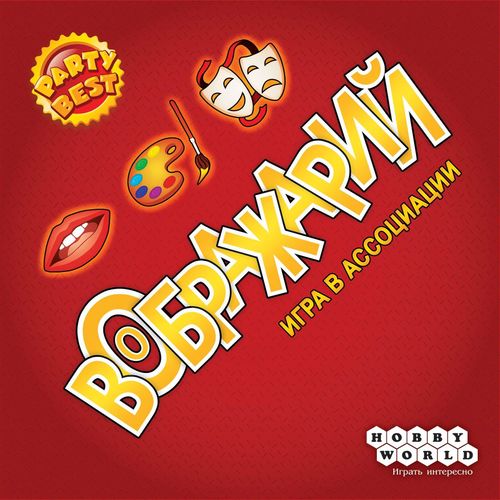
Action cards: each player receives one set of three action cards. The three cards show the three ways to explain a task: Telling (a mouth), Drawing (a palette and brush), and Performing (a pair of theatre masks).
The box includes a sand timer. Many players prefer an electronic timer that sounds a signal when the set time runs out (for example, 60 seconds). Such a timer is probably already on one of the players' phones.
Game Length
You can play Imagination for as long as the players like, but it is best to agree in advance when the game will end. Each turn (guessing one association) takes 1 to 3 minutes, so 20 tasks may take half an hour to an hour of real time. Each task uses 2 cards from the task deck. So if at the start of the game you select 40 task cards from the deck (return the rest to the box), the game will last exactly 20 tasks, i.e. 20 to 60 minutes. One more card should be added so that the player who chooses a task last receives a random number between 1 and 10 (for why, see "Choosing a Task" on page 3). It is desirable for the number of tasks to be a multiple of the number of players.
How many cards should go in the task deck? We can give the following recommendations for a game lasting about one to one and a half hours:
- 3 players: 49 cards
- 4 players: 49 cards
- 5 players: 51 cards
- 6 players: 49 cards
- 7 players: 57 cards
- 8 players: 49 cards
- 9 players: 55 cards
Another option is to play until one of the players scores a set number of victory points (for example, 10).
By mutual agreement at the start of the game, the explanation time can be increased or decreased for each of the three ways of explaining tasks (see "Three Ways to Explain" on page 4).
Translator's note: the printed reference "page 4" for «Три способа объяснения» points to the box on page 5 of the booklet. The page number is reproduced as printed; the section itself is the "Three Ways to Explain" section below.
Setup
The task deck consists of double-sided cards. One side is blue: these are the easy tasks. The other side is red: these are the hard tasks. All cards in the task deck must lie the same way (for example, blue side up). Before the game starts, the players must decide which tasks they will play with: easy or hard.
If players who have not played Imagination before take part, we advise choosing the easy tasks.
Depending on the players' choice, the task cards will lie with their red or blue backs facing up.
- If the players have chosen to play with the easy tasks, the cards in the deck must lie blue side down (in this case the blue side is also the face of the card).
- If the players have chosen to play with the hard tasks, the cards in the deck must lie red side down (in this case the red side is also the face of the card).
Shuffle the task deck and place it face down in the centre of the table. Leave space for a discard pile. Place the sand timer beside it.
Deal each player a set of three action cards in the colour they like. Each player places these cards in front of them face up.
To explain tasks by drawing, you will need writing materials, which are not included in the game: paper and a writing implement.
The player who was last at the theatre or the cinema becomes the presenter.
Turn Order
Choosing a Task
The presenter draws 2 cards from the top of the task deck into their hand, without showing the other players. The presenter looks at the back of the top card of the task deck and says aloud the number shown in that card's bottom right corner (from 1 to 10).
The presenter must now privately choose one of the two available tasks, which are listed on the two drawn cards in the rows with the named number. The presenter must then convey this task to the other players according to the rules described below.
Example: The presenter has drawn 2 cards. The number on the back of the next card in the deck is "5". The presenter may choose the 5th task from either card.
(Illustration: the two drawn cards, with the 5th task circled on each; the presenter may choose either one.)
Choosing How to Explain
Now the presenter must choose the way in which they will convey the task to the other players.
At the start of the game, the presenter has 3 action cards lying face up in front of them. Each card corresponds to one of the three ways: telling, drawing, or performing. The presenter chooses an available way and turns the corresponding action card face down. After this, they explain the task in the chosen way.
When the turn comes back to the presenter and they are obliged to explain a new task, one of their action cards will be face down, meaning that this way of explaining is unavailable. On the presenter's third turn, only one way of explaining will remain.
If at the start of their turn a player has all three action cards lying face down, they turn them face up: all three ways of explaining are available to them again.
Example
In the previous turn the presenter used drawing to explain. Now only the "telling" and "performing" cards are still face up. The presenter chooses "performing" and turns that card face down.
(Illustration: the "telling" card face up, the "drawing" card face down, and the "performing" card being turned over.)
Explanation
After this, the presenter turns over the sand timer and, within 60 seconds, explains the task to the other players in the way they chose. Each player tries to be the first to say the task aloud, in the exact wording given on the card.
If you have decided to play with the hard tasks, the players may agree before the game that more than 60 seconds (for example, 2 minutes) will be allowed for each explanation. The main thing is that all participants agree to this condition.
Outcome of the Explanation
If one of the players correctly names the word or phrase, they receive one of the task cards that the presenter drew at the start of the turn (if several players guess the task at the same time, the presenter decides which of them gets the card). The presenter takes the other card for themselves, for having been able to explain the task. The player and the presenter each put these cards into their own personal supply of victory points (each card brings 1 victory point at the end of the game).
If no player was able to guess the presenter's explanation within the allotted time, or if the presenter broke any of the rules of explanation, then no one receives victory points, and both cards drawn by the presenter at the start of the turn are sent to the discard pile.
Passing the Turn
The player to the left of the presenter becomes the new presenter, and a new turn begins.
Ending the Game
The game ends when 1 card remains in the task deck, or when one of the players reaches the agreed number of victory points, depending on what the players agreed before the game.
The player with the most victory points wins. If several players have the same highest number of victory points, they share the victory.
Team Variant
Imagination can be played as a team against team. For example, if there are six of you, you can play three against three; if there are nine, three teams of three people each.
If the number of players is such that it cannot be divided evenly by two or three, that is no problem: one of the teams will have one more participant.
Differences in the Team Variant
Each team receives one set of three action cards. This set limits the way of explaining not for one player, but for the whole team.
The turn passes from team to team. When the turn passes to the next team, the members of that team choose who will be the presenter (the game is more interesting if presenters within one team take turns).
At the start of a turn, the presenter draws 2 task cards, chooses the task with the given number on one of the two cards, and chooses an available way of explaining. The action card that belongs to the whole team is turned over. The presenter explains the task not in front of all the players, but only in front of the representatives of their own team (the other players may watch, but may not comment), and only their team tries to guess the explanation. If the team succeeds, it keeps both task cards as victory points. Otherwise, both task cards are discarded.
If at the start of a team's turn all of its action cards are face down, they are turned face up again: all three ways are available once more.
Otherwise, the game is played as in the free-for-all game. At the end of the game, the team that has accumulated the most victory points wins.
Three Ways to Explain
Telling
Within the allotted time, the presenter must verbally describe the word or concept to the players. When telling, the presenter may not use words that share a root with the word being explained, or words derived from it. For example, to explain the word "friendly" (дружеский), the presenter may not say "friend" (друг), but may say "comrade" (товарищ) or "chummy" (приятельский). The presenter must not use a foreign language.
Translator's note: this example depends on Russian word roots. In Russian, «дружеский» (friendly) shares its root with «друг» (friend), which is forbidden, while «товарищ» (comrade) and «приятельский» (chummy) are allowed. The rule itself applies to any language.
The presenter may explain a phrase in parts: first one word, then another, and so on. The victory card is taken by the player who first says the whole phrase.
While telling, the presenter may not make gestures or use any other elements of mime.
The presenter may say "yes" or "no" to players, hinting at how close the version they have said is to the task.
Drawing
Within the allotted time, the presenter must depict the word or concept on paper. The presenter may not use letters or digits, but may use pictures of any other symbols or images.
The presenter may explain a phrase in parts: first one word with a drawing, then another, and so on. The victory card is taken by the player who first says the whole phrase.
While drawing, the presenter may not talk or gesture.
The presenter may nod or shake their head, hinting to the players how close their version is to the task.
Try to position yourself so that all players can see equally well what the presenter is drawing.
Performing
Within the allotted time, the presenter must describe the word or concept to the players using gestures, mime, sounds and music. The presenter may not say meaningful words, but may imitate animal cries, the sound of wind, the rumble of machines, and so on. The presenter may hum tunes, avoiding meaningful words (for example, "la-la-la, ta-ta-tam"). The presenter may point to any objects within their field of view, pick them up, manipulate them, or act on one object with another.
The presenter may explain a phrase in parts: first one word, then another, and so on. The victory card is taken by the player who first says the whole phrase.
During the performance, the presenter may not speak.
The presenter may nod or shake their head, hinting to the players how close their version is to the task.
Try to position yourself so that all players can see the presenter's performance equally well.
Frequently Asked Questions
If two or more players say the correct answer to a task at the same time, which of them receives the task card as a victory point?
Only one player receives the card. Which one exactly is decided by the presenter.
If a guesser names the word or phrase in a different case or number, does this count as a correct answer?
Yes. For example, if the word is «слёзы» (tears) and a player says «слеза» (tear), this counts as a correct answer.
If in a phrase a modifier (adjective) can be replaced by a noun without losing its meaning, will an answer using the corresponding noun or adjective count?
Yes. For example, instead of «обеденный перерыв» (lunch break), a player may say «перерыв на обед» (break for lunch), and so on. Use common sense.
If a word has several meanings, may the presenter choose which one to explain?
Yes. For example, «такса» can be a synonym of «тариф» (tariff), or it can be a breed of dog (dachshund). The presenter chooses which meaning to explain. Moreover, if the presenter is telling, they may give the word «такса» like this: "This is a synonym of 'tariff' and at the same time a breed of dog."
How to Choose a Task and an Explanation Method
Example. The presenter draws 2 cards from the task deck face down. They check which number is printed large on the back of the top card of the deck, then look at both drawn cards and find the tasks under that number. Suppose the number on the back of the top card is "7". Then the presenter finds task number 7 on each of the two cards. Suppose these are "lucrative post" and "a million scarlet roses".
The two cards drawn in this example are:
- First card (number 10 in the bottom right corner): 1. Poet, 2. Glass of wine, 3. Brainstorm, 4. Dress code, 5. Two-faced Janus, 6. Gothic cathedral, 7. Lucrative post, 8. Town hall, 9. Keys to the city, 10. Last word.
- Second card (number 7 in the bottom right corner): 1. Cutlery, 2. Mendeleev's table, 3. Pole vault, 4. Troubadour, 5. Cannonball, 6. Old Believer, 7. A million scarlet roses, 8. Weather forecast, 9. Love letters, 10. Highway.
(Illustration: the two cards, with task 7 circled on each.)
Translator's note: the English names of the tasks are translations of the Russian task words; the tasks in the printed example are shown here in the same order as printed.
Before the presenter, face up (as before every player), lies their individual set of three action cards. Initially all the action cards lie face up.
The presenter may choose either of the two tasks and convey it to the players using any of the available actions. Suppose in our case the presenter reasons as follows: "Performing is the most difficult action to execute, so it is advantageous to spend it earlier, if possible. 'Lucrative post' is hard to show by performing, but 'a million scarlet roses' ..."
The presenter keeps the card with "a million scarlet roses" in hand and places the other card in front of themselves. They choose the action "performing" and turn the corresponding action card face down. The presenter hums (without words!) the tune of "A Million Scarlet Roses", and one of the players immediately quotes this line. Excellent: the words "a million scarlet roses" have been said!
Quick Guide
Setup
-
Determine the length of the game in one of two ways.
Limit the number of task cards. Our recommendations for the number of task cards:
- 3 players: 49 cards
- 4 players: 49 cards
- 5 players: 51 cards
- 6 players: 49 cards
- 7 players: 57 cards
- 8 players: 49 cards
- 9 players: 55 cards
or set a victory point limit (for example, 10).
-
Decide which tasks you will play with: easy or hard.
- If you have decided to play with the easy tasks, the cards in the deck must lie blue side down.
- If you have decided to play with the hard tasks, the cards in the deck must lie red side down.
-
Shuffle the task deck.
-
Deal each player a set of 3 action cards of one colour.
-
Determine the first player.
Turn Order
-
The presenter draws 2 top cards from the task deck into their hand.
-
The presenter looks at the top card of the task deck and says aloud the number shown in its bottom right corner.
-
The presenter chooses one of the two available tasks on the drawn cards, in the rows with the named number.
-
The presenter chooses a way of explaining the task, turns that way's action card face down, and begins the explanation. If at the start of the turn all three of the presenter's action cards lie face down, they turn back to their starting position together.
(Illustration: telling, drawing, and performing.)
-
The named word or phrase is said: the presenter gives one task card to the first player to guess it and keeps the other for themselves. 1 card = 1 victory point.
The named word or phrase is not said: no one receives task cards.
-
The player to the left of the presenter becomes the new presenter.
Ending the Game
The game ends when 1 card remains in the task deck, or when one of the players has reached the set number of victory points.
All players count their victory points. The players who have the most victory points become the winners.